Oh, those clean starched white dress uniforms

The 350 U.S. Navy sailors who descended on Eastport for our extended Independence Day festivities were the first to uphold the longstanding tradition since before the Covid pandemic.

They were a welcome contingent in our small community, often appearing in their pristinely ironed white uniforms, which do look impressive even though, as I was told, they can be a challenge to keep clean. You have to lean way over while eating, for instance, to keep from spilling anything on yours. Not that we noticed any dirt when they marched as a big bloc in the grand parade Tuesday afternoon. At least the sailors and officers who fielded teams in the very messy cod relay contest the previous day were more practical in their dress.

What they got was a six-day taste of small-town America having summer fun.

As the police chief reported, “the Fourth of July was relatively quiet, aside from a couple of fights involving sailors … which were handled by the crew from the Navy ship.”

Finally, a decent seafood selection Way Downeast

Even though we live a block from the ocean, we’ve been perplexed by the selection of local seafood available in the region’s markets. Or more accurately, it’s lack.

The bigger supermarkets have been a disappointment, and the smaller ones, quite limited.

The best overall selection we’ve found, especially for local catch, is Earle’s SUV that shows up on U.S. 1 down in Machias on selected days. That’s an hour away.

For crab, clams, and scallops, it’s Betty’s seasonal shack in Pembroke, about 20 minutes from home.

Other than that, it’s meant going directly to the fishermen, if you know where they are.

Finally, we’re feeling upbeat. The reopening of Quoddy Lobster’s dining operation, just a block from us, includes a fresh seafood counter.

New owner Look Lobster, a fifth-generation family company in Jonesport, has already invested heavily in the Eastport site by rebuilding the pier for straight-from-the-boat deliveries. Last summer it became my go-to place for fresh retail lobster, especially for anything over a pound and a half.

Now that the end-of-the-street site is serving traditional lobster plates for the first time since Covid, it won’t be long before the outdoor picnic tables by the sea are soon packed with devoted fans. The place, a very popular destination both among tourists and locals, was much missed.

Hold on to that fish!

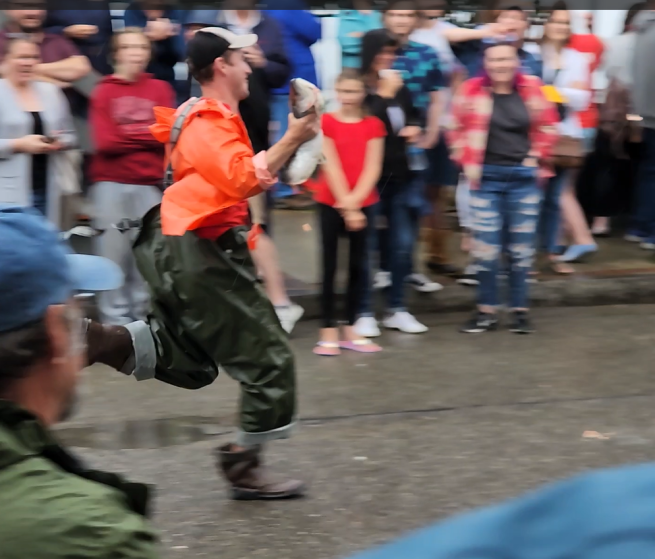
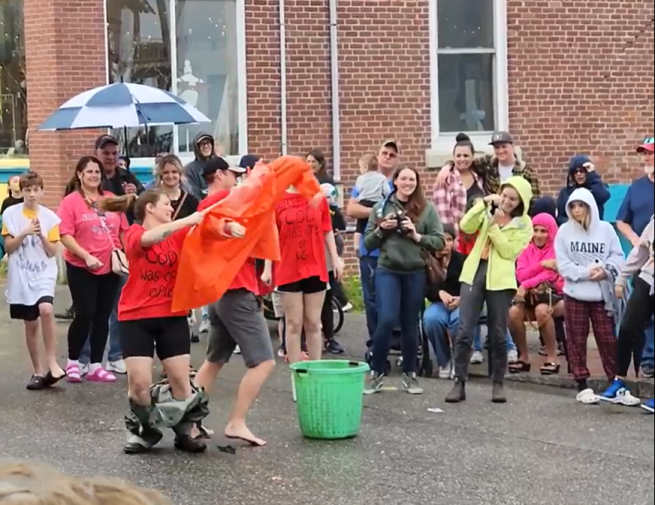
An annual cod relay race – using raw salmon instead – is one of the more hilarious traditions at Eastport’s extended Fourth of July festivities.

Running down the street with a fish is only part of the excitement.

Relaying the gear – boots and the slicker, along with the fish – to the next runner is the heart of the contest. Here, two of the younger runners have it almost down to a science.

All-ages teams are paired off during the day until there’s a first-place winner.

This is the big day for pyrotechnic displays

Unabashedly, I am a snob when it comes to putting big fireworks together in an aesthetic whole, rather than something that resembles an action movie big car smashup.

A smart design team can use the entire sky as a canvas of evolving colors, combined with the timing of a sharp comedian.

That said, here’s some perspective.

  1. A show like Boston’s on the Charles River Esplanade fires off 5,000 pounds of explosives in its half-hour glory. That performance requires a computerized launch system for five barges floating on the water.
  2. Macy’s, the nation’s biggest, goes for an average 1,600 shells a minute – more than three times as many as a typical town display uses for the entire night. That show has more than 40,000 shells fired from six barges in the Hudson River.
  3. China produces 85 percent of the world’s fireworks.
  4. Many of the styles are named for flowers such as peony, chrysanthemum, or dahlia. Others, after trees, as in willow and palm tree.
  5. Prices vary wildly, especially when you’re looking for some serious color intensity and blending rather than honky-tonk garish.
  6. Shells are sold by tube diameter, commonly six-, eight-, and ten-inches, with each additional inch typically adding another 100 feet of elevation to the shot. Are some of those bursts really a thousand feet overhead?
  7. An aerial shell contains six parts. Or more, depending on what bells and whistles are added on.
  8. Larger shells cost average around $336 apiece and may require an 840-foot display radius.
  9. Even a small-town show will run between $7,500 to $15,000 to produce, just for the fireworks. Add to that set-up and clean-up labor, sanitation, musicians, and public safety expenses. The average municipal show costs $25,000. In contrast, a wedding show is tabbed for $1,500 to $3,000. But don’t hold me to those figures. Other estimates I’ve seen simply soar.
  10. Injuries send about 10,000 Americans to the emergency room every year, two-thirds of them males, and many of the injuries are to children. That’s in addition to 7.9 fatalities. As another safety consideration, more fires are reported on July 4 than any other day of the year – some 19,000.

Let’s haul on some sea chanteys

As I’ve previously noted, the work songs went into the woods in the winter, carried by sailors who came ashore for the season. But few songs in return migrated from the forests to the sea.

Women’s names could be a clue to the, uh, moral integrity of many messages. “Sally” or “Nancy,” for instance, some more sterling than others.

Other work songs include chain-gang ditties or even the racist, “Zip-a-dee-doo-dah,” though it might fit what’s become of the minimum-wage American workplace.

As for spellings, I’m sticking with “chantey,” based on a scholarly friend’s insistence the notes having a chanter setting the pace. “Shanty” and “chanty,” though, are more common.

Here are some related facts.

  1. This folk music genre flourished aboard larger merchant vessels of the 19th century as a means of setting a rhythm to optimize joint labor involved in either a pulling or pushing motion, such as lifting anchor or setting sail, tasks that required working together for a long time. Think of circling a capstan. Think “Heave!” Or “Haul!”
  2. That’s why many of them are about whaling.
  3. The tradition soared in the period between the War of 1812 and the Civil War and died out with the arrival of steam-powered ships.
  4. Its roots, though, go way back through earlier work songs around the world, including stevedores loading and unloading ships.
  5. Some of the chanteys originated with African-Americans performing “cotton-screwing” on shore, using a large screw-jack to compress and bale cotton for shipment from Southern ports. Some of the incomprehensible words in the songs are attributed to this.
  6. Essentially, it’s a call-and-response form between the solo chantey man and the work crew.
  7. Sometimes they were accompanied by a bosun’s pipe, fife, drum, or fiddle.
  8. They were sung by pirates, too.
  9. About 200 were set down on paper, but thousands more were likely lost.
  10. Some may have been used when relaxing in the evening.


Musically, it’s about time moving on

One of the subtle changes in the world of high culture in my lifetime has been the widespread acceptance of women as both conductors and classical composers.

Long seen as a bastion of Dead White Males, almost exclusively Europeans, the musical bias was deeply engrained. Few of the world’s leading orchestras even had women in their ranks, much less on their programs or as regular guest soloists. That snobbery, by the way, also excluded American conductors and composers, and people of color in general, across the board in the Old World and the New.

When the gender line began to bend, the first women composers to gain significant attention, as far as I remember, were Felix Mendelsohn’s sister, Fanny, and Robert Schumann’s wife, Clara.

More recently, Amy Cheney Beach has come to the fore. New Hampshire-born and then proper Boston society, she was largely self-taught, a piano virtuoso whose hefty piano concerto and symphony are both personal favorites. Her keyboard works have justifiably gained advocates, and a comprehensive retrospective at the University of New Hampshire marking the 150th anniversary of her birth was a revelation. Some of her gorgeous chamber works, moving into a more Impressionistic vein, actually moved me to tears listening in live performance.

Today, talented women composers are showing up everywhere, even winning major prizes like the Pulitzer. Quite simply, it’s hard to keep up.

~*~

Similar advances are being seen on the podium, led by Americans.

Pioneered in the ‘60s and beyond by Sarah Caldwell at her Opera Company of Boston and Margaret Hillis at the Chicago Symphony Chorus, early conductors of note also included Judith Somogi with opera and orchestral roles across the U.S. and then Europe, Eve Queller at her Opera Orchestra of New York, and Fiora Contino, who I remember from opera productions at Indiana University.

Later, as innovative major symphony music directors, we’ve been blessed with Joanne Faletta at the resurrected Buffalo Philharmonic and Marin Alsop in Baltimore.

It’s all opened the doors for a slew of younger conductors who are moving up the ranks and in the running for major positions like heading the Los Angeles Philharmonic, now that Gustavo Dudamel will be moving on to Gotham.

Looking at the 18 conductors being heard on live Metropolitan Opera broadcasts this season, I see four are women, one twice, something that would have been unimaginable at such a conservative institution only a decade ago.

Do note the trend, then. Anyone else find it exciting?