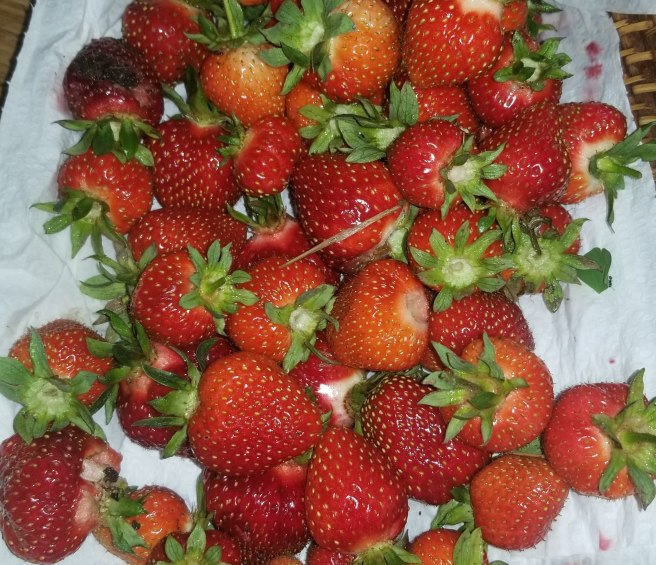
Fresh strawberries
You never know what we'll churn up in cleaning a stall
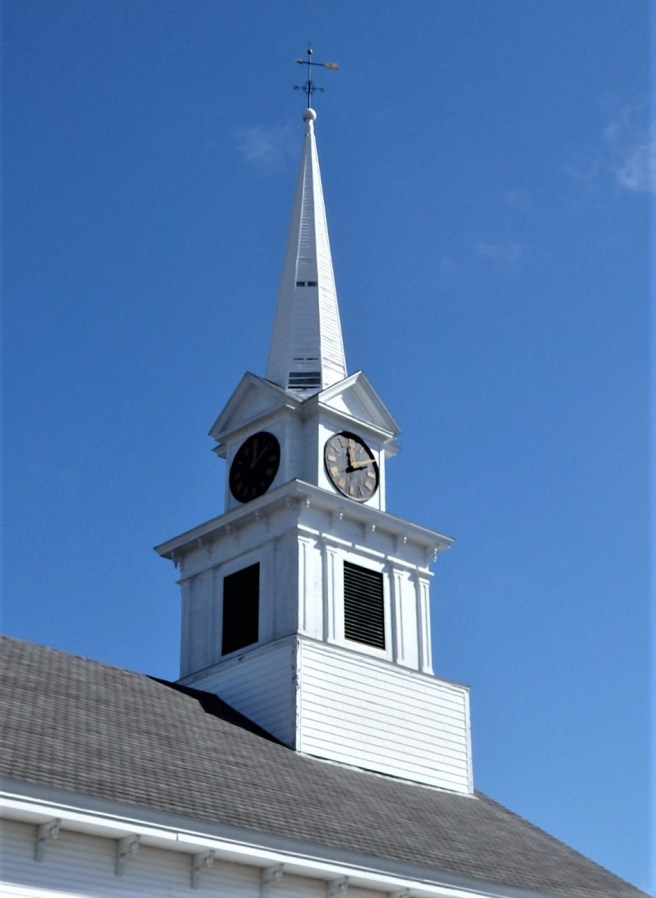
The spires are a distinctive part of the New England landscape, whether nestled in the mountains or close to the shoreline, like this one, where they also serve as landmarks for mariners.
One of my favorite lines I cut out of my novel What’s Left, was this quip:
I want some backbone in my religion. You can’t sit without it.
But as I looked at the flow of the story, I just couldn’t find a good place to develop some pushback from Cassia in her teens, where it would have been most appropriate.
Still, if you know anything about the practice of meditation itself — often called sitting — you just might enjoy the double-meaning.
Another way I thought of raising more color regarding their Buddhist identity was through rounds of Tibetan holidays. The names and special touches alone can be charming: New Year’s archery; incense to drive away evil ghosts; Sho Dun “yogurt festival”; the Meeting of the Eight Guardians (stay inside to avoid evil outdoors); Golden Star to wash away greed, passion, jealousy and to abandon ego; the washing festival. Think of the picnics and ritual bathing.
I might have also built something on the Eight Auspicious Symbols, including conch shell, parasol (crown), victory banner, golden fish, or treasure vase. The Endless Knot is the name of a chapter, though.
Beyond that, I kept looking for synonyms for Buddha or Buddhism. One of my favorites, which I didn’t use, is the hanging cliff-side wonders. Some of those monasteries are no place for anyone with a fear of heights!
~*~
Many traditions have special dishes for specific holidays — secular or religious. Sometimes it’s even a family thing, rather than something everyone does.
What’s your favorite “holiday food”?
~*~

My novel Pit-a-Pat High Jinks gives good reasons for Cassia’s future father to celebrate once he’s finally met her mother, as he does in my novel What’s Left. She quickly becomes the love of his life, and they’re well matched.
Do you know any couples who were brought together by a sage introduction from someone who knew them both well?
~*~


In past years, we’ve had Chinese college students stay with us during their term breaks. They were in Dover and nearby communities to work volunteer internships, usually a month long, and the New Hampshire Children’s Museum was a popular choice.
They would often bring a gift, typically fine green tea, but this one initially perplexed me until it was pointed out that it’s a holding cup for things like pens and pencils and is inscribed with four popular poems.
Cynthia later transcribed them, with translations in English.
She had no idea I am a poet, or that her gift would be so appropriate.
With the Chinese New Year on Friday, we’ll be thinking of her and the others who have brightened our household.
Here’s what she wrote out:


Anyone else remember when “long-hair music” referred to classical?
Back before rock went psychedelic?
You know, back with the Beatles?
After 7½ years of retirement, I returned to the workplace part-time for two months this year.
The job was supposed to begin in May and run through the summer but got pushed back to August and then abruptly cut off at the end of September.
I was a federal agent.
The private identifying details we recorded are sworn to secrecy – or the equivalent, for those of us who follow Scripture and refuse to take oaths. But I’m still trying to put the experience into perspective.
For nearly 40 years, I’ve worked through the available Census files in my genealogical research, as you’ll see in the posts on my Orphan George blog. It’s become something of a specialty for me, along with the Quaker minutes. I mean, it’s how I learned that Grandpa married the girl next door. There’s also one set of ancestors who were recorded twice in 1860 but with enough differences to make me suspect there were two Jacob Ehrstines closely related – one detail in the 1870 Census cleared that up. And I have one ancestor who shaved another year or two off her age every decade, though I have no idea whether it was intentional or out of ignorance, considering that Quakers didn’t celebrate birthdays.
So I set forth in part out of gratitude for those earlier enumerators. The first ones, incidentally, were federal marshals. This was that important.
What surprised me as I hit the streets and knocked on doors on behalf of the Census Bureau was how physically hard it becomes – bending over an iPhone placed on a clipboard to input data quickly had my back aching, especially. For a dozen years, I managed to work a double shift every Saturday as a newspaper editor, yet here I was pushing my limits when it got close to five hours a day. (Wimp!) Six really maxed it. An article in the Washington Post enlightened me that I wasn’t alone here, so I couldn’t blame it all on age.
I am surprised by how many Americans don’t know what a census is or that it’s required every ten years or that they don’t want to be recorded.
Well, I now also have a clearer understanding of why one household might disappear ten years later but reappear again in a subsequent Census. You know, be there in 1800 and 1820 but not 1810.
I am also surprised how much of my brain space got wrapped in a job again. You know, replaying cases and wondering how I might have done them differently. This was supposed to be something I could let go of at quitting time. Not so, though.
Inputting data in an app on an iPhone still strikes me as tedious. You might have guessed I pretty much hate texting, except as an alternative to an actual phone call. (Emails seem to be my preferred form of communicating these days.) How do kids do it, texting with their thumbs? Or are their exchanges all typos?
Oh, yes, another confession. I’ve typed for nearly six decades now. Self-taught, earned my livelihood with it. Written whole books, even. But ask me to re-create a keyboard from memory, and I have no clue where the individual letters of the alphabet are. The memory is all in my fingers, not my head. Seriously.
So I can’t imagine keyboarding with my thumbs. As I was saying about the kids? Besides, thumbs are awfully fat for those tiny screens. My dry fingers had enough trouble connecting, even before getting to any issue of accuracy.
In my rounds, I had a few near falls (including one wooden step that wasn’t nailed down anymore), a couple of dogs who could have turned nasty, some close calls in traffic, but emerged unscathed.
Some of the most enjoyable interviews turned out to be those where I could put my very limited Spanish to work. Other enumerators had backed off, so I guessed it was up to me, and somehow, we got the required data, often with a lot of laughter. Yes, I made some funnies.
The best part of the job, though, was meeting people who, for the most part, were warm, friendly, helpful. I have a much clearer understanding of the neighborhoods around me.
Would I do it again?
No, I’ll be too feeble – or feebleminded – in another decade.
But maybe you’d want to give it a crack.
We’ve heard the phrase a lot lately, but few know that it originated as a Quaker expression.
Most of us Quakers, or members of the Society of Friends, assumed it was one of those many great expressions from the beginning of the movement, back in the upheavals of the mid-1600s.
Not so, it turns out. Nor even the 1700s or 1800s. It’s much more recent than that.
The expression originated with a 1955 pamphlet published by the American Friends Service Committee titled “Speak Truth to Power: a Quaker Search for an Alternative to Violence,” which promoted pacifism.
Still, it rings true to the early Quakers, who spoke boldly with an alternative Christianity that brought many changes to British and American society. The faith and its practice went far beyond mere religion. It extended through one’s relationships, including labor, possessions, business, politics, education, leisure, and nearly everything else.
For them, Truth was Christ, so speaking Truth to those in authority was to challenge the rulers and oppressors, countering them with the greater life and dominion of Jesus.
This goes way, way beyond being factually correct.
It’s more like invoking what others might do when they form a sign of the Cross when facing a demon.
Let’s not forget that authority.
Living in the family I do, my TBR stack of books is well larded with Christmas and birthday presents – things others think I’ll like or should at least tackle, as well as volumes they’ve already enjoyed and wish to tempt me. I’m not complaining, mind you, though I can be perplexed by their choices, at least until I’m moved to open the cover and dig in.
Sometimes it takes me several years to get around to that, which was the case with The Fellowship: The Literary Lives of the Inklings, by Philip Zaleski and Carol Zaleski.
The tome surveys the Inklings, a literary circle established at Oxford University by the likes of J.R.R. Tolkien and C.S. Lewis, an affiliation that lasted their lifetimes and paralleled the more progressive Bloomsbury elite.
As I read of the budding authors’ early years and passions, my eyes were opened to how different their reading habits and expectations were from mine. They were steeped in a desire to recover a mythos of elves and other realms arising in ancient Britain but lost over time to the teachings from the Continent. There was also a fascination with invented alphabets and languages and secret communications. In contrast, apart from an early round of Tom Sawyer and English shipwrecks, my tastes ran to non-fiction – biographies, histories, and science, especially – and to visual arts and classical music. I still love to read maps, by the way. As for language, English still holds plenty of room for exploration, and Spanish and French are challenging enough.
Fiction returned to my lineup my senior year of high school via an essentially political route – Animal Farm, Brave New World, and 1984 on the leading edge. Besides, that was the time when I was finally getting serious about writing and editing, too.
In short, I read to learn things, and still do, for that matter. Rarely would I admit to reading for pleasure, as such.
But the first years after graduating brought a change, including The Lord of the Rings (which struck me as a rehashing of Wagner’s Ring Cycle material), Samuel Johnson, and Virginia Woolf before getting to Tom Wolfe, Vonnegut, and Kerouac and, after college, Brautigan.
My preference soon settled on contemporary and American, here and now, even if I have a fondness for baroque twists and long sentences.
I have to admit having little in common with the Inklings. Even our religious leanings veer in opposite directions – their thick Catholic and Anglican wrappings versus my Zen and Quaker ascetic.
~*~
At that point, while cleaning a very dusty bookshelf, I chanced upon Becky Gould Gibson’s Need-Fire, a poetry chapbook elaborating the life of Hild, a 7th century abbess who founded a monastery for men and women in Whitby, North Yorkshire but at the time Northumberland. It was a time when some women had more authority in the Catholic church than would be the case later. That, in turn, led me to learn more of the history of Britain in that period, including the reality that much of the land was openly pagan perhaps into the 9th century, much later than I’d assumed.
With another leap of thought, I realized that much of what I’ve found puzzling in the English folksongs, mummers’ plays, and the Abbots Bromley and Morris dances I’ve encountered through Boston Revels is thinly veiled pagan tradition living on, part of the deeper culture of the land and its earlier peoples.
Well, as we say, the plot thickens.
My next question returns to these shores and an awareness of what this land means to its inhabitants. For me, that’s a blending of science, economics in the broadest sense, spiritual awareness, and the arts.
So how would you define the grounding of your own reading habits and interests? Has it changed over time?
Sportsmanship?
As we were taught,
It’s not whether you win or lose but how you play the game.
In politics?
As we’ve too often seen,
It’s everything, and ruthless.
As for personal psychology or wisdom? Don’t we learn more from losing?
 Jnana's Red Barn