Looking at mainland New Brunswick

Americans, in general, know little about their “neighbor to the north,” meaning Canada, though where I live it’s actually closer to the east.

That said, I’ve been learning principally about its province of New Brunswick, with its border coming about a mile from our home.

Here are ten highlights.

  1. It’s one of the three Maritime provinces – the other two being Nova Scotia and Prince Edward Island – and one of the four Atlantic provinces when Newfoundland, which includes Labrador, is added in.
  2. It was set off from Nova Scotia in 1784 when 10,000 Loyalists arrived in exile from the new United States at the conclusion of the American Revolution. They established communities like St. John, St. Andrews, St. George, St. Stephen, and Fredericton. Some of them had even dismantled their homes in New England, shipped them, and erected them anew.
  3. Half of today’s population of 850,000 lives in three urban areas: Moncton, St. John, and Fredericton. As a result, New Brunswick, rather than say Manitoba or Saskatchewan, is proportionally the most heavily rural province in Canada.
  4. Although the first attempted French settlement in the New World was on St. Croix River, 1607-1608, on today’s border with Maine, it was abandoned. Later French colonists, from 1629 on, created a unique society based on dyke-based cultivation of tidal marshes along the Bay of Fundy. French authorities referred to the region as Acadia.
  5. The Treaty of Paris in 1763 not only ended the French and Indian wars with the English colonies but also gave England unchallenged rule of the region, leading to the forceful deportation of 12,000 Acadians. Those who emerged in Louisiana became known as Cajuns. Enough remained in New Brunswick to make it officially bilingual today – the only Canadian province so designated.
  6. About 8.5 percent of the population speaks French only. It’s a dialect stemming from southwestern France and is distinct from Quebecois elsewhere in Canada.
  7. Two-fifths of the city of St. John was destroyed by a fire that broke out in June 20, 1877. Among the 1,612 structures lost were eight churches, six banks, 14 hotels, and 11 schooners. Nineteen people were left dead and about 13,000 people became homeless.
  8. Today the city is home to the powerful Irving Group of Companies, including the gas station chain.
  9. Tourism is also a major economic factor, with the Bay of Fundy and its world’s highest tides as a central attraction. The province also has 58 covered bridges, including the world’s longest, and about 100 lighthouses, not all of them active.
  10. Four-fifths of the province is covered by forest. The Appalachian range extends across the northern half of the province.

Hand it to raccoons for wily ways

Native to North America, these mammals with the distinctive bushy dark-ringed tail typically live about two years in the wild, weigh up to 20 pounds, and have babies called kits.

Here are ten more considerations.

  1. They’re known as Trash Bandits because of the black “mask” across their eyes and their ability to find treasures amid human trash, often by overturning garbage cans or lifting the lids loudly in the middle of the night.
  2. They’re nocturnal and, during the day, rarely venture far from their dens.
  3. They eat a wide range of food. Grasshoppers, mice, insects, frogs, fish, ground-dwelling birds and their eggs all fall on their menu, as do dead animals, nuts, berries, pet food, and the content of bird feeders. If you possibly can, do not feed them.
  4. They’re excellent climbers who will even shimmy up a pole to get those bird feeders. (It’s not just squirrels, then?) And their back feet can rotate backward to allow them to climb down trees headfirst. Maybe even those poles, too.
  5. That mask deflects the sun’s glare and may aid their night vision. It may also hide their eyes from potential predators. As if you want to know what they’re thinking.
  6. They seem to wash their food before eating it, even if there’s no water, though water does enhance the sensory awareness of the finger-like toes of their front paws. Those slender fingers are nimble enough to hold and manipulate food and objects that include doorknobs, latches, lids, bottles, jars, and boxes. Beware, they are one of the few animals that can open doors. So far, I haven’t heard of any plants with that skill.
  7. They are smart, maybe even more than the typical domestic cat. They’re noted for solving complex puzzles in captivity, as well as their frequency of escape.
  8. Unlike many creatures that have declined as human development spreads, raccoon populations have thrived in urban and suburban areas. Toronto has even been dubiously dubbed the Raccoon Capital of the World.
  9. They are the second highest reported carriers of rabies, exceeded only by bats, though few cases have extended to humans. They are also susceptible to raccoon roundworm, which can spread through feces to the soil and then pets or small children. They can also transmit distemper and leptospirosis.
  10. Their hearing can even detect earthworms underground. Do watch what you say.

In case you’re interested, their name comes from the Algonquian word “aroughcun,” translating as “he who scratches with his hands.”

Of ship captains and their families at sea

The era of commercial wooden ships under sail is long gone, and Maine played a big role in its glory days. The town of Searsport, in fact, late in the 1880s claimed to be home to a tenth of the masters of American full-rigged ships, and thousands of ships were built along the state’s shores. Do note, though, steamships and steel hulls were rapidly changing the business.

As I learned in researching the history of our house, built by a shipmaster who raised four captains of his own, there seems to be nowhere they didn’t venture.

Unlike many, though, the Shackford wives seem to have stayed on land rather than venturing forth with their husbands and serving as the trusty navigator.

Here are some other families for perspective.

  1. Joanna Carter Colcord, daughter of Lincoln Alden Colcord, was born at sea in 1882 and is famed, among other things, for her collecting and musically notating maritime ballades and chanteys. She and her brother spent much of their childhood at sea, where they sent extensive letters to relatives in Maine. Later reminiscing how, after a break ashore where she could attend school, “when I was eight, I took my turn at seafaring, and Link got his introduction to the halls of learning. We put out from Portland lumber-laden into a full gale of wind, and I was sea-sick for the first (and last) time. On the fourth day out it faired away, and father took me, convalescent now, on deck and set me inside a life-ring that was lashed to the top of the after house. … I was not afraid; and I remember to this day the awe and enchantment of the scene. I thought I had never seen anything so beautiful, and I still think so. The little barkentine was running bravely, among the great seas which heaved up all around in sunlit walls of liquid sapphire. When she roe on one of the huge swells the seas stretched to a horizon of living blue, barred with mile-long white-capped combers. The sun warmed me, and its play on the snowy sails fascinated me.”
  2. Her brother Lincoln Ross Colcord, a year younger, was born at sea during a storm off Cape Horn. Recalling the life they shared growing up, he wrote: “I know no other home than a ship’s deck, except the distant home in Maine that we visited for a few weeks every year or two. My countryside was the ocean floor, where I could roam only with the spyglass; my skyline was the horizon, broken by the ghostly silhouettes of passing vessels, or at intervals by the coasts of many continents, as we sailed the world.”
  3. Also from Searsport was Georgia Maria Gilkey, who headed off to sea in 1906 as the bride of Phineas Banning Blanchard, of the same town. As she observed: “It seemed like old times being on board a vessel again. I spent most of my youth at sea with my parents, brothers, and sister. Banning grew up at sea, too, and he was a captain before he was twenty.”
  4. Not that the life was always so bucolic, as Captain John C. Blanchard noted in candid letters in 1844 to his wife Caroline in Searsport. “I am very anxious for to leave here for the mosquitoes,” in confessed in one, followed in another with “and the hot sun has made me look more like a native of Cuba than one from the North.  My health is tolerable good although I have no appetite to eat and the clothes that used to fit me now set like a ship on a handspike, as the saying is.” There was no respite in others, where “The mosquitoes would make you look more like a person with the smallpox than otherwise … The climate seems to me just as healthy in New York in heat of summer.” Also, “It seems as if the mosquitoes was determined on having the last drop of my blood. They were so plenty last night that we could but just breathe without swallowing them and as hungry as wolves. They make nothing of getting my blood right through my shirt and pants and now while I am writing they are doing their best.” Later, he noted having the American consul and two gentlemen from New York on board to dine as well as “a long string of Spanish ladies and gentlemen” who came calling. “I tell you what it is Dear C, you don’t know what a knack these Spanish ladies have of casting sheeps’ eyes but the gentlemen don’t like us Americans to even wink but dear Wife, all the Ladies in Cuba is no object to me.”
  5. Perhaps that provides one more reason for brides to join their sea captain husbands on his voyages. Nancy Sherman Mackintosh, for one, set forth with her new husband Alonzo Follansbee in 1837 and two months later admitted, “By this time I had learned all the nautical phrases, though I did not choose to use them, lest I get in the habit and use them on shore, which would be very mortifying for a captain’s wife.” Yes, salty language. At least she remained behind on shore in 1856, when her husband vanished at sea.
  6. Another bride, Fidelia Reed, in 1853 was so occupied with getting her quarters “systematized” for her honeymoon voyage from Boston that she barely noticed setting sail. Having “arranged all our books and movable articles so that they would not shake about by the motion of the ship,” she then saw “the steward fastened our trunks to the floor by nailing a bit of wood on each side of them to the floor, quite a new sort of arrangement to me.” As for her husband, John Jay Heard, “The Capt. says it seems quite as strange to him to have me on board, as it is to me to be here. He having always been alone, it looks rather queer to see ladies’ clothing hanging in the state room.” This, even though this was his second marriage. Novice Fidelia, by the way, did master the art of navigation.
  7. Manhattan native Cornelia “Connie” Marshall first set sail in 1855 as the bride of Captain Enoch Wood Peabody. Two days shy of Liverpool, their ship was overtaken by a tempest. As she wrote of that honeymoon cruise, “Weather continues very bad. Enoch is hard at work. Scarcely had a chance to speak to me during the entire day.” Conditions worsened, culminating in a cry in the night, “Breakers ahead! Hard down the helm!” as well as “That fearful sound, never shall I forget it, and amidst the noise I heard my poor husband’s voice in such tones as never before.” Amid the crisis, “He enters the cabin, how pale his cheek, my heart seems almost bursting. Oh, that he would but speak to me. His look is almost wild.” As for their life after that?
  8. Another Searsport-based wife, Maria Whall Waterhouse, took command of the S.F. Hersey in Melbourne, Australia, when her husband died, and according to legend faced down a mutiny with the aid of her late husband’s two pistols and the ship’s cook.
  9. Should you care to really dive into this topic, the academic article “Excitement and prey: Captains’ wives and the experience of marine animals on U.S. whaling ships in the 19th century” in the International Journal of Maritime History should be right up your alley, so to speak. Dealing with a more defined set of examples, author Emilia Svyalsami observed, “The ship’s society was hierarchical, and the captain had absolute power. A wife’s presence brought much needed comfort to captains, who often were lonely figures. They were even more so on the whaling ships, where the pressure of catching whales created tension and underlined the captain’s skills.” Many of the wives closely observed the natural world around them. Quoting shipmaster wife Mary Brewster, for instance, we have this about sunfish: “Had I never seen the fish perhaps it would have tasted better, but seeing it was sufficient to produce contrary feelings.” How droll. Add to that, from the following day, “Had porpoise for breakfast. The liver tastes very much like beefs’.”
  10. Missing from the records, though, are the observations of women like Sarah Bates, the wife of Captain Mariner S. Crosby, from the fatal last days before the ship went down. According to the memorial monument in Eastport’s Hillside Cemetery, the 33-year-old and her 44-year-old husband along with their four children, including an infant son, were “all lost at sea about Oct. 25, 1867, with the brig Sarah B. Crosby.” Similar markers, found across the region, have no bodies buried below.

Applying the Tao of food

The Chinese mystic Lao Tsu, the founder of Taoism, once said, or I think he did, that when it comes to food, we should eat what’s in season and from the region where we live.

Living in a so-called temperate climate, as I have, makes the adage difficult to maintain day to day through a full year, but as a guideline, I’ve appreciated its merits. Besides, it’s not a bad concept to keep in mind when sitting down to ponder seed catalogs and ordering, and then getting the mailings and planting the seeds under grow lights, as many folks do at this time of the year.

Here are some foods as I see them applying. Many but not all are items foodies pay dearly to obtain. Others are the basic reason for gardening – or is the practice itself the reason and any harvest arrives as one more blessing?

  1. Asparagus: I came to love this herald of spring when I was living in an apple orchard. The sprouts grew wild, free for the taking, and glutting out for the month they sprang forth was a delightful challenge. I repeated the celebration with a bed or two in Dover, and do miss those.
  2. Fiddleheads: These ferns are another herald of spring and well worth the expense. We’re hoping to raise our own, as well as asparagus, as we get better settled in here.
  3. Strawberries: Just in time for a few birthdays in June …  
  4. Crabmeat: It’s available if you know where to look, but Betty’s (the best) is available only from late spring to early autumn. Fresh is definitely the tastiest.
  5. Lobsters: Again, year-‘round, but the price does drop as the waters warm. Not that they’re ever cheap.
  6. Blueberries, raspberries, currants, and cranberries: Our county leads the nation in the harvest of wild, low-bush blueberries. Cranberries are a more recent addition at a few farms. Raspberries and currants are whatever we can keep from the deer.
  7. Summer garden abundance: lettuce, sugar snap peas, parsley, basil, cucumbers, tomatoes.
  8. Potatoes: The skins are so tender when fresh, and the insides haven’t yet turned starchy. My, they are sweet and creamy, definitely worth the excuse to head up to Aroostook County, where culls can be a bargain.
  9. Garlic and leeks: We do store these, so the “in season” doesn’t always apply. But they do brighten up what we’re eating through the winter months.
  10. Scallops: Speaking of winter, getting these straight from the fishing boats is heavenly. Those you buy at the market or in a restaurant aren’t quite the same.

Fresh cider and pick-your-own apples, peaches, and pears were things we enjoyed in Dover but haven’t yet located here in Way Downeast Maine. We’re lookin’, though.

Before you start your car, thank this auto pioneer 

When we think of many of the technological advances that impact our daily lives, we usually don’t know the names of their inventors, even when we know the businessmen who got wealthy as a result. Elon Musk did not invent the Tesla, for instance, nor did Bill Gates invent the internet or Henry Ford, the auto. The list is actually a long one.

Consider John William Lambert, mentioned in a previous Tendrils.

I remember visiting an early coworker and, upon seeing an old car with an impressive Lambert name in brass across the radiator sitting at an open garage door, I asked, “Ann? Is that car any relation to you?” She replied that her grandfather used to make them but otherwise conveyed no knowledge that he had been so prominent a figure.

Here are ten facts from his life.

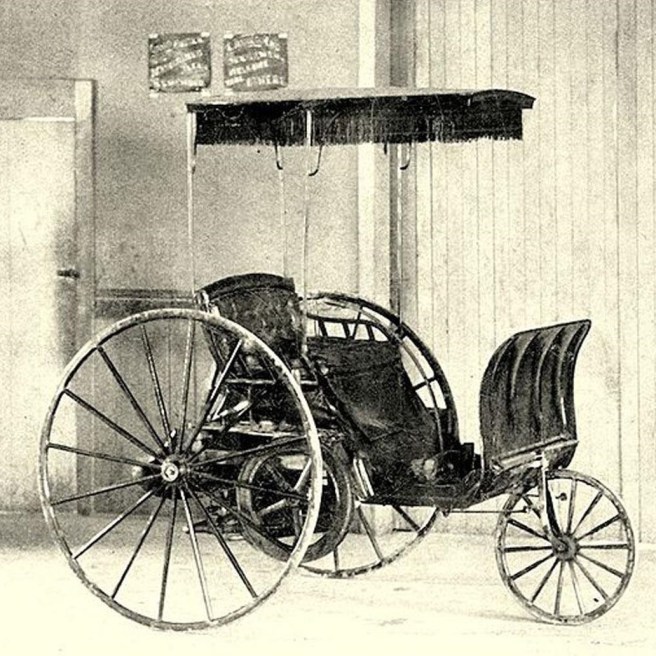
This was the breakthrough vehicle.
  1. He invented the first practical American internal combustion gasoline automobile in 1890 in Ohio City in Van Wert County, Ohio, where he tested it on the village streets early the next year. It was the Buckeye gasoline buggy, a surrey-topped three-wheel runabout with one seat. It had a three-cylinder, four-stroke engine.
  2. In 1891, that horseless carriage became the first automobile offered for sale in the United States. Priced at $550, it attracted no buyers.
  3. Undaunted by the buggy’s reception, he turned his attention in 1892 to making stationary gasoline engines for farm and industrial factory use.
  4. Lambert’s base of operations was the Buckeye Manufacturing Company, which he had founded in 1884 as a farm implement manufacturer and moved in 1892 to Anderson, Indiana.
  5. His experiments with drive-train technology led to the Lambert friction gearing disk drive transmission. The gradual, or gearless, transmission became a signature feature on all of his future cars.
  6. His next attempt at an auto line came in 1895 with a model called the Buckeye. It was a four-wheel modification of the buggy but failed to find buyers.
  7. His first marketing success was the Union, released in 1902. About 300 of the tiller-steered cars were sold.
  8. In 1906 he introduced his first Lambert, establishing himself as one of the more successful automakers of the time. Production peaked from 1907 to 1910 with 2,000 cars a year.
  9. Buckeye Manufacturing, which built the cars, had moved by 1905 to Anderson, Indiana. The Lambert Automobile Company was one of its subsidiaries. Touting its Lambert Friction-Drive Automobiles and Trucks, the Buckeye factory mass-produced Lambert’s cars, gasoline engines, and auto components as well as fire engines, railroad inspection vehicles, and steel-hoof tractors before closing in 1917. At its height, the company had more than a thousand employees.
  10. Lambert held more than 600 patents and died in 1952, age 92, in Anderson.
At its prime, the Lambert came with 15 layers of hand-painted color.


When it comes to daily bread, the French set a standard

Among the things we truly miss living on our remote corner of Maine is a first-class bakery, the kind that can turn out genuine baguettes and croissants.

Previous posts here at the Barn have touched on these distinctively French delights, but today the attention turns to matters of what makes something as basic as bread so marvelous.

Consider.

  1. While the roots of the baguette go back at least to the 18th century, the distinctive Parisian staple didn’t even go by that name until August 1920, when the department of the Seine regulated the product, declaring that the loaf had to have a minimum weight of 2¾ ounces and a maximum length of 16 inches and not cost more than .35 francs, making it affordable for nearly everyone.
  2. Today’s baguette has a diameter of roughly two to 2½ inches, a length of about 26 inches, but that can range up to 39 inches long, and a weight of 8¾ ounces. I’m sure the price has been adjusted over the years, even before the euro.
  3. The word itself means wand, baton, or stick. Well, from baguette to baton does make a bit of sense.
  4. French bakers were already using highly refined Hungarian high-milled flour, a compact Austrian yeast, and Viennese steam oven baking. Later ovens heated to more than 390 °F use steam injection to allow the crust to expand before setting. Vive la difference.
  5. Long loaves were already part of French culture. Some of them reached to six-feet long, resembling crow bars, in the eyes of some. Pity the poor maids trying to convey them to their master’s homes.
  6. The airy, chewy, crunchy-crust elongated bread loaves are made of basically flour, water, common salt, and yeast, perhaps with a few tweaks. We’re back to the importance of really good flour and yeast. As for the water and salt?
  7. By French law, a baguette is defined principally by its dough, not its shape. No wonder so many imitators on this side of the ocean disappoint.
  8. Sometime around 1920 (the accounts vary), bakers were legally prevented from working before 4 a.m., making it impossible to make traditional round loaves in time for customers’ breakfasts, as the Wikipedia account goes. (The bakers were also banned from working after 10 p.m.) Switching from the round loaf to the previously less-common, slender shape of the baguette solved the problem, especially since the bakers could no longer work later than 10 at night.
  9. When it comes to consumption, Algeria leads the world, with 49 million baguette loaves a day, compared to France at a mere 30 million.
  10. As far as history goes, we can revisit the classic quip of let the public eat cake when they’re out of French bread, even of the pre-baguette variety. Was Queen Antoinette out of her head? In my humble opinion, cake definitely finishes in second place.

Behind the first English ocean-going vessel built in the New World

Most Americans, dare I venture, have vast gaps in their knowledge of the history we inhabit. And inherit, as well.

Even though I had visited the site several decades before I wrote my book Quaking Dover, the impact of the attempted Popham settlement came back with a whammy in the developments that followed.

More recently, a post-concert conversation with Fred Gosbee of the folk-music duo Castlebay thickened the plot.

Here we go with ten points.

  1. As far as North America goes, the French had already failed with their St. Croix Island settlement, 1604-1605. I’ve posted on that previously, since it was only a few miles from where I now live. Quite simply, New England winters can be brutal. The English established a toehold in Virginia, at Jamestown, 1607, and were attempting a twin in today’s Maine, at Popham. Again, weather would be a factor.
  2. Sir Ferdinando Gorges, the godfather of New England, as I describe in my book, was the major mover behind the project. As I’ve argued, he’s largely overlooked in his impact on what would become New England. The Native honored today as Squanto actually lived for a few years in Gorges’ manor in England, where he learned English. (Alas, he had been kidnapped. Another story, no matter that Gorges was appalled.) The Puritans would arrive in New England only because they ran a successful end play around Gorges, and then had King Charles I, fatefully, fall prey. Not that I’m particularly pitying the king.
  3. Back to Popham, 1607, where the settlers at the mouth of the Kennebec River somehow managed to build a seafaring vessel during their dark winter. Try to picture them felling and shaping trees in the depth of winter, and then framing them into a ship. Where did they get the sails, nails, and other essential items? They were barely surviving as it was.
  4. The ship, which they named Virginia or Virginia of Sagadahoc, was a pinnace, a small tender. Even so, once a supply ship arrived in 1608, they were able to use it to abandon the new colony and sail back to England. The small ship not only made it but later returned to the New World.
  5. The second and third “local” pinnaces (Deliverance and Patience) were built soon afterwards in Bermuda following the loss of Sea Venture, another story altogether. Let’s just say that conditions in Jamestown were dire.
  6. One of the Popham colonists, a young boy named David Thomson, was intrigued enough to return in 1623 to the mouth of the Piscataqua River and briefly lead the settlement in what’s now New Hampshire. That plays into my Dover book, even though he vanished before he could claim any title. His colleague Edward Hilton, however, stayed on and earned due rewards.
  7. Gosbee also told me that one of the Popham leaders had also received a major inheritance during his New World sojourn. Hearing the news of his windfall, he joyfully headed a return to Merry Old England on the new ship.
  8. The site of their colony later served the bunkers at Fort Popham and Fort Baldwin on the opposite side of the river, defenses against intruding vessels. The beach, meanwhile, is a very popular state park with some of the best swimming along the Maine coast.
  9. The Jamestown colony, meanwhile, could be the basis of a big, juicy, scandalous streamed series. Folks who are opposed to “woke” would be truly rattled by the turns in Virginia’s origins.
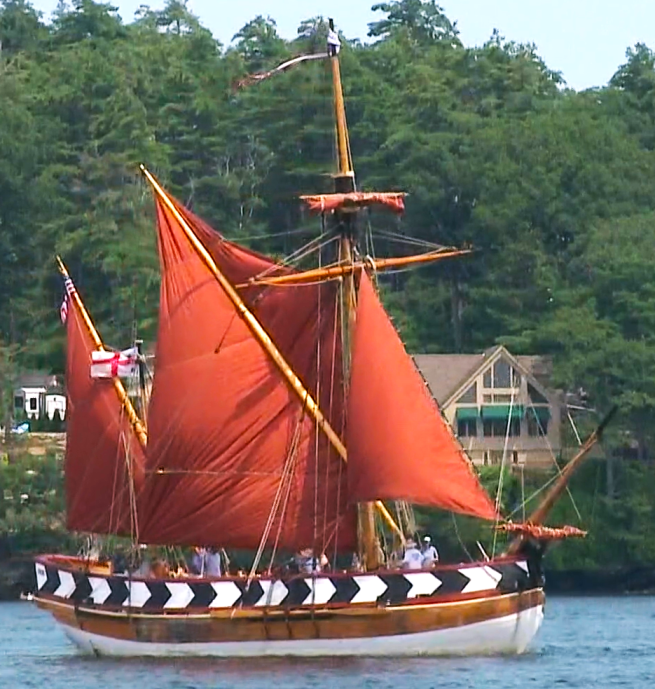
  10. A replica of the Virginia now has naval scholars wondering about some of the rigging. She is a most unusual vessel, from today’s perspective.
A replica of the Virginia of Sagadahoc plies the waters of the Kennebec in Bath, Maine, upriver from the site of the ill-fated Popham Colony. Can you imagine crossing the Atlantic in such a small craft?

Anyone ready for a dark valentine?

Love, if you haven’t noticed, can be very hard to define. Really define.

Here are some examples. Add “Be Mine” at your own risk.

  1. “Love isn’t soft, like those poets say. Love has teeth which bite and the wounds never close.” – Stephen King
  2. “The pain of love is the pain of being alive. It is a perpetual wound. – Maureen Duffy
  3. “Love is a hole in the heart.” – Ben Hecht
  4. “Sex isn’t hard, but intimacy is terrifying.” – Tatiana Maslany
  5. “Love meant jumping off a cliff and trusting that a certain person would be there to catch you at the bottom.” – Jodi Picoult
  6. “But let there be spaces in your togetherness and let the winds of the heavens dance between you. Love one another but make not a bond of love: let it rather be a moving sea between the shores of your souls.” – Khalil Gibran
  7. “You are the knife I turn inside myself; that is love. That, my dear, is love.” – Franz Kafka
  8. “I will not have you without the darkness that hides within you. I will not let you have me without the madness that makes me. If our demons cannot dance, neither can we.” – Nikita Gill
  9. “Truth is, everybody is going to hurt you; you just gotta find the ones worth suffering for.” – Bob Marley
  10. “Never love anyone who treats you like you’re ordinary.” – Oscar Wilde

As a postscript, let me add this: “If I love you, what business is it of yours?” – Johann Wolfgang von Goethe

So how do you define love?


Do I miss the goddess Caffeina?

Mugs of coffee laced with sugar and cream have accompanied me from high school on, especially while sitting at a desk writing or editing. Cutting back from my five or so big mugs a day did become an annual health goal, not that I ever pressed that hard. Working the night shift didn’t help, either.

Alas, since retiring from the newsroom, I’ve had to eliminate caffeine altogether from my diet. Doctor’s orders. My favorite drug of choice, it turns out, counteracts a daily medicine prescribed to me.

Here are a few related considerations.

  1. Tea may be the first caffeinated beverage, from 2737 B.C.E., according to one line of argument, but I’ve never found it satisfying. Sorry if you feel a need to object.
  2. Coffee beans are not really beans but the pit of a red or purple Coffea fruit. The leading producers are Brazil, Colombia, Vietnam, and Venuzuela.
  3. Was the first usage of coffee by an Ethiopian goat herder named Kaldi in 850 C.E. after he noticed his goats had extra energy after eating the fruits?
  4. Today an estimated 80 percent of the world’s population imbibes a caffeinated product daily – a number that rises to 90 percent of adults in North America.
  5. It’s also found in some soft drinks and in chocolate.
  6. Add to that cold, allergy, pain, and weight-control medications.
  7. One study found that two to three cups of caffeine coffee linked to a 45 percent drop in suicides.
  8. Significant daily consumption of caffeine in coffee or tea may also greatly reduce the likelihood of Alzheimer’s and Parkinson’s diseases. Other health benefits are reported.
  9. The United States is the leading consumer of coffee. I doubt, though, that we can blame that on the Boston Tea Party, which was a tax protest.
  10. Decaf does contain a residual amount of caffeine. Not enough, apparently, to keep me awake.

It’s not like I’m suffering, though. I must say I’ve found some good decafs for my morning ritual, sometimes abetted by French chicory. Still, there are some dull days I would really like that jolt of bitter stimulant to the nervous system.

About neighboring Campobello Island

It’s less than two miles away from our house. We even see it from our upstairs windows. But it’s in New Brunswick, Canada, and we’re in Maine, USA, separated by some serious ocean currents. As I proclaim when fog kicks and obliterates that view, “We lost Canada again.”

Before the border restrictions that resulted from 9/11 in 2001, visitation both ways was common. Just hop in a boat and land over there or over here. Families, employment, and shopping often spread across both sides of the border. At least one previous owner of our house was born on Campobello, a long time before Covid really shut things down.

Here are some details.

  1. The international bridge to Lubec, Maine, is Campobello’s only direct route to the mainland. Tiny Lubec then serves as their closest retail center. You need a passport to go either way. Before the bridge opened in 1962, much of the traffic went by ferry connecting to Eastport, Maine.
  2. The island is 8.7 miles long and 3.1 wide, covers 15.3 square miles, and has a population of 949. Half of the island runs along the spectacular Bay of Fundy. In fact, it’s the second-largest of the Fundy Islands.
  3. The island has one school, which serves all grades.
  4. At the end of the 1800s, the island became a summer resort colony for wealthy Canadian and Americans, including the parents of Franklin Delano Roosevelt. At their summer home, the future president learned to sail and explored the wild and, later, as an adult, tragically contracted polio. For Eleanor, the cottage was her favorite place to be, and she returned often, usually through Eastport. Today the residences are the core of Roosevelt Campobello International Park, with tours and programs administered jointly by Canadian and U.S. authorities.
  5. Combining its 2,800-acre natural preserve with an adjacent provincial park, the attraction extends to pristine cobble beaches, trails for hiking and cycling, breathtaking panoramas, rocky headlands, and several garden-like Arctic sphagnum moss peat bogs, one with an extensive interpretive boardwalk. The interior roads are, by the way, unpaved.
  6. Also within the park is Friar’s Head and its related trails, one down to a beach. On the Maine-facing side of the island, its views present the lower stretch of Passamaquoddy Bay and the beginning of Cobscook Bay. The highland sits above a landmark monolith outcropping dubbed the Old Friar for a presumed resemblance that has apparently faded, in part due to artillery practice from nearby crews in time of war. The waterway between Campobello and Eastport is known as Friar’s Road. (Now you know.)
  7. A small car-and-truck ferry connects Campobello and one end of Deer Island; from the other end, a second ferry runs to mainland New Brunswick.
  8. Campobello’s mail delivery comes through the U.S. There have been controversies over U.S. Border Patrol searches of the posts.
  9. Harbour Head Light, first built in 1829, is perhaps the most photographed lighthouse in Canada. Pedestrians who wish to climb to its beacon room can visit it only at low tide, but it is visible from other points.
  10. The island shelters us from heavy surf of the open Atlantic in Fundy Bay, as well as its fierce storm winds.
The Old Friar stands above the tide at the Roosevelt Campobello International Park in Canada.