What’s below the pavement in Manhattan?

A compact and congested city center sits atop a spaghetti pile of underground pipes and wires and more.

Here are ten things you might find below the pavement in Manhattan:

  1. Con Edison’s 105 miles of steam pipes heating nearly 2,000 buildings. (Take care – it’s 350 degree heat!)
  2. Water mains. Many lead to buildings. Others to fire hydrants or drinking fountains.
  3. Electrical conduits and telecommunications infrastructure.
  4. Natural gas mains. Beware of the pressure.
  5. Sewage pipes. These have to run downhill in the end.
  6. Storm drainage. Ditto.
  7. Underground storage tanks containing things like Freon or fuel oil or industrial chemicals. Who knows what else.
  8. History, from cobblestones and Colonial foundations to bottles and bones.
  9. Passenger and freight train tunnels. Think PATH, Metro North, and the Long Island Rail Road when they roll into Penn and Grand Central stations.
  10. Subway tubes and stations and the air vents that support them. The city has 275 fully underground stations.

What’s actually down there often remains a mystery, even to public and utility officials. What happens when a corroded pipe bursts?

Ten facts about Laconia Bike Week

For nine days each June, the sound of Harley’s is heard everywhere across the Granite State. The annual Laconia Bike Week schedule ends on Father’s Day, just before the traditional summer vacation season begins.

  1. It’s the oldest rally in the country. It originated in 1916 when hundreds of motorcyclists convened on Weirs Beach in the city of Laconia. It was officially organized in 1923 as an annual event.
  2. A 1965 riot between motorcycle gangs and police cast a pall over the rally. Attendance plummeted.
  3. Civic boosters revived the event’s popularity in the 1990s to enhance tourism revenue.
  4. New Hampshire does not require motorcyclists to wear helmets. The freedom to feel the wind in your hair – or these days, for many, bald head, is a huge attraction as they tool along scenic, winding highways in the state’s mountainous Lakes Region.
  5. Deaths often accompany the rally. There were at least two fatal crashes in 2018.
  6. Weirs Beach on the shore of Lake Winnipesaukee is Ground Zero. It’s filled with vendors and jammed with parked bikes during the rally.
  7. It has the third- or fourth-highest attendance (400,000). Sturgis, North Dakota, is first (500,000 to 700,000 in August); Daytona, Florida, is second (450,000 to 550,000 in March); and the Bikes, Blues, and BBQ in Fayetteville, Arkansas, comes in about the same (400,000 in September).
  8. The event brings an estimated $100 million into the state.
  9. The Mount Washington Ride to the Sky is a bikes-only event to the top of the tallest summit in the Northeast. Snow is sometimes part of the attraction.
  10. The crowd is graying – but still mostly male and white.

Ten facts about American subway systems

The Big Apple isn’t the only North American city to have a subway system. Underground rapid transit is a defining quality for a great metropolis, after all. Here are ten related facts.

  1. A shared dream: Two brothers – Henry Melville Whitney in Boston and William Collins Whitney in Manhattan – vied against each other to create the first public subway system in North America. Boston won in 1897. New York’s opened in 1904. Who says sibling rivalry doesn’t have its place?
  2. Chicago: While the Windy City is known for its “L,” those elevated tracks running in a loop through downtown, Shy-town also has a portion operating underground. That was a late entry, though, opening in 1951.
  3. Washington: Opened in 1976, the spick-and-span Metro has 117 miles of route, six lines, and 91 stations. It’s the third busiest rapid transit system in the country. Just don’t get caught snacking en route to work.
  4. San Francisco: The Bay Area Rapid Transportation system has six lines connecting 112 miles of route and 48 stations. It carries an average of 423,000 riders daily. Opened in stages from 1972, it was hailed for its technological advances. And then for its glitches.
  5. Philadelphia: SEPTA’s modes include about 25 miles of underground route in the center city, mostly as the Broad Street Subway, opened in 1928, and the Market-Frankford Line. As for safety? It’s far less terrifying than those Jersey drivers across the Delaware.
  6. Cincinnati: Abandoned tunnels and stations from the city’s efforts to build an underground rail system haunt the city. Construction halted during World War I and was officially cancelled in 1928 but bonds for the project weren’t paid off until 1966. Some fans say the failure to complete the dream caused Cincy to fall from the front ranks of American cities – traffic congestion remained a big headache until Interstate highways brought some relief.
  7. Montreal: Canada’s busiest system opened in 1966, running on the then innovative rubber tires. Le Metro now has four lines, 68 stations, and 43 miles of routes serving an average of 1.3 million riders daily – third highest in North America.
  8. Toronto: Opened in 1954, the TTC has an average of 915,000 daily riders on its four lines, 48 miles of route, and 75 stations. Its Yonge-University Line has a U-shaped route. Two others run east-west, while the fourth heads north and then turns east.
  9. Mexico City: The second-busiest in North America, with an average 4.6 million riders daily, it opened in 1969 and now has 12 lines and 124 miles of route. It’s likely the most colorful system on the continent.
  10. Los Angeles: Metro Rail, which opened in 1990, has two lines operating fully underground. They run 36 miles and have 22 stations. They carry an average of 153,000 riders daily – a low figure that stymies observers, considering the region’s notoriously jammed freeways. But poor connecting bus service may be part of the problem.

Ten facts about the New York City subway system

Opened in 1904 and the second-oldest system in the country, the New York subway is the biggest and busiest in North America.

Here are ten facts for perspective:

  1. Riders: 5.58 million on a weekday. (OK, even if most of them are probably using it at least twice, coming and going, that’s still over two million people. The busiest time is between 7 and 8 a.m.)
  2. Top speed: 55 mph.
  3. Average speed: 17 mph.
  4. Average voltage in the third rail: 625 DC.
  5. Route length: 245 miles.
  6. Total track length: 850 miles. (Remember, a route requires two tracks, one in each direction. And where local and express routes overlap, you can double that. Stretched out, the track would run well past Chicago.)
  7. Daylight: 40 percent of the track runs above ground, mostly in three boroughs outside Manhattan. (It doesn’t run on Staten Island.)
  8. Two sizes of cars in operation: The IRT tunnels, curves, and stations are too small for the cars running on the IND and BMT lines.
  9. Directions: The current official map by Michael Hertz Associates dates from 1979. It is not geographically accurate but makes Manhattan larger to accommodate for the borough’s having the most services. The earlier 1979 subway map by Massimo Vignelli is considered a modern classic but is flawed by its placement of geographical elements.
  10. Men working: Because the system does not shut down overnight, all track maintenance occurs while trains are running. It can account for delays and rerouting, as needed. (Well, some of them did inspire my novel now running as Subway Visions.)


Mixmaster? Just look at ‘Subway Visions’

What, me as a Mixmaster?

Just look at the topics percolating in Subway Visions.

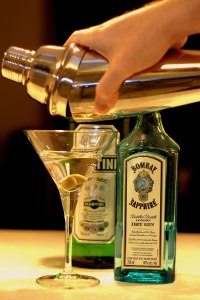
A great bartender is a Mixmaster, too. In fact, the origin of the dry martini is sometimes linked to one at the Knickerbocker Hotel in Manhattan in 1911 or 1912. (Wikimedia Commons photo by N. Renard.)

Here are ten:

  1. Underground mass transit rails. Not just in Gotham, but around the world, too.
  2. Weird chance encounters. A big city is all about people, most of them, I’d say, somehow eccentric. Get on a subway car and just look around – clandestinely, if you’re savvy.
  3. The nature of great cities. Tenements and trash are part of the scene.
  4. Bohemian underground. There’s always been a counterculture in a healthy society. It’s what makes great cities tick.
  5. T-Rex and graffiti. Ah, Kenzie shows up in Gotham just as its trains are being defaced by wild blobs of paint. And here he is as a photographer identifying himself as an artist, too. What’s the point of any art, anyway?
  6. Alternative means of transport. It’s also a time of hitchhiking on the open road. Kenzie discovers parallels in the bowels of the city.
  7. Crashing and couch-surfing. When you have friends, your options multiply. And it’s much better than the one hotel room he rents in his visits.
  8. The Dharma. Kenzie’s visits largely revolve around his studies under his Tibetan Buddhist guru in SoHo.
  9. Overcoming fear. His first ventures into the unfamiliar underworld are scary steps. By the second half of the novel, though, Kenzie is out along the fatal third rail and the elevated heights. How free can he get?
  10. Surrealist vision. He begins seeing in encounters in a fresh light. Maybe it’s a kind of X-ray? It’s entertaining, all the same, as well as refreshing. What else don’t most commuters notice?

Be among the first to read my newest novel.


Ten ways this ‘Subway’ is new and improved

My new novel Subway Visions comes a long way from its earlier incarnation as Subway Hitchhikers.

Here are ten ways it’s new and improved.

  1. The novel no longer serves as an introduction to three other volumes but stands fully on its own in a more timeless Gotham.
  2. The central character is now identified as Kenzie, in line with the other novels in my Freakin’ Free Spirits cycle. Gone are the Duma Luma and later D.L. monikers. He’s more grounded than they were.
  3. The action is now built on a clear chronology that runs parallel to his ongoing life to the north. For that, you can read Pit-a-Pat High Jinks.
  4. He now has monthly opportunities to visit the Big Apple and ride its rails, thanks to a floating three-day weekend off from his job. This gives more plausibility to his familiarity with the city while living hours to the north. He is young and ready for adventure, after all.
  5. With his Tibetan guru living in Manhattan’s SoHo district, Kenzie’s Buddhist studies now run through much of the story. His sessions there become his principal motivation for the monthly visits.
  6. The story is now anchored by a set of regular characters, beginning with his guru and Buddha buddies like Holly and Wilson before expanding in the second half with the wild tagger T-Rex.
  7. As one reader said of the earlier version, “I really dig that chick Holly.” Now there’s a lot more of her. (And Wilson and T-Rex are altogether new.)
  8. The language is tighter; the sentences, more staccato, befitting the grimy trains and their stations.
  9. The funky sweet surrealism of the original tale now floats over the substance of an inescapably malodorous substratum. There’s nothing bland and disinfected in this gritty demimonde of endless night where Kenzie encounters the most remarkable souls and visions.
  10. These events are now seen in a historical perspective, thanks to the unseen presence of Kenzie’s daughter Cassia while I was revising the tale. Credit her for the snippier tone, too.

Be among the first to read my newest novel.

Ten reasons the hippie movement collapsed

  1. No clearly defined identity. Long hair or passing the pipe was pretty superficial, ultimately.
  2. No underlying unity or structure. It’s not like we had a manifesto or membership cards or even paid dues.
  3. And bad trips. Especially bad trips.
  4. No reliable leaders or prophets. And definitely no reliable followers.
  5. End of the military draft. Not that it was the end of the war now, was it? But it turned the heat off the burner.
  6. Not enough self-discipline. Even before we got to the hard stuff.
  7. Demands of jobs and families kicked in after all. And since many of ours weren’t like our parents’, we had to keep improvising. There weren’t many guidelines left to follow.
  8. The soul mate who wasn’t. Or as they say in Zen, what’s the sound of one clap handing.
  9. Everyone else left. Maybe with your lover.
  10. The Grateful Dead couldn’t carry the beat forever. Even with all these oldies still hanging on.

What would you add to the list?


Ten random bits revolving around Greek-American families

My novel What’s Left has me thinking about families – especially like Cassia’s Greek-American household in Indiana.

  1. Number of single-parent families in the U.S.: 13.7 million (27 percent).
  2. Number of Greek-Americans: 1.3 million to 3 million of full Greek ancestry estimated. (With her mixed ancestry, Cassia wound not be counted here.)
  3. Number of Greeks in Indianapolis area, 1900: 29.
  4. Number of Greek-Americans (full ancestry) in Indiana: 23,993 (2010).
  5. Number of family businesses in U.S.: 5.5 million.
  6. Greek diners: More than 600 founded in New York area between 1950 and 1970 alone.
  7. Number of diners in New Jersey: about 525 (the leading state).
  8. Greek-menu restaurants in U.S.: 3,100.
  9. First Greek Orthodox church in the U.S.: New Orleans, by 1866
  10. First Greek Orthodox church in Indiana: Holy Trinity, Indianapolis, 1910.

Ten facts about the Ohio River

In a whimsical twist in my novel What’s Left, I placed the town along the Ohio River. Well, the navigable waterway is a defining element of southern Indiana.

  1. Length of the Ohio River: 981 miles
  2. Length along Indiana: 240 miles before adding twists. Drains all but the northernmost area of the state.
  3. At its mouth: It is considerably larger than the Mississippi, making it the main hydrological stream of the whole river system.
  4. Number of states feeding into the Ohio River: 15.
  5. Largest tributary: Tennessee River, 652 miles long. Its watershed includes Virginia, North Carolina, Georgia, Mississippi, Alabama, a corner of Louisiana, as well as Tennessee and Kentucky.
  6. Largest northern tributary: Wabash River, 503 miles long. It originates in Ohio and flows across Indiana before becoming part of the border with Illinois.
  7. Average depth of Ohio River: 24 feet.
  8. The biggest city along its way: Pittsburgh, metropolitan population of 3.5 million. The river begins with the confluence of the Allegheny, from upstate New York, and the Monongahela, which drains part of West Virginia and Maryland as well as Pennsylvania, at Point State Park in the Gold Triangle.
  9. Next largest: Cincinnati, metropolitan area population of 2.2 million. Can be seen as the waterway’s hub.
  10. Major hurdle: Louisville, Kentucky, sits at the Falls of the Ohio, which once presented a barrier to river traffic. The McAlpine Locks and Dam stand where the Louisville and Portland Canal was built in 1830 to allow vessels to bypass the falls. It was the first major engineering project on the river and, by some accounts, the first on an American waterway.