Ten reliable wines in our cellar

Let me tell you, for most of the American public, wine has really improved in the past fifty years. Most of what was available back then, except for snobs and wealthy insiders, was pretty nasty. Thankfully, that’s changed. Yes, definitely.

As for those snobs? The typical Trader Joe’s makes some good stuff truly affordable, just for starters.

Here are ten we like, with the caveat they can vary widely in quality from label to label and season to season.

And, for the record, we prefer dry rather than sweet.

  1. Cotes du Rhones. Lighter in weight than what I’d normally reach for, but oh my, how gorgeously it goes with everything on the table. If I had to limit it to only one, this is it.
  2. Merlot. OK, I like big, chewy red. Lots of body. Especially for that now-once-a-week red meat. I don’t care how much it’s disparaged by some critics. Bless them, they keep the price down.
  3. Malbec. A South American equivalent.
  4. Cabernet sauvignon. Once known as Bordeaux, it’s far outstripped its French confines. Lighter in weight, it’s a red we think goes with nearly everything. Well, maybe not fish. But definitely cheese and crackers beforehand.
  5. Pinot noir. Another notable red, but definitely tricky in the lower price levels. Never mind what the movie says, either. I mean, sometimes Zinfandel does the job better.
  6. Sauvignon blanc. We had one that was truly, marvelously stony. It’s our ideal, our holy grail, should we ever encounter it again. It was a unique year, as we learned later. And it remains our ideal of a white wine.
  7. Prosecco. Look, we love bubbly. And when a daughter discovered this during a semester in Italy, where it was priced like Coca-Cola here, we were soon hooked. Like cava, it’s champagne by any other name. Try it with pizza, if you must.
  8. Rose’. A summer favorite around here. Don’t snicker. An Austrian bottling knocked our socks off, all eight bottles we were able to clutch up.
  9. Good Italian and Spanish varietals. They come in so many varieties we won’t attempt to name them. I’ve come a long way from my ex-father-in-law’s bubbly Lambrusco, though I still harbor a fondness for it, as do my now wife and elder daughter after encountering it in Bologna, along with authentic prosciutto that melts in the mouth.
  10. I’d add Macedonian, but we’ve been able to score just one bottle in New Hampshire before my wife and daughter debarked for that part of the former Yugoslavia republic. As they discovered there, many folks are making great wine in smaller quantities and keeping it home. Heads up, should you chance across any.

~*~

If you notice, there’s no chardonnay on this list. Too much oak, my wife insists, adding if she wanted that, she’d just bite the table.

~*~

What would you add to the list?


Have you ever lived in a desert?

In my novel Nearly Canaan, Joshua and Jaya settle into a place unlike anything they would have imagined. It’s desert, for one thing, where nearly everything has to be irrigated, for another. Quite simply, it’s a lot like Yakima, in the middle of Washington state.

The city’s doubled in population since I lived there, but I’m not surprised. It’s mostly sunny.

Here are ten factoids.

~*~

  1. The name applies to the city, the county, the valley, and until recently, the Indians, too.
  2. The valley gets nearly nine inches of rain in a typical year, most of it in the winter. Almost every green thing that sprouts requires irrigation. And if that supply fails, everything goes kaput.
  3. The valley produces more than 75 percent of the hops used in American beer – and a quarter of the hops used worldwide. If you’re a beer lover, be grateful. The locale also raises a lot of barley, up in the Horse Heaven Hills.
  4. The valley has more than 70 wineries. It’s become a great place to grow varietal grapes, many of which are pressed into fermentation elsewhere. On the globe, it lines up quite well with France.
  5. The trolleys have been running for more than a hundred years. Fun trip, by the way, especially the ones that run out through the orchards.
  6. The original site of the city was renamed Union Gap, made famous by the rocker Gary Puckett.
  7. Yakima County leads the nation in apple production, with 55,000 acres of active orchards. It’s the state’s highest valued agricultural product. By the way, they’re no longer mostly Red Delicious.
  8. The average income of an apple picker is $6 a day.
  9. The Native Americans have renamed their tribe and reservation as Yakama. One letter makes a huge difference.
  10. I still miss living there, especially Mount Adams every morning.

~*~

So what’s special about where you live?

What do you know about the Ozarks?

In my novel Nearly Canaan, Joshua and Jaya leave Prairie Depot and settle into a place unlike anything they would have imagined. It’s not where they promised themselves that they’d relocate, but it would have to do. At least it was hilly and wooded.

It’s hillier and more forested than I had expected.

Here are a few of the things they discovered.

~*~

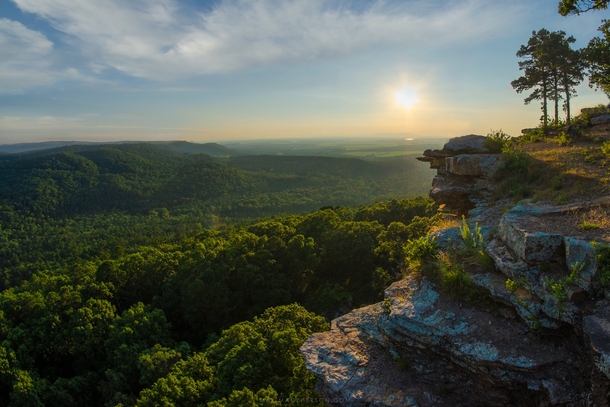
  1. The Ozark Mountains, also known as the Ozarks Plateau, stretches into five states but is situated mostly in southern Missouri and northern Arkansas. It’s the highest land between the Appalachian and Rocky mountains, having some peaks of more than two thousand feet elevation.
  2. Technically, there are two mountain ranges: the Boston Mountains of Arkansas and the St. Francoise Mountains in Missouri, the latter having some of the oldest rocks in the United States.
  3. The majority of the region is forested. Logging is a major industry.
  4. The plateau is laced with underground caverns. Found deep within some of them is the species of Ozark blind cave salamanders, which lives nowhere else in the world.
  5. The shoreline of the Lake of the Ozarks is longer than the coastline of California. The man-made lake covers 61,000 square miles and is a popular vacation site.
  6. The Ozarks has a distinctive culture, architecture, and dialect deriving from its backwoods heritage. Square dances were a popular social activity, as was storytelling.
  7. Historically, the Ozarks were predominantly Baptist or Methodist in faith. Today, the Assemblies of God and Baptist Bible Fellowship International have their world headquarters in the region.
  8. Big-name live musical entertainment has made Branson a major tourist magnet.
  9. Fayetteville, home to the University of Arkansas and with 77,000 population, is the third largest city in the state and is the principal metropolis in the Arkansas part of the Ozarks. It claims to defy many stereotypes about Southerners and could well be the model for Dolomite Center in my novel.
  10. Wal-Mart is headquartered in Bentonville, a short drive from Fayetteville.

~*~

What can you add to the list?


What do you mean by ‘promise’?

One of the foundations of my novel Nearly Canaan is the varied meanings of the word “promise.” It’s central to a marriage, especially, as we see with Jaya and Joshua. It also centers on their vision of arriving in their own Promised Land.

Here are ten examples of its possibilities.

  1. Potential or vision. “I saw her potential.”
  2. Vow or oath. “I will do this, so help me God.”
  3. Agreement or contract. “My half of the bargain in exchange for your half.”
  4. “If you do that, I’ll do this.”
  5. Word of honor. “I place my reputation and character behind this.”
  6. Betrothal, engagement, marriage. Now we add romance and a life together, venturing into the unknown.
  7. Security, warranty, or insurance. As a shield against risk.
  8. “I agree to this willingly.”
  9. An emblem of the agreement, making it more fully visible. The Biblical Promised Land would fit in here, I’d say. Perhaps also the birth of Jesus.
  10. Obligation or devotion. “This is what I’m moved to uphold.”

~*~

What would you add to the list?

Mixmaster? Just look at ‘Nearly Canaan’

What, me as a Mixmaster?

Just look at the topics percolating in my novel Nearly Canaan.

Take just ten, shaken or stirred or mixed in a bowl:

  • Promise. The word has many meanings, including ability, talent, potential, opportunity, guarantee, understanding, agreement, contract, oath, pledge, vow. It can also have quite different meanings for each person. In this novel, especially, it’s a promised land, a dream, and sometimes even a broken promise.
  • Place. This story is rooted in the surrounding landscapes, beginning with a small-town on the prairie and moving on to the Ozarks before landing in the desert interior of the Pacific Northwest, where Mount Rainier and the Cascade Range and Seattle beyond also play into the action.
  • Intimacy. The story goes behind closed doors, for sure.
  • Friendships. In this story, these usually arise among the couples and their shifting inner dynamics. Often, these friendships prove essential for daily survival.
  • Family. Jaya becomes quite fond of her in-laws and their support despite their initial differences.
  • Spirituality. It’s not just faith and meditation but a meaningful faith community, too.
  • Career. Jaya isn’t the only young adult trying to navigate a demanding career in this story. The long hours and endless struggles of being a rising executive even in nonprofit organizations take a toll. As for their spouses? Finding their own niche is not always easy.
  • The seasons. Dwelling in an apple orchard, Jaya and her husband observe the rhythms of the year close up.
  • Wilderness. Part of the allure of the Pacific Northwest is its access to forests and mountains, but open desert is wilderness, too.
  • Lasting impact. For many in their circle, Jaya is seen as the Wise Woman who fosters a better life. How far does her impact extend?

Be among the first to read the novel!

The beaters were a pain to clean, though. Licking frosting from them was another matter.

What makes ‘Nearly Canaan’ new and improved

My newly released Nearly Canaan is a thorough reworking of three earlier novels that were intended to be a series.

The publication of What’s Left and the revisions it prompted for four related books soon had me also reconsidering my Promise, Peel (as in apple), and St. Helens in the Mix novels. Sensing the possibility of restoring them to the original concept of a single big book, I made drastic cuts and still added colorful new material.

Here are ten ways the result is new and improved.

~*~

  1. The story is now primarily character-driven. It’s a richer brew. The landscapes now blend in as the backdrop.
  2. Jaya’s romantic partner gains more prominence and independence. His inner turmoil may leave her perplexed, but it’s an essential element in their developing relationship. He’s renamed, too, and refocused.
  3. He’s not the only ongoing conflict. Her professional ambitions in nonprofits management are more sharply detailed as she runs into organizational crises.
  4. She and Joshua become especially close to two other young couples. Everyone seems to look to her for answers, while she turns to an older couple for counsel.
  5. One exception is the pastor’s young wife in the opening section, who serves as a counterpoint to Jaya’s Hindu-based spirituality. The two develop a unique but clandestine budding best friendship. Wendy will return to bring the book to its conclusion.
  6. The new release compresses three books into one centered on Jaya’s influence once she leaves Manhattan. Can she really change lives for the better?
  7. The story is now connected to my novel Yoga Bootcamp, thanks to revisions that installed Jaya as a central figure there. The backstory provides a better understanding of what’s driving her as she settles into Prairie Depot and beyond.
  8. Jaya’s desire to find a suitable artistic means to express her mystical experiences is more clearly envisioned. She may be stressed, but her private discipline continues as best she can. She has to have somewhere to turn.
  9. The pivotal catastrophe moves to the middle of the book, rather than hanging at the end of what was the first volume. Can they survive and pick up the pieces and go on? That’s the stream that follows.
  10. Or, as I didn’t ask earlier, has Jaya unleashed a demon?

~*~

Be among the first to read it!

Hey, just wait till you’re old

No to brag, but I’m in pretty good shape for my age. Admittedly, that’s setting the bar low. Still, there’s a lot I don’t like when it comes to getting older. For example.

  1. Everyday aches and pains. Well, I was fine until I took up daily exercise.
  2. Slowing down. I run out of energy in tackling chores, for one thing. An hour or two and I’m ready to quit. On the other hand, retirement has allowed me to focus more fully on my writing and reading projects. At least when the chores don’t get in the way.
  3. Balding and graying. Among other matters of vanity.
  4. Diminished sex drive. Ouch! Let’s not call it libido.
  5. Fuzzy memory. OK, I do have a lot more crammed into my cranium, but retrieving specifics can be difficult. And that leads to worries about Alzheimer’s or dementia. Not that I can stop any of the aging progressions, which could be a point of its own.
  6. Realizing all the babies in the neighborhood have now graduated from high school or college. At least the ones when we moved here. Or, for that matter, being called “Sir” rather than “Dude.”
  7. Being required to take a handful of pills every morning. Well, it could be worse, like rounds twice a day. Obviously, we’re not talking about recreational drugs, either.
  8. Seeing old acquaintances for the first time in years and being shocked at how old they’ve become. Sometimes I don’t even recognize them. Worse yet, they don’t recognize me.
  9. Overhearing things. Like the kid in the swimming pool locker room who turned to his uncle and proclaimed, “That man’s old,” when I’m the only other person present.
  10. And this. Realizing I’m now the oldest generation in many of my circles and expected to fill the role of the Old Wise One. The ones who went before were so much better.

~*~

What can you add to the list?

Got any favorite books of the Bible?

My As Light Is Sown blog is running a weekly commentary on my experience and thoughts arising in reading the Bible straight-through, from Genesis to Revelation. It’s a wildly varied collection of writings.

But if I’d have to pick my top ten books? Here’s a stab.

  1. Gospel of John: I’m intrigued by a counterargument running through the text that identifies Christ as the Holy Spirit more than Jesus. You’ll have to wait for the post to see my reasoning. The book is also called the “Quaker gospel,” giving me an extra interest.
  2. Genesis: It’s a bang-bang-bang way to begin the chronology, with human desires and conflicts at the fore, even that far back in antiquity. Much of the book would make a great soap opera, but for me, it’s more primal and fundamental than that. Although it often seems to be a telling of patriarchy, keep an eye on the women. And don’t blame Eve when the ball starts rolling.
  3. The Psalms: This collection of heartfelt poems, many of them written anonymously in the guise of King David, span a range of deep emotion. They’re rich enough that the Eastern Orthodox read six in their entirety each Sunday – the same six.
  4. Ruth: The whole story explodes into fullness on a single word – Moabite. But what an incredible love story.
  5. Song of Songs: This is an incredible poem of illicit love. Forget the argument about it’s being an allegory about divine concern and all that. What is religion without passion? Leave it at that.
  6. Esther: Again, a complex soap opera is unleashed here. The bad guys don’t get any worse. By the way, “chamberlains” in the King James translation masks a bigger meaning – they’re eunuchs, who play a surprisingly big role throughout the Hebrew Bible.
  7. Revelation: Read this as poetry, not dystopian doom or a blueprint for human destruction.
  8. Ezekiel: I was surprised by how psychedelic this book is. Whoa!
  9. Tobit: The Apocrypha, not included in most Protestant or Hebrew Bibles, has some lovely stories. This is one. Like Susannah, also from the collection, it tells of injustice, suffering, and ultimate redemption.
  10. Epistle of James: The epistles, most of them attributed to Paul, are a specialty unto themselves. As the brother of Jesus and a leader of the Essenes, though, James has special authority.

~*~

What would you add to the list?

My national parks bucket list

When I lived in Yakima, Washington – like Joshua and Jaya in my new novel, Nearly Canaan – Mount Rainier was practically in our backyard, metaphorically, at least, and I got to explore it repeatedly, in all seasons. In addition, I camped in the Olympics and North Cascades national parks and visited Crater Lake in Oregon. I had already camped as a kid in the Great Smokies and at Mammoth Cave and have since probed the Everglades. I can attest that Acadia and the Cape Cod parks in Provincetown are prime New England. And Cuyahoga in Ohio was just to the west of a town where I lived and worked for four years after leaving the Pacific Northwest. Gateway Arch in St. Louis is another? Gee, this list of parks I’ve visited keeps growing.

Still, there’s a lot of stunning choices in the system I have yet to explore.

How many items are required for a bucket list, anyway? Ten or 20? Well, this is in my Tendrils category, so that settles it. These are all United States parks, by the way – an international list will have to wait.

Here goes.

  1. Grand Canyon, Arizona.
  2. Yes, in Montana.
  3. Yellowstone in its corner of Wyoming, Montana, and Utah.
  4. Grand Teton, Wyoming.
  5. Zion in Utah.
  6. With seven of the ten biggest parks, I’ll lump them all together in what could become yet another Bucket List. I’d definitely want to get to the Last Frontier by ferry from Seattle. Am I too old for a sleeping bag on the deck?
  7. Hawai’i Volcanos.
  8. Mesa Verde in Colorado. The Anasazi cliff dwellings, especially.
  9. Kings Canyon. Sequoia, Redwood, and Joshua Tree, all in California. I’d love to spend more time in the sequoia groves than I did passing through back in ’79.
  10. Calsbad Caverns, New Mexico.

~*~

What’s on yours?

Why presidential hopefuls brave the ice and snow

Its first-in-the-nation presidential primary has the Live-Free-or-Die state in the headlines these days. We want to meet and evaluate them all. It ain’t always easy.

The state’s presidential primary originated in Town Meeting Day, which is traditionally conducted on the second Tuesday in March each year. Since everybody had already come out for this unique form of grassroots democracy, it made sense to add one more item to the warrant, as the agenda is called, rather than make yet another trip to the town hall. (Besides, being winter, we’d have to heat it.) As other states have tried to jump into the spotlight, the presidential part has moved forward on the calendar. Theirs, though, don’t have organic roots like ours.

Contrary to what some candidates label their appearances, a real Town Meeting is not a political lecture or Q&A opportunity but rather a community session for debating and then voting on local government decisions for the year. Everyone can speak up and be heard. The town and school budgets are major considerations.

Now for some other perspectives on the Granite State:

  1. New Hampshire is bigger than it looks on the map. Rotate it 90 degrees and you’ll see it’s larger than Massachusetts, New Jersey, Hawaii, Connecticut, Delaware, and Rhode Island. It’s slightly smaller than Vermont. When water is included, Massachusetts and Hawaii jump ahead.
  2. Small-business owners comprise 96 percent of the employers in the state.
  3. An estimated 87,000 residents, mostly in the southern tier, commute to jobs in Massachusetts.
  4. It’s the only state where seatbelts are not required and one of only a handful where motorcycle helmets are not mandatory.
  5. The state has no income or sales tax. Property taxes make up much of the difference.
  6. The state ranks dead last in its support of secondary education.
  7. New Hampshire has the longest running state lottery in the continental U.S. Originally, the numbers were not drawn at random but based on results from the Rockingham racetrack.
  8. Dover, settled in 1623, is the nation’s seventh-oldest permanent community.
  9. The first potato crop in America was planted in 1719 by Scots-Irish immigrants in Nutfield (now part of Manchester).
  10. Although the state has only 18 miles of ocean frontage, the 6,000-acre Great Bay 10 miles inland is one of the largest estuaries along the Atlantic coast. It’s crucial for sustaining fish populations in the ocean.

~*~

Ever been to the Granite State? What can you add to the list?