Facts about the mills in Dover

  1. The Cocheco Manufacturing Company had the largest overshot flywheel in the world. It powered the looms and shuttles inside the long five- and six-story building.
  2. It was the scene of the first all-women’s strike in U.S. back in 1828.
  3. The mills once had 1,200 workers.
  4. There were more than 100 company-owned boarding houses.
  5. The town itself wrapped around the mills rather than to one side.
  6. Less than half of the mill complex remains.
  7. The printworks produced 1,000 new patterns a year.
  8. Mill workers received free milk from the company’s herd on Milk Street. Urine from the cows was essential as the fix (stabilizer) for dyes in the fabrics.
  9. Calico, sateen, velvet, and seersucker were the principal textiles produced.
  10. Fire was a constant threat, on occasion erupting spectacularly.


What is it about Memphis?

In my novel Yoga Bootcamp, Jaya’s guru is a native of Memphis, there on the Mississippi River.

And much of the action in my novels Nearly Canaan and The Secret Side of Jaya takes place in Arkansas, right across the river.

It’s more influential than I’d thought.

Here are ten tidbits.

~*~

  1. It’s populous. With a metro population of more than 1.3 million, Greater Memphis is the most populous locality in Tennessee. However, the city itself has 650,000 residents, making it second behind Nashville.  
  2. FedEx headquarters. The airport is the world’s second-biggest cargo operation.
  3. The river. The busy shipping port moves 11 million tons of cargo a year, much of it arriving by train or truck.
  4. King Cotton. Half of the nation’s cotton is traded at the Cotton Exchange on the riverfront.
  5. Music. Sun Records (founded in 1950) became the birthplace of rock ‘n’ roll in the 1950s. It was the first label to record Elvis Presley, Roy Orbison, Jerry Lee Lewis, and Johnny Cash. It was sold in 1969 and eventually moved to Nashville. Meanwhile, Stax Records (1959-1976) was a fountain of the Memphis Sound, mixing blues, rhythm and blues, and soul.
  6. Graceland. Presley’s mansion is visited by 600,000 tourists each year. In America, only the White House attracts more.
  7. Civil rights. The motel where Martin Luther King Jr. was gunned down in 1968 now houses the National Civil Rights Museum, a Smithsonian Institution affiliate.
  8. Edible flesh: The city is the largest livestock and meatpacking center in the South.
  9. Fire up: The World Championship Barbecue Cooking Contest each May offers $110,000 in prizes.
  10. Namesake: It’s named for the city on the Nile in Egypt.

~*~

Ever been there? What struck your fancy?


Things I’d do if I were president

It’s in the air. Can’t help but wonder.

  1. Raise taxes on the super-rich to bring them more into line with the rest of the populace. Like if you own 50 percent of the wealth, you pay at least 50 percent of the federal budget. Use the income for health care, education, and similar benefits for all citizens. (Yes, it’s income redistribution … but so is an economy where cheap imports keep lowering wages.)
  2. Support environmental action and sustainable economics. We’d be back in the Paris climate control accords, for certain.
  3. Raise the cap on Social Security contributions by the rich. Of course, we can afford Social Security if we’re willing. Just raise the cap on the superrich.
  4. Demand auditing controls on military expenditures. Bernie’s right on this one.
  5. Impose a national sales tax for health care relief for domestic manufacturers. This would level the playing field when it comes to imports versus homegrown.
  6. The next step? Medicare for all.
  7. Raise the minimum wage. Nobody can live on the current level. It’s an insult to the value of labor.
  8. Recognize a shorter work week as the basis for benefits and workplace protections.
  9. Break up the banking and financial conglomerates. Too big to fail is an invitation to another colossal collapse.
  10. Name Barack Obama to the Supreme Court.

~*~

OK, since we’re dreaming, I’d also have a problem-solving Congress. One without Mitch McConnell.

What would you do?

Feel like quitting?

Got the day after Labor Day blues? Think of a job or school or volunteer post. Whatever. If you need an excuse, you can always tell them something like this.

  1. I’m tired.
  2. Won Megabucks.
  3. Am about to be beamed up, out of here.
  4. Got a better offer.
  5. Have had enough B.S.
  6. Don’t like the public I’m dealing with or my coworkers or the setting or my surroundings.
  7. Don’t agree with policy.
  8. Can’t live with the dress code.
  9. Just don’t care.
  10. It’s too expensive compared to the pay.

~*~

And here I am, retired.

What would you add as an excuse?


What makes for a memorable getaway?

Getaway? I was about to say vacation. Who am I trying to kid? I’m retired!

Actually, when I was dutifully employed, “vacation” usually meant hunkering down at home to concentrate on my literary enterprises and revision, or maybe even a reading orgy, or taking off to a family or Quaker gathering. T’ain’t quite the same as going fancy free. Still, I managed to get away on some memorable trips.

In this list, I’m ruling out daytrips. Gotta be an overnight, at the least.

Here are ten I remember fondly, sometimes even from repeated visits.

~*~

  1. Appalachian Trail. Backpacking when I was barely 12 was an ordeal. One that’s everlasting deeply imprinted in my soul, especially the mountaintop of blooming rhododendron at the end of our week. What I recall most is the discovery that if you go far enough away from the trailhead, the litter disappears … and then you’re in a whole new, pristine, world.
  2. Fort Warden. The location itself didn’t overwhelm me, even though it overlooked the point where Puget Sound and the Strait of Juan de Fuca come together. I think that was because of all the remaining fortifications. But such incredible waters! The former World War II naval post had become a Washington state park for the arts and hosted a weeklong workshop with some of my favorite poets. Nearby Port Townsend gave us some fun bars for our evenings. The former base is featured in the movie “An Officer and a Gentleman.”
  3. North Cascades National Park. My three times of camping there and a single mountain climb with views of Mount Shuksan included finding gold dust in my dishes as I washed them in a mountain stream that swelled with melting ice during the day. I had no idea how many tall peaks rise in British Columbia till I crested the summit that day and looked north.
  4. San Francisco. It was the southernmost point of a two-week vacation that included North Pacific Yearly Meeting sessions in Olympia, Washington, and camping in the North Cascades. My then-wife and I spent two nights in our sleeping bags in the San Francisco Friends meetinghouse (I think we paid two dollars a day). My introduction to fine Japanese and Thai cuisine came just around the corner. Why haven’t I returned?
  5. Chicago. Repeatedly, each one leaving vivid memories. The art museum alone is worth the trip, but I’ve also spent time high in the Chicago Tribune tower with Pulitzer-winning journalists. The last few visits were helped by having a lover residing in Hyde Park.
  6. Greensboro, North Carolina. It was a genealogy-research trip that then swung northeast to Philadelphia and Brooklyn. I need to go back and see more, now that I know what to expect.
  7. Lake Sebago region. The year before I remarried, I spent a week in October in a rustic cabin on the shore of Crescent Lake in Maine. Cold nights required a wood fire, that sort of thing. Learned to canoe there, too. Guess it was my Walden Pond experience.
  8. Cape Cod. Since the kids’ grandfather lived in Wellfleet, we had a great excuse to visit. It was an easy walk to the ocean and a short drive to Provincetown.
  9. Providence. We found a great deal on a luxury downtown hotel, one where we looked down on the dome of the Rhode Island state capitol. The mattresses alone were enough to make us not want to go anywhere else, but we did enjoy innovative cuisine and easy public transportation. Our strolls along the river and Colonial neighborhoods were enchanting. And then there was our tour of the Slater Mill and the industrial revolution.
  10. Eastport, Maine. To put this in context, we had earlier visited Camden in dead winter and were delighted. But that’s a tony, crowded tourist hive each summer and way out of our league. Ditto for another B&B up the shore in Belfast, when we attended the Common Ground Fair. Our trip to Eastport on a Memorial Day weekend, however, was more inviting. The unpretentious, working-class easternmost city in the U.S. simply felt like the real thing. And yes, the ocean views and fresh seafood were spectacular.

~*~

Where would you suggest? Any great memories?

Ten things to do in Dover

The city where I live is basically a family-friendly kind of place. We don’t have much of what tourists might expect as a big-time destination. Still, there are times when my wife and I are having breakfast or lunch or an early repast downtown when we realize people travel halfway across the country for a taste of this – tranquil New England.

Here are ten things to see and do if you visit the seventh-oldest permanent settlement in the U.S.

  1. Cocheco Falls. Whether the flow’s near flood stage or merely a trickle, I can spend hours watching the river cascade to the tide right in the center of downtown. The stream exits through an impressive arch in the mill. In season, you can dine or enjoy cocktails a deck beside the water. I think that’s pretty impressive.
  2. The historic textiles mills. In the 19th century, Dover was famed for its calico, and two of its big riverside mills have survived. Today they serve as incubators for new enterprises, including some adventurous cuisine, plus displays, boutiques, artists’ studios and galleries, apartments, a function hall, and even a church or two, should you choose to explore. Of special note are Noggin’s toy store, with its special events, Lickees and Chewies candies and ice cream chamber and gathering space, and the Smuttynose brewpub. Need I say more?
  3. The Children’s Museum of New Hampshire and its Adventure Playground. Nestled amid the old mills, this small but imaginative and active museum attracts nearly 100,000 visitors a year for good reason. It’s gained a loyal following from all over the country.,
  4. Woodman Museum. Just up the street, this old-fashioned and unabashedly eclectic “cabinet of curiosities” collection reflects the range of Dover history, natural history, and arts. The centerpiece is its 1675 William Damm garrison house, now under protective cover. The rough-hewn structure survived the 1684 massacre when Indians attacked the frontier settlement in retaliation for atrocities committed by Major Walderne (or Waldron). Its most popular attraction, though, is the two-headed snake, now badly deteriorating, or maybe the four-legged chicken. And then there are the dolls.
  5. Garrison Hill observation tower. Tucked away on a small hill just north of downtown, this green metal lookout has fantastic views of the classic downtown and the forests and mountains around us. Supposedly you can see the Atlantic, but for me, that scene always blends into the eastern horizon. The short hike from our house, up through a small forest, always impresses our guests.
  6. Strolling. It’s a pedestrian-friendly town. Around the downtown, the old neighborhoods, with their blend of architectural styles and history, are fun to wander. Add to that the community trail, with one leg following an old railroad line through backyards and over the river, where there’s an impressively redesigned bridge, and another leg leading up to Watkins Falls through scenes that could easily be in the White Mountains further north. Can’t complain about getting exercise when it’s like this.
  7. Pub crawl. I’ve already mentioned Smuttynose, named for a variety of mottle-faced seals that lend their moniker to one of the Isles of Shoals, but with Dover’s large proportion of University of New Hampshire students also living in town, our small city does have a lively bar scene. Key stops to hit are the Brickhouse and Cara Irish Pub, for live music, and Sonny’s, for a Brooklyn kind of buzz. Fury’s Publick House, Thompson Tavern, the Farm (with a lovely deck overlooking the river), 603 (named for our telephone area code), and Thirsty Moose Taphouse (for sports fans or a wide array of draughts on tap). Chapel and Main also brews its own, while presenting some fine cuisine. The Garrison City Beerworks, a sampling house for brews they’ll happily can for you to take home, is open on a more limited afternoon schedule, and it’s often crowded, meaning you can easily join in on some animated conversations.
  8. Dining. Food is always part of travel, and I just mentioned some fine dining options. Now let’s add Dos Amigos, for good inexpensive Mexican; Kaophums, for amazing Thai; and Embers and Blue Latitudes, both on the upscale side, all in a close orb around downtown. For breakfast or lunch, Two Home Cooks is awesome.
  9. Tendercrop Farm. Until recently, this was Tuttles, America’s oldest family-owned farm and locally known as Tuttle’s Red Barn, a prompt for the title of this blog. In addition to the store in the barn, the farm has expanded into something of a destination, with animal exhibits, picnic areas, trails, and special events. The fresh corn on the cob and eggs are the focus of our regular visits.
  10. Red’s Shoe Barn. It’s not really a barn, but the exterior is painted bright red – another local prompt for the name of this blog. The place has more footwear options than all the stores at the mall put together and is a back-to-school tradition for many families in much of New England. It’s just around the corner from our place.

Since this list aims at year-’round options, I’ve neglected special events like the Labor Day weekend Greek Festival (opa!) coming up or the big Apple Harvest Day the first Saturday in October or all the things happening at the University of New Hampshire one town over.

What’s something special to do where you live?


Ten cool facts about glaciers

In my novel Nearly Canaan, Joshua and Jaya settle into a place unlike anything they would have imagined. One of its features is the glaciers on Mount Rainier and Mount Adams.

Glaciers are made up of permanent snow cover that’s become compacted into what are sometimes called rivers of ice as they are pushed down a mountainside or valley.

Here are some details.

~*~

  1. About 10 percent of the earth’s surface is covered by glacial ice, but that’s shrinking fast.
  2. Glaciers store about 75 percent of the earth’s fresh water.
  3. If all of the land ice melted, sea levels would rise 230 feet.
  4. During the last ice age, glaciers covered up to a third of the world’s land mass.
  5. Glacier National Park in the Rocky Mountains of Montana has 35 named glaciers. At current global warming rates, none will be left by the year 2030.
  6. Scientists categorize glaciers into eight types, from ice caps and continental ice sheets to hanging glaciers and cirques in depressions on a mountain.
  7. Their surface often appears rough and wrinkled, containing deep cracks or fissures known as cravasses. These can be a deadly hazard for mountain climbers, especially when hidden by fresh snow or a whiteout.
  8. Ice caves melting into a glacier mouth are filled with ethereal blue light during the day.
  9. Antarctic ice shelves calve icebergs that are up to 50 miles long.
  10. To be classified as a glacier, an ice field needs to maintain at least .1 square kilometer of size throughout the year. That’s nearly 25 acres or 19 football fields.

~*~

Have you ever seen one? Up close?

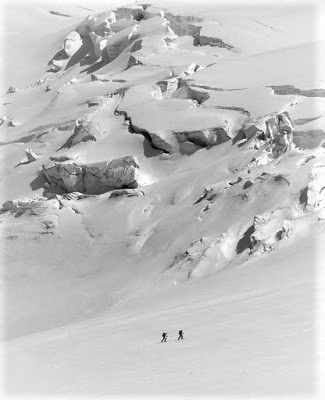
Two climbers pass under a glacier. (Photo by Kurt E. Smith)

As for that dream house itself?

We’re at a point of downsizing. On a limited budget, at that.

Here’s what’s on my list of considerations.

~*~

  1. A pleasing work area: In my case, that’s the writing studio. For my wife (the foodie), the kitchen and pantry plus utility space. And in both, abundant wiring.
  2. A good view: In our dream, we’re looking at the ocean, but a lake or mountain might do.
  3. Wood heat: At least as backup. We’ve been very happy with our efficient Jotul wood stove. Besides, it’s good backup during power outages.
  4. Adequate insulation and heating/cooling: We’re set on New England, after all. Cold drafts are expensive and annoying. And summer is really only six weeks.
  5. Easy maintenance: I’m not a hobby do-it-yourselfer, and I have other ways to spend my time than amateur house repair. Our budget needs to keep calls to construction-industry tradesmen minimal.
  6. Smart use of space for our needs: Think affordable IKEA. Bigger is not necessarily better.
  7. Sufficient and efficient storage: Closets are a recent addition to New England houses. Take it from there. In our case, this would also include expansive bookshelves and a large garden shed.
  8. A three-season porch: Elbow-room, if you want, especially for entertaining guests in all but deep winter or tackling special projects.
  9. Minimal snow plowing: Even a short driveway can be difficult to clear if there’s nowhere to pile the snow. A long driveway can be expensive to keep clear and, for that matter, decently paved. As for parking?
  10. Hot tub? Well, this is a dream list and there is that three-season porch.

~*~

What would be on your list?

What would your dream home have?

My, have things changed from the time I first proposed this as a Tendrils topic and the time I actually sat down to draft the text. I thought I’d be living in Dover for the rest of my life, but now we’re actually looking to relocate to somewhere, well, for us more dreamy. I’ll leave it at that for the time being, and besides, that prospect just may turn out to be a very pleasant pipe dream.

What I am sensing that much of the dream has to do with location, beyond the house itself. This week I’ll focus on the locale. Next week, the walls, floor, and roof.

~*~

  1. Walkability: Pedestrian-friendly, with suitable restaurants, stores, parks, medical facilities within an easy stroll. What we like to call civility.
  2. A Quaker Meeting: Kindred spirits and spiritual friendship.
  3. Natural wonder: At the moment, that includes a view of the ocean. Nearby trails a plus.
  4. Cultural amenities: Classical music, live theater, classic film series, that sort of thing. A good choir to join, poetry readings, especially. Plus a decent library.
  5. Medical facilities: At my age, having qualified doctors and a hospital or well-equipped clinic at hand has become an important consideration.
  6. Good neighbors: We’ve been quite lucky in Dover that way.
  7. Community spirit: A sense of common good makes a huge difference. I’ll include local and state taxes here, with an eye to what’s provided for the buck. (In Dover, for example, my indoor swimming pool activity would fit into the equation.)
  8. Public utilities: Hard to think that in our times, the reliability of the electrical system or broadband access has to be questioned. Water and sewage become considerations, too.
  9. Visual balance: This includes houses, gardens, and retail areas that are well maintained and have personal expression. That rules out most suburbs.
  10. Safe and secure: Low crime rate, as well as fast fire and ambulance response, are definite considerations.

~*~

What would be on your list?


Be sure to carry a raincoat in the Olympic Peninsula

The Olympic Peninsula, set off in the northwest corner of the continental U.S., is a unique place. My longpoem American Olympus is a travelogue of one week we spent camping there.

Here are ten things to consider.

~*~

  1. Size: About 3,600 square miles, it’s a large arm with the Pacific Ocean on the west, the Strait of Juan de Fuca on the north, and Puget Sound on the east. You can’t drive straight through it, by the way – only around the perimeter.
  2. Distinctive features: The Olympic mountain range fills the center. It’s dominated by 7,980 foot elevation Mount Olympus, which has seven notable glaciers. The peninsula’s Pacific coastline (including 73 miles inside the national park) has impressive sea stacks and dense old-growth rainforests.
  3. Precipitation: The Hoh Rainforest receives 12 to 14 feet of rain a year – that is, up to 170 inches. In contrast, the eastern half of the peninsula, facing Seattle, is in a rain shadow, where lawns and gardens may require irrigation. The mountains, as you may have guessed, get buried in snow.
  4. Public lands: The peninsula includes Olympic National Park and national forest, plus designated wilderness areas and state parks. The national park itself covers nearly a million acres.
  5. Rangers: The national park has 139 full-time rangers. Seasonal support pushes that to 256 in season, assisting nearly three million visitors a year.
  6. Natives: It’s home to eight contemporary tribes of Native Americans and ten reservations.
  7. Population: 104,000 people. The largest city is Port Angeles, 20,000 residents.
  8. Wildlife: Cougars, bear, elk, bobcats, eagles, salmon.
  9. Freshwater attractions: Glacier-carved and crystal-clear, 12-mile-long Lake Crescent is up to 624-feet deep. Average depth is 300 feet. The peninsula also touts 13 significant salmon-bearing rivers, most of them wild, plunging from the mountains to the sea.
  10. Who was Juan de Fuca? The band of seawater between the peninsula and Canada is named for a Greek maritime pilot who lived from 1536 to 1602. Though we know him by his name in Spanish, he was Ioannis Phokas, sailing in service of King Philip II of Spain. He claimed to have discovered the strait on a voyage in 1592, and though much of his report departs from reality, a few details make it possible that he was just a lousy recordkeeper.  

~*~

What’s the wildest place you’ve explored?

Sea stacks are shown at Ruby Beach. The Olympic Peninsula coastline is often strewn with tangles of fallen trees like this.