One of the criticisms that Evangelical Friends level at quietist Meetings like ours is that we are short on teaching. “Silent worship, for those who are well-instructed in divine truth, has real benefits,” they write, before cautioning: “upon those who have neither read the Bible nor hear it expounded the effect may be very different.” The passage I quote continues: “As a result, the Friends Church became victim to a group of erroneous teachers, among whom Elias Hicks was most prominent.” The section also points to some very deep misunderstandings among Friends, including Job Scott’s decision to remain silent in sessions called on his behalf during his traveling ministry; he sensed too many people had come with “itchy ears” primed for novelty rather than an open heart.
Ideally, vocal ministry arises as a prophetic voice, as William Taber describes in his Pendle Hill pamphlet, The Prophetic Stream. From this perspective, pastoral sermons can be criticized as arising too much as a matter of teaching and too little as an outpouring of the Holy Spirit.
Walter Wangerin Jr.’s novel, Miz Lil and the Chronicles of Grace, also addresses this, though from a different perspective. There, the young Lutheran pastor realizes that in greeting parishioners after the service, he cannot tell whether one woman is telling him he offered good teaching or good preaching on any given morning. One Sunday, however, it becomes quite clear she has been making a distinction: “’Pastor?’ All at once, Miz Lillian Leander. She took my hand and we exchanged a handshake, and I let go, but she did not. … Her voice was both soft and civil. It was the sweetness that pierced me. I think its tones reached me alone, so that it produced a casement of silence around us … there was Miz Lil, gazing up at me. There was her shrewd eye, soft and sorry.
“’You preached today,’ she said, and I thought of our past conversation. ‘God was in this place,’ she said, keeping my hand in hers. I almost smiled for pride at the compliment. But Miz Lil said, ‘He was not smiling.’ Neither was she. Nor would she let me go. … The old woman spoke in velvet and severity, and I began to be afraid.” Then she gently rebukes her pastor for unintentional consequences, after he has prided himself for being frugal by cutting off the water to an outdoor faucet.
“’God was in your preaching,’ she whispered. “Did you hear him, Pastor? It was powerful. Powerful. You preach a mightier stroke than you know. Oh, God was bending his black brow down on our little church today, and yesterday, and many a day before. Watching. ‘Cause brother Jesus – he was in that child Marie, begging a drink of water from my pastor.”
I love the way that passage illustrates how the prophetic voice flowing through an individual can be larger than its vessel. “Did you hear him, Pastor?” I love, too, the way it illustrates an elder laboring with a minister: “Miz Lillian Leander fell silent then. But she did not smile. And she would not let me go. For a lifetime, for a Sunday and a season the woman remained immovable. She held my hand in a steadfast grip, and she did not let it go.”
Like it or not, practicing an art means wrestling with power, including, in St. Paul’s phrase, the “powers and principalities.” Powers of destruction, on one hand, and sustenance, on the other. Destruction that can, as we’ve seen too many times, include the artist. Hence, the fascination with Faust. With madness. Alcoholism. And on. Self-absorption and inflated self-importance rather than humble service.
We hazard much, often without the slightest awareness of the risks afoot. For the Christian, these involve Satan’s dominion over “the world,” which includes the realm of the arts; in Asian teachings, we can turn to the traps of Maya, that spider web of worldly attraction and deadly illusion. Either way, cause to be wary. Need for disciplined faith. Yes, let’s introduce something we’ll call Satan, just to thicken the drama.
Which raises an ancient point of conflict for a Christian artist: I’m not at all sure art is a proper activity for a Quaker. Through much of Friends’ history, most of the arts were considered superfluous and dishonest engagements taking our attention away from true worship. “We Quakers only read true things” is the way one expressed it while returning an unread novel to a neighbor.
Yes, “we Quakers read only true things,” or used to. The exclusion of not just fiction but theater and paintings and sports as distractions from worship. Traps of the flesh?
And yet: discipline is essential in spiritual growth. Self-discipline, route to true freedom. And where is the mind without imagination? I continue to read and write fiction and poetry. I love symphonies, string quartets, and opera. I’m a baritone or occasional tenor in four-part a cappella singing. When I practice my art, I am fed by this love/compulsion/infusion.
So we’re back to the ways and spirit in which we engage the powers and principalities, and the ways we order our lives.
Coming, as most of us modern Quakers do, from other faith traditions, it’s fair to ask ourselves just what we carry with us into the Quaker circle.
My own family, for instance, was quite active in the Evangelical United Brethren denomination, now merged into the United Methodists. Despite the many Sunday mornings spent listening to quarter-hour sermons, however, I find myself remembering very little. There was one telling us not to waste time (because time was a gift from God), another about our bodies being temples that should not be abused by smoking or drinking, another about non-conformity as a Protestant duty (this back in the gray-flannel ‘50s!), as well as the annual money sermon, reduced to a plea for financial support. Surprisingly, I recall no Bible stories. The senior pastor, a quiet and bookish man, quoted many volumes along the way, yet my sense is that he was likely much more effective in his hospital visits and pastoral counsel than he was in the pulpit. The youth pastor, meanwhile, taught me more about organizing and managing successful political campaigns and establishments than about matters of the Holy Spirit.
More influential, I suspect, were the short trailside vespers of our Scout troop. One boy, a preacher’s kid, even spoke of the church being the people, along the lines of the Quaker argument I’ve previously presented. And then there was the twilight circle of rowboats and candles when we camped at Lake Vesuvius – that awe of the stilling day and waters reflecting something of our current worship.
It all seems so long ago, and so far back. Yet a few turns later, emerging from a yoga ashram, I encountered a circle of Friends who began opening the Scriptures to me, and then a few Mennonites who restored the hymn legacy, and something from that past took shape, in a new way. Maybe the last laugh, though, belongs to those EUB officials of my youth who tried to steer me into their ministry – and a faith I soon rejected fully. After all, it opened the way that landed me into free Gospel ministry here.
None of the accounts mention it, though as I find in online searching, none of them had an actual obituary, either. But within the span of a year, three special acquaintances – all in their prime – had died of what appears to be suicide if you read between the lines of the news releases.
One was my best friend ever of my adult years, until our lives turned in much different yet somehow parallel directions. The second, a high school classmate of deep intellect – a shared rarity where we were in that troubled period. And the third, someone who stayed a week with us before returning to some truly horrific visions in the realms of international policy.
All three were remarkable and important individuals.
Anais Nin once posited that each of us has a demon to battle, and my response remains, “Only one?” On another level, I wonder about those individuals who have never felt the despair that prompts suicide.
I suspect this is one of those areas of our spiritual quest and practice we rarely discuss. Where could we even begin? How can we possibly define life fully, much less death? We can speculate, of course. Yet the darkness and accompanying numbness are, for me, inarticulate as the void described in Genesis 1:1.
There are no answers, in the end. Only the dawning of Light, when we can greet it.
While my personal struggle bobbled between practicality and art for its own sake, the yoga and Quaker teachings introduced new tensions. Consider:
Creativity? No, God creates. Man discovers. Man cultivates and brings culture and learning, nurtures, softens, establishes coherence. This is the difference between the artist who submits to a greater power and the one who tries to use it for his own ends. The first desires to serve God, by whatever name or description; the second, his or her own ego.
Which leads to: Problems of the ego. Gertie Stein: Every writer wants to be told how good he is, how good he is, how good he is. Insecurities!
Yet in yoga, all for God: the sacrifice, the labor gifted to generate good karma. (As if your boss is another deity, rather than bottom-line motivated and conscious. Here’s a letter of commendation plus your pink slip.)
Early church father Tertullian warned, in De Spectaculis, Latin circa 200 C.E. Essentially: “The Author of truth loves no falsehood: all that is feigned is adultery in His sight. The man who counterfeits voice, sex or age, who makes a show of false love, anger, sighs and tears He will not approve, for He condemns all hypocrisy. . . . Why should it be lawful to see what it is a crime to do?” (Translation by Kenneth Morse).
These are hard charges, along with the seduction of “preaching for sin,” as George Fox warned.
So to examine the multiplicity of personality / goals / desires. Just who am I? Who are you? Empathy. Anger. Bliss. All the rest.
Honesty. Our dark sides. Do we really express our weakest aspect in our art? (In vocal ministry, how often the message comes from that area of our current conflict!)
Versus becoming so rarified we lose all sense of joy and delight. The danger of Plainness or strictness, that it suffocates personality, makes us so humbled we cannot move forward in the Holy Spirit to perform bold action. Crushes or stifles the imagination.
So how do we make a living without violating our beliefs? (Military-industrial extensive penetration of all facets of American society: not even the universities immune.)
Or how do you practice your art to the fullest, without undue restraint, while still being faithful?
So what have our children learned, as far as religion goes? What seeds have we planted? Actually, I’m thinking of this not so much as a curriculum matter for the Religious Education committee or as a reflection for parents but rather as a consideration of what’s happened in American society in general – the kind of place where soccer practice is now seen as more valuable (“value enabling”) than Sunday School. Or where a child may develop an aversion to being viewed, in any way, as a “Miss Goody Two-Shoes.”
My thoughts leap ahead to the tension many of us feel in the workplace. As Michael Lerner writes in The Left Hand of God, it’s the conflict of values between our dog-eat-dog competitive economy and those we hold dear and sacred. Fundamentalists, at least, attempt to resolve it by separating the two worlds, but at what cost? Children, of course, pick up on this, tuning out what they see as useless to their survival. And that includes what they observe at home. (Should we note the popularity of so-called “reality TV” – as manifested in The Survivor?) The Amish and other old orders attempt to hold the values of workplace, home, and faith in one sphere, but we can easily imagine the difficulty that, too, presents.
Obviously, I’m not going to resolve any of this in the next few sentences. Without the music of hymns and praise songs, the pageantry of robes, processions, lighting of altar candles, and communion, or the attentive consideration to set prayers and sermons, what do we give our children to cling to? (In the old days, did the plain clothing and “thee/thou” speech offer some refuge or rooting?) Or what invitation do we extend to those “voted off the island”? What I am going to suggest is that the answer is not found so much in any catechism or ceremony as in the way we treat our smallest members, our moments of laboring together, and, yes, the repeated ritual of a certain casserole on youth retreats and its reception.
Before my graduation from college, back in my social activist period, I wondered how American society could possible afford High Art while so many went hungry and homeless – domestically as well as internationally. Then I began to see everywhere a desire for expressiveness even in every ghetto – for that matter, ranging from ghetto blasters to Playboy. There were murals and blues bands. To say nothing of the infusion of professional sports, to which every poor youth, from the inner city to the mining company towns, seems to aspire. So opera and museums and other “Establishment” operations came to lose their exclusivity in my mind. Indeed, over the years I’ve heard that the real classical music lovers are the ones in the cheaper seats, the ones they can afford. Mankind, after all, has a need to reach to the higher realms of thought and the imagination of the spirit; anything less reduces our existence to nothing more than economics, impoverishing everyone in the society.
Look closely, and you’ll also see that in America, Art has become the state religion, no matter the level of state and federal funding exists. In this country, at least, there’s also been a long recognition of the fine arts as an adjunct to wealth, for whatever reasons. Many sense an abstract “goodness” in the products of art chamber music, art museums, Shakespeare festivals, opera, poetry, the “book” that so many people dream of writing even if the artist himself/herself remains (often with good reason!) somewhat suspect, a shady character. Perhaps that’s why these big institutions stand between us and the rest of ourselves, as artists and audiences. Something abstractly “good” even when they themselves admit they don’t know much about the field. Contrast that to the related state religions in America: collegiate and professional athletics, Hollywood movies, and rock concerts, wherein no one actually advocates any common wealth. (The High Priests are paid handsomely, after all.)
Art as the semi official State Religion of today? Or should that be entertainment and its host of celebrity worship? The stamp of approval. The aspiration.
Art as commodity, too. “How much did it sell for?” What was the box office?
At heart, all art is, primarily, either spiritual/religious or secular/amusement in intent and execution. Take Milton or Pepys. Today, the overwhelming materialism of our society reflects an insatiable hunger.
Even as starving artists we’re enmeshed in materialism, one way or another. It’s so easy to hold the artist up in some idealized light or the product itself as the object of worship, an idolatry, totally forgetting to turn to the Source of All. The worship of living genius, from Beethoven and the Romantic era on. Or the pretty faces of mostly Hollywood celebrity today.
As an editor on newspapers where nearly everyone was giving totally (many unpaid hours of overtime, etc.) in an attempt for excellence, I was always appalled by the charge of “elitism,” which comes to mean “give me mediocrity not the truth” or “mere pleasantry” from the same people who would not accept such standards in their professional football team or new automobile.
The shift in the meaning of “culture” from learning and aspiration to the mundane lowest common denominator of daily life. Culture, as in a petri dish of mold or germs, rather than a rare book library or new opera.
Still, if you want to comprehend the view from the top of the mountain, you need to climb it. And be warned: driving, if a road’s an option, loses a lot in the translation. From a religious point of view, at least, we can’t settle for anything less than the best in the end.
We’re well into the back-to-school swirl. Considering how many Friends teach for a living, it’s a wonder we don’t talk more about what Quakers used to call Sound Doctrine.
Not dogma, creed, doctrinaire, or even indoctrination, mind you. Doctrine, meaning teaching. The essentials for practicing our faith, just as certain skills are needed in mathematics or foreign language. Or, for that matter, for good cooking or carpentry or sewing.
It’s not just the children, either. Some messages arising in worship are basically teaching, and some are admittedly sounder than others, the latter including those that George Fox derided as mere “notions.” (Consider the Quaker who preached that Friends should not disturb the ground to obtain well water, until another spoke out during worship, “And Abraham digged a well,” citing Genesis 21:30 and apparently settling the matter.) Our own reading and inquiry, meanwhile, can be pretty much hit or miss. Who knows about other sources? Film, television, radio? And, as with all teaching, how strict should one be – and how flexible?
If we were passing a hat to collect slips of paper suggesting what should be included in our own “sound doctrine,” what would you write on yours? For that matter, how much would be a matter of content – and how much, process?
Sometime, perhaps, we’ll even have a session to hear our teachers talk a bit about their teaching – both content and method – and a continuing awareness of learning. Or maybe another, to consider all the ways we have learned from each other – and not just matters of faith, either. The progress of my compost bins, after all, is guided in part by eavesdropping on a few after-meeting conversations and their lessons of patience, humility, and renewal.
~*~
This has me wondering, as well, how we might extend a pursuit of “sound doctrine” into our secular circles. Economics, politics, education, even entertainment could all use a dose of what Friends used to call “close labor” – the effort of living with ever greater integrity. Any ideas?
For much of its history, the Society of Friends forbid the use of engraved gravestones, deeming them vain and superfluous. Even so, another custom emerged, the drafting of memorial minutes for Quakers whose lives might serve as an inspiration for others.
The result was quite different from either the typical obituary or eulogy, and many of them prove surprisingly candid, as genealogists discover. If a eulogy celebrates the person, the memorial minute focuses on the individual’s spiritual life and service, especially in the ways these play out in the world.
Often, the minute would be approved by the local Quaker Meeting and entered into its records. If the individual had been active at a wider level, the minute would also be forwarded to the Quarterly Meeting (a gathering of local meetings that comes together four times a year), where it would be shared and, in due practice, approved. If appropriate, this would be repeated at the larger Yearly Meeting level.
As an example of the practice, here is the nearly finished draft of the minute for one Friend. As a member of the committee that prepared this, I’d like to show the “long” version that includes more of her remarkable career, in contrast to the shortened versions that were approved by the circles of Quaker meetings.
Alanna’s minute was approved by Fresh Pond Monthly Meeting and endorsed by Dover Monthly Meeting, and then accepted by Salem Quarterly Meeting, before being included in the minutes of New England Yearly Meeting’s sessions last month.
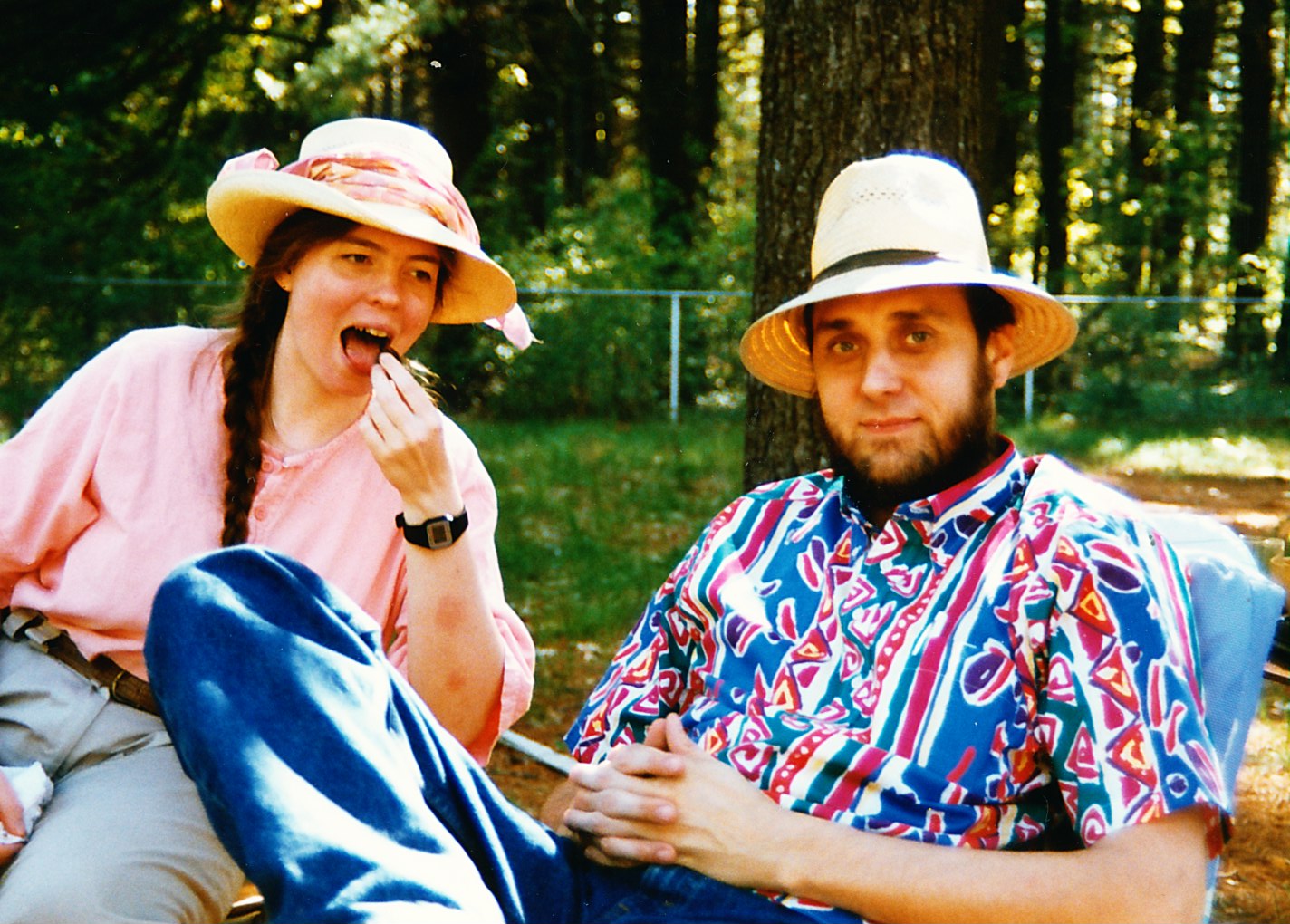
Alanna and me early in our friendship.
ALANNA CONNORS
September 25, 1956 – February 2, 2013
From an early age, Alanna Connors discovered a need and a capacity to trust her own compass. She was a mathematician at a place in time where women were seldom found. When her high school math teacher flunked her for excellent work, another teacher told her: “You know he’s giving good grades to boys and not to you, because you’re a girl.” Recounting the story in later years, Alanna said, “I didn’t need that; I knew I could do the math.” She held true to her course.
Long before finding Quakers, Alanna lived the testimony of experiencing God in everyone. While most of us have tight circles of caring – our family, friends, coworkers – Alanna’s circles were as unbounded as a wave expanding to all of space. It seems no accident her profession became looking at objects distant in the universe: across the many communities of her life’s paths, she welcomed all beings. Living with her was a joy; her love for others was never abstract but a centered flame close to her and everyone she touched.
Alanna was born September 25, 1956, in Hong Kong to Richard and Sonia Mitchell Connors. Her mother, who herself had a degree in mathematics and studied with Jean Piaget at the Sorbonne in Paris, ultimately worked as a font designer. Richard learned to fly in his youth and became a pilot with Pan American Airways, stationed in Hong Kong. Through his delight in sailing, his five children all learned to sail. Alanna took the lead, becoming a competitive sailor in her time at the Massachusetts Institute of Technology.
Returning to the United States in 1963, Alanna’s family settled in Greenwich, Connecticut. Living with four siblings – one older, Cynthia, and three younger, Kathleen, Noirin, and Patrick – in environments not always centered on these children’s welfare, Alanna developed an immense capacity to listen and extend empathy. Imagination shone through her grade school writings; her elaborate, award-winning gingerbread houses; and family-staged dramas.
Alanna was irrepressibly fascinated by math and science. She thrilled to the elegance of mathematics in expressing, revealing, and predicting physical behaviors. For her, mathematical physics was inseparable from the playfulness, color, artistry, and imagination by which she produced it. Whether it was classroom notes, derivations on scratch paper or napkins, or formal solutions, her handwritten analyses were crafted in flourishing script, vivid with colored pencil illuminations, and playfully annotated with such characteristically inventive words as “whatsit.”
Alanna’s dorm room hosted a wide array of human spirits. Her hotplate, washstand, handmade teapot, and mismatched cups provided hearth and an excuse for tea and convivial warmth at all hours of the night.
She met fellow student Phillip A. Veatch while they were both organizing MIT’s first on-campus food cooperative. After a year of courtship, they exchanged private vows of marriage in 1978, on a basketball court in East Cambridge. Alanna was opposed to the state-sanctioned institution of marriage because of its historical role in the oppression of women.
Communal living, conceived around Alanna’s dorm room, continued into her committed life with Phil through group houses with shared vegetarian cooking. While in Maryland during her doctoral years, they asked all prospective housemates: “Can you have: 1) too much garlic; 2) too much chocolate?” A no answer on both questions was mandatory for joining the group house.
With one housemate, Alanna went “church shopping.” While appreciating the wide span of worship experiences, Alanna gravitated to the Religious Society of Friends in 1982 in Adelphi, Maryland, dragging along her then-reluctant partner. A deep commitment to the Quaker principles of simplicity, peace, integrity, and justice soon enriched both of their lives. They continued at Dover Monthly Meeting in New Hampshire and finally settled at Fresh Pond Monthly Meeting in Cambridge, Massachusetts, in 1998.
Wanting to understand stars, she became a groundbreaker in charting the sky of X-ray sources. Being of a mind to “like thinking we are all professional visionaries,” Alanna’s deep searches into the distant sky uncovered new observations and questions. After earning her doctorate at the University of Maryland, Alanna made significant contributions to the Compton Gamma Ray Observatory as a research scientist at the Space Science Center at the University of New Hampshire. She introduced astrophysics to Bayesian methods of statistics, which start from an assumption that knowledge about a problem is always incomplete. Applying this rigorous data analysis to X-ray and gamma-ray astrophysics, she provided a foundation for statistical methods generally unknown to astronomers in the early 1990s.
As a banjo player, she encouraged use of the Rise Up Singing songbook, learning by heart its song “Julian of Norwich.” Original lyrics and tunes came to her, either fully formed or developing through writing. Alanna’s spirit still comes to us through the texts and music of the dozen songs she set down in composition.
Despite being an intense introvert, she harbored a lifelong belief in the importance of community-building. She cofounded an astrophysics statistical working group at the Harvard Smithsonian Center for Astrophysics. As a senior scientist, she was known for her support of young graduate students. She founded a singing group at Dover Meeting, and while living in Arlington, Massachusetts, enjoyed singing with Nick Page’s Mystic Chorale Singers. After the birth of her son, Roy, in 1999, she worked with other parents to reform special education in the Arlington public schools. She volunteered regularly at New England Yearly Meeting annual sessions working both in child care and the bookstore. She regularly attended the Women’s Group at Fresh Pond Meeting, where she spoke regularly about her concerns in raising her gifted son.
Alanna envisioned and encouraged public science education. She taught astrophysics at Wellesley College as a visiting professor, participated in university physics instruction at UNH and UMD, contributed to public education in science through projects at the Christa McAuliffe Planetarium in Concord New Hampshire, c0-organized family science days at her son’s elementary school, and encouraged exploratory science learning and teaching through many other avenues. She had an abiding interest in the history of physics and astronomy from its ancient origins, in welcoming women’s participation in physics, and in celebrating stories of diverse contributors to science.
Alanna was first diagnosed with breast cancer in 1995. She lived with the disease for 18 years. Characteristically, through its recurrences and treatment, she refused to be defined by the disease and conceived her son, Roy, born in March 1999. To her, the illness was but a single strand of her life. When Roy was 4, her disease recurred, and she took him with her to treatments, where he found the hospital’s high-energy accelerator intensely interesting. Whatever life brought her, she lived with it; she saw illness as no excuse to build walls. When her disease recurred for the last time, in an advanced form, Phil asked if she wanted to go on a special vacation. She did not, preferring to live in her callings.
At Dover Meeting, 1988-1998, she rotated through nearly every committee but also stayed long on Buildings and Grounds. During the first Persian Gulf War, Dover Friends called on her to write a compelling minute explaining the Meeting’s opposition to the invasion of Iraq and Kuwait. Phil and Alanna were lifelong advocates of same-sex marriage. When they decided for Roy’s sake to get legally married, they would not seek marriage under the care of Dover, as that meeting had not yet completed its process of hosting marriages for same gender (it has since done so).
During her time at Fresh Pond, her participation in committee work was limited by parenting and the recurrences and treatments of breast cancer. She was, however, a quiet and regular presence at Meeting for Business and an infrequent but powerful minister during Meeting for Worship, where her ministry was often structured around song.
Just as she knew not to take to heart a teacher’s censure that could have devastated a young mathematician, Alanna maintained integrity without ceding herself, her work, or others to be diminished. Mathematics was one route by which she independently investigated, questioned, and confirmed the truth for herself without relying on the claims of teachers and other external authorities. She stood up for discovering and expressing the full potential of one’s mind and heart, inspiring those around her to undertake aspirations and risks of which they did not suppose themselves to be capable. She knew greater being lies imminent within us all. Whether it was the rights of any couple to publicly live their committed love or a child’s mind emerging along ways and curiosities differing from the school norm, Alanna honored and worked for the fuller life she knew to be there.
Alanna’s spirit lives with us and continues to teach us. We remember her implacable but gentle striving to see the truth and to tell it. The women of Fresh Pond recall Alanna’s intense, powerful mothering, against all odds. Throughout her life she resisted the limits and distortions that social norms can impose on our vision of others. Knowing that a prism takes a beam of light and separates it into many separate parts, Alanna lived her life striving to bring the many separate parts of our world together into one shining beam.
Her memorial service was March 2, 2013, in the Wellesley Friends meetinghouse under the care of Fresh Pond Meeting. She was 56.
So here I am, looking at a catalogue of “every Sunday bulletin subscription service and other ministry resources.” You’d be surprised by some of the products addressed to a Quaker meetinghouse, and I’m still wondering why church furniture has to be so uniformly ugly. This one, however, catches my imagination.
If you’ve ever been part of a congregation that has ushers, you likely remember how they hand out a leaflet while leading you to a pew. The folded paper would have a colorful image on the front and a meditative reflection on the back. Inside, mimeographed back in the days I remember, was the order of service and an array of announcements. I have to say that the graphics have improved in recent years, and I rather like the format that opens into three leaves, rather than two. For a moment, I consider this as an alternative to our announcements period, at least until I realize that someone would have to type and print them. Still, the thought of ushers revives my meeting’s concern for having greeters at the door.
As I look over the samples, however, I must admit how foreign most of them are to our experience. The one with a large American flag and a kneeling soldier over the words, Lord Jesus, is especially troubling. Others seem superficial with their platitudes or cliché. Maybe there would be shock value in some, with their communion cup and bread or photos of country church spires. One set proclaiming nature’s splendor comes close, if it weren’t for the cutesy texts, while the set I find most acceptable is aimed at black congregations – which isn’t quite us, either. Not with all our blue eyes and master’s and doctorate degrees.
I guess if we ever have a need of weekly bulletins, our best option would be to feature work by our resident artists – Brown, Carolyn, Connie, Edi, Gail, Jane … and, of course, the children. Now that would be inspiring.