Solitude. Prophecy. Communion.
You never know what we'll churn up in cleaning a stall
As Greek Orthodox Christians everywhere sing joyously while waving candles aloft in the darkness before dawn this morning, the hymn continues:
Thanato thanaton patisas,
ke tis tis mnimasin,
zoin xarisamensos.
And in English-speaking places, they alternate that stanza with a translated version before repeating both over and over:
Christ is risen from the tomb
trampling down death by death!
And on those in the tombs, he has granted life!
XRISTOS ANESTIEK!
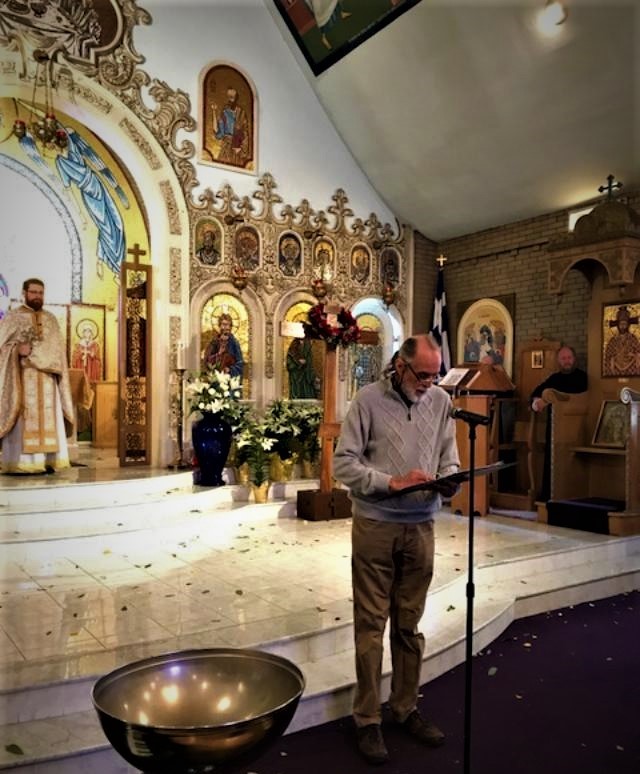
Original? Turns out the Eastern Orthodox do this, too … every year.
Many Americans participate in a congregation close to their homes – a neighborhood church, as it’s often called.
For others, though, the decision is more selective and may require travel to gather for worship, communal action, and other events.
Frequently, these members define their personal identity strongly by these religious circles – I certainly do as a Quaker. Still others, like Jews or Greeks, find their identity further enhanced by the use of a foreign language, such as Hebrew or Greek, in worship and possibly also at home, as well as unique holidays on dates the wider public doesn’t celebrate.
I am fascinated by the intensity of this identification for some people or its relative weakness in others. I rarely hear individuals define themselves as, say, Methodist or Presbyterian or even Baptist with the sense of intense core identity I hear in Quaker, Greek, Mennonite, or even “nonobservant Jew.”
Think about the Amish, with their German dialect accompanied by distinctive dress and horse-and-carriage transportation. Or Ultra-Orthodox Jews who also observe the dress restrictions and likely add Yiddish to the mix.
Let’s assume we’ll find similar patterns in new ethnic populations appearing in the nation – Islam, especially. Anyone else feeling some empathy?
What’s your experience of religion and personal identity?
Among other things, the birth of Jesus is riddled with scandal. (As is his execution.) Here are 10 things a close reading of the story in Matthew and Luke will reveal:
~*~
Whatever your faith, here’s wishing you a time of love, joy, and deep refreshment as we gather among family and friends in the shortest days of the year.
~*~
In Quaker organizational structure, the ultimate decision-making body is the Yearly Meeting – so named because of its annual sessions. While the central event is the convocation, the organization itself (also called the Yearly Meeting) has ongoing activities and committee meetings throughout the year. One of the purposes of the gathering is simply to coordinate and nurture these missions.
Unlike some denominations, we have no central headquarters. Our Yearly Meetings are rather distributed across the country and the globe, and these bodies work together through cooperative affiliations, shared projects, communication, and inter-visitation.
My local Friends Meeting is part of New England Yearly Meeting of Friends, the oldest such body in the world. In fact, when more than 800 people – representatives, their spouses, and children – assemble next month on the Castleton University campus in Vermont, it will be our 358th gathering. (Until 1905, we met in Newport, Rhode Island. Since then, we’ve moved around New England.)
Here are some reasons I attend, whenever possible.
~*~
Is there a similar assembly – maybe a camp? – that you like to attend for similar reasons? What is it? And why?
~*~

Continuing the poetry parade, see what’s new at THISTLE/FLINCH.
Much happened in my life in the past year that I haven’t mentioned in the blog. My attention was largely focused on the new novel, which underwent three major revisions, completely changing its focus from, first, what Cassia discovered about her hippie father to, second, what she discovered about her Greek-American family through his photos to, third, finally the way she emerged from the emotional loss and grew stronger and wiser as a consequence. Now that What’s Left (the third title, by the way) is finally released as an ebook (Cheers!), you can tell me if it was worth three years of angst, fasting, and flagellation on my part.
One personal accomplishment was my reading the Bible straight-through at the beginning of the year. I started with Everett Fox’s extraordinary translation of the Five Books of Moses and ended with David Bauscher’s translation of the New Testament from Aramaic, while covering most of what’s in-between in the New Jerusalem version. Wanted to hear it all afresh. My notes from the experience will probably fuel an upcoming series, likely at my As Light Is Sown blog.
Also on the religious front, I attended the entire Holy Week (what they regard as Passover) services in the Greek Orthodox tradition. Outwardly, it’s about as far as you can get from my quietist Quaker aesthetic, but again, it was a powerful way of hearing the story afresh. With the shortest service running about an hour-and-a-half and the longest well beyond that, the closest comparison I could come up with would be Bach’s St. Matthew Passion (nightly) or Wagner’s Ring Cycle, which runs shorter in time and isn’t repeated the next morning. It was a miracle the priest and psalmists had any voice left by Easter. And the final services border on chaotic, wax-dripping celebration. Well, that’s the short take. My one regret is that I’ll never again be able to experience this for the first time.
In late spring, I felt called to assist our neighboring Indonesian immigrant community as a number of Christian refugees face deportation to a land where they fear profound religious persecution. As many of us have found, accompanying them to monthly immigration appointments an hour from home has been a life-changing experience. The vigil outside the federal building has been the biggest ecumenical gathering in the state, with clergy and laity blending together. I’m getting teary simply typing this. A last-minute federal court stay has us hopeful, but nothing’s certain as we await the final rulings. I am so proud that my Quaker Meeting has stepped up to this challenge, supported by at least a dozen other congregations in our corner of the state. Whatever action we take, we cannot do alone, but we feel God’s Spirit leading.
At home, our garden flourished, especially with an unprecedented fall in which the first frost didn’t strike until November 8 — a full month later than normal. We still had our own tomatoes up to New Year’s Day.
YES, EVERYBODY TALKS about the weather. I’m no exception, and I usually enjoy the exchange. But I also listen with a grain of salt. To take a longer view and talk about the seasons, however, is another matter – one heightened in recent years by concerns about climatic upheaval and global warming. Living as I have in various locales in a band across the northern half of the United States, I’ve come to appreciate a wide seasonal ebb and flow. Deep snowfall and subzero spells, crackling and booming thunderstorms, an extended spring – I’m not one for the monotonous sunshine of Florida or southern California. I want to be jolted and moved, with all the accompanying influence on my emotions and thinking. There are seasons for curling up late at night with a book; others for reading on the beach or under the trees. Times for shoveling snow or cross-country skiing; times for raking leaves and mulching. Each new place has meant adjusting my expectations and observing fine differences from what I had previously encountered. All this, before dealing directly with the variations from one year to another within a specific place.
Over the years, the repetition adds up to knowledge and expectation. As the winter solstice observations of Christmas and New Year’s, there’s anticipation before ordering garden seeds in January and bringing the grow lights up from the cellar so you may start the seedlings. Having the cross country boots and skis ready. Keeping an eye on the pussy willows, to collect their sprigs. Planting, harvesting, cooking, sharing, and preserving. There’s the anticipation of the sequence of flowers or garden produce, each to be savored in its moment. From asparagus, snow peas, and strawberries through to potatoes, garlic, and leaks. From snow lilies, forsythia, and crocus through to asters and Jerusalem artichokes. Ordering firewood early, so it will season properly. Calling the chimney sweep and annual furnace checkup. Making room in the compost bins for October leaves. Trimming the hedges. And that’s just from a homeowner’s and urban gardener’s perspective. Normally, I wouldn’t be writing in July – my attic workspace simply becomes too stuffy, but this year’s an exception. There are other fronts. We’ve brewed ales in late autumn and lagers in deep winter, to take advantage of the favored requirements of each yeast. There’s also the seasonal flow of paying taxes and insurance, registering the car, taking a vacation, enjoying holidays. We also see academic years, baseball and football seasons, opera and symphony seasons, television seasons. There are many more, of course, as you start looking.
The challenge comes in not falling behind, but to instead preparing for the next stage. Here come the tomatoes, here comes the sweet corn. Pace yourself for the playoffs. Budget accordingly.
gratitude
for minutia and large
flowing creation
and homing
family, mystery within walls
around our bedding
wealth beyond cash
and clutter
overabundance of opportunities
to engage
any strength generously
distinguishing between gifts
and hard-earned wealth
and everything seized from others
remembering greed
bondage and
warfare
gluttony all entangle
lust
yet if we love liberally
this sojourn
exposing each deception
in relentless light
reunion . reconciliation
uttered utterly
forgives . accepts
corrects . and gives again
Poem copyright 2016 by Jnana Hodson
To see the full set, click here.

