Finally hitting ‘real’ time

In this self-isolation during our Covid-19 outbreak, I no longer have weekly Meeting for Worship, regular committees or social gatherings, rehearsals, or daily indoor lap swimming to define my daily schedule. Even for an introvert like me, their absence can be disconcerting.

It does alter my awareness of aligning myself with the outside world. I mean, it’s been ages since I’ve watched television, so knowing what’s on any particular night is irrelevant.

What happens is an alternate awareness.

For example:

It was Saturday afternoon, no doubt in my mind.

No, it’s Friday, my wife asserted.

No, it’s Saturday. I had the number of the date in my head, thanks to the little numerals in the corner of my laptop screen earlier in the day. But the name of the day didn’t register. A Saturday would explain the number of people I encountered out on the trail in the woods along the Isinglass River.

Back home, ready to prove my wife wrong, I turned to the wall calendar. The date fell under a Friday, not a Saturday. How could that be?

The jolt left me feeling a bit wobbly. You know, Rip van Winkle mode. I felt I’d lost a day, like a pair of missing socks, maybe. Well, actually, I had gained one, but it didn’t feel like finding a 20-dollar bill. Something still felt hollow.

But then, something also felt healthy, as in being more fully focused on the little things I’m taking on.

It’s been a long time since I experienced that, probably nearly a half century, back when I was living in the yoga ashram, distanced from the daily affairs of society. There, every day was full and special. Yes, we had some connection with the weekly calendar – guests arriving and departing on the weekends, especially – but there were few other demands that required knowing the names of the days. Instead, it was more Today, Tomorrow, Yesterday.

I came to consider that living in “real” time, rather than externally defined hours and days and their nights.

So here we are. Yes, I still need to consult my weekly planner. No escaping that.

And my daily to-do lists remain important.

I know things will change when we all get back to normal, whatever that will be at the time. The fact remains that what we’re encapsulated in now is unique.

Why fundamentalist Christians prefer the King James translation

It’s less intelligible to the modern ear.

OK, that’s the flip retort, but it’s true. The King James Version of the Bible sounds truly remote and incomprehensible to most Americans, and I suspect that’s part of the appeal, the way Latin used to be for Roman Catholics.

I’ve tried to teach our teens in Meeting how to use the “thee” and “thou” that are so much a part of traditional Quaker expression, but find the kids are completely baffled. The 17th century language is the core of the KJV, too. Take note.

But as those fluent with Hebrew remark, the KJV is also full of mistranslations, some of them deeply ingrained in our English language and thinking.

We can blame one of the characters in my upcoming book The Secret Side of Jaya for that translation problem, since the KJV (more officially known as the Authorized Version) drew heavily from his English renderings. That’s something that could lead to an arcane debate we’ll not get into today.

As for me, I’d prefer cracking the nut open, using as many different translations as possible, making the events all the more astonishing.

You’re welcome to check out what I’ve been examining in my reading of the Bible straight through at my blog As Light Is Sown.

But first, in recognition of today’s celebration, Happy Easter.

If one approach doesn’t work, here’s another

The Bible often offers multiple versions, often sharply contrasted, as if knowing that we, as humans, will keep thinking and asking this and that without seeing the fuller picture behind words and our preconditioned concepts.

These versions say, in effect, “OK, you don’t accept that one, you don’t get it, so how about taking the matter from this angle?” Sometimes the facts or accounts even contradict themselves, especially in details, to get us to start questioning our assumptions. The whole point, I sense, is that ultimately the issue is unanswerable, along the lines of the conclusion of Job’s struggle. You just have to look at it in utter awe.

In an approach that says in effect, “OK, you didn’t understand this story, now try this one,” seems to assume, “You’re going to keep asking questions, thinking, circling, so let’s short-circuit that flow,” because much of what’s really at hand is beyond logic. No wonder in the big Job scene, God finally erupts in righteous indignation.

Quite simply, there are many times where words just can’t convey an awareness of the infinite. Or even a fleeting sunset. Or hope or love.

What can you think of that goes far beyond the ability of words to express fully?


Inspired by a Shaker spirit

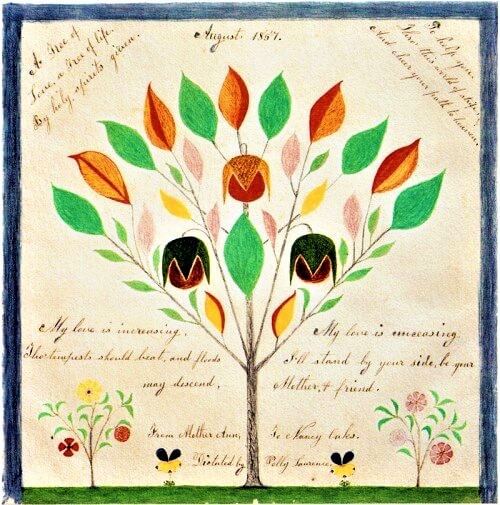
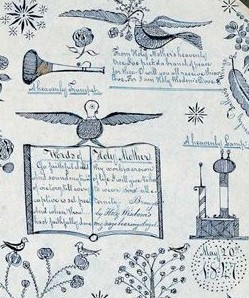
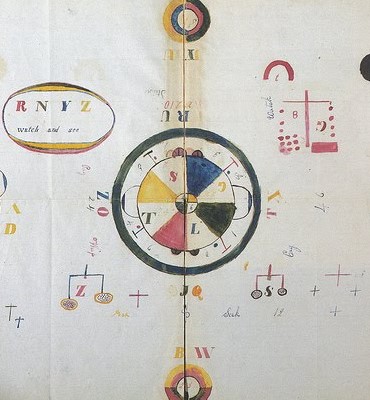
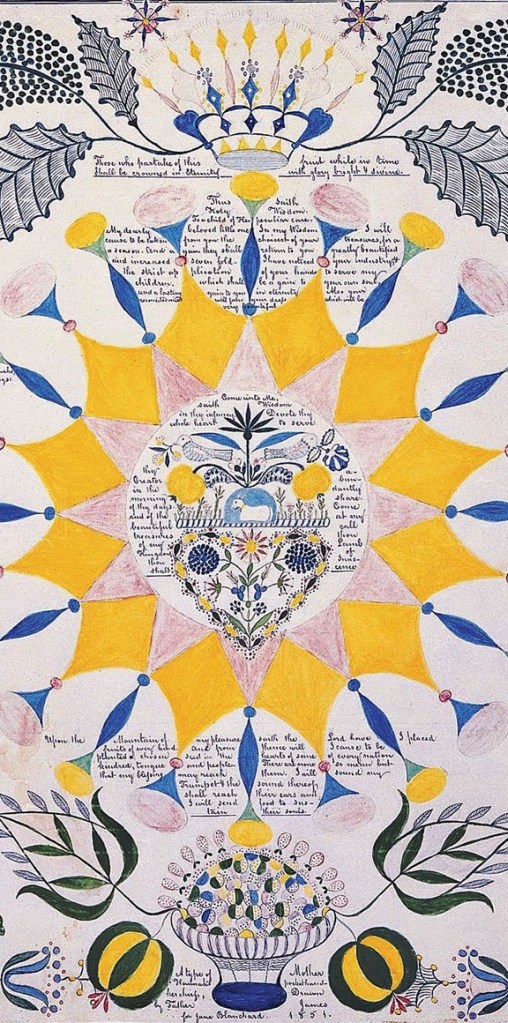
In my novel NEARLY CANAAN, Jaya searches in her spare time for an means of personal expression that isn’t quite poetry or prose but somehow truer to her spiritual stirrings. After I finished drafting the book, I came upon an exhibit of Shaker gift drawings and writings channeled by one member of the monastic community to be presented to another. Sometimes these would also originate as song, and an unique form of musical notation also arose.

Here are a few examples.

Spirit Message from 1843 appears to be a random series of letters or perhaps a new language akin to speaking in tongues.


Thus saith Holy Wisdom, detail


A Tree of Life, a central Shaker concept


Detail, To Sally Lomise, 1847


Mystical letters and images


Would I do a different novel about yoga?

The original novel that’s been recast into Yoga Bootcamp kept the action to a single day – albeit while recalling past events leading up to those 24 hours. The revised version retains that structure.

At the time I drafted the story, I was largely in the dark about what happened to the real ashram after the year-and-a-half I resided there. Nearly all of the teachers or organizations bringing Asian spiritual traditions to America eventually suffered sexual or financial scandals, or so it seemed. While introducing that element would have led to a juicier book, I refrained from the temptation, in large part because I wanted to retain the euphoric innocence we experienced or aspired to.

A few of the former residents I tracked down while drafting that story shared my sense that something powerful and life-changing had happened with us, but much of our teacher and the teaching remained an enigma.

A visit to the site, in fact, confirmed a sense I’d been ostracized and that our teacher had died in the interim.

In the years since the book first appeared, I’ve reconnected with some of the more central figures from the period. We’ve had intense emails and telephone conversations, and not everything was as rosy as my recollections. I hadn’t been ostracized, but the elements of self-destruction were in place.

I could have taken the revised work more in the direction of tragedy – there would be a morbid fascination, I’d assume – but chose instead for a comedy. Bootcamp was a term we accepted gleefully.

Still, there were other big changes.

Continue reading “Would I do a different novel about yoga?”

What happened to the yogis and their dream?

We were wide-eyed and innocent as doves though not wise as serpents, as the Bible would add.

We had room for exploration, certainly, and for some of us that included yoga or Zen. Hitchhiking was part of the scene, too. I touch on those in several of my novels.

I realize that in posing the question as “yogis,” I’m focusing on a corner of the hippie experience. The dream I’m thinking of is a better world for everyone, and not just a few who wanted to drop out altogether.

I don’t see that among today’s youth, who have good reason to be more cautious about the future. Besides, they’re shackled by college debt, an outrageous amount compared to their income realities.

But it’s not all economic. I’d say much of the current malaise is spiritual.

Without that element of hope and universal love, how can we possibly overcome the forces that are dividing and oppressing us?


American yogis touring India

As young yogis living at the Poconos Ashram in Pennsylvania, Bhakta and Jay made a pilgrimage to India in December 1973. It was Bhakta’s first trip to the source of the religious tradition and Jay’s second. Unlike many young American and European aspirants who moved to India to study with a guru, they were teaching and practicing on a rundown farm not far from New York City. Their daily encounters in the household they shared resembled much of what I describe in my novel YOGA BOOTCAMP.

I remember our teacher, an American woman, telling of her first experience with a real elephant in India. I think she would have loved having one on our farm.

Standing in our brahmacharies

My novel YOGA BOOTCAMP describes the events of being initiated into brahmacharya and being given the two strips of cloth cut from the guru’s robe as our new underwear, supposedly to restrain our male sexual impulses. As a bit of real-life evidence, here we are at the Poconos Ashram in Pennsylvania in mid-1972. The girls found it highly amusing, especially since we were all living under celibacy.

At least I didn’t use the title of an old hymn here, “Blessed Be the Ties that Bind.”


Abundance versus scarcity in my life

Perhaps you’re familiar with the abundance versus scarcity question. You know, do you feel you’re blessed with enough – or do you instead feel you’re always lacking.

I’m programmed from early childhood to feel the latter. My parents were children of the Great Depression, after all, and handed the attitude down.

It tends to make me something tighter than frugal. Generosity doesn’t come easily, I don’t open up to others easily, either – not even to ask for help. It’s a long list of negatives.

As I returned to this concept recently, I’ve been feeling a lot more sense that I have more than enough in many ways, even on a very limited budget.

So much for material goods.

Curiously, it’s time where I’m feeling the scarcity kick in. There’s just never enough. Not for what I’m trying to do.

I’m realizing, often after the fact, how much that outlook crimps my relationships.

This is, ultimately, a spiritual matter. The one place I find time opening up is within the hour of mostly silent Quaker worship. Not that it’s always easy, not even after all of these years I’ve been doing it. But it is always refreshing and renewing.

To think, I started meditating to get naturally high, as in stoned. But somewhere along the way it became a practice to simply get natural – to breathe and get grounded again.

Oh, but I’m still on the internal clock, even there. How on earth am I supposed to cope with Eternity just around the corner?

Don’t overlook your guardian angels

In my Freakin’ Free Spirits novels, aunt Nita serves Cassia’s guardian angel.

Earlier, she had played a similar role for Cassia’s future father, from their college years together onward.

In fact, without Nita in the background, the daughter may have never come along at all, as she eventually appreciates in What’s Left.

Reflecting on my own life, I’m now sensing moments when someone stepped in, behind the scenes, to affect a change that opened an opportunity in my life. At the time, I was clueless. One led to a summer job and later part-time employment. Another, to my being able to transfer away to college, rather than continue at a commuter campus.

There were another attempts that were turned away, in my ignorance or incomplete understanding.

But there were also the other, more typical and ethereal guardian angels, the kind that kept me a brush away from death or serious injury, say being hit by a car or bus or finding myself in the deep end of the pool when I could barely swim or maybe even getting sexually involved with the wrong person.

Has someone in your life ever functioned as a guardian angel?