APPREHENDING

gratitude
for minutia and large
flowing creation

and homing
family, mystery within walls
around our bedding

wealth beyond cash
and clutter
overabundance of opportunities
to engage

any strength generously

distinguishing between gifts
and hard-earned wealth
and everything seized from others

remembering greed
bondage and
warfare
gluttony all entangle
lust

yet if we love liberally
this sojourn
exposing each deception
in relentless light

reunion .  reconciliation
uttered utterly
forgives . accepts
corrects . and gives again

Poem copyright 2016 by Jnana Hodson
To see the full set, click here.

IN THE STARS, MEANING MOSTLY PLANETS

I used to get quite annoyed at those at the ashram who were so deeply into the astrology, into charting every minuscule bit of mathematics (and do they ever get into the calculations! hour after hour). And the following is all very tentative, superficial scratching especially when the serious astrologer is looking over our shoulders. But then they look to see what seems to fit and what doesn’t from their findings.

The idea of celestial influences on our lives can be seen in as a dimension of Seasons of Spirit. Sometimes conditions are more favorable than others. Sometimes things go more smoothly than others. The Biblical counsel, however, is to stay faithful in one’s practice. Make no excuses. Be ready.

Those of a more scientific bent can point instead to the precision of celestial calculations. The annual sequence of heavenly turning, the appearance of various meteor showers (with their own unpredictable volume and visibility), is complicated by the individual calculations for moons and planets.

From either perspective, we watch. Two or three planets approach in the evening sky, moving through the night, to reenact an ancient mythological tale.

~*~

For more Seasons of the Spirit, click here.

AND HAVE A GOOD DAY?

In the early days of Friends, they’d often greet each other with the question, “How does Truth prosper among you?” Not “How are you doing?” or even “Good morning.”

Strikes modern ears as puzzling, even problematic, beginning with that verb prosper, which we tend to consider along financial terms rather than thrive or even proliferate. Equally unfamiliar is the idea of Truth being active – alive – rather than static and unchanging.

To further thicken the plot, consider their linkage of Truth and Christ, so the question also asks, “How is Christ alive among you?”

How would you answer that!

~*~

For more along these lines, take a look at Religion Turned Upside Down.


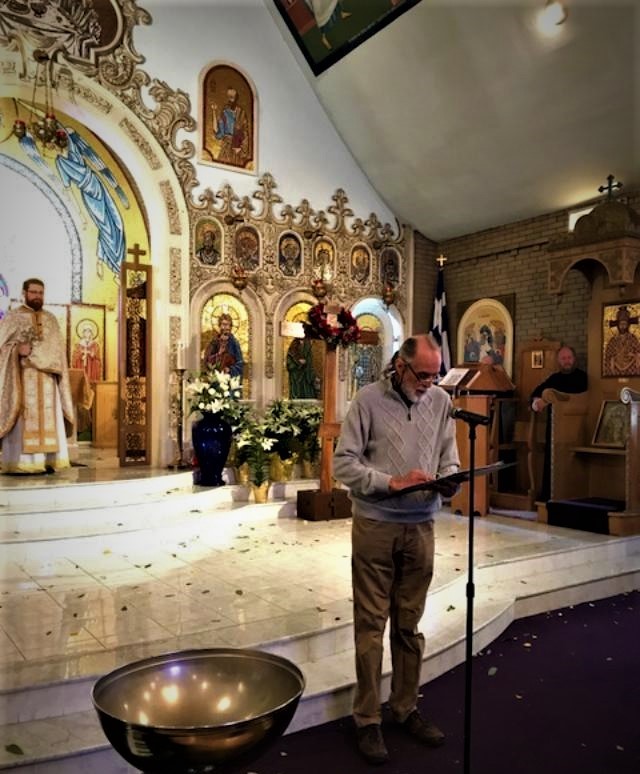
THE PRIEST’S WIFE

The celibacy expectation for their priests and monastics leaves many Roman Catholics perplexed when they hear of the married ministers of their Protestant and Anglican/Episcopalian neighbors. Sometimes this is seen as a question of whether a pastor is able to focus all of his attention on the work of the church without the distractions of family life – or, on the other hand, the ways that family service enriches his ability to understand and counsel the members of his congregation.

(Yes, I’m aware of the male pronoun there – we haven’t touched on the matter of the ordination of women in many of those Protestant and Anglican/Episcopal churches, contrary to Roman Catholic strictures.)

While the focus is usually on the pastors, the condition of their spouses is typically overlooked. Are they fully members of the congregation or are they somehow set apart? They’re definitely in a spotlight and held to a higher standard than the rest of those in the pews. In addition, many congregations assume the spouse – usually the wife – will function as an enthusiastic unpaid full-time employee of the church, either as an unofficial co-pastor, minister of music, choir director, secretary, or some other visible role. Whatever the ultimate definition, it’s a high-stress situation to fill. Not all marriages survive. As one former pastor told me, “My wife said she married me, not the church.” For him, to take another pastorate would have led to divorce.

To add insult to injury, they’re rarely accorded any open recognition of the duties they fulfill, much less given a place of honor. Their husbands are typically addressed as “Reverend,” for starters. As for the wives, though? Only Mrs.

In contrast, the Eastern Orthodox introduce a fascinating alternative. While the priesthood is reserved for males only, they are allowed to marry – if they do it before ordination. The last year of seminary, according to the story, is a time of intense courtship. (Otherwise, it’s celibacy.)

As for the wife? In Greek circles, she’s accorded the title presbytera in English, drawn from priest or elder. Among other Orthodox, similar titles from their native tongues.

Of course, now I’m wondering how it plays out in practice.

REVELATION, BEGINNING WITH GROUNDHOG’S DAY

BEING SINGLE AND without children for much of my adult life, I could get around Christmas without getting caught up in many of its trappings. One year, getting my holiday greetings out late, I launched my annual letter with “A happy Ground Hog’s Day to thee.”

That’s particular calendar date had seemed so weird, until I discovered there are “solar seasons” as well as the ones our calendars show. In solar winter, for instance, the solstice comes at the middle of the season, rather than the beginning; so Christmas would be right around the middle of solar winter, even though it’s at the beginning of the calendar winter. Why does my brain ever go into these bizarre leaps? Oh well, as long as we’re at it: If my calculations are right, Ground Hog’s day comes at the end of solar winter. Follow that? In other words, as far as the amount of sunlight falling on the Earth is concerned, winter is over, even if we wind up getting another six weeks or so of cold and snowy weather, right up to the vernal equinox. So what I really began asking was whether Punxsutawney Phil, the official ground hog those Pennsylvanians in tuxedos and stovepipe hats bring out every year, is stuffed or live. He sure looks stuffed in the official portrait the wire services move, but what do I know? One of my coworkers, who has witnessed the event, claims it’s a living critter.

Awareness of solar seasons puts other events into perspective. Halloween, for instance, acknowledges the beginning of solar winter. May Day brings solar summer. The Midsummer’s Day or Night, ostensibly announcing the beginning of calendar summer, really does come at solar midsummer. The beginning of August is the invisible event in our awareness.

(Neo-Pagans, incidentally, put their own significance into this alternative alignment of seasons.)

Dwelling in northern New England, as I do, presents another awareness of seasons. They are not evenly divided across the year, as a calendar would do, but are instead of unequal duration. Winter, for instance, begins around Halloween and lingers until the beginning of April – five months, rather than three. Summer, on the other hand, opens around the Fourth of July and ends by mid-August – all of a month and a half. That leaves three months for spring and two-and-a-half months for autumn. Within that there are other divisions. Winter, for example, ends with Mud Season, Black-Fly Season, and Mosquito Season. Or some Mainers see the year as Freezin’ Season, Black-Fly Season, and Road Construction Season.

It’s easy to make the leap to the emotional dimension of the seasons. Skiers and ice fishermen can view deep winter with their own appreciation. I revel in the glorious mutations of October foliage, while another friend dreads its appearance, knowing all too well the gloom that will follow.

Some creatures, of course, will hibernate.

~*~

For more Seasons of the Spirit, click here.

MUTED WITNESS

best known for our anti-war witness
we could do much more
individually and together
to summon others
to transcendental worship

*   *   *

if we hesitate to strip naked or don sackcloth
to march brazenly into parking lots
and through malls
or the courthouse
or legislature
to proclaim Truth

to those who reach for a Budweiser
the first thing
1st-Day morning
or so passionately decry anything
smacking of religion or church

how else do we extend the welcome?
maybe we’re just getting old
or sedate
or muffling passion

this is more important
than placing a notice
in the paper or a line in the phone book
if anyone remembers

*   *   *

there’s no invitation
without an address
or sign
or billowing aromatic
celebration
made visible

Poem copyright 2016 by Jnana Hodson
To see the full set, click here.

UNCOVERING THE PLACE OF STRUGGLE

In his Pendle Hill pamphlet last year, Marking the Quaker Path: Seven Key Words Plus One, Robert Griswold opens with the term “condition,” which initially seems familiar enough. Quakers often remark to a comment, “This speaks to my condition,” or even “the Friend speaks my mind,” conveying a sense of unity and affirmation.

Griswold, though, gives the concept a darker twist, noting that a meaningful spiritual journey requires seeing ourselves in our places of failure and weakness rather than a state of “being in charge,” as we so often do. Think of Anne Lamott’s “three essential prayers” — Help, Thanks, and Wow — and admit a long personal list invoking the first.

I would extend that awareness of condition not just to ourselves individually but to our families and circles of faith and then the wider society. I’d say there’s great need everywhere.

This, then, leads to the subsequent steps where we turn to the Holy One and our kindred spirits for direction and growth.

Curiously, condition is not a word I find used widely in either Scripture or early Quaker literature – not directly, that is – but it does fit the situation of many people as they set out in faith as recorded in both.

Could it be that in many of our religious circles, we’ve been running away from this very difficult but essential challenge? We go to worship looking for rest and renewal, not more turmoil and suffering.

O, Lord, give us strength!

~*~

More of my own reflections on alternative Christianity are found at Religion Turned Upside Down.

WAITING BEYOND PASSIVITY

Another aspect of myself that’s just coming to light is a kind of passiveness that the Asian practice has encouraged – indeed, Yoga and Zen direct the practitioner to become invisible or transparent, egoless, etc. Put that together with my experience in employment, relationships, and so on, and it can become – as it has in my life – a reactive, rather than active, series of events: me as a passive victim rather than standing up on my own. Or when I’d stand up for something, it was to get cut down – again, becoming the victim. At least, that’s a quick overview of the openings at the moment. It’s not quite that severe: I’ve been a lot of places, done a lot of things. But there has been a kind of short-circuit that’s depleted too much energy and maybe even been self-destructive. A passive outlook leading to a victim mentality. Fun stuff. At least – and at last – I’m coming face to face with it. In seeing this, though, some interesting things are beginning to happen.

~*~

For more Seasons of the Spirit, click here.

IN THE FINE PRINT

oh, stranger
you seem to expect a believer will forgive anybody

you seem to think a devotee must forgive everybody

you seem to presume a saint can forgive all

but it’s nothing you attempt in return

*   *   *

oh, stranger, there are conditions
according to Jesus

if you ask
we can begin

and if you express regret
and if you turn course
and do good actions
we can truly begin

if you want any forgiveness between us
we can begin gently working
according to Jesus

*   *   *

but if you think forgiveness is a license
to come back
the way you were, to continue harming
and hurting others
you’re mistaken
oh, sinner

forgiveness begins by admitting the mirror

Poem copyright 2016 by Jnana Hodson
To see the full set, click here.

WHY HAVE THE YOUTH GONE?

Quakers are not alone in this regard, but what we’ve been enduring is that no matter how much effort we put into raising our children within the faith community, they disappear somewhere in their junior high years. For decades, we’ve been hoping they’d reappear as they started raising their own families, but we’re seeing little of that, and again, we’re not alone.

It’s all too easy to blame competition with Sunday morning soccer leagues and the like, although we might also argue that the values the kids learn in their athletic competition more closely fit those of the larger, secular society than those they are taught in religious settings. Rabbi Michael Lerner makes an extended argument in his 2006 The Left Hand of God: Taking Back Our Country from the Religious Right, as he contends that too often our children see all too clearly the dichotomy between what we say we believe in faith and what we actually do in a dog-eat-dog marketplace. It’s a harsh criticism. No wonder religion is losing.

As I gaze around our mostly graying worshiping circle, I wonder just where the young adults are today – not just within religious communities, but just about everywhere I venture. Maybe they’re all hidden away working multiple 24/7 jobs trying to make ends meet. I don’t envy them the economic scene they’re contending with.

But I also wonder about the message they carry about faith itself. If the teaching among youths growing up “under the care” of Quaker Meeting has been to build a hopeful, optimistic foundation of values, how do we help them survive the brutal struggles they’ll encounter in the wider world? How do we instill an awareness of the importance of religious community and shared discipline in maintaining a drive toward a more loving and just society?

Perhaps we’ve been too comfortable in our safe, middle-class, largely professional upbringings and neighborhoods and expectation of college and career.

In my own thinking, I keep returning to the concept of the two seeds, one of Christ and the other, call it what you wish – the point is, we face not just “that of God within each person” and its potential, but also a counter element to challenge. It was a line of thinking at the time the Quaker movement erupted in Britain. Think of the parable of the wheat and the tares.

Contending with the two may be what’s been missing in our teaching and example.

~*~

More of my own reflections on alternative Christianity are found at Religion Turned Upside Down.