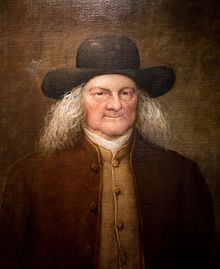
Closely related to poet John Greenleaf Whittier was the Cartland family in Lee. In fact, Greenleaf was especially close to cousin Moses Cartland, though their expectation of dying as bachelors was ultimately crushed when Moses wed a much younger first cousin, contrary to Quaker discipline.
My trail starts with Joseph Cartland, born in Dover in 1721, who moved the family to Lee and established Walnut Grove farm, which would eventually encompass two thousand acres. With first wife Lydia Allen, who died in 1758, and second wife Anna Hanson, he had 11 children, most of them active Quakers.
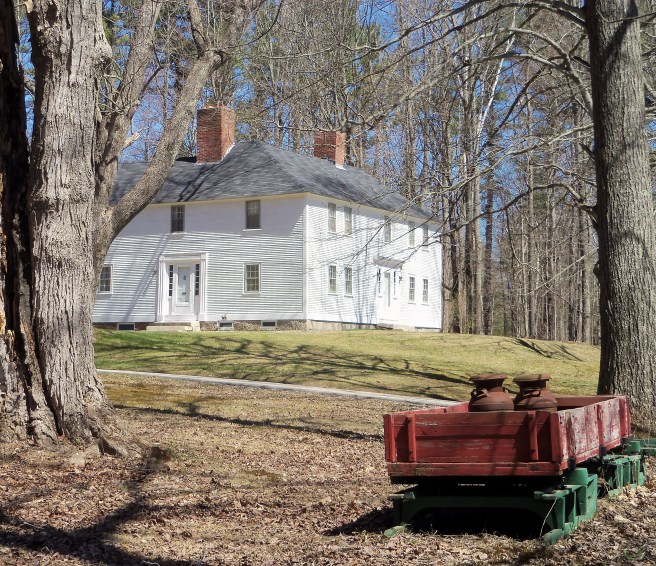
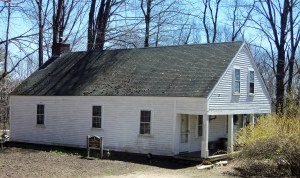
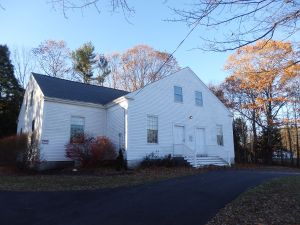
The Cartland home in Lee is known as a stop on the Underground Railroad of escaping slaves.The meetinghouse doubled as a Friends school.
Their spacious home became a stop on the Underground Railroad, and the Quaker meetinghouse, which doubled as a Friends school, stood across the road.
His son Jonathan Cartland, married to Elizabeth Austin, and their children included the noted abolitionist and educator Moses A. Cartland, a confidant of second-cousin John Greenleaf Whittier, who was a frequent guest. Moses also served in New Hampshire’s House of Representatives and was a founder of the Republican Party. His brother Joseph Cartland, husband of Gertrude Whittier, headed Haverford College for four years before they became principals of the Friends School in Providence, Rhode Island. They retired to Newburyport, Massachusetts, which had a Meeting that was part of Hampton/Amesbury Monthly Meeting.
Cartland influence in Dover continued. In the late 1800s and early 1900s, William and Howard Cartland owned Cartland Grocery on Locust Street.
From there, my notes trail off.
~*~
Check out my new book, Quaking Dover, available in a Nook edition at Barnes & Noble.
Dover Friends have long been proud of their connection to the rock-star protest poet John Greenleaf Whittier of neighboring Amesbury Friends Meeting in Massachusetts.
His mother was from the Hussey family in today’s neighboring Rollinsford, New Hampshire, and she married in our meetinghouse.
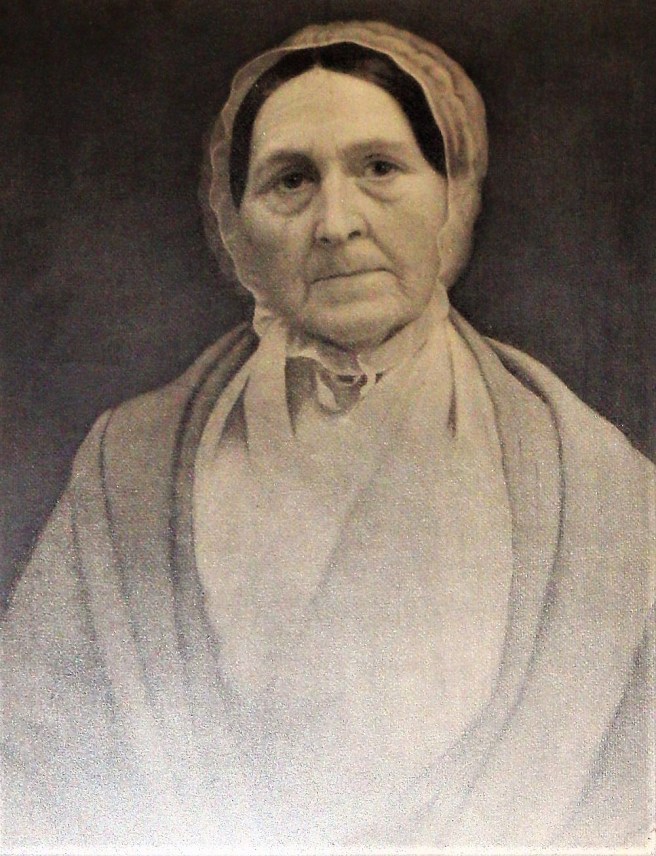
Abigail Hussey, mother of poet John Greenleaf Whittier
Usually, we trace her ancestry through the Husseys of sprawling Hampton Monthly Meeting, which eventually settled down into Amesbury.
But Greenleaf’s uncle Obediah thickens the plot.
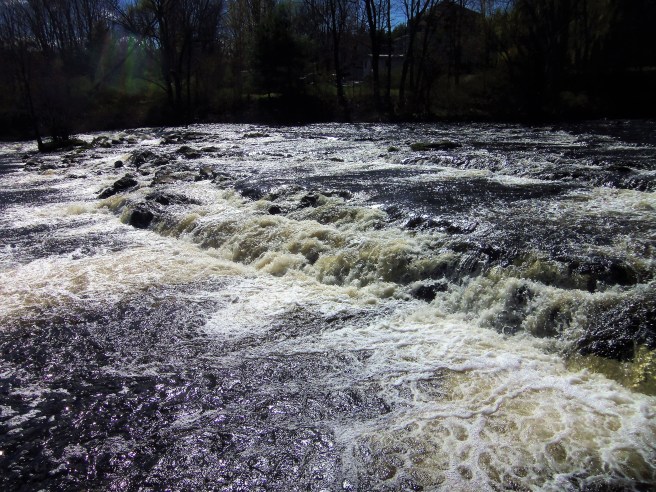
Quite simply, Dover’s Whittier Street and Whittier Falls in the Cochecho River are not named for the famed poet, but rather his uncle and cousin.
And the alternative Whitchers spelling and pronunciation is most tempting, though I won’t go there.
Whittier Falls in the Cochecho River.
Obediah Whittier (1758-1814) moved from Haverhill, Massachusetts, to Dover and married Sarah Austin of Rochester in 1786. He owned a fulling mill, gristmill, and building for dressing cloth on the eastern side of the upper falls of the Cochecho River that were destroyed in January 1817 by a fire that broke out in the carding mill. Son Moses Whittier (1789-1857), however, at once erected new machinery and resumed the carding, fulling, and clothing business the following month. The falls, now known as Whittier Falls, were also called Whitcher’s (a variant on Whittier), Tolend, or the Upper Falls, though there were more cascades upstream.
Obediah and Sarah’s daughter Anna wed Isaac Wendell of Dover in 1809. Daughter Sarah married George D. Varney of Somersworth in 1813. Daughter Mary wed Gideon C. Smith of Somersworth in 1827. (Isaac Wendell was a cofounder of the Dover Cotton Factory, which was the origin of the big mills downtown.)
Son Moses (1789-1857) married Sarah Hacker Jones (1793-1837) of Brunswick, Maine, in Durham, Maine, in 1821, probably at the Friends Meeting. The Jones cemetery in Brunswick has stones for several Dover surnames, including Cartlands, who were also related to the poet – and many of these use Quaker dating.
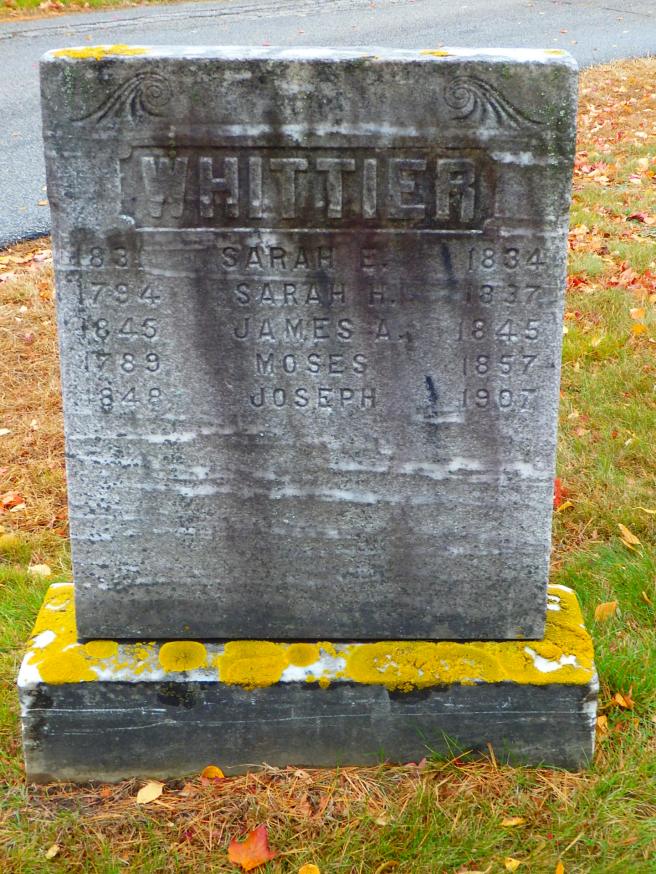
Dover’s Whittier family is buried in Pine Hill Cemetery abutting the meetinghouse.
It’s possible that Greenleaf’s father, John Whittier, met Abigail Hussey through visits to his brother in turn, or that Obediah, likewise, met his wife through other family visits. Opportunities either way would have strengthened any fascination and eventual courtship.
John Greenleaf Whittier’s brother, Matthew Franklin Whittier, even moved to Dover at one point but died in Boston.
You’d never guess any of this walking today’s Community Trail along the river.
~*~
Check out my new book, Quaking Dover, available in your choice of ebook platforms at Smashwords.com.
Early histories of Friends in New England generally overlook Dover, Hampton, and Salem, apart from fleeting references. The focus is instead on Rhode Island, Buzzard Bays, and Cape Cod, in part because of their relative wealth and influence and in part because of their cache of surviving records.
My investigation, prompted by the 400th anniversary of the British settling of Dover, has convinced me that the three northernmost Quaker Meetings of the late 17th and early 18th centuries were equally as important, and their stories need to be told.
One thing I’ve found is that these Friends were not ignored by traveling Quaker ministers. Some of them, especially from England, essentially “set up camp” on the Piscataqua, and their journals offer candid insights into the community and its struggles.
Friends were also connected through New England Yearly Meeting and, closer to home, through Salem Quarterly Meeting, before the creation of Dover Quarterly Meeting in 1815.
We see that in the assistance industrial pioneer Moses Brown of Providence, Rhode Island, provided Dover Friends in the manumission of their slaves in the years leading up to the American Revolution.
Today the Moses Brown School in Providence, Rhode Island, is a highly respected prep academy. Dover Friends who could afford to sent their children there.
The Friends Boarding School in Providence, later renamed in his honor, became another way for Quakers to become integrated into the wider Society of Friends – especially when it led to marriages with other Quakers. Much later came the prestigious Quaker colleges at Haverford, Swarthmore, Guilford, Earlham, and more.
Facilitated by the traveling ministers, who likely also conveyed business information and perhaps even money, along with the counsel of financially savvy elders, some Friends prospered in the industrial revolution. Some Dover Friends did find success in Philadelphia or Massachusetts, and others spread up the Cochecho River and across Maine.
Today, we also connect through alliances like the American Friends Service Committee, the Friends Committee on National Legislation, Friends General Conference, Friends United Meeting, the Friends Historical Association, the Quaker Theological Group, and much more.
Well, as Jesus said, wherever two or three more are gathered …
But it’s also how we stay recharged and focused in the work we’re called to do. Heaven knows, we can’t do it alone.
~*~
Check out my new book, Quaking Dover, available in your choice of ebook platforms at Smashwords.com.
Through much of its history, the Society of Friends was rooted in families, in contrast to today’s more individualistic lacework.
I use the earlier term, Society of Friends, rather than the more modern version, Religious Society of Friends, because Quaker practice emphasized all facets of one’s life, not just a spiritual component. We can argue about whether Friends worship is mystical or meditative as well as about our understandings of the nature of the Divine, but the faith has led us over our history to closely examine our political, business, educational, community, and family interactions. Often, as we’ve seen, from an intensely practical point of view.
It has been said that there are no Quakers apart from a Meeting, meaning that we need each other to hold ourselves to the path and practice. Families, too, need other families who share a similar vision.
When Friends had large nuclear families, three households could easily fill a small meetinghouse, especially when grandparents and unmarried siblings were included. As Quaker families intermarried over the generations, it became common for children to address everyone in Meeting, except their own parents, grandparents, or siblings, as aunt, uncle, or cousin. We can see how that would easily apply in Dover.
What I hadn’t expected when I began examining the genealogies of Dover’s early Friends was to discover just how intermarried their families had already become in the four decades between the arrival of the Quaker missionaries and the beginning of the Meeting’s surviving minutes. Some families were close even before that, suggesting religious conversions, “convincements,” often came within extended relations or among neighbors more than one by one, individually.
In other cases, some lines of a Dover family were Quaker while others hewed to the Congregational church. Even after a surname line left the Society of Friends, some individuals might later rejoin, and sometimes it is hard to determine precisely when or how. In addition, children of households listed in Dover Friends records might seem to disappear from further consideration when, in reality, their location was one finally set off within a newly recognized Monthly Meeting. In effect, their Meeting moved while they stayed put on the same land. A diligent researcher will need to go to those minutes to continue, if possible.
Compounding this, in terms of this particular history, is the fact that for some of Dover’s Meeting’s families, few or maybe none of the households lived within the current city limits. The Eliot, Maine, role – still officially in the town of Kittery – stands out, as do the Berwicks, in Maine, and Oyster River, now Durham, New Hampshire.
As long as a family was Quaker, we can make some general assumptions about its values and lifestyle.
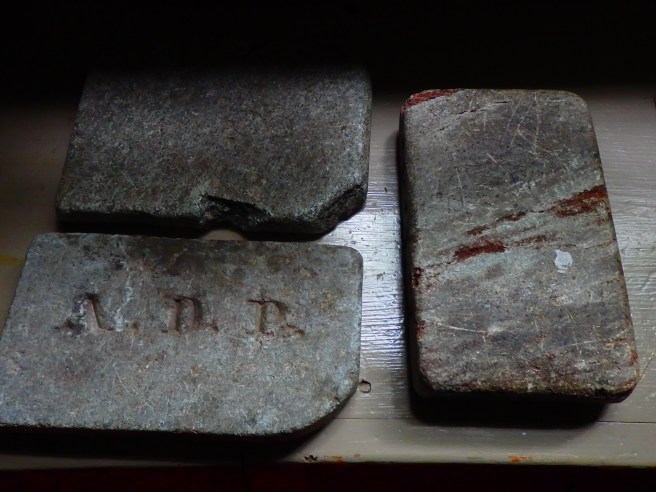
Through much of the history, neither the Congregational nor Quaker meetinghouses had heat in the winter. Instead, members heated soapstone cut like these and carried it in containers from home. I have no idea why they were given to the Meeting, other than a reminder of how tough those characters were.
In some ways, they were like Amish today, with distinctive dress and turns of speech, though choosing to “live behind a protective hedge” rather than separate more totally from the wider world. We’ve seen that Dover Friends were not afraid of speaking out in public and pressing for political redress, unlike the Amish.
Among the values were simplicity, plainness, integrity (honesty, no oathtaking), pacifism and nonviolence, equality of sexes and races. In addition to an avoidance of oathtaking, gambling and gaming, military service, Friends eschewed vain entertainments, including fiction, theater, dance, music, visual art. Science, mathematics, and poetry, however, were valued. There were no headstones until the 1850s. Nor did Friends take other Friends to court – differences were to be settled within Monthly or Quarterly Meeting. Quaker inheritance guidelines sought equal distribution for all the children rather than the bulk of an estate going to the eldest son – over time, raising the overall wealth of a family.
Anger, which commonly leads to violence, was curbed or suppressed – at a hidden price of burying all of one’s emotions.
Yes, the restrictions could be severe, but they also led to some remarkable accomplishments.
As I’ve reviewed Dover Quaker surnames, I find some moved out of the immediate area altogether. Others stayed, but moved completely out of the Society of Friends – still, their accomplishments were part of the larger society.
Even in a small community like Dover Friends Meeting, trying to keep the 41 or so surnames straight over several generations becomes difficult, but is a tight-knitted fabric of individuals and kinships. Sometimes, when I’m sitting in the silence of the meetinghouse, I feel that they’re also sitting with me. It’s a comforting, even strengthening, experience.
~*~
Check out my new book, Quaking Dover, available in an iBook edition at the Apple Store.
In January 1774, a large protest meeting against England called by the town of Dover was held in the Quaker meetinghouse. A resolution upholding the demand for the right of representation in government was unanimously passed.
We’re left wondering why the Friends meetinghouse rather than the Congregational one funded by the town, or whether the town fathers even asked permission.
But a year later, Quaker Nathaniel Meader and others made a public declaration, “We do not choose to sign allegiance to the colonies,” in part as a matter of not swearing oaths but more likely a reflection of their desire to avoid warfare.
~*~
Like the earlier decades of hostilities with the French and their Native allies, this was a special trial of faith for Quakers, who were committed to nonviolence and peacemaking. The historic peace testimony given to King Charles II in 1660 declared warfare to be contrary to the spirit and teaching of Christ as well as the practice of the apostles. Friends recognized clearly that violence begets more violence and arises from sin.
“Our principle is, and our Practice have always been, to seek peace and ensue it and to follow after righteousness and the knowledge of God, seeking the good and welfare and doing that which tends to the peace of all,” the testimony states. “We know that wars and fightings proceed from the lusts of men, out of which lusts the Lord hath redeemed us, and so out of the occasion of war. The occasion of which war, and war itself (wherein envious men, who are lovers of themselves more than lovers of God, lust, kill, and desire to have men’s lives or estates) ariseth from the lust. All bloody principles and practices, we, as to our own particulars, do utterly deny, with all outward wars and strife and fightings with outward weapons, for any end or under any pretense whatsoever. And this is our testimony to the whole world.”
The document also rejects conditions for allowing arms:
“That the spirit of Christ, by which we are guided, is not changeable, so as once to command us from a thing as evil and again to move unto it; and we do certainly know, and so testify to the world, that the spirit of Christ, which leads us into all Truth, will never move us to fight and war against any man with outward weapons, neither for the kingdom of Christ, nor for the kingdoms of this world.”
Friends were instead set upon living out the Peaceable Kingdom described in the prophecies of Isaiah. “For which cause we shall freely give up our bodies a sacrifice, rather than disobey the Lord. For we know, as the Lord hath kept us innocent, so he will plead our cause, when there is none in the earth to plead it. So we, in obedience to his truth, do not love our lives unto the death [that is, a life of sin, but rather] that we may do his will, and wrong no man in our generation, but seek the good and peace of all men. And he that hath commanded us that we shall not swear at all, hath also commanded us that we shall not kill, so that we can neither kill men, nor swear for or against them.”
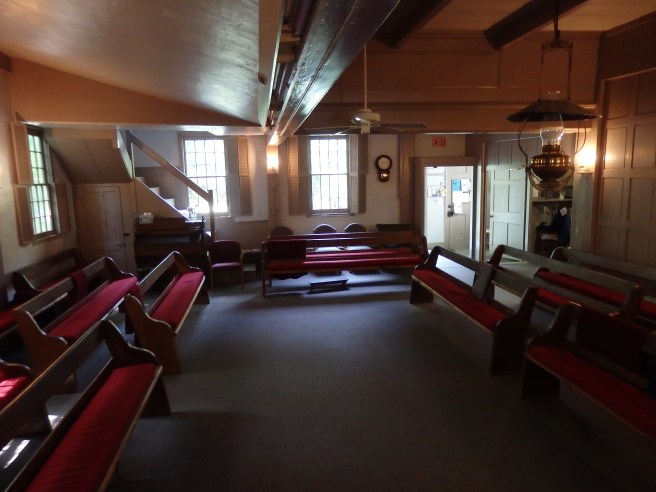
Important public meetings at the outbreak of the Revolutionary War took place in this room. The dividing wall to our right would have been raised, doubling the space. The seats would have faced toward the camera and the raised platform. The balcony, or gallery, overhead would have added more capacity for a crowd.
A Dover Meeting minute of 3rd mo 23rd 1776 speaks of three who went to war: “After deliberate consideration thereof it is the judgement of the meeting that the above named friends should not stand as members of our said meeting until they return with unfeigned repentance for the above misconduct.”
Even so, the first reading in town of the Declaration of Independence was made at the Quaker meetinghouse.
The Peace Testimony wasn’t the only reason for Friends to be troubled by the Revolutionary War. There was no basis to assume that a new government would respect their hard-earned religious liberty. Quakers also had strong ties to their British coreligionists.
Some, like Nathaniel Greene of Rhode Island, did take up arms or otherwise support political independence. British unjust seizure of his brother’s shipping fleet pushed Nathaniel into action. As a general, he is renowned as a brilliant strategist, though his most famous campaign was one largely of retreat that ultimately exhausted the enemy.
Dover Friends sadly agreed that those who joined the fighting could no longer be counted as members, at least until they expressed repentance. The decision came at a steep price.
The Quaker archives at the University of Massachusetts contain three collections of Denials, or disownments, at Dover. The first covers general offenses, 1761 to 1801. The second, marriages, 1721 to 1800. The third, military service, 1775 to 1778.
I’m sure all three are heavy reading.
In Berwick alone, at least 18 young men with Quaker surnames enlisted, according to a tally by the local historical society. Assembling similar tallies in the other communities covered by Dover Meeting would be a challenge.
In the end, the Constitution of the new nation would include a Bill of Rights based largely on Quaker William Penn’s 1701 Charter of Liberties for Pennsylvania. To commemorate the jubilee anniversary of that charter, a large bell was commissioned to be cast and initially known as the Great Quaker Bell, now renowned as the Liberty Bell for its inscription from Leviticus 25:10.
Look it up. It’s a revolutionary economic and social concept.
~*~
Check out my new book, Quaking Dover, available in your choice of ebook platforms at Smashwords.com.
To the northeast, resettlement of Maine’s Casco Bay region began in 1714 at Falmouth, a town that would also encompass today’s Portland, South Portland, Cape Porpoise, and Westbrook. Among its early residents was James Winslow, who arrived in 1728 with his wife and seven children from Bristol County, Massachusetts, to establish a gristmill on the Presumpscot River. Although he descends from a prominent extended Plymouth Bay family that includes Mayflower arrivals, Winslow became Quaker, likely in Maine. The questions of when, where, and how remain.
Portland Friends Meeting historian Wayne Cobb notes, however, “When the first regular Quaker meetings began here, they included James Winslow and his son Benjamin, as well as four men from Harpswell.”
That’s where the Dover influence appears. In 1750, Ebenezer Pinkham and his wife, Sarah Austin, and at least some of their 11 children moved to Merriconeag Neck in Harpswell and, as Dover Meeting’s family records note, were considered members of Falmouth Meeting once it formed. Over time, some would move on to Durham and its Monthly Meeting.
Friends moved from Dover to Falmouth and Vassalboro. So many, in fact, that all three locations were soon Quarterly Meetings.
The Dover connection with Falmouth and the Winslows intensified. In 1760, John and Jacob Morrill were granted certificates of transfer to Falmouth Friends Meeting, soon joined by brother Stephen and sister Mary, who wed Samuel Winslow, according to Dover’s records.
They were followed by John Robinson in 1767 and his brothers Stephen and Samuel as well as their sisters Sarah, who married James Winslow, and Mary, who wed Job Winslow.
In addition, Dover’s Huldah Varney wed Benjamin Winslow around 1770.
By the time of the Revolutionary War, 25 to 30 Quaker families were clustered around the Presumpscot River, by Cobb’s count. Dover had provided a significant core.
By the early 1800s, at least 60 Dover adult Friends had transferred to Falmouth, some with their families and some to marry, adding the surnames Allen, Dow, Hanson, Hussey, Meader, Peaslee, Purinton, Rogers, Tuttle, and Varney to the Pinkhams, Morrills, and Robinsons.
Cobb observes that for about 50 years in the mid-1700s, “close to half the land mass in Falmouth was owned by Quakers and they were a significant force. By and large they were farmers,” though some built mills on the Presumpscot. “Their legacy really shows up most in the 19th century, when the Winslow descendants became well-known industrialists, inventors, and abolitionists.”
Acknowledging that Quakers in and around Falmouth have been “largely forgotten,” Cobb points out “they’re really responsible for much of the early commercial success of Portland. And in their day, they were well respected and well thought of in the community.”
Expansion in Maine continued. In 1780, Friends began to worship together in Vassalboro in the Kennebec Valley near Augusta. Within 20 years, they had attracted 19 adult Quakers from Dover, beginning with Joshua Frye in 1787.
Vassalboro meetinghouse today.
~*~
Traveling around the Pine Tree State, I encounter these surnames seemingly everywhere.
I like to think that Dover Friends have made a positive difference.
Windham Friends Church near Sebago Lake is one of today’s Quaker Meetings in Maine.
~*~
Check out my new book, Quaking Dover, available in a Nook edition at Barnes & Noble.
In the organizational system of the Society of Friends, the local congregation is called a Monthly Meeting, based on its deliberative business sessions held once a month. This is the body that maintains the membership rolls, conducts marriages and memorial services, holds the property, and enforces discipline, as needed – not that we do much of the final one these days.
Neighboring Monthly Meetings are linked together in a Quarterly Meeting, so-named because they assemble four times a year.
The Quarterly Meetings themselves are arrayed within a larger region, creating a Yearly Meeting, the top of the hierarchy of Friends’ administrative structure.
Beyond that, the Yearly Meetings communicate as independent equals, somewhat like the Eastern Orthodox churches.
Remember, traditional Friends never take a vote, with a majority winning the decision. Instead, we wait until all are in unity. Time and again, our clerks prove sensitive in their discernment, though not always perfectly.
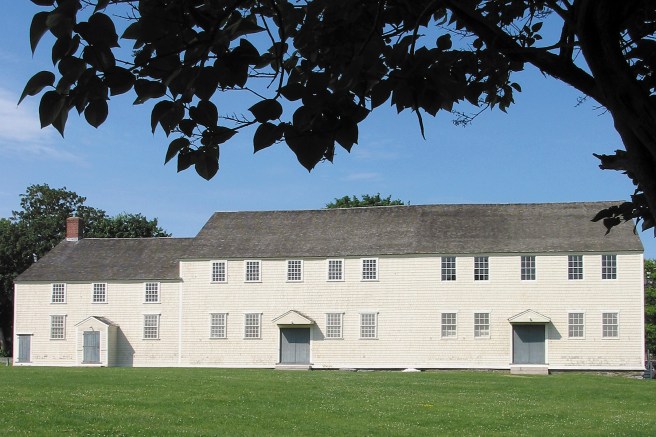
The Great Meetinghouse in Newport, Rhode Island, long served the annual sessions of New England Yearly Meeting. Men sat in the right side, women in the center. The left building served the local Meeting and likely committees.
Thus, Dover Monthly Meeting is part of New England Yearly Meeting, the oldest in the world, which met for much of its existence in Newport, Rhode Island, before venturing to fresh locations in the 20th century.
Dover Friends also fit into Salem Quarterly Meeting, with its sessions rotating among Salem, in Massachusetts, and Hampton and Dover, in New Hampshire, and Berwick, Maine, until Dover was set off as a Quarter in 1815.
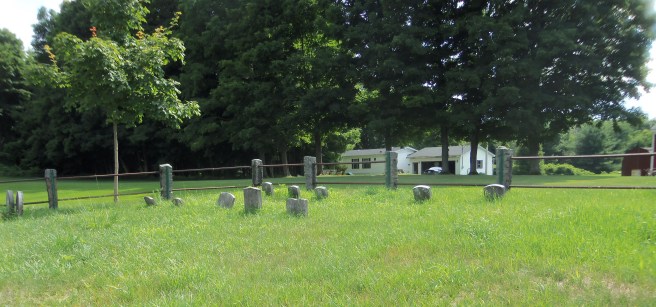
A small roadside burial ground is all that remains of Eliot Friends Meeting, barely a mile across the river from Dover Friends first meetinghouse. In accord with Quaker discipline, many of its members were buried in unmarked graves, the locations recorded within the Meeting’s books.
Dover’s role as a Friends’ center evolved through the establishment of “Indulged” and “Preparative Meetings” that conducted weekly worship in their own neighborhood but joined in the larger Monthly Meeting for the business decisions and community. Over time, Dover Monthly Meeting had not just the two meetinghouses in Dover – the one on Dover Neck and the other at Cochecho Village – but also groups worshiping in Gonic and Meaderboro in Rochester as well as Lee, New Durham, Gilmanton, Wolfeboro, Sandwich, and possibly Barrington, in New Hampshire, and Eliot/Kittery and Berwick, Maine.
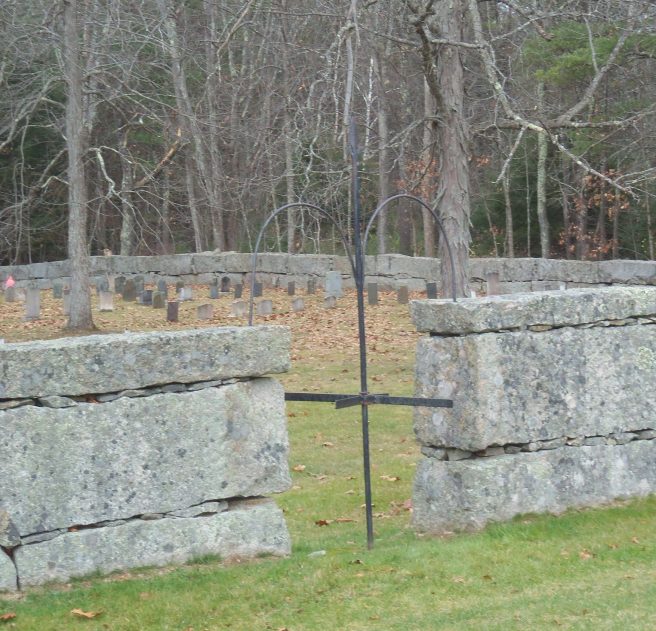
Berwick’s second meetinghouse was erected here in 1758, where the impressive stone wall to the burial ground still stands.
A turnstile leads into the burial ground.
The third meetinghouse was built in 1850 in the village at North Berwick. It’s now used for retail stores.
During this period, Dover Monthly Meeting’s sessions rotated across both sides of the state line, meaning the first Quaker business in Maine was done as part of Dover, Friends Meeting based in New Hampshire. Some of Dover’s earliest clerks, in fact, resided in Maine.
In time, when these smaller bodies grew sufficiently, they were set off as their own Monthly Meetings. Three large families, after all, could fill a small meetinghouse, especially if grandparents or aunts and uncles were included.
And then, once these new Monthly Meetings were functioning, Dover continued the relationship as a kind of “mother” to the newer bodies through Dover Quarterly Meeting.
Thus, while my new book is a history of Dover from a contrarian perspective, it ranges far beyond the city itself, both before and after the Quakers swirl in.
~*~
Check out my new book, Quaking Dover, available in your choice of ebook platforms at Smashwords.com.
Up to the American Revolution, despite opposition, some Quakers held slaves, and Dover was not exempt. Up to ten were manumitted, likely with the equivalent of a year’s wages.
~*~
Slaveholding was a particularly difficult issue. Initially, queries pointed slave-owning Friends to treat their subjects fairly, but that perspective evolved under the influence of ardent abolitionists. In 1731, as the minutes record, “Whereas some Friends signified at our last Monthly Meeting that they were uneasy with the practice of Friends buying or trading Negroes or slaves which was left to this meeting for consideration. After due consideration thereof the desire of this meeting is that all Friends that are clear of slaves may not be concerned with the practice thereof, but to keep themselves clear of practicing ye trade of buying or selling slaves.”
Nevertheless, that proved insufficient at the time.
Finally, on 9 mo 22, 1777, a committee was appointed – James Neal, Elijah Jenkins, and Jonathan Dame – “to visit those Friends belonging to this Meeting that hold Negroes as slaves, and advise them to set them free, and make report to our next Monthly Meeting.”
Doing so would not be easy. For Friends, manumission included payment of the equivalent of a year’s wages, a hefty amount. Elsewhere, it bankrupted some Quakers, who were then disowned for failing to keep their financial promises and their debts clear.
Still, three months later, “The Friends that were appointed to visit those Friends that held Negroes as slaves have made their report that that they proceeded likewise and obtained the manumissions from those that had Negroes in their possession. It is the judgment of this meeting that those manumissions should be recorded upon our minutes.”
Eight manumissions involving ten slaves were recorded.
Moses Brown of Rhode Island helped facilitate the freeing of slaves in Dover.
Assisting in the process was Moses Brown of Providence, Rhode Island, who had been appointed by New England Yearly Meeting to the manumission drive. He was an abolitionist who had separated himself from a prominent, wealthy family involved in the slave trade and instead joined Friends. Through his co-ownership of the Slater Mill at Pawtucket, he is considered a founder of the industrial revolution in America. He also helped establish Brown University, and the Quaker-affiliated Moses Brown School is named is his honor. He signed as a witness to most of the Dover manumissions.
One of them, Seasar Sanky, or Caesar, liberated in 1777 by James Neal of Kittery, had earlier married another slave, Sarah Sharp, among Dover Friends on November 23, 1774.
In the manumission, as Annie Pinkham relates, “Neal stated that he had some years since permitted Seasar to go and labor for himself, but received his wages, and applied same to his use in purchasing a piece of land with a house in Berwick on Oak Hill for which a deed was taken in Seasar’s name.”
However, when Seasar entered the Revolutionary War in 1777, he lost his membership as a Friend.
In another case, “I, Thomas Hanson of Dover, in the Government of New Hampshire, having for some years held Peter, a Negro man, as a slave, according to the tradition of the Country, but being convinced of the Error of the Practice, and the right of all men to be Free, I sometime in the past gave him his Liberty, but the more Effectually to Secure the same and to publish my Unity with our Christian Testimony in this Matter, I do by these presents Manumit, Release, and Set Free the Said Negro Man, Peter, in as full a manner as if he had been Free born, and hereby Warrant to Secure and Defend his said Freedom against the claim of all persons Claiming by, from, or under me, in Witness Whereof I hereunto set my hand the Twenty-First day of the Eleventh month 1777.”
The document was witnessed by Moses Brown and James Neal.
Others manumitted were Jack by Moses Roberts and Dinah by Keziah Roberts, the widow of Stephen Roberts.
The actions were part of a larger drive. By 1784, no Friend in America held slaves. In all fairness, I will also note that some of the wealthiest Quaker families had instead become Episcopalian or Presbyterian, in part as a way of avoiding the Quaker discipline, including its emphasis on equality, and in part to better enjoy a lifestyle of the rich.
~*~
Check out my new book, Quaking Dover, available in your choice of ebook platforms at Smashwords.com.
For the first half of the 1700s, Dover Monthly Meeting was the most northern and eastern Quaker body in New England.
Friends were more or less accepted as members of the wider community, and in the 1720s they even built a second meetinghouse for those living near the village around the Lower Falls of the Cochecho – today’s downtown – in addition to the first meetinghouse serving those on Dover Neck.
A distinctive Quaker culture had set in, one that included Plain dress and thee-and-thou language. Friends referred to First-day rather than Sunday, for example, and First Month rather than January.
A piece of needlework now residing in the Quaker meetinghouse on Central Avenue quotes an advice from George Fox in 1658.
There was a tightening of discipline over daily conduct and over marriages within the faith.
The Meeting and its families were also visited by traveling ministers, some of them staying for extended stretches.
~*~
Relations between the town and its taxes and other civic requirements could often be touchy. For one thing, those appointed as constables were required to serve or pay stiff fines.
In reviewing the early history of New Hampshire and Maine, I presumed that titles like Major, which we’ve seen with Richard Waldron, reflected their role in the militia. Thus, when I came across a rank applied to a Quaker surname, I figured that the individual was no longer a member of Meeting. That changed when I came across a reference to Capt. John Canney as “a Quaker who ‘affirmed'” rather than take an oath of office when he became a representative to provincial assembly, 1742-1745. Most likely, then, is that Captain was a term given to constables, the way police and fire officers today can be given ranks. Or it could also be applied to skippers of vessels.
Quakers serving as constable did face moral quandaries. On October 10, 1729, for instance, “A petition from several Quakers in behalf of themselves and their friends at Dover, praying to be exempted from gathering the Minister’s rates as Constables, was presented to the Assembly.”
The issue of collecting taxes for a minister the Friends didn’t use or respect remained.
On May 3, 1731, “The ‘people called Quakers’ again petitioned to be excused, when constables, from gathering Minister’s rates; and the Assembly excused them by enacting that such persons shall be exempted from gathering such rates of any other persuasion, and that the town should make choice of those who were not Quakers to gather the same.”
There were also tensions over expenses for the First Parish meetinghouse, which doubled as town hall.
George Wadleigh notes that March 31, 1760, appears to have been the last “public town meeting held at the old meeting house on Pine Hill,” but instead of shifting the sessions to the new building, on October 13, “At a public town meeting held at the Quaker meeting house, a committee was appointed to sell the old school house standing on Pine Hill and pay the proceeds thereof to the selectmen.”
This would have taken place at the Friends second meetinghouse, a block west of the newer First Parish home.
Dover Friends second meetinghouse, now a private residence on Spring Street, where it was moved in the 1830s
On January 28, 1761, “The Quakers of Dover, by Joseph Austin, Thomas Tuttle and that many persons who had agreed to do so, by the purchase of pew privileges, had neglected it, &c. a town meeting was held at which the committee for examining their accounts made report that the whole amount expended,” for the Congregational church, ” was 248pds. 18s. 4d, old tenor: which report was accepted and the building committee was empowered to sue those men who owe money towards building the house.”
That wasn’t the only issue Friends were fired up about. At that same town session, “The Quakers of Dover, by Joseph Austin, Thomas Tuttle and Samuel Austin, for and on behalf of themselves and the rest of their brethren and by order of their monthly meeting held at Cochecho the 18th day of the 10th mo. 1760, petitioned the Assembly, setting forth that they were burthened with a tax to hire soldiers into the service, and praying, for reasons assigned, to be relieved therefrom. The Assembly assigned a day for a hearing thereon, and ordered them to cause the chief officer of the Regiment, & the selectmen of the town to be served with a copy of the petition and order thereon, at their own cost and charge, that they might appear and shew cause, if any they had, why the prayer should not be granted.”
On February 6, “It was voted that the prayer thereof be granted and that the tax ordered by the Treasurer’s warrant to be assessed on the people called Quakers in the towns of Dover, Durham, Somersworth, Rochester and Barrington in the year 1760, be remitted and that the same be added to the Province Tax of said towns for the year 1761.”
On March 30, “At a public town meeting it was voted to petition the General Court for a law to empower the First Parish to transact their affairs exclusive of the other town business.”
On June 11 the next year, the church was incorporated as a parish distinct from the town government. Though this separated the two, taxes would continue to support the church and its minister perhaps as late as 1819, when the state passed its religious toleration act.
Still, on July 2, 1761, “The committee for building the new meeting house having complained that the money for that purpose had not been fully paid them, that many persons who had agreed to do so, by the purchase of pew privileges, had neglected it, &c. a town meeting was held at which the committee for examining their accounts made report … and the building committee was empowered to sue those men who owe money towards building the house.”
Though the town paid for the First Parish meetinghouse, it also used the new Quaker meetinghouse for public events. Possibly the building was larger, intended to accommodate Friends from the smaller neighboring Meetings when they came together as a Quarter.
~*~
Check out my new book, Quaking Dover, available in an iBook edition at the Apple Store.
Quakers have always faced an inherent conflict in trying to uphold a community of faith predicated on a personal experience of the Divine. How do you know you’re not being deluded or misled? You have to turn to others. (I’d say this is a great value in marriage, as well!)
This is further complicated by the profession of embodying an eternally unchanging Truth while acknowledging shortcomings in our human comprehension and changing social conditions.
I’m convinced that when the Friends movement first burst forth in Britain, anti-blasphemy laws precluded them from fully articulating the scope of their theological vision. They couched some of that by referring to the Light rather than Christ, and focused on daily conduct, or “walking in the Light.” And, no, it was never “Inner Light,” not until the late 1800s, but rather “Inward Light” or some variant. Light pouring into oneself, like a lighthouse beacon. Well, that’s the thrust of my pamphlet Revolutionary Light, available as a free download at my Thistle Finch site.
~*~
BY THE END OF THE 1600S, Quaker leadership had resolved to push away from theological correctness in favor of right daily practice – orthopraxis rather than orthodoxy.
The choice has come back to bite us repeatedly.
What we did inherit was a system of unique decision-making.
First is the organization of Meetings designated by the frequency of their decision-making sessions.
The local body is called a Monthly Meeting, and this is where memberships are “held” or recorded. A Monthly Meeting likely encompassed smaller neighborhood bodies of worship within it, such as Preparative Meetings (so called because they might “prepare” items for the monthly business session) or Indulged Meetings or, nowadays, a Worship Group.
Thus, Dover Monthly Meeting over time included Sunday and midweek worshiping bodies on Dover Neck and Cochecho Village, as well as in Kittery/Eliot, Berwick, Rochester, Lee, Barrington, New Durham, Wolfeboro, and Sandwich. In time, those that survived were set off as their own Monthly Meetings and then included in Dover Quarterly Meeting.
Which leads us to the way neighboring Monthly Meetings joined four times in a Quarterly Meeting, for mutual nurture and the resolution of lingering issues. These could be a kind of holiday that Friends and family spent together. I’m told that the local meetinghouses were closed on these occasions, because everyone was away, together.
And once a year, a regional Yearly Meeting gathered, essentially uniting a common discipline and practice for the Quarterly and Monthly Meetings within it. For Dover, this was New England Yearly Meeting, which gathered in the haven of Newport, Rhode Island. And those present were largely representatives who could afford to be away for a week.
~*~
SECOND, AND UNIQUELY, Friends developed sets of Queries and Advices to guide practice. At each Monthly Meeting, a few questions would be pondered, personally and then collectively, and a written response would be drafted and sent to the Quarterly Meeting, which would then draft a summary to be considered at the Yearly Meeting.
Until the late 1800s, business was done by the men’s “side of the Meeting” and by the women’s – the meetinghouse had interior dividing shutters that could be opened for worship and closed for business – and each half had its own responsibilities. If there were problems in a marriage, for instance, the man had to report to the women’s Meeting. Or at least, more privately, to its elders.
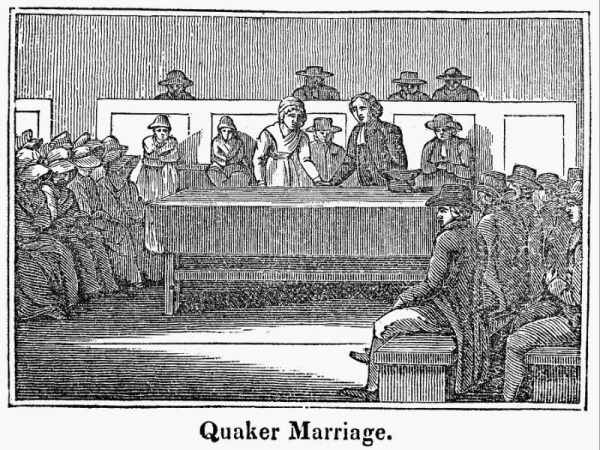
The Quaker marriage process reflected the faith’s discernment and discipline, as I explain in my new book.
~*~
THIRD, FROM THE DUTCH MENNONITES, via the General Baptists they influenced in England, was our recognition of ministers and elders (aka bishops within a Meeting) and, by extension, overseers.
Through them, we also gain our peace testimony, Plainness, even anti-slavery plank.
~*~
AND, YES, WE’VE COME TO APPRECIATE “continuing Revelation.” That is, an awareness of our own human fallibilities combined with some flexibility.
If only that had come more fully into Quaker awareness earlier. Instead, at times, we’ve fallen under a deadly legalism.
~*~
Check out my new book, Quaking Dover, available in your choice of ebook platforms at Smashwords.com.