Some facts related to Prairie Depot

My novel Nearly Canaan starts off in a railroad crossing called Prairie Depot. It’s imaginary, of course, a blend of several small cities I’ve encountered. But, for the record, let’s say this.

  1. It was a dozen or so miles from the nearest Interstate Highway.
  2. It sat in what had been the Great Black Swamp that covered roughly 1,500 square miles before being drained to open up some of the best farmland in the world … and some of the flattest, stretching for miles.
  3. There really were some surviving patches of original prairie nearby, as well as new reservations harboring restoration. The ecosystem had reached westward to the Rocky Mountains, especially in a broad swath through much of the Midwest.
  4. Five different railroads once interconnected in the town. It could lead to frequent delays for drivers and pedestrians alike, as well as interrupted sleep.
  5. It was also a good place for grain elevator dealers to ship from.
  6. The real center of town was a small restaurant owned and operated by two brothers and their wives.Back to the novel!
  7. The town library had a translucent marble exterior wall and a fine collection, thanks to a resourceful director who managed to deflect criticism. He could be a fictional character all in his own.
  8. The region was the scene of a big oil boom, back in the early 1900s. Petroleum was still being pumped at the time of the novel, on a smaller scale, though the grade was lower grade than the market desired.
  9. The place was best known for its collectible glass, before the company relocated to West Virginia, where the name lives on, if not the quality, at least in the estimation of some.
  10. The most celebrated resident dwelt quietly on a shaded side street, her secrecy preserved by the locals, even though she was rumored to have been gangster Al Capone’s mistress. Yes, the one.
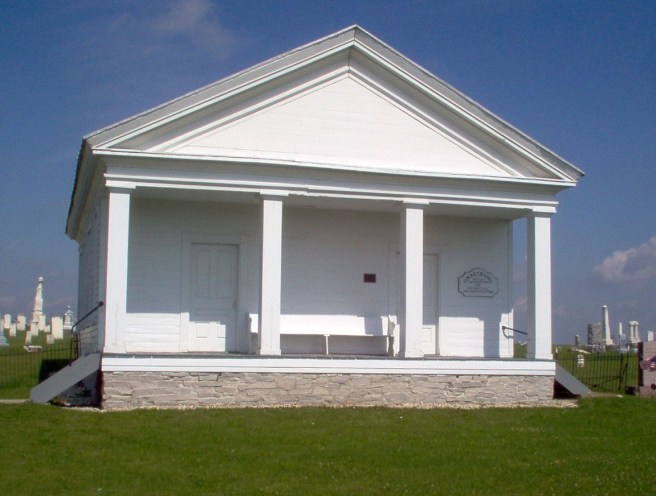
The astringent Greek Temple Revival appearance of Omar Chapel, in Seneca County, Ohio, not far from the prompt for Prairie Depot in my novel Nearly Canaan, continues to haunt me. It says so much about the dreams of its benefactor, out on what was then still frontier.


What I like about gardening

Candidly, I’m not the gardener in our household, but I still have to pitch in with the work. Let me look on the bright side. Plus, when it comes to dining, I definitely enjoy the benefits.

  1. There’s less grass to mow, thanks to the beds that take up at least half of what would have otherwise been lawn.
  2. The sequence of blossoms and produce give me a heightened seasonal awareness. Every week is different, from mid-March as far as mid-November, in the progression of blossoms .
  3. The selections and placement of plants reveals my wife’s mind with its shifting palate of color. She designs English-style clumps, unlike my straight rows. Yes, it really can be a feast for the eyes, even as we look out from our windows.
  4. Asparagus, in a permanent bed, is a delight to cut and eat almost immediately each day through the month of May. It’s the first of our you-can’t-buy-it-this-fresh revelations and reminds me of my years of living in the Yakima Valley of Washington state, where it sprouted like a weed. There, our goal was to sate our taste buds for the coming year. Besides, the delicate ferns are stunning foliage all summer.
  5. Fresh greens. Salads, especially.
  6. Berries, starting with strawberries and extending into blueberries and raspberries. We also have a bank of currants.
  7. Real tomatoes, not the poor substitute you find at the supermarket. We always raise a variety of sizes and shapes, and you’d be surprised how much their flavor varies. One year, I think we had 14 different kinds. Nothing surpasses a tomato and mayo sandwich every day through August and much of September. The king of France should have been envious. You can forget the bacon or even lettuce, as far as I’m concerned, they detract from the star attraction. Again, it’s enjoy it while it’s so gloriously available. (We also freeze a lot for deep winter – the soup, especially, can be heavenly while you watch the snow fall.)
  8. Weeding, which I’d normally avoid, has become a quick means to collect food for the rabbits, which they so greedily and efficiently compost.
  9. Which brings up composting, a lesson in patience and the importance of worms, as I feel virtuous in turning what would have otherwise gone to the landfill into a miracle mixture that’s revived much of our property from what my wife termed “dead dirt” into something soft, pliant, and fertile.
  10. Hummingbirds. They make their rounds through everything flowering, but you have to be alert to see them. Sometimes they’re even right behind your back.

~*~

Well, gardening does also serve as an item of conversation.

What would you add?

People of today I admire

OK, I’m counting couples as one here. And I’m excluding some nominees I celebrated earlier in the year in my ten fine couples list. Here goes:

  1. The Obamas, of course.
  2. And my wife and daughters and the two guys they bring into my life. Natchurally. Think of this as a team.
  3. Noah Merrill, the ever patient and faithful field secretary of New England Yearly Meeting of Friends.
  4. Brown Letham, energetic painter and activist and father of one very fine author.
  5. Jim and Eden Grace, holy peaceniks on a global scale.
  6. Timothy and Nijmeh Curren, Orthodox priest and presbvtera.
  7. George and Althea Coussoule, welcoming stalwarts of Dover’s Greek community.
  8. Sherry Wood. See my dedication in Hometown News.
  9. Jay O’Hara, free-Gospel minister and Quaker activist.
  10. Gary Snyder, American poet and Zen Buddhist.

~*~

So what if this adds up to more than ten individuals in all?

Who’s high on your own list?

Just look at Upstate New York

You say “New York” to someone and the first thing they think of is Manhattan. Not even the rest of the city, where most of the population works, studies, and sleeps. Or Long Island, as an extension of The City.

Easily overlooked is the sprawling region of Upstate New York, with a population of more than six million people and the cities of Buffalo, Rochester, Syracuse, Albany, and more. A population that would make the region itself the 18th largest state in the U.S.A., if it were independent. Larger than Missouri, Wisconsin, Minnesota, Colorado, or a host more.

Besides, it’s a lot like the place where Kenzie alights in my novel Pit-a-Pat High Jinks.

Here are ten more facts to consider.

  1. Upstate starts right outside New York City, at the Tappan Zee Bridge over the Hudson River, where you can still see the towers of Manhattan when the pollution-induced haze abates. OK, the boundary is debated, let’s not argue. Maybe it’s just upriver at the Bear Mountain Bridge.
  2. The region has two major mountain ranges, the Catskills and more impressive Adirondacks, plus a lot of Appalachian foothills. It is largely rugged terrain.
  3. It was largely uninhabited by whites until after the Revolutionary War, when the Iroquois natives were pushed out. What it means is that the bulk of the region was then settled about the same time as much of the Midwest.
  4. The opening of the Erie Canal in 1825 turned the region into a hotbed of manufacturing along its route, as well as religious upheaval, leading it to be called “the burned-over district” because of its zealous waves of missionary activity.
  5. Many of those companies led to giants including General Electric, IBM, Kodak, Xerox, Bausch and Lomb, Carrier air conditioning, Endicott Johnson shoes, Gannett newspapers – manufacturing enterprises heavily hit by Rust Belt devastation in the past five decades. The region is still hard-pressed to recover economically.
  6. It gets a lot of snow. Nobody accepts the crown of the snowfall capital, which seems to shift each year.
  7. The Mormon movement took off when Joseph Smith reported having visions while living in the Palmyra area in the 1820s and ’30s.
  8. The Shakers first settled at Watervliet, near Albany, in 1776.
  9. The Catskills supply New York City’s water via an elaborate pipeline system.
  10. Welch’s makes a lot of grape juice in Chautauqua County, while the Finger Lakes Region is noted for wine making, including Manischewitz sweet kosher wine in Canandaigua.

Reasons I still love type on paper

Well, compared to ebooks and all this digital reading.

  1. I can caress it. Yes, even the texture and weight of the paper itself.
  2. Admire the spine on a shelf.
  3. Frame a page and mount it on a wall. (I’m thinking of a broadside, especially.)
  4. There’s marbling in some old editions, and end-papers. Nothing like that in ebooks.
  5. Underline and make notes as I read, enhancing the engagement.
  6. A sense of timelessness. Unlike a computer crash.
  7. Open an old book and there’s a special aroma. Hopefully not mold.
  8. Reading one works better at the beach, in full sunlight.
  9. Easier to find errors when correcting galleys or drafts.
  10. It really does feel finished.

Ten clerks of Dover Friends Meeting since I’ve been in New Hampshire … it’s a very hard (volunteer) job

In local Quaker congregation, the head honcho is called a clerk, an important (unpaid) job even when there’s a pastor. (A whole other discussion.)

In a traditional body that observes “unprogrammed” worship like ours, the role carries the added burden of being the official spokesperson for all and the presumed face and voice of the Meeting. (Not that everyone will agree. Not in our pluralistic age. Beware of the back-sniping.)

The position rotates among members deemed worthy, and I have served five years, plus a few others as the deputy recording clerk and also as clerk of our regional umbrella, so I’ve done more than a little. But I’m far from the only one. Nor am I whining.

Here are ten others from the three-plus decades I’ve been in New England and active in Dover Friends Meeting.

  1. Silas Weeks. Replanted from an old Long Island Quaker family and long the steady hand in rebuilding our Meeting. Quite a Character.
  2. Pat Gildea. Quite an administrator. She loved having lunch to discuss things. After marrying, she scurried to England and new challenges. Whew!
  3. Barbara Sturrock. A beloved elder. Now in a retirement center up the coast.
  4. Charolotte Fardelmann. Grounded in her heart. In a retirement center closer by.
  5. Sara Hubner. Now much appreciated in her demanding, detailed work in the yearly meeting office. Membership moved to Gonic Friends up the road. Board games, anyone?
  6. Connie Weeks. Silas’s wife and then widow.
  7. Chip Neal. A New Hampshire public television personality and producer with a gentle sense of wonder who has since moved under the shadow of Parkinson’s, yet still showing flashes of wonder.
  8. Bill Gallot. Deceased all too early and dearly missed.
  9. Jean Blickensderfer. Also deceased and ditto. I never would have made it through my terms in the role if it weren’t for her support, eventually recognized as assistant clerk.
  10. Chuck Cox. Organic farmer. It helps, especially where nurture and patience and more patience are needed. I always lean on his warm smile and twinkling eyes.

~*~

As you can see, it’s an equal-opportunity job gratefully sifted by the Nominating Committee. Tell us about similar public servants you’ve known.


Ways reading an ebook feels different from a paper edition

  1. No pencil or highlighter. You type notes or make marks in a side column instead.
  2. No flipping ahead. You scroll or use the slider at the bottom of the screen.
  3. But it also means you have less of a feel for the size of the text ahead – whether this is going to be a novella or an epic.
  4. You’re less likely to lose your place if the pages slip free of your finger.
  5. Search function for a particular word or phrase. Now this is really useful!
  6. Easier to transport and store. You can have hundreds at hand on your reader, tablet, or laptop, where they add nothing to the weight of the device.
  7. You can discover more unknown writers.
  8. Your hands can be free. You need them only to tap to the next page or keyboard a note. Or, if you’re like me, there’s no pencil in the hand that isn’t holding the book open.
  9. You’re less likely to read it at the beach, I suppose, because of the glare. But I find the ebook easier to read at a table.
  10. It’s cheaper. Ideally, much cheaper.

Some things about NW grunge

Although I’ve concentrated a lot on the hippie end of the counterculture revolution, I’m not that conversant in many of its more recent manifestations.

Considering the events in my novel Nearly Canaan, when Joshua and Jaya settle into a place unlike anything they would have imagined, out in the desert on the other side of the mountains from Seattle, I see I need to pay attention, especially since grunge entered the scene just a little later.

Here are ten points.

  1. Sometimes called the Seattle Sound, grunge was a blend of punk and heavy metal revolving around the local independent record label Sub Pop and featuring a distorted electric guitar sound. (I’ll let others define both punk and metal.) And then it took off into the ’90s and mainstream.
  2. The lyrics are typically angst filled of a socially alienated sort. Apparently, we could do a Tendrils right there.
  3. Kurt Cobain’s suicide in 1994 likely played into its demise.
  4. Its mundane, everyday style of clothing sharply contrasted to punk’s mohawks, leather, and chains. It also featured Doc Martens boots, wool flannel plaid shirts, and thermal underwear befitting the Pacific Northwest.
  5. It was seen as anti-consumerist. The less you spent, the cooler you were. Cobain’s widow Courtney Love was the embodiment of the thrift-shop philosophy.
  6. Males, especially, had unkempt hair.
  7. Espresso, beer, and heroin have been cited as its three main drugs.
  8. It led to a distinctive graphic design based on “lo fi” or low fidelity imagery, with intentionally murky lettering, photography, and collage enhanced by desktop publishing and digital image processing on Macintosh computers.
  9. The appearance of ‘zines, often of a literary sort, blossomed as an off-shoot of this. I’ve appeared as a poet in many of them, mostly photocopied and stapled.
  10. Some see the movement as introducing non-binary sexual awareness to the wider culture.

~*~

Can’t help thinking this sounds like hippie on a downer trip to me.

What’s your take on grunge?


Still trying to make sense of this

Random notes in no particular order:

  1. A neighborhood can be a community of peace or of conflict. Either one is layered with opportunity for faith.
  2. Some say I approach life as a mystic.
  3. Silence can be overwhelming; no wonder it is widely avoided!
  4. Right now, it would be a job rather than service.
  5. I’ve preferred to ride Lone Ranger rather than fly with the team in coach.
  6. Great line from M.W. Jacobs’ San Fran ’60s: “It was only later amid the flashing chrome and rumble-clatter of the subway that I realized my accomplishment.” Remember, I love the underground rails and have written a novel set there.
  7. Visions of your lover as God, where you’re only a passing sacrifice.
  8. Eastport Convention. Like maybe a rock band from Maine?
  9. Nola, a possible character appellation.
  10. Presidents as first names … Grant, Clinton, Carter, Lincoln, Madison, Roosevelt etc.

Places I’ve enjoyed dancing

Look, I never have figured out what passes for “popular” dancing, but I am grateful a few forms of folk versions have come to my rescue.

I could mention those times I’ve been moved while watching others dance, like at the Tinowit on the Yakama reservation or maybe at a ballet, but this list is places where I’ve done the steps, too.

  1. The Rockwells’ apple barn in Barnesville, Ohio. My introduction to contradancing, despite my initial resistance.
  2. Scout House, Concord, and VFW, Cambridge, Massachusetts. Mecca. The latter was also known as the Rocket House, ‘cuz of its mock-up Nike missile out front.
  3. Town Hall, Nelson, New Hampshire. Mecca again. Plus the legendary sloped floor.
  4. Dublin Academy, New Hampshire, for Bob McQuillan’s CD release party. I wound up waltzing with an Amelia when I mentioned the tune we were dancing to shared her name, she said calmly, “It was written for me,” back as a toddler.
  5. Town Hall, Bowdoinham, Maine. Always fun and lots of kids out on a Saturday night out.
  6. Town Hall, Kingston, New Hampshire. Smokey of the band Old Wild Goose shucked fresh oysters at intermission one night, and I really pigged out as most folks turned up their noses, not knowing what they were missing. This was November, and the shells were fattened to perfection. There was another night somewhere when he was both the caller and musician, who knows where the rest of the band was, but everything certainly was fun.
  7. City Hall, Dover, and the Oyster River Band, bringing with it memories of times when they starred in Madbury and Lee and even the Kittery, Maine, Grange Hall.
  8. The Star Grange, Greenfield, Massachusetts. They dance wild out there in the Pioneer Valley. Plus I thought I was engaged to be married, and she was a great dancer. Whole other story.
  9. Our wedding, Dover, New Hampshire. The reception featured national treasures Dudley and Jackie Laufman at their best, getting even beginners moving elegantly on the old one-room schoolhouse floor.
  10. Greek festivals at the Hellenic Center in Dover and a big tent at St. Nicholas in Portsmouth, New Hampshire. Feels great learning a new talent, even at this age.

~*~

Gee, how could I overlook the big Ralph Page Legacy Weekend at the University of New Hampshire, Durham, just a dozen or so minutes from us? Maybe because it’s always on the Martin Luther King weekend, when my schedule is pressed by other demands.  This gets serious.