Reasons to like Watertown, Mass.

Greater Boston is comprised of many suburbs that were originally Colonial towns out in the country. As a result, much of the metropolitan area today retains a village feel in addition to its cosmopolitan chic.

Each town – or, in many cases, now city – is different, however subtly.

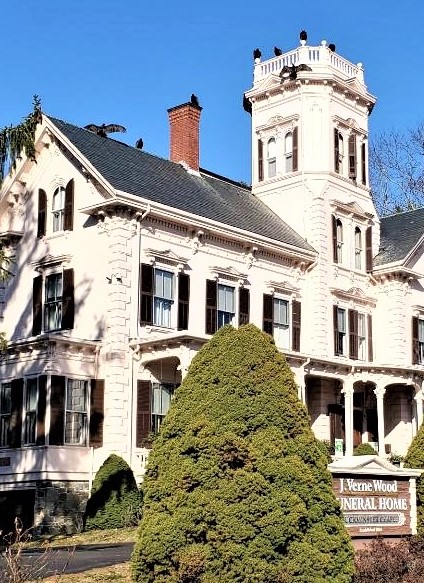
Let me illustrate with Watertown, where my choir rehearses.

  1. It’s on the Charles River, which once powered its paper mills and other factories. Today the river has lovely parks and pathways, as well as crewing teams practicing out on the water in season.
  2. The impressive Arsenal produced military armaments from 1816 through World War II. Today it’s a shopping district, and its restored antebellum commander’s mansion is a kind of museum.
  3. Settled in 1630, Watertown soon became the seat of the Whitney family of invention, investment, and horse-breeding fame.
  4. It’s largely overshadowed by neighboring Cambridge and the Harvard crowd. The famed Mount Vernon Cemetery, the first garden style burying ground in America, 1831, is usually thought of as being in Cambridge, when it fact it lies mostly in Watertown, with a who’s who of famous Americans buried in its rolling grounds.
  5. Watertown has a wide ethnic range of residents, mostly working class or professionals.
  6. The Armenian Library and Museum of America is well worth visiting for exhibits that acknowledge many genocides beyond their own. Watertown is the third largest center of the Armenian diaspora in the United States, surpassed by only two cities in California.
  7. When it comes to cheap eats, I think it definitely beats hipper Cambridge. Some of the best Chinese I’ve ever had was in a modest storefront in Watertown Square, and I’m really sold on the Iranian takeout just up the street. But we also like Wild Willy’s.
  8. The Perkins School for the Blind, founded in 1829, is the oldest such institution in the U.S. and is world famous. It manufactures its own machine to record text in braille. It moved to Watertown in 1912.
  9. I really like the public library, which even has its own coffee shop.
  10. The Gore Place is an opulent summer home built by a man who a fortune in speculating in Revolutionary War debt.


Come explore the Olympic Peninsula

When Jaya and Joshua set of for the Pacific Northwest in my novel Nearly Canaan, what they expect to find is something very much like the Olympic Peninsula rather than the fertile desert where they land.

Here’s some of the alternative.

  1. Set on the far western end of Washington state, the Olympic Peninsula is an anvil of land comprising nearly 3,600 square miles – more than Rhode Island and Delaware combined. It has rare temperate rainforests, glacier-clad mountains, hot springs, timber-tangled shorelines, tall seastacks in the surf, hot springs, waterfalls, large lakes, and eight Native tribes and their reservations.
  2. Olympic National Park at the heart of the peninsula covers nearly a million acres and includes the state’s second-largest mountain range, crowned by 7,980-feet-tall Mount Olympus. Glacier-climbing skills are essential for ascent and descent. The park is the system’s sixth most popular, attracting more than 30 million visitors a year.
  3. The restoration of elk was so essential to the park’s mission that it was nearly named Elk National Park.
  4. The town of Forks gets 119.7 inches of precipitation a year – making it the wettest municipality in the continental U.S. And the nearby Hoh rainforest receives 140 to 170 inches a year.
  5. The peninsula abuts the Pacific Ocean on the west, the Strait of San Juan de Fuco on the north, and Puget Sound on the east. Its rugged interior shunts auto traffic toward the coastlines.
  6. The 300-mile, two-lane Route 101 loop around the peninsula is considered a three-day drive. More, for those who investigate scenic offshoots. There are no alternatives for traversing the peninsula.
  7. Hot springs access is available to the public at Sol Duc. Other sites are local secrets.
  8. Following the biggest dam removal in U.S. history, completed in 2014, the Elwah River once again runs wild for fish migration.
  9. There are more than 60 named glaciers.
  10. While the Olympics Range is seen prominently from Seattle on a clear day, its tallest point, Mount Olympus, is visible from no city.

~*~

Hope that serves as an introduction. We haven’t even touched on Port Townsend.


My daily rituals

  1. Wake up and fill a mug with coffee.
  2. Grab the paper from the front steps.
  3. Do Spanish. (Not a bad way to wake up.)
  4. Check emails, the blog, etc.
  5. Clean the coffeemaker and refill for tomorrow.
  6. Write, revise, whatever.
  7. Household chores plus yardwork and errands.
  8. Check the mail.
  9. Try to get some exercise in. Laps in the pool, a hike up the hill, that sort of thing. Maybe followed by a nap.
  10. Sit down together for a lovely dinner.

~*~

So much for the plans I’d set up for my retirement years. Extensive meditation, Bible study, copious reading?

What frames your days?

Trailings from a writer’s life

Random notes in no particular order:

  1. Consider each chapter a movie – beginning, middle, and end – conflict and some resolution. Boy meets girl etc.
  2. My characters don’t lie … it’s one of my defects.
  3. Any time it sounds like writing, cut!
  4. Always go for RIGHT BRAIN revisions
  5. Each book is unique, special, fragile in its own way. Honor it.
  6. Talk to your readers. Like in a smoky bar.
  7. Rereading an old favorite, only to realize how much my own standards have risen.
  8. Certainly, there is room for a range of Midwestern writing as well – and for recognition of the manifold subtleties among the smaller localities within that country. It ain’t as bland as you’d think.
  9. “Riotous complexity moving swiftly within a basic unity” (from How the Irish Saved Civilization) … not a bad formula for creativity, is it?
  10. What was I really hoping to accomplish, back when there were only 500 new novels a week?

Hops, as in beer

In my novel Nearly Canaan, Joshua and Jaya settle into a place unlike anything they would have imagined. It’s desert, for one thing, where nearly everything has to be irrigated, for another. Quite simply, it’s a lot like Yakima, in the middle of Washington state, where some of the world’s best hops are grown.

Did you know …

  1. The flowers (also called cones) are full of perishable resins that are dried and processed for use as a bittering, stabilizing, and flavoring agent in beer.
  2. Hops have a complex chemical composition leading to two distinct types. Bittering hops have higher concentrations of alpha acids and counter the sweetness of the malt base of a beer. Aroma hops, added toward the end of brewing, prevent the evaporation of essential oils, thus retaining and enhancing the taste.
  3. The choice of hops and techniques of hopping can give a particular recipe its unique taste, as today’s microbrewers are emphasizing. Quite simply, some hop varieties are much better than others in creating a distinctive brew. Think of the way wine lovers describe a bottle, and then apply it here.
  4. The vines (or technically, bines – vines without tendrils) are typically grown on strings or cables to overhead wires, maybe 15 to 20 feet in the air, and cut down for harvest. They’re loaded onto wagons and taken to the hop house for processing and packing.
  5. They grow best in a soil type that is also highly suited for potatoes.
  6. The United States is the world’s leading grower, followed by Germany, together accounting for more than four-fifths of the global hop supply. Despite its fame in the field, the Czech Republic is a distant third.
  7. Three distinct districts in the Yakima Valley, each uniquely different in their output, together produce more than 77 percent of the nation’s hop crop. Most of the farms are third- and fourth-generation family operations.
  8. Pollinated seeds are deemed undesirable for beer. Only female plants are grown in commercial fields. So much for sex discrimination.
  9. Harvesting is a labor-intensive effort, dependent on migrant workers.
  10. They’re in the hemp family, though I don’t know of anyone smoking them.

~*~

Cheers!

Some of my most memorable folk music events

I’m also quite fond of folk music. Here are some concerts at the top of my list.

  1. Peter, Paul, and Mary in Dunn Meadow, Bloomington, Indiana, 1968. Also performing were Phil Ochs, Tom Lehrer, and a raft of others.
  2. Bill Harley and friends at Friends General Conference, Kingston, Rhode Island. The friends included Sally Rogers and Reggie and Kim Harris.
  3. Joan Baez, St. Louis, 1964.
  4. Fiddler Lissa Schneckenburger. She blew us away when she sat in as a teen guest with the contradance band Yankee Ingenuity in Concord, Massachusetts, and later in concert, Rollinsford, New Hampshire, when she also sang.
  5. David Francey at Mill Pond, Durham, New Hampshire. Also on the billing were Bill Staines and bluegrass band Lunch at the Dump.
  6. Pete Seeger in Akron, early ’80s. Charlie King was part of the show.
  7. Peter Blood and Annie Patterson, sometimes just sitting down together after dinner at yearly meeting.
  8. Mike Seeger in a survey of the development of roots styles in America, Bloomington, 1969 or early ’70.
  9. Patty Larkin, Prescott Park, Portsmouth, New Hampshire. Twice.
  10. In the chorus at the Revels equinox concert along the Charles River in Boston, five years, if I’m counting right. It’s impossible to describe the joy of working with Noel Paul Stookey, for sure.