Some of these have already passed into oblivion, but they were still part of the transformation.
Window screening. Maine is loaded with black flies and mosquitos. Somebody still had to go outdoors, though.
Steamships. Not just allowing you to get away or back, but conveying the mail, especially. Think Internet and email for comparison. Remember, Eastport was a major port, including the exportation of canned sardines.
Railroads. Ditto for mail and newspapers. As well as exporting goods to market. Or deliveries back. (Think Amazon.)
Canning. Home canning, of course, but also grocery stores. Out-of-season food options suddenly exploded. Winter wasn’t mostly beans. Not that we’re so fond of it now that we have frozen food choices. But sardine canning also became the economic powerhouse of Eastport.
Sanitation. Let’s start with antiseptics and move on to indoor plumbing as well as the rotary washing machine. Nowadays, that also means the clothes dryer and dishwasher.
Electrical lighting. Especially in those truncated winter nights we have up here.
Linotype. I used to live in Baltimore’s Bolton Hill, where its inventor resided. Daily newspapers and cheap books became commonplace.
Telephone. Did any other invention save more steps? Or do more to relieve loneliness?
Sound recordings. You no longer had to be a musician to have decent music any time you desired.
Automobile. John William Lambert invented the first practical American gasoline automobile in 1891 in southwest Ohio and later moved his operations to Anderson, Indiana. I remember visiting a friend and seeing an old car with an impressive Lambert name in brass across the radiator sitting at an open garage door. “Ann,” said I, “is that car any relation to you?” She replied that her grandfather used to make them but otherwise conveyed no knowledge that he had been so prominent a figure.
And let’s not forget toilet paper to our roll of advances.
They are clean critters, for the most part. And ours always smell good, though their cage can be a different matter. Sometimes they even groom each other, like this.
And not all of it’s meant for human consumption. Some of it’s used for bait, usually for lobsters.
Along the coast we have mackerel. It’s a small fish and oily, one that doesn’t keep well, but cooked promptly or smoked for storing, it’s a lot like salmon. For sports fishing here, seems everybody’s catching ‘em, sometimes six on a line. Some folks even trade buckets of them for lobster.
Alewife. Migrates from the sea late every spring. Another small fish that needs to be cooked promptly or pickled for canning. Also used as prime lobster bait.
Herring. A century ago, these were the basis of Maine’s sardine industry.
Smelt. They’re small, often dip-netted, and can be pan fried and eaten whole. Pacific Northwest Natives called them candlefish, for their oil. Around here, they often show up on the line when casting for mackerel.
Flounder. The species includes fluke, and they like to hang out around pilings and docks – the kinds of places where many folks fish.
Halibut. Now we’re getting to the kinds of fish you might recognize on a restaurant menu or at the grocery.
Haddock. Ditto.
Turning to freshwater, we have several species of trout.
And bass. or perch.
Plus landlocked salmon. Migratory salmon are off-limits, however.
Clamming is also big when the tide’s out. Not that they’re actually fish.
Intimacy. Oh, my, this could lead to another Tendrils. You know, the ways we feel vulnerable.
Poverty. This one even gets twisted up in white superiority and racism, if you look really closely.
Being pulled over while driving. Though it’s unlikely to be a death sentence for me.
Lawsuits. Which can lead to poverty, above.
Being held up or robbed. Well, that can be like a lawsuit plus potential violence.
Rejection. Which also leads back to intimacy, above.
Shame. Well, usually shame is linked to something you’re born with, but it still connects with fear, along with its first-cousin, guilt – arising from something you did bad, really bad.
Hunger. Not that most Americans actually go without food long, but just watch their reactions when they have to fast or go more than two or three hours without a nibble.
Debilitating illness or physical handicap. Blindness, deafness, dementia, for starters. Or falling off a ladder at my age.
Dying as a failure. You know, without achieving something big to advance mankind. Or just plain going to Hell.
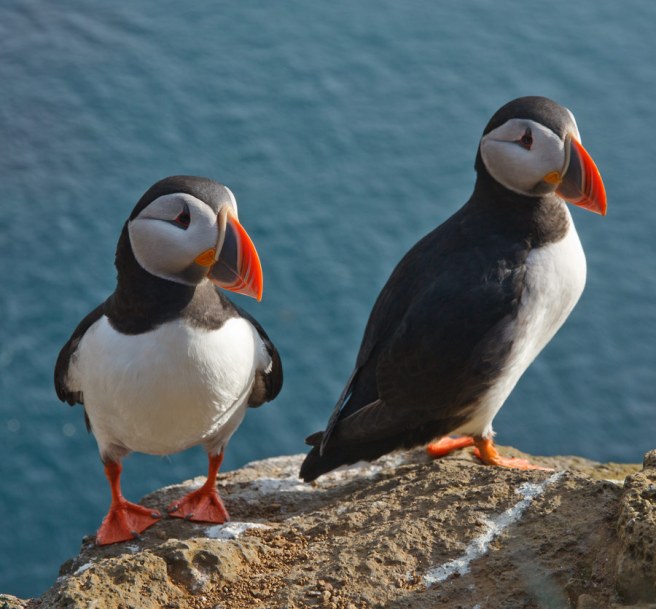
The distinctive seafaring bird is on any serious bird-watcher’s bucket list. Here are some things to know.
They don’t make muffins, contrary to the children’s ditty.
Apart from their nesting time on North Atlantic or Pacific cliffs, they spend all their life at sea, resting on the waves when they’re not flying. They’re essentially an arctic bird, though they come south to breed. Considering where I’m living, maybe I’ll take the boat tour and see some, too, if the outings aren’t already booked solid.
These birds can dive underwater for a full minute and are fabulous swimmers.
As a group, they’re a colony, a puffinry, a circus, a burrow, a gathering, or – get this – an improbability.
They’re quite social, with one colony in Iceland reported to have more than a million nests.
They can flap their wings in a blur of 400 times a minute, reaching a flying speed of 55 miles an hour. At least they’ll evade cops with radar guns.
Two opponents in flight can lock beaks and then beat at each other with their wings and feet. OK, that’s ugly but still impressive.
They generally stay with the same mate for life, returning to the same burrow nest.
Sometimes they’re called Sea Parrots or Clowns of the Sea.