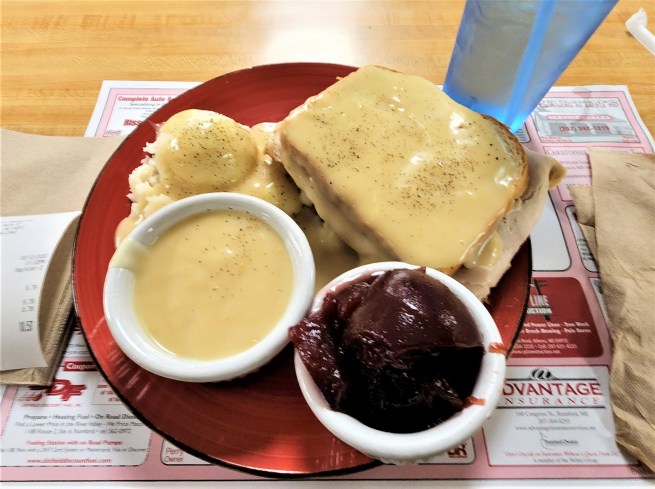
Open-face hot turkey sandwich at a great diner-style eatery in Mexico, Maine.
What’s high on your comfort food list?
You never know what we'll churn up in cleaning a stall
Open-face hot turkey sandwich at a great diner-style eatery in Mexico, Maine.
What’s high on your comfort food list?
LOWER
HIGH
STREET
The butterfly in the boy
running down the beach
in January
After finding myself being referred online to another as “a compelling and brilliant man,” I have to admit how energizing that felt.
All of my Quaker humility aside.
Islands come in all shapes and sizes, and even that can change dramatically with the tides. Now that I’m living on one, I’m really beginning to appreciate their variety. Some you can drive to or from, while others require a ferry or even an airplane. The better-known ones seem to be vacation or travel destinations.
Here’s a sampling, starting with home.
Care to tell us about others?
Quakers Do
Quaker Stew
You know, the changing photo that keeps appearing when you log in. The calculations have no idea, really, of what I like or don’t. My sensibilities are far more complicated than its simple “mountains” or “seashores” calculus.
In one photo, for instance, a single bright-colored backpack at the bottom of the scene threw off the entire wilderness message. It looked like trash. That sort of thing. I didn’t like the particular photo for that reason, but I loved the bigger landscape.
It’s like living with a painting and one day you finally observe something that becomes a flaw. You loved it up to that point. And then?
It’s a binary switch rather than a scale of one-to-ten.
For now, I’m finding some comfort in that, sensing they still aren’t outsmarting me.
Living in places where firewood is readily available – unlike, say, Manhattan or the Arctic Circle – has made it relatively affordable to heat by a wood-burning stove, at least when we’ve had one. (Let me repeat, it’s high on our renovations and home improvement list.)
OK, my Eagle Scout training left me quite aware that green wood – that is, freshly cut – burns inefficiently, unlike wood that’s had time for the sap and related moisture to dry out. That said, here are some other points.
As for air pollution? I really don’t want to go there. It could be a Tendril all its own, once we find the right tech geek to sift through the varied reports.
Oh pour me
A poor me
Saudi Gnome
Sauvignon
What autocorrect gems have you savored?

