I’m not as flexible as I was, and my sense of balance is unreliable. It’s even led to feeling queasy on heights, a realm I once fearlessly loved. And a fall late at night can be terrifying.
Along with spidery thin hair.
As for the bladder?
Slower mental recall, along with hearing.
Declining mojo.
Can’t get warm in winter. Or autumn. Or early spring. I’ve always been cold-blooded, but geez Louise!
Being addressed as “Sir” by polite female teens. I am, after all, emotionally still 17.
The shrinking horizon of life goals and dreams. Like is that best-seller ever going to happen, really?
All the damned pills in the morning.
Gee, and we haven’t even gotten to an inability to understand pop “culture” or the appearance of varicose veins.
It was a favorite breakfast when I was growing up in Ohio, but not an everyday offering.
First, it would be served as a hot cereal, and afterward, after hardening in bread pans, it would be fried in slices and served in melted butter and syrup.
I still remember the reaction when I was head chef (briefly) at the ashram and served it for brunch. It was vegetarian and fit into that part of our yoga practice. But half of the staff and guests were openly baffled. What is this stuff? It wasn’t anything like the buckwheat kasha they’d introduced me to. The other half, though, delighted in it.
It’s still not an everyday dish in my household, but I still relish the moments when it comes up.
My wife, of Southern roots, is more familiar with grits – a variant – and also the Italian polenta, which is much more expensive for no understandable reason.
The one place I’ve seen it on the menu is at the Bob Evans restaurants, where it’s deep fried and typically sells out early in the day.
Cornmeal does show up in my novel The Secret Side of Jaya and on many supermarket shelves, especially under the Hodgson Mill label, reflecting some distant relations of mine who went back to inserting the “g” into our surname.
So where, if at all, do you use or eat cornmeal? It was a basic foodstuff of much of early America.
Or more accurately, the bastard son of a Frenchman in Haiti.
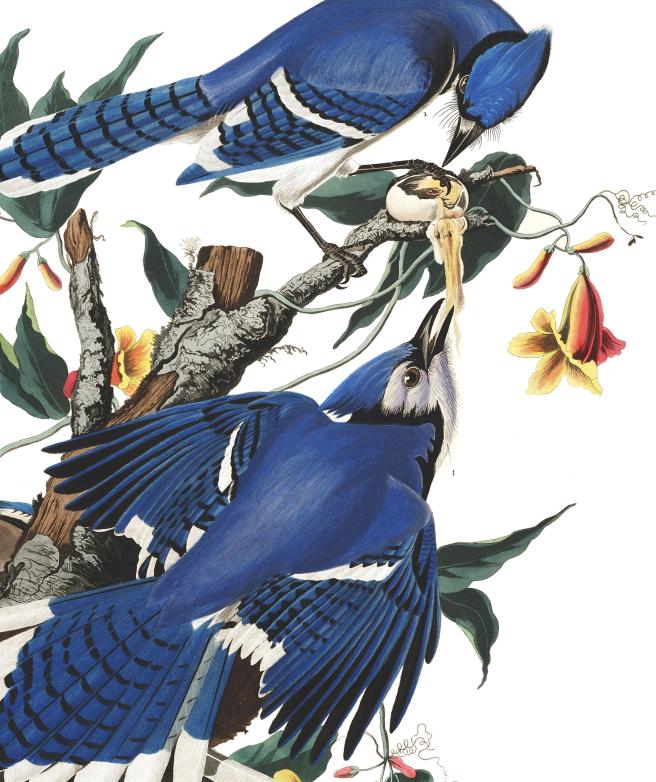
Yet, despite the iconic honor given his name, few have seen his legendary work in its full glory.
I’m speaking, of course, of John James Audubon, in the anglicized version of his name.
While I had viewed his work behind glass framing in art museums, nothing prepared me for my hands-on encounter with the four folio print volumes. That happened in Indiana University’s rare book Lilly Library when a librarian interrupted to ask if I would help her return two of the volumes to the cart so she could take them by elevator back to the stacks.
Yes, they really did need two people to move. As I’m seeing now, the books measured about 29½ inches by 39½, otherwise known as double elephant paper, the 435 prints being the same size as the original drawings.
We decided to take a peek and were both blown away. It was as if the birds had been pressed full-size onto the plate. You could actually see the veins in each feather. And that was, it turns out, a copy of the original. Oh, yes, and each species was presented full size, with some favored vegetation.
As for the color? Unbelievable. You have no idea how much is lost through any glass.
We both admitted it was too much for a single viewing.
Well, we had an acquaintance who was terrified of blue jays.
Now, for ten more facts.
As an 18-year-old, Jean-Jacques Audubon was sent to Pennsylvania on a false passport to avoid conscription into Napoleon’s army.
A feud originating during his research in Kentucky closed off American support for young Audubon’s work. Instead, his backing came from England, where subscribers underwrote the classic Birds of America.
One bookseller claimed it would never succeed because the book took up an entire table to view and would render other volumes useless.
A reduced-size two-volume collection, a gift from my younger daughter, has me appreciating the radical design and style of many of the images. There was no way, after all, to approximate the original color, yet any approximation opened other dimensions.
He worked from actual specimens he had shot and killed, arranged in lifelike settings.
He did create a controversy regarding the smell of turkey vultures, or what some of us call buzzards.
Some of the birds he discovered remain a mystery.
He’s known mostly by copies of copies or even additional copies, each time diluting the impact of the originals.
He had nothing to do with the national Audubon Society or its Massachusetts and New Hampshire spinoffs.
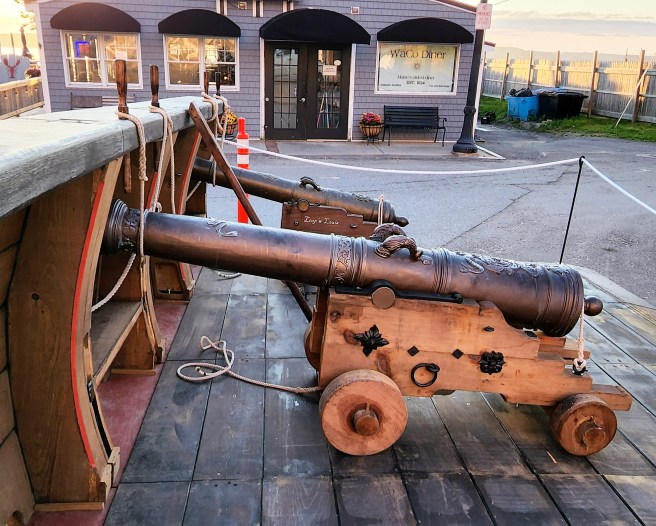
The popular image, shiver me timbers, comes straight out of Disney.
To set the record straight:
They didn’t punish people by making them walk a plank blindfolded. Instead, the victims were killed immediately or keelhauled – tied to a rope and dragged behind the ship.
They didn’t say “Ahoy!” or “Matey!” I’m not so sure about “Argh!”
Female pirates had to disguise themselves as men to protect themselves. But, by some accounts, there were many of them.
Forget the buried treasure. And their loot was often something other than gold or jewelry.
In fact, maps and some books were more treasured as booty than gold.
Captains were elected and could be removed. Who would have thunk?
The eyepatch wasn’t to hide a missing eye but rather to allow for rapid visual adjustment between above deck and below. Anyone want to try that for verification?
Conditions aboard a pirate ship were often more civilized than those on merchant vessels, where lousy rations and low pay were often common.
The skull-and-crossbones Jolly Roger wasn’t the only terrifying pirate flag, by far. How about Black Bart’s one having himself holding an hourglass with the Devil? Or Captain Low’s blood-red skeleton standing at the ready?
Pirates still flourish today, especially in the Indian Ocean and parts of the Pacific.
Well, Eastport’s annual pirate weekend festival’s coming up. We’re bracing for the invasion.
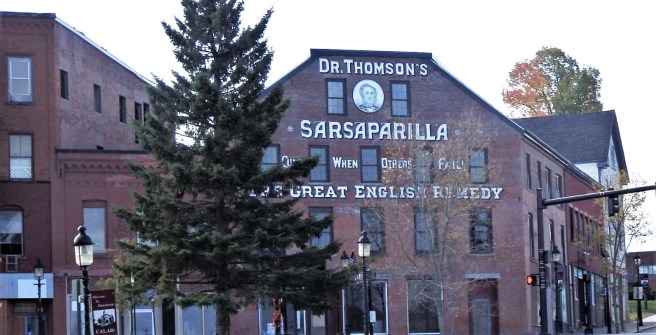
The biggest municipality in sprawling Washington County is the city of Calais, pronounced CAL-us, like hardened skin, rather than the French Cal-LAY, its namesake port on the English Channel.
Set north of Eastport and having a population of slightly more than 3,000, it’s the retail hub of the county and neighboring Canada and the principal international border crossing for traffic to and from the industrial port city of Saint John, New Brunswick, and other coastal points.
With that in mind, here are a few more facts.
Thanks to the border traffic, much of it as Sunbury tractor-trailer rigs, Calais has all of the permanent traffic lights in the county. Three, make that four, if I’m counting right. Yup, pay attention.
It’s the eastern terminus for the Airline Highway, a section of State Route 9 that connects those trucks to Interstate 95 in Bangor and all points south and west in the U.S.
Calais abuts Saint Stephen in Canada, which has both a candy museum and manufacturer and the best health fitness center in our region. The Saint Croix river separates them before continuing upstream as the international boundary.
Calais has the only new auto dealership in the county, as well as the only Walmart.
It’s home to the community college.
The first European to explore the place was Samuel de Champlain in 1604.
That year he was one of two leaders in settling on an island in the tidal stretch of the river. That effort was abandoned the following spring after a brutal winter in which more than half of the colonists perished. Had the venture succeeded, it’s possible we’d all be speaking French here. Today the site of this first French settlement in New France is commemorated at the Saint Croix international historical park.
While its name honors French assistance to the American Revolution, I should also point out that the original had also sometimes been part of England.
It was first settled by Daniel David Hill of York County, Maine. He was likely a descendant from an old Quaker family affiliated with Dover, New Hampshire.
In summer, it’s often much hotter than Eastport. In winter, it’s typically colder.
Oh, yes, there’s even a tiny movie theater we want to check out.