If you missed my latest Zoom presentation

You can catch up with my insights on “Quaker Meeting as a nest for social justness” via YouTube, thanks to West Falmouth Friends on Cape Cod.

The event, the latest of the special presentations based on my book, Quaking Dover and the New Hampshire city’s 400th anniversary, was recorded and is now available.

Many thanks to all involved.

To see what transpired during the hour, click here.

So where were the Baptists in New Hampshire?

Dover’s third minister, Hanserd Knollys, no doubt laid a foundation for the Quaker message two decades after his brief tenure in the town pulpit. He was beset by controversy and even a physical skirmish or two, but he organized the church as a Congregational society even as his own theology was evolving into Particular Baptist.

Some of New Hampshire’s early Baptists did relocate to New Jersey, where they named a town Piscataway, in honor of Dover’s Piscataqua River. And Knollys himself became the pastor of London’s first Baptist church, once he had fled New Hampshire and the New World.

By the way, the number of colonists who returned to England from America still amazes me. How could they even afford it, much less the time involved?

Some of his challenges to conventional Christianity, like rejecting the baptism of infants, opened the way for Quakers to build on, once they arrived.

Still, I couldn’t get a clear picture of the existence of the Baptists as New England’s other dissident denomination in the colonial era. Was it all down in Rhode Island, where they contended with the Quakers over the governance of the colony?

My own book, Quaking Dover, concentrates on Dover Friends Meeting and its families, once they’re established, but the Baptists seem to be largely invisible until the Revolutionary War or so.

Carla Gardina Pestana’s Quakers and Baptists in Colonial Massachusetts now provides an understanding of the faith north of Rhode Island. Essentially, it was long comprised of one church in Boston, and its members were scattered across the region, rather like a network of solitary souls. The church underwent an evolution over the years, from lay ministry to ordained pastors, and ultimately presented less of a threat to the Puritans/Congregationalists than did the Friends.

Still, their insistence on a separation of church and state and their view of a church being comprised of fellow adult believers rather than a place one had to attend regardless of one’s heart and thinking were liberal and revolutionary.

Pestana’s description of the impact of the Great Awakening on the Baptist movement gives me a clearer understanding of why so many of its churches appeared in and around Dover – and the rest of New England – in the early 1800s.

The 1630s was a most remarkable decade in New England

A comment from a professional historian after one of my Quaking Dover presentations has me realizing how much more needs to be seen in fresh light.

New England history, he said, is told through Harvard. And then, to smaller degrees, Yale and Williams College. A more accurate verb might be “filtered” or “focused,” but the implication was clear. The tale is party-line. Even Greater Boston-based.

When I delved into the roots of tiny Dover to the north, from the perspective of its Quaker Meeting, I had no idea how unconventional my stance would be.

The traditional history, I will argue, is Puritan-based and largely pushes aside the earlier settlers and the cultural differences or influence they had.

The well-organized Puritan invasion began full-force in 1630 with Massachusetts Bay and then the Connecticut colonies. Their utopian vision was far more fragile in practice than we’re led to believe. In that first decade, Roger Williams, Ann Hutchinson, and Samuel Gorton were banished, leading to the establishment of Rhode Island and quickly afterward, in reaction, Harvard College. Their own charter was under threat of revocation from the king, and they placed cannon on Boston Harbor to fire on Royal Navy ships, if needed. Think about that. And its Pequot War enslaved Natives who were exchanged for Africans, spurring the lucrative slave-trade.

That’s a lot in a small space in a short time.

Settlement to the north was not immune.

In New Hampshire, two of the four colonial towns were established by religious dissidents fleeing Massachusetts. Dover’s Edward Hilton conveyed his charter (exactly how or for how much remains unclear) to the Lords Saye and Brook for their own management … or mismanagement. As my book details, the New Hampshire province and neighboring Maine quickly became a hotbed of dissidents and misfits – a story that is largely overlooked in the traditional accounts. Let me just say it was a ripe time.

What I’ve also been seeing is that the story of dissent has focused on Rhode Island and largely ignored the north, including Salem, Massachusetts.

Should one of my upcoming presentations redress that?

To those who say God wrote the Bible, let me reply as a writer

If He’s so perfect, why didn’t He do a better job of it? (See any masculine references here as traditional and object to them as you wish.)

Even in Hebrew, so I’m told, many key passages are unintelligible. As for the King James English, which many Protestant fundamentalists hold as inerrant (meaning flawless, perfect, unblemished), let me object. There’s a lot of clumsy translation – and outright mistranslation. Add to that the ways our own language has shifted in the centuries since. (To wit: I find myself having to retranslate many key Quaker writings from the mid-1600s on for modern readers, even those with PhD credentials. Those early Friends were conversant with the KJV lingo. Does thee understand?)

For perspective. When’s the last time you read Shakespeare? Without relying on footnotes?

More to the point. He (yes, He, in the current argument) certainly could have used a better editor, in any language. As for revisions? Let me contend that no work of language is ever perfect, it is ultimately a human artifact. Including the arcane collection known as The Bible.

For me, the best we have in those pages is all the more exalted because of that edge of imperfection and decay. It allows humanity to creep in. I’m thinking of some very cutting-edge contemporary poets, actually.

My fascination with that divine text has turned to the struggle to accurately record our own, very personal, experiences of the Holy One. Name it as best you can. And, from the other direction, the ways our own lives have reacted to the struggle from our own first-hand encounters with those haunting great mysteries.

I’ve come to see – and treasure – what we have in that book more as a set of deeply personal journals of individual and group experiences, including their failures, than as any set of how-to steps to eternity.

The persecution wasn’t consistent

Had the Puritan persecution of dissidents been consistent, the Quakers and Baptists likely wouldn’t have survived. Instead, it came in waves aimed more at the traveling missionaries as well as to constrain the political and business prowess of resident Friends.

Further, there were relatively few congregations or ministers in New England. Despite required attendance at worship on the Sabbath, the buildings couldn’t hold them all, had they showed up.

Who was keeping attendance rolls, anyway?

Under its stern exterior, Puritan polity was fragile in nature

No, I didn’t expect to be feeling some sympathy for the Puritan authorities in America.

In fact, I had assumed they were a pretty formidable front.

But then, in researching my new book, Quaking Dover, I was rather amazed by the range of developments they faced in the 1630s, their first decade in the New World. It’s like they were being hit on all sides.

In addition, they had no direct representation in Parliament. And they didn’t necessarily represent the majority of the residents in their own towns.

In their tribulations with the Crown, the place was ripe for Revolution from the very beginning, rather than having to wait for Paul Revere’s midnight ride.

The Quaker challenge of the late 1650s hit at some intrinsic flaws in the Puritan mindset. As one challenge voiced it, the flaws were essentially theological rather than focusing on the unfolding news events. The title of the pamphlet?

An examination of the grounds or causes which are said to induce the Court of Boston in New England to make an order or law of banishment, upon pain of death, against the Quakers

As also

Of the grounds and considerations by them produced, to manifest the warrantableness and justness both by their making and executing the same; which they now stand deeply engaged to defend, having already put two of them to death

As also

Of some further grounds for justifying the same, in an appendix to John Norton’s book (which was printed after the book itself, yet part thereof); whereof he is said to be appointed by the General Court

And likewise the Arguments briefly hinted, in that which is called, “A true Relation of the Proceedings against the Quakers, &c.”

Whereunto somewhat is added about the Authority and Government Christ excluded out of his church; which occasioneth somewhat his true Church-Government

By Isaac Penington, the Younger

[1660]

~*~

It’s a remarkable document, actually, well worth reading, even in light of the headlines and news flashes we encounter. It argued, essentially, that the Puritans were falling far short of their true goals and potential.

As for the full title?

It would never sell today.

The Puritans do get a bad rap

Oh, it’s hard for me to admit that, at least in light of the early persecution of Friends. I started out with my new book, Quaking Dover, assuming the Puritans were a monolithic opponent of religious liberty for others.

I did know, however, they weren’t always as uptight as they’ve been portrayed. In some ways they were liberal, with high literacy rates for men and women. Startlingly, a woman could divorce her husband if he didn’t sexually satisfy her. Besides, in England their Parliamentarian armies were the vanguard of the radical World Turned Upside Down that toppled the king. And they did love their beer.

As I researched my book, I began to sense that the old adage about coming to America for religious freedom but not extending it to others wasn’t exactly on target, nor was the part about neighboring colonies like New Hampshire being founded purely for monetary gain. As for Rhode Island? You see, it complicates.

For starters, the Puritans’ Massachusetts Bay charter was a commercial document, like the one for the East India Company, with their brilliance coming in immediately moving the annual stockholders meeting to the New World rather than London, under the King’s eyes.

The Pilgrims at Plymouth, too, had come under a commercial charter, one that left them strained by heavy debt. The majority of the first settlers at Plymouth weren’t even fellow Separatists in faith, but here for economic opportunity.

What the Puritans envisioned was a utopia, one within an economic, political, and religious worldview. While it’s sometimes described as a theocracy, ministers were banned from town office – not so elsewhere in the colonies.

Two of New Hampshire’s first four towns, meanwhile, were founded by ministers fleeing Massachusetts. That’s Hampton and Exeter.

And then, the Puritan fundamentalism somehow evolved into a liberal Unitarian strand and more mainstream Congregational wing, now part of the United Church of Christ denomination.

I’ve previously noted an essay by Marilynne Robinson in the August 2022 Harper’s Magazine, delineating ways Massachusetts was far more liberal than Virginia or the Carolinas when it came to religion and liberty in general. In early Virginia, for instance, missing church three times or speaking ill of the King merited a death sentence. Let it be noted, too, that Puritans, along with Presbyterians, Baptists, Quakers, and Roman Catholics, were unable to gain much of a foothold anywhere in colonial Virginia, with its ruthless Anglican state denomination.

There are even arguments that the persecution of the upstart Quakers in both New England and the southern colonies was based more on political and monetary motivations than religion.

The historian at First Parish church in Dover had me seeing that the opposition in New England wasn’t nearly as monolithic as I’d assumed, and then that New Hampshire’s four local congregations had somewhat different characters from those in Massachusetts.

More recently, I’m facing Carla Gardina Pestana’s contention in Quakers and Baptists in Colonial Massachusetts that Friends went out of their way looking for trouble. It does rather thicken the plot. The Baptists somehow found ways to fit in more agreeably.

Considering current attacks on freedom of speech (and printing), some of it under the guise of religion, I do wonder about the status of the separation of church and state.

Sometimes history isn’t so far back there as we’d like to suppose.
 

There’s much more than one big story to touch on

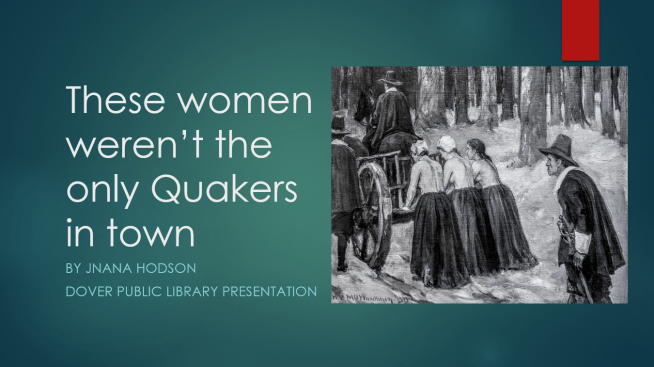
There’s more to the origin of Dover Friends Meeting than the three women who were whipped out of town in December 1662 in what would have been a death sentence, had it been carried out to the letter.

Still, it’s a big story, one that occupies a central place in my new book, Quaking Dover. The horrific incident is also the most frequently visited page at the public library’s online history site, and it’s the subject of one of Greenleaf Whittier’s most famous poems.

I’ll be using that to introduce other examples of courage and faith from the town’s Quaker experience when the Dover Public Library features me in a book reading in front of a live audience this coming Wednesday. I hope you can join me, perhaps even posing a question or insight.

The appearance will also be streamed live, but preregistration is required.

That’s 6:30 pm this Wednesday (March 22).

If it’s anything like the Dover400 new authors presentation earlier in the month, I can assure you it will be a blast.


Maybe I’m going soft, but I am viewing the Puritans in a fresh light

Readers of my new book are telling me how shocking they find the Puritans’ cruel persecution of the up-and-coming Quaker faith. That reaction is quickly followed with their disgust that the Puritans came to the New World for religious freedom but then refused it to others.

What we need to acknowledge, though, is how deeply our outlook is engrained with an expectation of freedom of speech and religion, something that would have been foreign to mindsets back in the 1600s. There, religion and politics were one, as in a one-party state. In England in the early 1600s, the king had the state church, what we know as Anglican or Episcopal, well under his thumb, while the Puritans had Parliament and its armies. It was a volatile mix, even before we get to New England, where my book is set.

I should emphasize that for us, as modern Americans, it’s all too easy to condemn Puritans as backwater bigots, when in fact they were radical progressives on many fronts. They were decidedly anti-monarchy and proto-democracy, and advanced a less feudal, more equitable economy and society. They championed education and literacy for men and women alike and founded Harvard College within their first six years in New England despite deep divisions within their attempt to establish a godly Utopia. Boston was even prepared to fire cannons at Royal Navy ships in the mid-1630s, had they arrived to revoke the colony’s charter, which the Puritans had obtained from the king in an end-run around the man who was responsible for New England’s development – Sir Ferdinando Gorges, the father of Maine and first cohead of New Hampshire, as you’ll find in my book. He definitely would have torpedoed their application. (Whew! The amassing details do thicken the plot, hard as they become to follow.) A Puritan wife could actually divorce her husband if he failed to fulfill her. And they loved their beer.

In other words, Puritans weren’t nearly as awful as we want to portray them today, even if they do come across as villains in my book, Quaking Dover.

Since its release, I’ve been coming to believe the Quakers pressed the Puritans simply for not going far enough in their reforms and intended Utopia. Historian Carla Gardina Pestana, in her wonderful “Quakers and Baptists in Colonial Massachusetts,” even came to the conclusion that the Quakers (or Friends, as we more often refer to ourselves) went out of their way to provoke the Puritan authorities. Ouch, I’m thinking that’s true.

More recently, in revisiting Kenneth Carroll’s book “Quakerism on the Eastern Shore,” meaning Maryland, I felt affirmed by his statement, “Quakerism was, in some ways, an extreme form of Puritanism,” followed by, “It is not surprising, therefore, to discover that Quakerism, in its opening days in Maryland, reached into the centers of Puritanism … for a great number of its converts.”

Well, that latter point was surprising to me. I do see Friends blending Mennonite strands via the English General Baptists into what emerged.

~*~

While my book is focuses on New Hampshire and its adjacent provinces, I’m finding that religious restraints in the southern American English colonies of the time were far harsher than those in New England. For instance, a provocative essay by Marilynne Robinson, “One Manner of Law, the Religious Origins of American Liberalism” in the November Harper’s Magazine, notes that the under the repressive laws in Virginia the penalty for missing church services three times or speaking ill of the king was death, along with the harshest penalties for minor infractions of other laws. She adds there was no mention of trial or appeal and much of what we consider Common Law was nebulous. The Carolinas were just as extreme.

Carroll, for his part, finds that in contrast to New England’s persecution of Quakers, “there may be a skeleton in the closet of the southern colonies also.” He remarks, “The intense persecution experienced by Friends in Virginia soon drove many of them into Maryland,” followed by a series of drastic laws that even kept Quakers from being allowed to enter the colony. “There was to be no challenge to the Established Church as the one religious institution in Virginia,” something that excluded Puritans, Presbyterians, Baptists, Quakers, and Roman Catholics alike. Carroll then states, “The full nature and extent of persecution suffered by Quakers in Virginia is not known. … We do know that William Cole, of Maryland, and George Wilson, of England, were imprisoned in a ‘nasty stinking, dirty’ dungeon in Jamestown where Wilson was whipped and heavily chained so that ‘his flesh rotted from his bones and he died.’” A number of Indian converts to Quaker faith may have also been sentenced to death because of their conversions.  And Maryland for a while also imposed harsh persecution, including the banishment and whipping of Quaker “vagabonds” from constable to constable through the colony.

Among those in the South who had visited Dover were William Robinson, before his execution in Boston, and Alice Ambrose and Mary Tompkins, once they left the north.

This statue by Sylvia Shaw Judson sits in front of the Massachusetts statehouse, with copies in Philadelphia and Richmond, Indiana. Mary Dyer was one of four Quaker missionaries hanged in Boston because of their faith. She’s the only one who hadn’t visited Dover, New Hampshire, although the site of the gallows later became known as Dover Street. As a fine point, she didn’t offer her life for religious freedom but rather as a sacrifice to a Truth she espoused.

~*~

To see how this played out in Dover, please turn to my book, Quaking Dover.

I, for one, would definitely like to see a fuller understanding of how religious liberty came about in the Southern colonies and also a presentation of how Puritans in New England evolved to emerge, in one strand, as Unitarians.

Ten major American religious dissidents

Who says you had to conform growing up? Here are some people who made America the land of the free, not that I agree with all of them. Still, it really does come down to language and how we use it. Especially when religion and politics are mixed in.

  1. Samuel Gorton. Just plain onery in early New England.
  2. Roger Williams. Leading to a progressive movement then known as Baptists.
  3. Anne Hutchinson. Pointing the way to New England Quakers.
  4. John Woolman. A Quaker who worked ardently against slavery and other economic perils.
  5. Henry David Thoreau. It’s a Unitarian thing, ultimately.
  6. William Miller. The foremost of the voices that would become the Seventh-day Adventist church. Ellen G. White emerged as an essential proponent in its development as it organized in Battle Creek, Michigan, and then Takoma Park, Maryland.
  7. Joseph Smith. You know, the Mormons. Along with Brigham Young and Utah.
  8. Dorothy Day. Catholic Workers, a truly radical movement.
  9. Martin Luther King Jr. Civil rights and much more.
  10. Bayard Rustin. Gay Black Quaker ahead of his time on many fronts.

Who am I overlooking?