WITH OR WITHOUT A PULPIT

If I speak of pastoral Friends, it’s often because I often see there some attempts to respond to problems we, too, face. There are ways their side has adapted from broader society, just as we have, in our own manner. We typically share periods of open worship, though theirs are admittedly much shorter and often filled with prayer requests. We share some common difficulties, starting with the “herding cats” problem or the attempt to transport a hundred frogs in a wheelbarrow; at least we don’t have to go through the trials of hiring or firing a pastor. But there are times, admittedly, when I wish we had someone who could devote more full attention to the demands of our Meeting.

Visiting among pastoral Friends can be challenging, as well as rewarding. There are often differences in language and understanding – same-gender marriage being one. Sometimes we can see ways we fail to reach out into the wider community; I recall one minister telling of making a pastoral call here in New England, where he entered the kitchen of one of his parishioners to find the man seated under a bare light bulb, wearing an undershirt, smoking, and drinking a can of beer. “I go because it’s the neighborhood church,” the pastor was told, as if we should be so inviting. Sometimes it’s the insights from our Puente connection, and the life of Cuban Friends as a community of faith. These encounters certainly help me look at Dover Meeting from fresh perspectives.

Some of the most interesting dialogue among Friends has been happening in the journal, Quaker Religious Thought, which is found in our Meeting library. It’s not just that we share a common root, but also that we face a common future that fascinates me. Often, our experience has more in common than we might care to admit. Sometimes there’s even strength in numbers.

CHOOSING FRIENDS

Theological issues play very little into why a family chooses one church over another. So the surveys tell us. Instead of its beliefs, a church is chosen for its youth program, its overall vitality, music, the kinds of expectations it will or won’t place on members, and so on.

Puts Friends in a pretty strange position, doesn’t it? What committee do you want to serve on?

On the other hand, our existence as a “do-it-yourself” congregation requires us, personally and as a group, to draw out individuals and families and engage in their daily lives. One of our strengths is that Quaker meeting allows room for spiritual growth over the years, within a wide range of activity, while maintaining an intimate connection. Our small size, in an era of mega-churches, presents us with advantages, especially in knowing one another authentically. Besides, worship is quite distinct from entertainment.

Now, how do we roll out this welcome mat? Maybe I would remind folks that our place of worship is a house, first and foremost. Come on in and get comfortable. And then be fed. Be sure, of course, to lend a hand with the dishes.

WITHOUT A DOMINANT LEADER

As I wrote at the time:

My spiritual work from my Yakima years on has always been within a collegial circle, rather than with a dominant leader. In this, much of my reading/study of Scripture has been along the lines of Arthur Waskow’s book, Godwrestling, a Jewish communal tradition of arguing with the text, asking if the writers had it right, if there were alternate outcomes, and so on. This is quite different from the legalistic approach taken by fundamentalists of all stripes or even much of the mainstream.

Quaker Theology has published my piece, “The Quaker Enterprise of Metaphor,” laying out an alternative way of thinking, one based on personal experience more than speculation or splitting hairs. Your mention of Kaballah reminds me of a volume I got as a present, The Jew in the Lotus, about an individual who discovered the mystical and varied sides of his heritage while traveling in a small delegation to the Dalai Lama, who was curious not just about angels being everywhere but also about keeping a faith alive in Diaspora.

Over the past few years, I’ve been connecting the dots of an alternative Christianity, one that apparently flourished before the Nicene Council in 325 C.E. and resurfaced in the early Quaker movement, which had to couch its articulation because the Blasphemy Act still included capital punishment. This line of reasoning remains controversial, and I hesitate to say too much too early in my writing. Essentially, “Christ” is something other than the historic person known as Jesus – more along the lines of the Judaic Sophia and the Greek Logos concepts or principles. (So I had to laugh when you reminded me, regarding the spelling of Chanukah, of Jesus’ last name! No, it’s not Christ! It would have been Joshua bar Joseph!) This version also points away from the conventional teaching of Trinity, or of Jesus as God incarnate, and toward a different framework. Just don’t try this on your more conventional neighbors, even with chapter and verse from the New Testament. They’d be really baffled by the short version: Christ is bigger than Jesus.

In all of this, I recognize that something happens in the meditative silence, or “waiting worship,” no matter how we try to define it. In sitting, especially among others, I’m somehow reconnected to intuition and deep emotions, as well as to the other people in our circle. And without it, I really can’t write poetry. (Prose is another matter.)

Still, as my wife asks, how does this make me a better person? I hate to think what the replacement would be!

BUSINESS AT HAND: IN THE MINUTES

Much in our Quaker practice seems quaint, none more than our practice of minuting. It’s not the same as taking minutes of a company board meeting or city council session, but has a dimension all its own. Originating in the recording of persecutions in the initial decades of the Quaker movement, and in the subsequent petitions for redress and justice, our earliest minutes tell of “sufferings for Truth’s sake” and soon lead into the efforts of determining just what it means to live as a people of conscience.

Sometimes today we find the practice burdensome or unnecessary. Friends who follow the Old Ways in this matter will draft and read aloud the record on that part of the agenda, moving ahead only after that minute has been revised to satisfaction and approved. It’s slow and tedious, but it does focus the deliberations.

Here, the concept of clerking – especially for the recording clerk – has a meaning related to “clerk of court,” where the official records decisions from the bench above. In our case, Friends traditionally feel the high judge as Christ, and the meeting gathered as witnesses who would voice the sense of the resolution. I suppose we might see Friends attending our business sessions as a jury, then. If it were only as simple as guilty or not guilty!

Revisiting historic minutes, as I’ve done as a genealogist in the archives at Swarthmore and Guilford colleges, opens an appreciation for the practice as an art form. Perhaps no other records in America before the 1850 Census offer as much genealogical information as ours do. Even so, one discovers how faulty even the best efforts become. A individual simply fades from sight, a family moving away is recorded simply as “Robert and Sarah and children,” rather than naming them individually, as another clerk might have done, or the records might be lost to a house fire, as Centre, North Carolina’s, were, or simply lost altogether, as the first half-century of Dover’s were or West Epping’s were in our own lifetime. You might see an erasure, from first cousin to second, or a misspelling – and suddenly, you find yourself sitting with that clerk, somewhere in our history. This becomes something other than quaint, but personal engagement.

LOOKING FOR AN UNCOMMON GROUND

If you’re part of a faith community, you can ask this about your own circle: What do we have in common? That is, if we were required to write a “confession of faith” (in my case, for our Quaker meeting), what would we profess? What I’m envisioning is not a listing of what we do together, which our annual State of Society Report too easily becomes, but rather what lies under and behind our actions. I know that some Mennonite congregations from time to time draft what they call a “constitution,” although a corporate “mission statement” may also do here. The idea is to sharpen the focus of what a group already possesses and where it would like to go into the future. It’s a way of acknowledging and enlarging on the strengths and dreams of its members. Think of one retailer’s slogan, “Let’s build something together,” with its unvoiced understanding that they’re talking about people’s homes, rather than their investment portfolios, and maybe you get the picture.

I would hope that what we have in common is something other than similar tastes, income, educational attainment, lifestyles, party affiliation, or the like. Perhaps, in asking the question, we can even come to a clearer understanding of what diversity we, in fact, possess, and the potential it offers us.

Answering the question would, I suspect, be far more difficult than we might originally anticipate. On one hand, answering candidly might actually prove divisive. We’ve seen this as we responded to New England Yearly Meeting’s attempt to revise Faith and Practice for the next generation. On the other, delving into the question might also lead us into a clearer understanding of the core energies at the heart of our worshiping community. I recall Caroline Stephen’s amazement Friends can do anything, considering that Quakers are essentially a body of mystics. We’ve heard others compare trying to get us moving together like “trying to herd cats” or go somewhere with “a wheelbarrow full of frogs.”

What I do know is the difficulty of maintaining a witness – even plainness – apart from a community of faith. Community, with its definition of common unity. In the end, it requires far more than strength in numbers. It’s a matter, I’d say, of strength from our hearts.

*   *   *

Now, for my stab at the statement:

Dover Friends Meeting (Quaker) is a body of individuals and families who together encourage and pursue the New Testament goals of simplicity, equality, honesty, integrity, nonviolence and pacifism, and divine love in daily life. At its organizational core are the weekly hour of open, waiting worship in the presence of the Holy Spirit and the monthly meeting for business, both conducted in accord with the longstanding manner of the Society of Friends.

FUN-DRAISING

Looked up as I drove by a big green lawn the other day and saw it was dotted with pink. A bright pink unlike any flowers we grow in these parts.

Then I smiled, realized the house had just been flocked – there was even a note stuck on a stick.

In a flash, even at a distance (this was the kind of place that has a small pond between the house and the highway), I sensed the two dozen flamingos were all uniform, likely brand-new, unlike the motley band we “quarantined” for our own use all too many years ago now. Why, ours even multiplied in the course of their service – some of the dads were making new ones from plywood, rather than plastic.

Flocked, you ask? Oh, I was sure I’d told that story, somewhere.


COLORING THE WIND

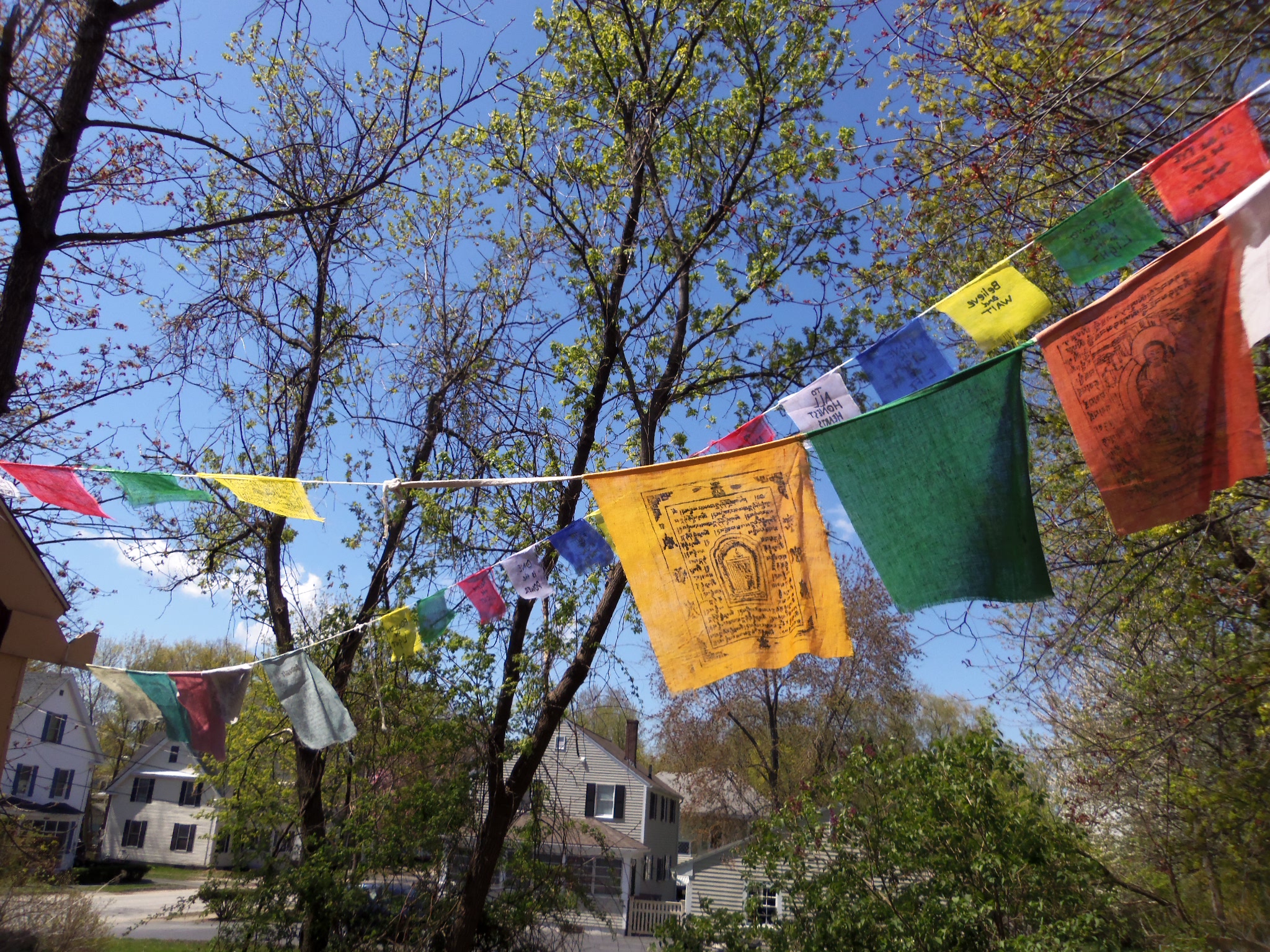
Each spring, new flags join the line in our yard.
Each spring, new flags join the line in our yard. The second strand, at the rear, has quotations from James Nayler, a powerful minister in the early Quaker movement.

The Apostle Paul has urged Christians to pray without ceasing.

I view Tibetan prayer flags rising in the breeze as joyous reminders my heart can do likewise.

THE SHORT VERSION

Asked for a short theology, I’m likely to reply I’ve come to the conclusion God has a different way for us, individually and as a society, to be living.

It’s the story I see evolving in the Bible, for one thing. And in much of the history since.

It’s not hierarchy-based, for starters, and something quite different from nations, with their armies, as we know them.

We get a hint of it in the suggestion of the Jubilee, the redistribution of wealth every 50 years for the entire populace.

Maybe you’re already sensing I don’t draw a distinction between here and eternity, not the way Augustine did. It’s the “Kingdom Come, on Earth as it is in Heaven,” as Christians pray.

The long version, of course, is where all the details come into play.

AN ILLUMINATING DIALOGUE

I’ve suggested meeting with some of the historic Friends sitting on our meeting library shelves, and mentioned the possibility of finding one or two who converse intimately with you, usually in the English of another era. (I’ve seen this happen rather frequently, even if it takes time to find the unique voice.) In this sense, one or two may become timeless companions in your inward growth. Or maybe an old Quake is simply a mentor along the way.

Knowing them can also help us as a PEOPLE of faith. Their range of experiences and concerns provides insights into other streams of Friends today, as Dover Friends have found in our relationship with Cuban Quakers. It also gives us a basis for renewed dialogue on everything from worship and teaching to outreach and social justice issues. We quietist Friends have as much to learn from Evangelical Friends as they do from us – even as we explore our branching out from the same powerful roots.

I’ll leave this for now, saying only that in digging for Quaker roots, it’s possible to find yourself jolted, like grabbing onto a live wire. And who knows where that will lead.

*   *   *

Now, for an update. For ease of convenience, let me point you to overviews of these earlier Friends, all at my As Light Is Sown blog:

MEETING WITH HISTORY

Some have observed that Friends look to their history more than most other denominations do. They say a group that lacks dogma, creed, or liturgy will by necessity rely on its tradition for its guideline and authoritative reference. Well, maybe so. After all, to function as a Society of Friends, we need a common language that enables us to convey our diverse experiences, insights, desires, and needs in ways that knit us together. English Quaker Caroline E. Stephen (1835-1909) was amazed that any group of mystics could actually operate together at all, yet Friends do – and have. Eventually, I think, that functioning becomes part of the attraction early Quakers, especially, extend to us.

While much can be learned by exploring the history of Friends, there’s even more to be gleaned by uncovering a historic Friend who resonates especially with YOU. Sometimes these appear in the published journals, which relate inward and outward journeys through life (a gem may pop up in the middle of an otherwise tedious stretch of travel). Other times, they’re in memorial minutes, letters, or tracts. Sometimes, the words of an obscure Friend begins a lifetime dialogue. Ask around meeting, and there will be many suggestions. Or simply delve into the meeting library (the leatherbound collection holds many surprises, too).

In my experience, I can say that in actively invoking these ancestors, we cross a point where they’re no longer quaint (that nostalgic view of the smiling Quaker Oats man or people in some country meetinghouse) but instead astonishingly revolutionary. Their struggles and discoveries may suddenly speak to our own, even if what erupts is a loud argument – like the one Lewis Benson and John Curtis had in the mid-20th century before concluding that George Fox meant exactly what he was saying, scriptural citations and all. To speak of walking cheerfully in the face of brutal oppression and imprisonment is startling – and a starting point for transformation. It’s beneficial, too, when we discover we don’t need to constantly reinvent the wheel in our practice of faith, but also disconcerting when we realize how much of the work they began remains for us to continue. At least they stand ready to help us.