THE MEMORIAL MINUTE

For much of its history, the Society of Friends forbid the use of engraved gravestones, deeming them vain and superfluous. Even so, another custom emerged, the drafting of memorial minutes for Quakers whose lives might serve as an inspiration for others.

The result was quite different from either the typical obituary or eulogy, and many of them prove surprisingly candid, as genealogists discover. If a eulogy celebrates the person, the memorial minute focuses on the individual’s spiritual life and service, especially in the ways these play out in the world.

Often, the minute would be approved by the local Quaker Meeting and entered into its records. If the individual had been active at a wider level, the minute would also be forwarded to the Quarterly Meeting (a gathering of local meetings that comes together four times a year), where it would be shared and, in due practice, approved. If appropriate, this would be repeated at the larger Yearly Meeting level.

As an example of the practice, here is the nearly finished draft of the minute for one Friend. As a member of the committee that prepared this, I’d like to show the “long” version that includes more of her remarkable career, in contrast to the shortened versions that were approved by the circles of Quaker meetings.

Alanna’s minute was approved by Fresh Pond Monthly Meeting and endorsed by Dover Monthly Meeting, and then accepted by Salem Quarterly Meeting, before being included in the minutes of New England Yearly Meeting’s sessions last month.
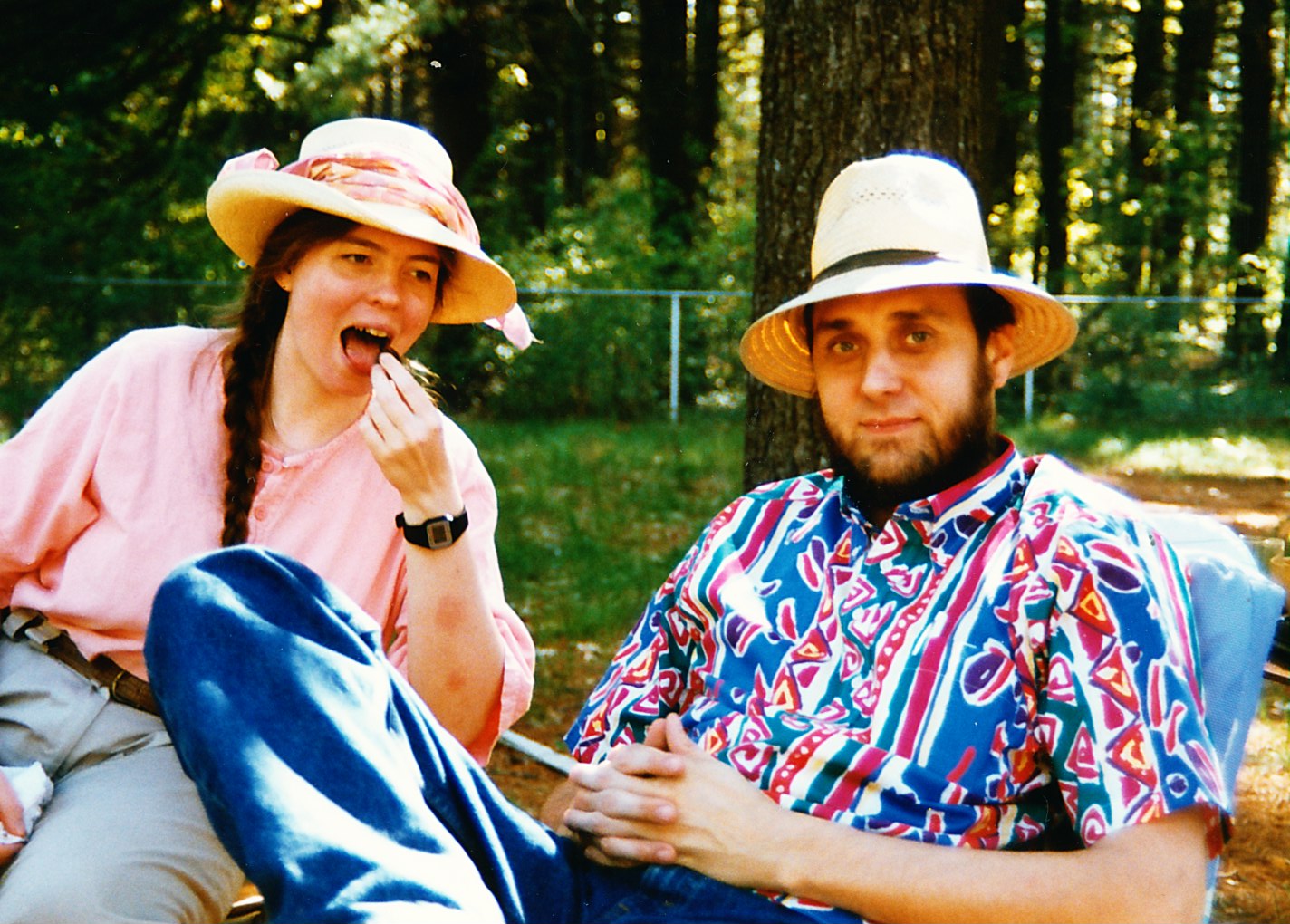
Alanna and me early in our friendship.

 ALANNA CONNORS
September 25, 1956 – February 2, 2013

From an early age, Alanna Connors discovered a need and a capacity to trust her own compass. She was a mathematician at a place in time where women were seldom found. When her high school math teacher flunked her for excellent work, another teacher told her: “You know he’s giving good grades to boys and not to you, because you’re a girl.” Recounting the story in later years, Alanna said, “I didn’t need that; I knew I could do the math.” She held true to her course.

Long before finding Quakers, Alanna lived the testimony of experiencing God in everyone. While most of us have tight circles of caring – our family, friends, coworkers – Alanna’s circles were as unbounded as a wave expanding to all of space. It seems no accident her profession became looking at objects distant in the universe: across the many communities of her life’s paths, she welcomed all beings. Living with her was a joy; her love for others was never abstract but a centered flame close to her and everyone she touched.

Alanna was born September 25, 1956, in Hong Kong to Richard and Sonia Mitchell Connors. Her mother, who herself had a degree in mathematics and studied with Jean Piaget at the Sorbonne in Paris, ultimately worked as a font designer. Richard learned to fly in his youth and became a pilot with Pan American Airways, stationed in Hong Kong. Through his delight in sailing, his five children all learned to sail. Alanna took the lead, becoming a competitive sailor in her time at the Massachusetts Institute of Technology.

Returning to the United States in 1963, Alanna’s family settled in Greenwich, Connecticut. Living with four siblings – one older, Cynthia, and three younger, Kathleen, Noirin, and Patrick – in environments not always centered on these children’s welfare, Alanna developed an immense capacity to listen and extend empathy. Imagination shone through her grade school writings; her elaborate, award-winning gingerbread houses; and family-staged dramas.

Alanna was irrepressibly fascinated by math and science. She thrilled to the elegance of mathematics in expressing, revealing, and predicting physical behaviors. For her, mathematical physics was inseparable from the playfulness, color, artistry, and imagination by which she produced it. Whether it was classroom notes, derivations on scratch paper or napkins, or formal solutions, her handwritten analyses were crafted in flourishing script, vivid with colored pencil illuminations, and playfully annotated with such characteristically inventive words as “whatsit.”

Alanna’s dorm room hosted a wide array of human spirits. Her hotplate, washstand, handmade teapot, and mismatched cups provided hearth and an excuse for tea and convivial warmth at all hours of the night.

She met fellow student Phillip A. Veatch while they were both organizing MIT’s first on-campus food cooperative. After a year of courtship, they exchanged private vows of marriage in 1978, on a basketball court in East Cambridge. Alanna was opposed to the state-sanctioned institution of marriage because of its historical role in the oppression of women.

Communal living, conceived around Alanna’s dorm room, continued into her committed life with Phil through group houses with shared vegetarian cooking. While in Maryland during her doctoral years, they asked all prospective housemates: “Can you have: 1) too much garlic; 2) too much chocolate?” A no answer on both questions was mandatory for joining the group house.

With one housemate, Alanna went “church shopping.” While appreciating the wide span of worship experiences, Alanna gravitated to the Religious Society of Friends in 1982 in Adelphi, Maryland, dragging along her then-reluctant partner. A deep commitment to the Quaker principles of simplicity, peace, integrity, and justice soon enriched both of their lives. They continued at Dover Monthly Meeting in New Hampshire and finally settled at Fresh Pond Monthly Meeting in Cambridge, Massachusetts, in 1998.

Wanting to understand stars, she became a groundbreaker in charting the sky of X-ray sources. Being of a mind to “like thinking we are all professional visionaries,” Alanna’s deep searches into the distant sky uncovered new observations and questions. After earning her doctorate at the University of Maryland, Alanna made significant contributions to the Compton Gamma Ray Observatory as a research scientist at the Space Science Center at the University of New Hampshire. She introduced astrophysics to Bayesian methods of statistics, which start from an assumption that knowledge about a problem is always incomplete. Applying this rigorous data analysis to X-ray and gamma-ray astrophysics, she provided a foundation for statistical methods generally unknown to astronomers in the early 1990s.

As a banjo player, she encouraged use of the Rise Up Singing songbook, learning by heart its song “Julian of Norwich.” Original lyrics and tunes came to her, either fully formed or developing through writing. Alanna’s spirit still comes to us through the texts and music of the dozen songs she set down in composition.

Despite being an intense introvert, she harbored a lifelong belief in the importance of community-building. She cofounded an astrophysics statistical working group at the Harvard Smithsonian Center for Astrophysics. As a senior scientist, she was known for her support of young graduate students. She founded a singing group at Dover Meeting, and while living in Arlington, Massachusetts, enjoyed singing with Nick Page’s Mystic Chorale Singers. After the birth of her son, Roy, in 1999, she worked with other parents to reform special education in the Arlington public schools. She volunteered regularly at New England Yearly Meeting annual sessions working both in child care and the bookstore. She regularly attended the Women’s Group at Fresh Pond Meeting, where she spoke regularly about her concerns in raising her gifted son.

Alanna envisioned and encouraged public science education. She taught astrophysics at Wellesley College as a visiting professor, participated in university physics instruction at UNH and UMD, contributed to public education in science through projects at the Christa McAuliffe Planetarium in Concord New Hampshire, c0-organized family science days at her son’s elementary school, and encouraged exploratory science learning and teaching through many other avenues. She had an abiding interest in the history of physics and astronomy from its ancient origins, in welcoming women’s participation in physics, and in celebrating stories of diverse contributors to science.

Alanna was first diagnosed with breast cancer in 1995. She lived with the disease for 18 years. Characteristically, through its recurrences and treatment, she refused to be defined by the disease and conceived her son, Roy, born in March 1999. To her, the illness was but a single strand of her life. When Roy was 4, her disease recurred, and she took him with her to treatments, where he found the hospital’s high-energy accelerator intensely interesting. Whatever life brought her, she lived with it; she saw illness as no excuse to build walls. When her disease recurred for the last time, in an advanced form, Phil asked if she wanted to go on a special vacation. She did not, preferring to live in her callings.

At Dover Meeting, 1988-1998, she rotated through nearly every committee but also stayed long on Buildings and Grounds. During the first Persian Gulf War, Dover Friends called on her to write a compelling minute explaining the Meeting’s opposition to the invasion of Iraq and Kuwait. Phil and Alanna were lifelong advocates of same-sex marriage. When they decided for Roy’s sake to get legally married, they would not seek marriage under the care of Dover, as that meeting had not yet completed its process of hosting marriages for same gender (it has since done so).

During her time at Fresh Pond, her participation in committee work was limited by parenting and the recurrences and treatments of breast cancer. She was, however, a quiet and regular presence at Meeting for Business and an infrequent but powerful minister during Meeting for Worship, where her ministry was often structured around song.

Just as she knew not to take to heart a teacher’s censure that could have devastated a young mathematician, Alanna maintained integrity without ceding herself, her work, or others to be diminished. Mathematics was one route by which she independently investigated, questioned, and confirmed the truth for herself without relying on the claims of teachers and other external authorities. She stood up for discovering and expressing the full potential of one’s mind and heart, inspiring those around her to undertake aspirations and risks of which they did not suppose themselves to be capable. She knew greater being lies imminent within us all. Whether it was the rights of any couple to publicly live their committed love or a child’s mind emerging along ways and curiosities differing from the school norm, Alanna honored and worked for the fuller life she knew to be there.

Alanna’s spirit lives with us and continues to teach us. We remember her implacable but gentle striving to see the truth and to tell it. The women of Fresh Pond recall Alanna’s intense, powerful mothering, against all odds. Throughout her life she resisted the limits and distortions that social norms can impose on our vision of others. Knowing that a prism takes a beam of light and separates it into many separate parts, Alanna lived her life striving to bring the many separate parts of our world together into one shining beam.

Her memorial service was March 2, 2013, in the Wellesley Friends meetinghouse under the care of Fresh Pond Meeting. She was 56.

BULLETIN TIME

So here I am, looking at a catalogue of “every Sunday bulletin subscription service and other ministry resources.” You’d be surprised by some of the products addressed to a Quaker meetinghouse, and I’m still wondering why church furniture has to be so uniformly ugly. This one, however, catches my imagination.

If you’ve ever been part of a congregation that has ushers, you likely remember how they hand out a leaflet while leading you to a pew. The folded paper would have a colorful image on the front and a meditative reflection on the back. Inside, mimeographed back in the days I remember, was the order of service and an array of announcements. I have to say that the graphics have improved in recent years, and I rather like the format that opens into three leaves, rather than two. For a moment, I consider this as an alternative to our announcements period, at least until I realize that someone would have to type and print them. Still, the thought of ushers revives my meeting’s concern for having greeters at the door.

As I look over the samples, however, I must admit how foreign most of them are to our experience. The one with a large American flag and a kneeling soldier over the words, Lord Jesus, is especially troubling. Others seem superficial with their platitudes or cliché. Maybe there would be shock value in some, with their communion cup and bread or photos of country church spires. One set proclaiming nature’s splendor comes close, if it weren’t for the cutesy texts, while the set I find most acceptable is aimed at black congregations – which isn’t quite us, either. Not with all our blue eyes and master’s and doctorate degrees.

I guess if we ever have a need of weekly bulletins, our best option would be to feature work by our resident artists – Brown, Carolyn, Connie, Edi, Gail, Jane … and, of course, the children. Now that would be inspiring.

FORGET THE STEEPLE, IT’S ALL THE PEOPLE

One of the most revolutionary concepts the Society of Friends has upheld is an understanding of “church” as a body of believers – not as the building (“the Methodist Church” beside the river) or the organization (“Presbyterian” or “Congregational”) or a hierarchy (“the Vatican” or even a nearby bishop I once heard quoted as saying, “I am the church.”) This sense of a gathering of the saints is the reason ours is a “meeting” of the church – of the believers – and why we gather in a meetinghouse, rather than calling the building itself the church. For that matter, early Friends typically referred to the gathering place of other denominations as a “steeplehouse,” thus emphasizing a distinction between the building and its users.

Keep your eyes and ears open, though, and you’ll observe the inevitable turns that try to fit us into those other concepts. Calling us, for instance, “the meetinghouse people” or our organization the Dover Friends Meetinghouse, rather than Meeting. While there is something quaint about referring to a “Quaker Church” down the road, it misses the point entirely. For us, a church does not burn to the ground – its martyrs may burn at the stake or we may burn with a passionate cause, but the church itself will be found everywhere, with many different individuals, and at odd moments. In fact, in this understanding, “church” even becomes a verb – something that can happen on a street corner or a field or our workplace as easily as in our historic meetinghouse. As I remember one couple saying, “We were unchurched and then we discovered Quakers.”

By extension, the Society of Friends was envisioned as being a people of God, modeled loosely on the Jewish people, with much of the teaching and practice coming down at home through generations of families. Whatever shortcomings Quakers have experienced in instilling the continued practice in their children, we remain a people of faith – one chosen freely, and experienced both personally and together. We meet, indeed, in many ways.


IN THE MIX

I’ve heard it said at both ends of the Society of Friends that it takes three committed families to plant a new Meeting. So even with a pastor, a healthy mix of talents is required. This is probably true of other congregations as well, but I’ll continue to use “meeting” here because I think much more is involved than just seeing each other on Sunday morning.

In envisioning an ideal Meeting, let me ask if having six committed families or if having sixty not-so-committed members would be preferable. That is, a smaller group that is highly responsive to each other in their daily activities, or a larger, more loosely knit group that is more widespread through the surrounding community. I’d say there are pros and cons both ways.

The question becomes less abstract when we consider our own expectations of our local family of faith. First, what do you require from a faith community, and then how willing you are to work toward achieving that? Second, how do your personal expectations and participation differ from others in that faith circle? And third, considering the future of the Meeting, what would you hope for? (These, by the way, might be good queries for the annual State of Society Report answers.)

Planting a new Meeting is, of course, only a start. Nurturing it is another matter. My guess is that three families form the minimum requirement because of the range of vision they engender and can pursue together – a microcosm of what we already have here where I worship.

WITH OR WITHOUT A PULPIT

If I speak of pastoral Friends, it’s often because I often see there some attempts to respond to problems we, too, face. There are ways their side has adapted from broader society, just as we have, in our own manner. We typically share periods of open worship, though theirs are admittedly much shorter and often filled with prayer requests. We share some common difficulties, starting with the “herding cats” problem or the attempt to transport a hundred frogs in a wheelbarrow; at least we don’t have to go through the trials of hiring or firing a pastor. But there are times, admittedly, when I wish we had someone who could devote more full attention to the demands of our Meeting.

Visiting among pastoral Friends can be challenging, as well as rewarding. There are often differences in language and understanding – same-gender marriage being one. Sometimes we can see ways we fail to reach out into the wider community; I recall one minister telling of making a pastoral call here in New England, where he entered the kitchen of one of his parishioners to find the man seated under a bare light bulb, wearing an undershirt, smoking, and drinking a can of beer. “I go because it’s the neighborhood church,” the pastor was told, as if we should be so inviting. Sometimes it’s the insights from our Puente connection, and the life of Cuban Friends as a community of faith. These encounters certainly help me look at Dover Meeting from fresh perspectives.

Some of the most interesting dialogue among Friends has been happening in the journal, Quaker Religious Thought, which is found in our Meeting library. It’s not just that we share a common root, but also that we face a common future that fascinates me. Often, our experience has more in common than we might care to admit. Sometimes there’s even strength in numbers.

CHOOSING FRIENDS

Theological issues play very little into why a family chooses one church over another. So the surveys tell us. Instead of its beliefs, a church is chosen for its youth program, its overall vitality, music, the kinds of expectations it will or won’t place on members, and so on.

Puts Friends in a pretty strange position, doesn’t it? What committee do you want to serve on?

On the other hand, our existence as a “do-it-yourself” congregation requires us, personally and as a group, to draw out individuals and families and engage in their daily lives. One of our strengths is that Quaker meeting allows room for spiritual growth over the years, within a wide range of activity, while maintaining an intimate connection. Our small size, in an era of mega-churches, presents us with advantages, especially in knowing one another authentically. Besides, worship is quite distinct from entertainment.

Now, how do we roll out this welcome mat? Maybe I would remind folks that our place of worship is a house, first and foremost. Come on in and get comfortable. And then be fed. Be sure, of course, to lend a hand with the dishes.

WITHOUT A DOMINANT LEADER

As I wrote at the time:

My spiritual work from my Yakima years on has always been within a collegial circle, rather than with a dominant leader. In this, much of my reading/study of Scripture has been along the lines of Arthur Waskow’s book, Godwrestling, a Jewish communal tradition of arguing with the text, asking if the writers had it right, if there were alternate outcomes, and so on. This is quite different from the legalistic approach taken by fundamentalists of all stripes or even much of the mainstream.

Quaker Theology has published my piece, “The Quaker Enterprise of Metaphor,” laying out an alternative way of thinking, one based on personal experience more than speculation or splitting hairs. Your mention of Kaballah reminds me of a volume I got as a present, The Jew in the Lotus, about an individual who discovered the mystical and varied sides of his heritage while traveling in a small delegation to the Dalai Lama, who was curious not just about angels being everywhere but also about keeping a faith alive in Diaspora.

Over the past few years, I’ve been connecting the dots of an alternative Christianity, one that apparently flourished before the Nicene Council in 325 C.E. and resurfaced in the early Quaker movement, which had to couch its articulation because the Blasphemy Act still included capital punishment. This line of reasoning remains controversial, and I hesitate to say too much too early in my writing. Essentially, “Christ” is something other than the historic person known as Jesus – more along the lines of the Judaic Sophia and the Greek Logos concepts or principles. (So I had to laugh when you reminded me, regarding the spelling of Chanukah, of Jesus’ last name! No, it’s not Christ! It would have been Joshua bar Joseph!) This version also points away from the conventional teaching of Trinity, or of Jesus as God incarnate, and toward a different framework. Just don’t try this on your more conventional neighbors, even with chapter and verse from the New Testament. They’d be really baffled by the short version: Christ is bigger than Jesus.

In all of this, I recognize that something happens in the meditative silence, or “waiting worship,” no matter how we try to define it. In sitting, especially among others, I’m somehow reconnected to intuition and deep emotions, as well as to the other people in our circle. And without it, I really can’t write poetry. (Prose is another matter.)

Still, as my wife asks, how does this make me a better person? I hate to think what the replacement would be!

BUSINESS AT HAND: IN THE MINUTES

Much in our Quaker practice seems quaint, none more than our practice of minuting. It’s not the same as taking minutes of a company board meeting or city council session, but has a dimension all its own. Originating in the recording of persecutions in the initial decades of the Quaker movement, and in the subsequent petitions for redress and justice, our earliest minutes tell of “sufferings for Truth’s sake” and soon lead into the efforts of determining just what it means to live as a people of conscience.

Sometimes today we find the practice burdensome or unnecessary. Friends who follow the Old Ways in this matter will draft and read aloud the record on that part of the agenda, moving ahead only after that minute has been revised to satisfaction and approved. It’s slow and tedious, but it does focus the deliberations.

Here, the concept of clerking – especially for the recording clerk – has a meaning related to “clerk of court,” where the official records decisions from the bench above. In our case, Friends traditionally feel the high judge as Christ, and the meeting gathered as witnesses who would voice the sense of the resolution. I suppose we might see Friends attending our business sessions as a jury, then. If it were only as simple as guilty or not guilty!

Revisiting historic minutes, as I’ve done as a genealogist in the archives at Swarthmore and Guilford colleges, opens an appreciation for the practice as an art form. Perhaps no other records in America before the 1850 Census offer as much genealogical information as ours do. Even so, one discovers how faulty even the best efforts become. A individual simply fades from sight, a family moving away is recorded simply as “Robert and Sarah and children,” rather than naming them individually, as another clerk might have done, or the records might be lost to a house fire, as Centre, North Carolina’s, were, or simply lost altogether, as the first half-century of Dover’s were or West Epping’s were in our own lifetime. You might see an erasure, from first cousin to second, or a misspelling – and suddenly, you find yourself sitting with that clerk, somewhere in our history. This becomes something other than quaint, but personal engagement.

LOOKING FOR AN UNCOMMON GROUND

If you’re part of a faith community, you can ask this about your own circle: What do we have in common? That is, if we were required to write a “confession of faith” (in my case, for our Quaker meeting), what would we profess? What I’m envisioning is not a listing of what we do together, which our annual State of Society Report too easily becomes, but rather what lies under and behind our actions. I know that some Mennonite congregations from time to time draft what they call a “constitution,” although a corporate “mission statement” may also do here. The idea is to sharpen the focus of what a group already possesses and where it would like to go into the future. It’s a way of acknowledging and enlarging on the strengths and dreams of its members. Think of one retailer’s slogan, “Let’s build something together,” with its unvoiced understanding that they’re talking about people’s homes, rather than their investment portfolios, and maybe you get the picture.

I would hope that what we have in common is something other than similar tastes, income, educational attainment, lifestyles, party affiliation, or the like. Perhaps, in asking the question, we can even come to a clearer understanding of what diversity we, in fact, possess, and the potential it offers us.

Answering the question would, I suspect, be far more difficult than we might originally anticipate. On one hand, answering candidly might actually prove divisive. We’ve seen this as we responded to New England Yearly Meeting’s attempt to revise Faith and Practice for the next generation. On the other, delving into the question might also lead us into a clearer understanding of the core energies at the heart of our worshiping community. I recall Caroline Stephen’s amazement Friends can do anything, considering that Quakers are essentially a body of mystics. We’ve heard others compare trying to get us moving together like “trying to herd cats” or go somewhere with “a wheelbarrow full of frogs.”

What I do know is the difficulty of maintaining a witness – even plainness – apart from a community of faith. Community, with its definition of common unity. In the end, it requires far more than strength in numbers. It’s a matter, I’d say, of strength from our hearts.

*   *   *

Now, for my stab at the statement:

Dover Friends Meeting (Quaker) is a body of individuals and families who together encourage and pursue the New Testament goals of simplicity, equality, honesty, integrity, nonviolence and pacifism, and divine love in daily life. At its organizational core are the weekly hour of open, waiting worship in the presence of the Holy Spirit and the monthly meeting for business, both conducted in accord with the longstanding manner of the Society of Friends.

FUN-DRAISING

Looked up as I drove by a big green lawn the other day and saw it was dotted with pink. A bright pink unlike any flowers we grow in these parts.

Then I smiled, realized the house had just been flocked – there was even a note stuck on a stick.

In a flash, even at a distance (this was the kind of place that has a small pond between the house and the highway), I sensed the two dozen flamingos were all uniform, likely brand-new, unlike the motley band we “quarantined” for our own use all too many years ago now. Why, ours even multiplied in the course of their service – some of the dads were making new ones from plywood, rather than plastic.

Flocked, you ask? Oh, I was sure I’d told that story, somewhere.