“Rebellion to tyrants is obedience to God.”
Guess this falls under the commandment against worshipping false gods and gets amplified in the resistance to the many evil kings, queens, and emperors in the Biblical narrative.
You never know what we'll churn up in cleaning a stall
“Rebellion to tyrants is obedience to God.”
Guess this falls under the commandment against worshipping false gods and gets amplified in the resistance to the many evil kings, queens, and emperors in the Biblical narrative.
Many know the Robert Frost poem, “The Road Not Taken,” but few know of its underlying Puritan foundation, expressed in Daniel Read’s 1785 shape-note hymn, Windham, based on lyrics by Isaac Watts. As the first stanza proclaims:
Broad is the way that leads to death
And thousands walk together there;
But wisdom shows a narrow path,
With here and there a traveler.
Frost, in contrast, has none of that grim Calvinist view, one that leads the next stanza to open, “Deny thyself and take thy cross,” and builds to a closing plea, “Create my heart entirely new, which hypocrites could ne’er obtain, which false apostates never knew.”
I can say that singing Windham in a choir is a rigorous experience. And, my, it feels incredible to bite on that final phrase, self-righteous though it can be.
Others can debate which piece better expresses New England terroir, but in contrast to Frost and his leisurely stroll in autumn foliage, I’d say the ideal embedded in the hymn remains the road less taken. Winter here is a much, much longer season than the fleeting falling of leaves..
Until the next-to-the-last chapter of my novel What’s Left, the resident Tibetan Buddhist master, Rinpoche, stays largely in the background.
He’s a stabilizing influence of Cassia’s family, all the same.
As she realizes, in earlier drafts of the novel:
I am impressed by Baba and Tito’s roles — the entire family’s role, in reality — in establishing the Buddhist institute. Our charitable foundation was established as a vehicle to support Baba’s research time as well as the institute and the new Pan Orthodox church — along with college scholarships for family children as well as those of many who’d worked for us. The foundation, then, was another enterprise from Dimitri’s socialist cognizance as it blended with our growing spirituality.
The family’s financial security was especially important in supporting her own parents through some transformative years:
For my parents, it provided enough income for them to pursue their dreams, even before we kids came along. Manoula’s share of the dividends and, I’m inclined to think, a consulting stipend from the company itself also allow Baba to focus on establishing the Tibetan institute here. For the first year, the Tibetan research operates out of their apartment, along with our publishing setup. And then, with Rinpoche in place, the institute settles into a small house more or less in the middle of Mount Olympus, where the guru can live in proximity to selected students the way Baba had.
But over the years, their individual practice wavered. With Barney, for instance, as Rinpoche explained:
More and more, we argued. Your Baba could still converse with him about these matters, but Barney kept quoting another teacher, far more permissive than me. What he allowed, we wouldn’t. But a few years ago, that guru died of complications of his wild lifestyle. It was scandalous.
As for her aunt Pia?
Rinpoche tells me she attended the weekly sessions with Theos Barney and the rest of the family, but her heart remained with the church.
And then Cassia has more pressing matters:
Pain? You say it’s an illusion, not real.
Oh, I’ve had some long discussions with your priest about that! From a Buddhist point of view, pain’s not real the way material things aren’t real. That doesn’t mean they don’t get in the way. You just have to learn to see through them. You can’t refuse to directly examine an obstacle, though, and expect to be liberated from it. You just have to remember what’s beyond it.
The mountain?
There’s no avoiding it.
~*~
In Cassia’s family her father finds much more than a circle of faith. He gives and receives support in everything he values.
How do you support others? Is there one place you feel is especially important? What causes or organizations do you help?
~*~

~*~
I think it was in Peter Ouspensky’s writing that I came across the concept. He argued that having a foundation in an activity that requires patience and long training is essential for anyone hoping to grow in spirituality.
Simply put, practicing an art, a sport, a craft, a trade, or the like provides the stamina for personal religious enhancement. He called it the magnetic center.
It’s not a passive pleasure but rather active, with deferred gratification in terms of results. It requires doing something for its own nature rather than some final event or production, even though such things might provide inspiration. What’s important is the means itself rather than the end.
These other activities aren’t a substitute for spiritual progress, which can come about by undertaking any number of tested traditions, but it does offer a solid starting point.
Maybe there are exceptions, but I still find it an interesting insight.
What do you love to do as a disciplined practice?
The Covid-19 shutdowns are reminding many of us how much of religious practice involves community interaction.
Yes, personal practice is also essential – we could easily build a list of ten examples – but it blossoms and bears fruit in our interactions.
Here are ten ways those are being impacted by coronavirus.
I do want to mention a renewed appreciation for the medieval tradition of anchorites, women who lived in isolation in the church tower itself and prayed unceasingly for the members’ well-being. These days, their writings seem especially meaningful.
OK, there’s no bingo on my list. What else am I missing?
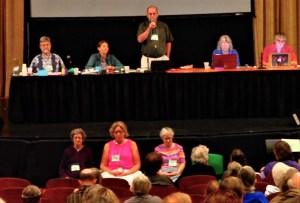
The top level of governance in the Society of Friends is the yearly meeting, so-named because it gathers once a year in decision-making sessions. The constituent local congregations, in contrast, are termed monthly meetings, since they gather in business sessions once a month. (Yes, it’s confusing, since we sit together in worship at least once a week as well.) Everyone active at the local level is welcome to participate in the annual sessions.
Rather than having a single overarching yearly meeting, ours exist independently, originally on a regional basis. Something like the various strands of Eastern Orthodox, for that matter, with the Greek Orthodox and Russian Orthodox the best known of many.
Among Quakers, New England Yearly Meeting is the world’s oldest, founded in 1661, and was held in Newport, Rhode Island, until 1903. Since then we’ve gathered for a week each August on college campuses or other residential sites around the six-state region. In my time here, that’s been Hampshire in Massachusetts, Bowdoin in Maine, and Castleton in Vermont, and I’ve heard tales of the years the event was held in a camp on Lake Winnipesaukee in New Hampshire.
It’s a solemn and joyous occasion, one that many participants – and many families – schedule their work vacation time around. It’s something like a huge class reunion, too, where you reconnect with many people you hold dear. And living in a college dorm, as most of us do, it’s not uncommon to find that random pairings among those of us who go solo turn into regular roommates, year after year.
So I’m still stunned by the announcement a few weeks ago that we will not be meeting in person this summer, due to the coronavirus. Yes, we will be attempting something online, but it won’t be the same.
Just as jarring is the more recent cancellation of summer sessions at Friends Camp in Maine. For many of our kids, it’s a highlight of their year, and friendships they form there sustain them through high school and college. As one of our neighbors says, a camper who became a counselor, the news is a bummer.
Amen.
To put the U.S. coronavirus crisis in perspective, consider that its toll has surpassed the 58,220 deaths of American servicemen in the Vietnam war. And to think, it would have been much worse if we hadn’t hunkered down, even as the virus continues to multiply.
Yes, I know it’s premature to expect our social lives to be returning to “normal” anytime soon, but let’s keep the hope alive.
Here are ten things I’ll say we’re missing.
Schools I’ll set aside as a whole special category.
What are you especially missing these days?
Coming to join the Society of Friends, or Quakers, puts me in a unique religious circle.
Here are ten examples.
~*~
~*~
What do you like about your own path of faith?
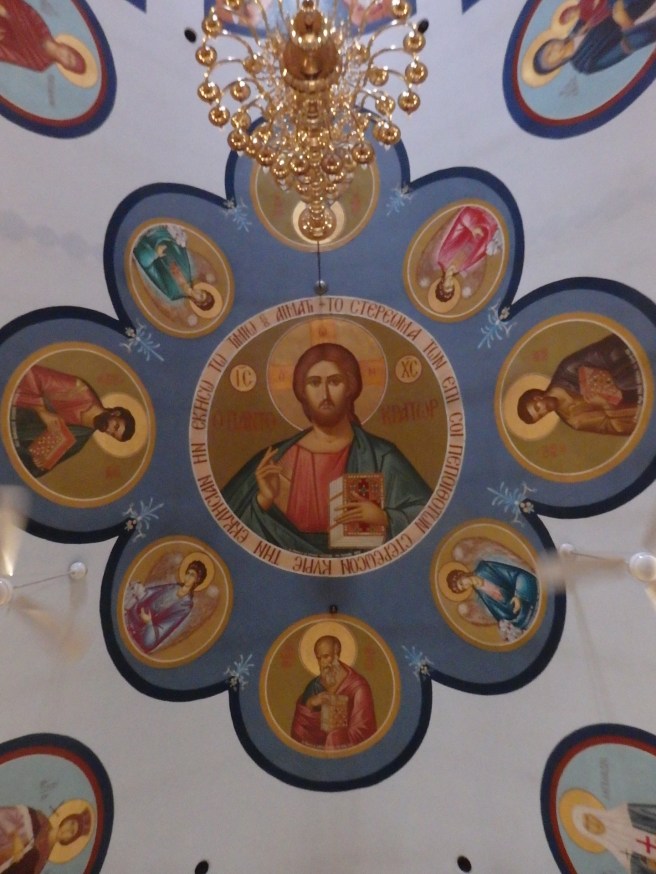
For the Eastern Orthodox, today ushers in 40 days of Pascha, or Easter. It’s not a one-day event, but the joyous response to Great Lent, culminating in the feasts of the Ascension and Pentecost.
It’s less intelligible to the modern ear.
OK, that’s the flip retort, but it’s true. The King James Version of the Bible sounds truly remote and incomprehensible to most Americans, and I suspect that’s part of the appeal, the way Latin used to be for Roman Catholics.
I’ve tried to teach our teens in Meeting how to use the “thee” and “thou” that are so much a part of traditional Quaker expression, but find the kids are completely baffled. The 17th century language is the core of the KJV, too. Take note.
But as those fluent with Hebrew remark, the KJV is also full of mistranslations, some of them deeply ingrained in our English language and thinking.
We can blame one of the characters in my upcoming book The Secret Side of Jaya for that translation problem, since the KJV (more officially known as the Authorized Version) drew heavily from his English renderings. That’s something that could lead to an arcane debate we’ll not get into today.
As for me, I’d prefer cracking the nut open, using as many different translations as possible, making the events all the more astonishing.
You’re welcome to check out what I’ve been examining in my reading of the Bible straight through at my blog As Light Is Sown.
But first, in recognition of today’s celebration, Happy Easter.
 Jnana's Red Barn