On my Monday free of the office, I drove up the palisades to nose around a picturesque river city in dull, mid-October weather. Looked at the signs. City Fish Market – Fresh or Smoked, down along the water. “Bill’s,” one door said; the other was “Private.” Down the main street from Doug’s Steak House, which was supposed to be THE place for Mississippi catfish, the town school stood in front of Lock and Dam No. 10.
I pulled into the Corps of Engineers parking lot as the Jack Wofford pushed its barges into the lock, noticed an observation tower, and climbed up to a deck occupied by mostly married retirees. But in the corner, more my age, was a woman in a London Fog trench coat and big boots, her long, black hair blowing in the cold wind. For a while I wondered if she was part of the pairs and quartets of older folks with their cameras who had come to view the autumn foliage and poke around the gift shops and galleries. She turned her head, noticed me briefly, turned back several times. Between twenty-five and thirty-two, I guessed. Proper makeup, classy.
Then, on the riverboat, a cook appeared at a door and fired back with his camera. She laughed.
Once the retirees beside her left, I asked her how the crews got their three lengths of barges – 3×3, for nine in all – out of the locks. “I don’t know,” almost a question. “I’ve never been here before.”
This time I noticed her crooked teeth. Began to wonder about games.
The cook emerged again, this time from the pilot house, and threw something, calculating for the wind. The object curved sharply at the last moment, into her fine catch. She unwrapped it a bit, saw it was a brownie with a phone number and address inside. She giggled to another old couple: “I think he’s had a lot of experience.”
Once the riverboat churned out of the lock, she descended to a powder blue Ford Torino, donned kid gloves with little holes for driving, and drove off.
The wrapper around her plates left me wondering if she was from the Henry County in Iowa or the one up in Minnesota.
I was left wondering, of course. Why so dressed up? And free on a Monday? That wasn’t a typical single person’s car. A professional, between stops? An art major, who gave it up for money? A government worker, with Columbus Day free? Off to a sweet rendezvous? Delightful divorced? Bored, with kids?
Me, at the time, with my own wife a thousand miles to the west, presumably finishing college.
I read – and write – not to escape the world but rather to more fully engage it. So literature for me hardly falls into the Entertainment category, even when it’s entertaining.
Likewise, my goal in the written word is to perceive some basic or essential connection with new clarity, understanding, and compassion.
This makes a world of difference, page by page. Maybe I’m just looking for holy scripture, even of a secular sort. Or at least the Holy One along with the mundane.
Often, my approach to writing and other fine arts resembles the essence of a dream – one foot in the present, the other in the past. Or, in another way, one foot in concrete reality, the other in fantasy of some sort, such as surrealism, as a way to engage more than I’d otherwise apprehend.
Rockport, Massachusetts, sits at the end of Cape Ann.
Mention “the Cape” anywhere in New England and people assume you’re talking about Cape Cod, that marvelous arm extending from southeastern Massachusetts. (Well, it does have its own dictionary entry.)
Mention “the Other Cape,” and a few knowing heads will nod or smile in recognition of Cape Ann, jutting from Boston’s North Shore.
It’s not that those are New England’s only two points of land extending into the ocean – the definition of a cape. For perspective, two of Maine’s most photographed lighthouses are on Cape Elizabeth and, close to us, Cape Neddick.
What Cape Ann and Cape Cod share is a certain ambience, a feeling that – well, you’re in a unique place and not just anywhere in New England.
If you’re not familiar with Cape Cod, let me say there are many fine guidebooks that describe the experience. Today’s gallivant, though, takes us ever so briefly to Cape Ann, which by its most generous definitions (probably mine) can be no more than a third the length of its famed rival. While Cape Cod is neatly demarked by the Bourne and Sagamore bridges, Cape Ann is a bit more diffusive. Since we come down from the north, we find that “Cape” familiarity in the air as we come into Ipswich, which claims more “first period houses” (1625 to 1725) than anywhere else in America – 58 in all. It’s a charming community and, like most of Cape Ann itself, has a more varied mix of social classes than you typically find on the bigger peninsula.
My introduction to the town came last fall when K. Peddlar Bridges invited me down to do a poetry reading on his Roadpoet cable-access television show – and we had a blast. Before the taping, I went for a walk through some lovely year-round neighborhoods that could stand as textbook tours of American architectural styles. I crossed a stone arched bridge as geese took V-formation and honked low above me. Turns out the 1764 Choate Bridge is the oldest double stone arch bridge in continuous use in the country. (I don’t make this up, nor do I challenge the accuracy of the claims.) Leading to an impressive Colonial-era garrison house, the span connects to Turkey Shore and Labor in Vain roads. You get the picture. And, yes, you don’t get a better sense of that Puritan outlook than “Labor in Vain,” do you?
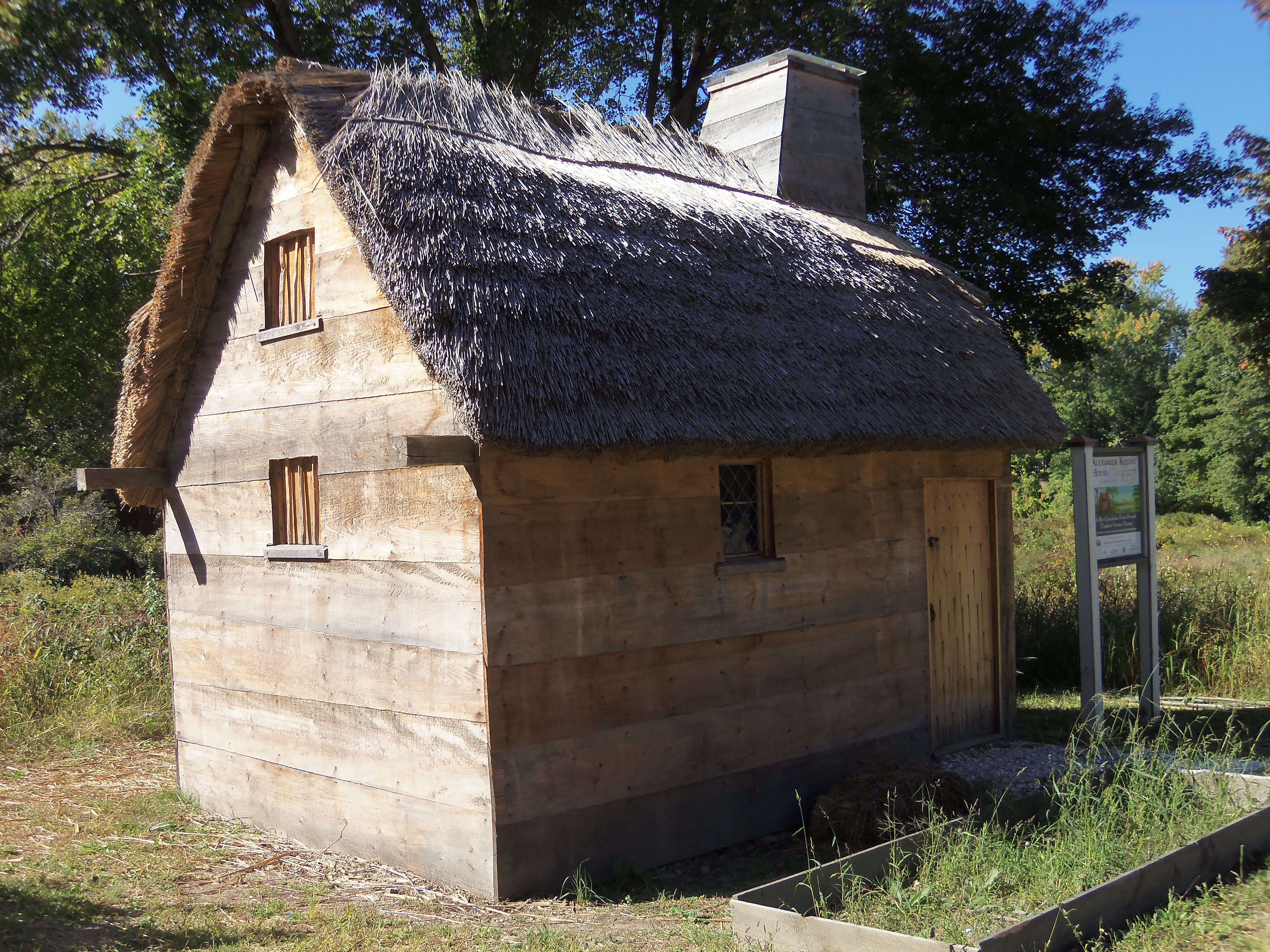
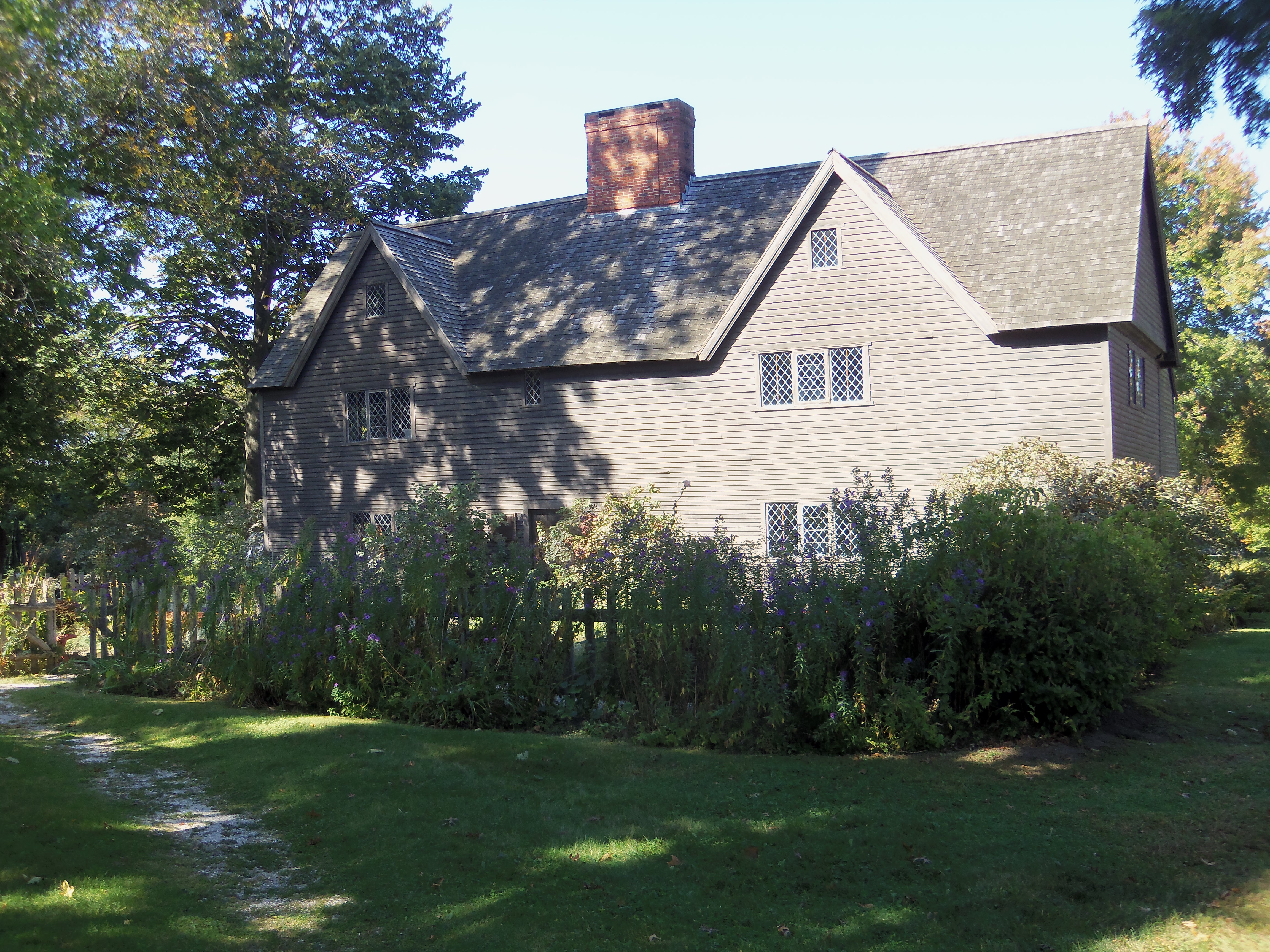
The reproduction 1657 Alexander Knight house in Ipswich, Massachusetts, suggests the difficult life facing the early settlers, especially through a New England winter.The elegant 1677 Whipple House in Ipswich is considerably smaller than the House of the Seven Gables in Salem but similar in style.
So the next week, my wife and I took off for a fuller exploration. We headed on down the road through gentleman farms and veered off for Crane Beach, passing long vistas of salt marshes where prized hay was once harvested. (It was high in mineral nutrition but gave the milk a salty taste, according to the tales.)
The beach itself was once part of the Crane family’s Castle Hill summer estate, which is another destination. The estate, the 1,234-acre Castle Neck dunes and beach, and adjacent 700-acre wildlife preserve are part of the Trustees of Reservations holdings. (Be advised, there’s an admission fee to the park – $8 a car when we went; up to $25 a car on summer weekends.)
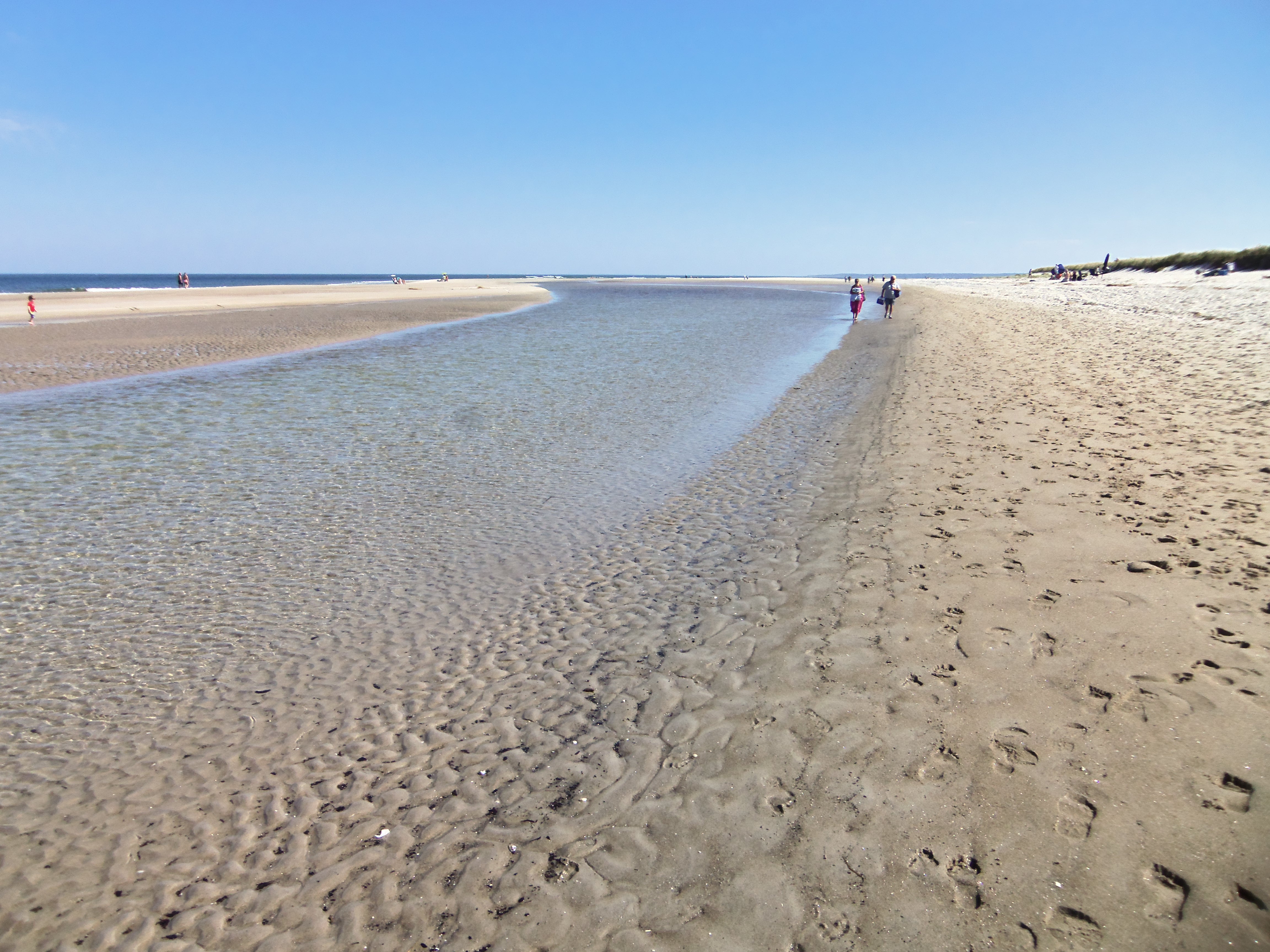
But what a beach! My wife was overjoyed to see white sand, like those of her native North Carolina, rather than the usual gray or brown of New England. And that sand seems to run on forever, with fascinating patches of rippled washboard, tufts of sea oats, and an array of shells we don’t find in our usual rounds of the coast. It may have been October, but our nostrils were greeted with that distinctive Coppertone aroma, and our eyes viewed an array of sun worshippers extending their tans as well as a few daring souls in the water. We walked and walked and, well, might still be walking if we hadn’t felt hunger kick in.
We’ll be back.
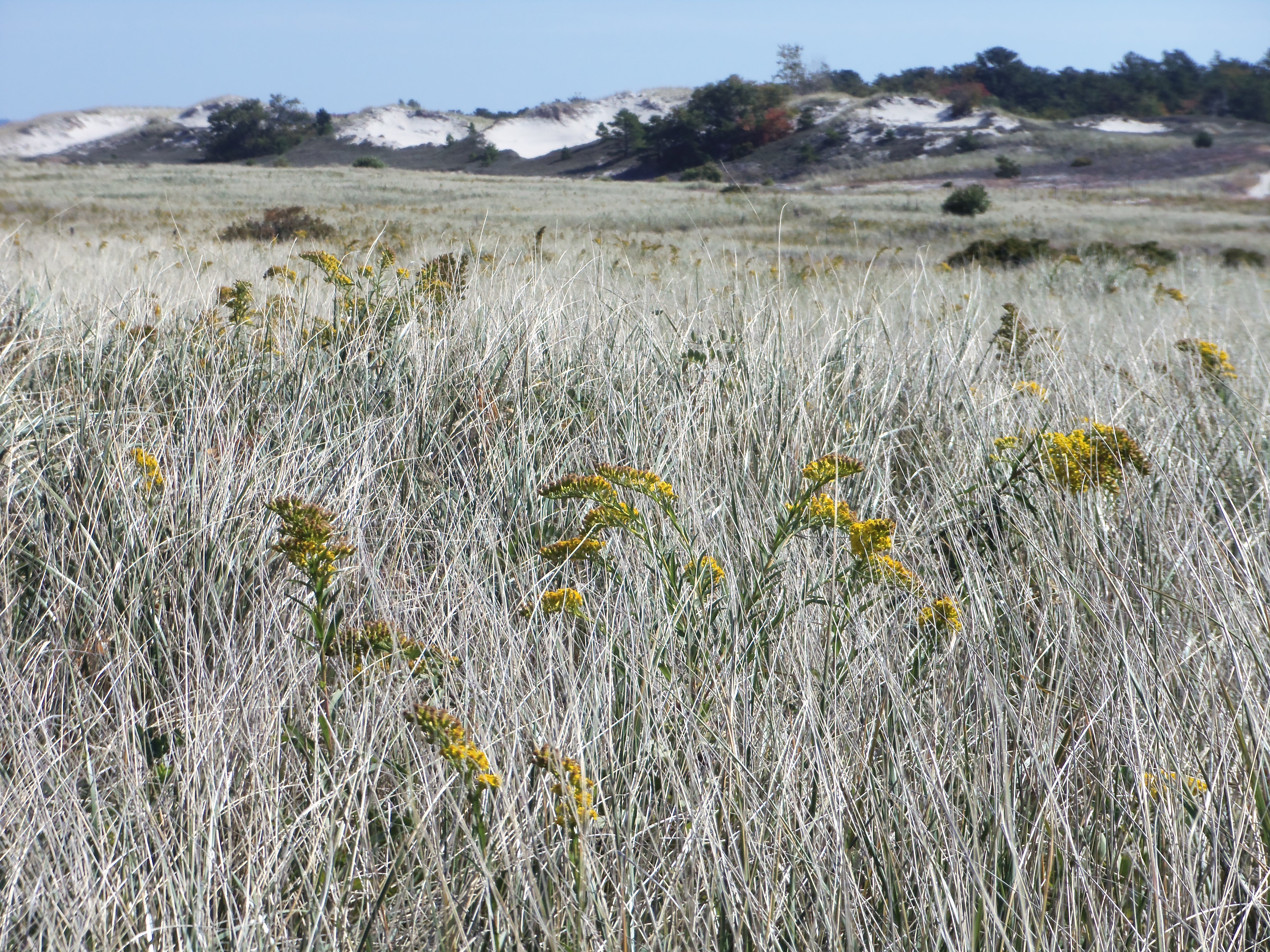
Washboarding and footprints decorate the sand at Crane Beach.Here’s a view looking into a dune behind the beach.
Venturing on, we came into the small waterside village of Essex, where we poked into Woodman’s “in the rough” for a seafood lunch. “Rough,” which is also in the name of an outdoor haunt we love in York, Maine, seems to indicate ordering and picking up from a counter rather than wait staff service, as well as a picnic-flavor rustic decor. As we looked at the blackboard and its prices, we nearly left for cheaper fare, but Rachel caught a posted review by food gurus Michael and Jane Stern – and I knew we weren’t leaving. I’m glad we stayed.
It was fun and filling – they don’t skimp on their portions. We can see why it’s a classic destination for the traditional regional seafood, especially of the “messy” sort. And, as she said, they “know how to do batter.” That’s a high compliment on her part. (Onion rings, anyone?)
The heart of Cape Ann is the city of Gloucester and its varied neighborhoods around the waters. It claims to be from the same year as Dover, although unlike my city, it was abandoned for a period, and is about the same size, roughly 29,000 residents. It lays claim to being America’s oldest seaport and has always been a busy, often brutish, fishing harbor. Gorton’s Seafood uses the city’s sea captain sculpture as its emblem. The Perfect Storm movie captures some of this legacy. These days it’s also the home to a number of whale-watch operations, due to its proximity to the famed Stellwagen Bank fishing grounds. In the 1950s and ’60s poet Charles Olson sought to capture the local spirit in his Maximus series, drawing on Ezra Pound’s literary foundation.
For us, though, the glory of the place is its three large wind-generator turbines rotating gracefully from the highest points along Route 128. They are immense works of art, comforting, landmarks. How anyone can oppose their construction baffles us. And, yes, they do sing … softly.
The trees might give you an idea of the scale and majesty of these Cape Ann landmarks.
Cape Ann culminates in the town of Rockport, which has long attracted summer artists to its shores. More recently, the three-decade old Rockport chamber music summer festival has developed a loyal following, which led to the 2010 opening of the 330-seat Shalin Liu Performance Center and its year-round offerings that include classical, folk, blues, and jazz. When they say “intimate,” it’s true. What makes this hall truly amazing is that the back of the stage has wooden panels, for acoustical purposes, that roll away to reveal a panorama of the harbor. Maybe the Santa Fe Opera surpasses the view, but I bet you can find folks who can quibble.
The village itself has much of the Cape Cod shopping flavor of boutiques, restaurants, artist galleries, jewelers, and so on – especially in its Bearskin Neck district.
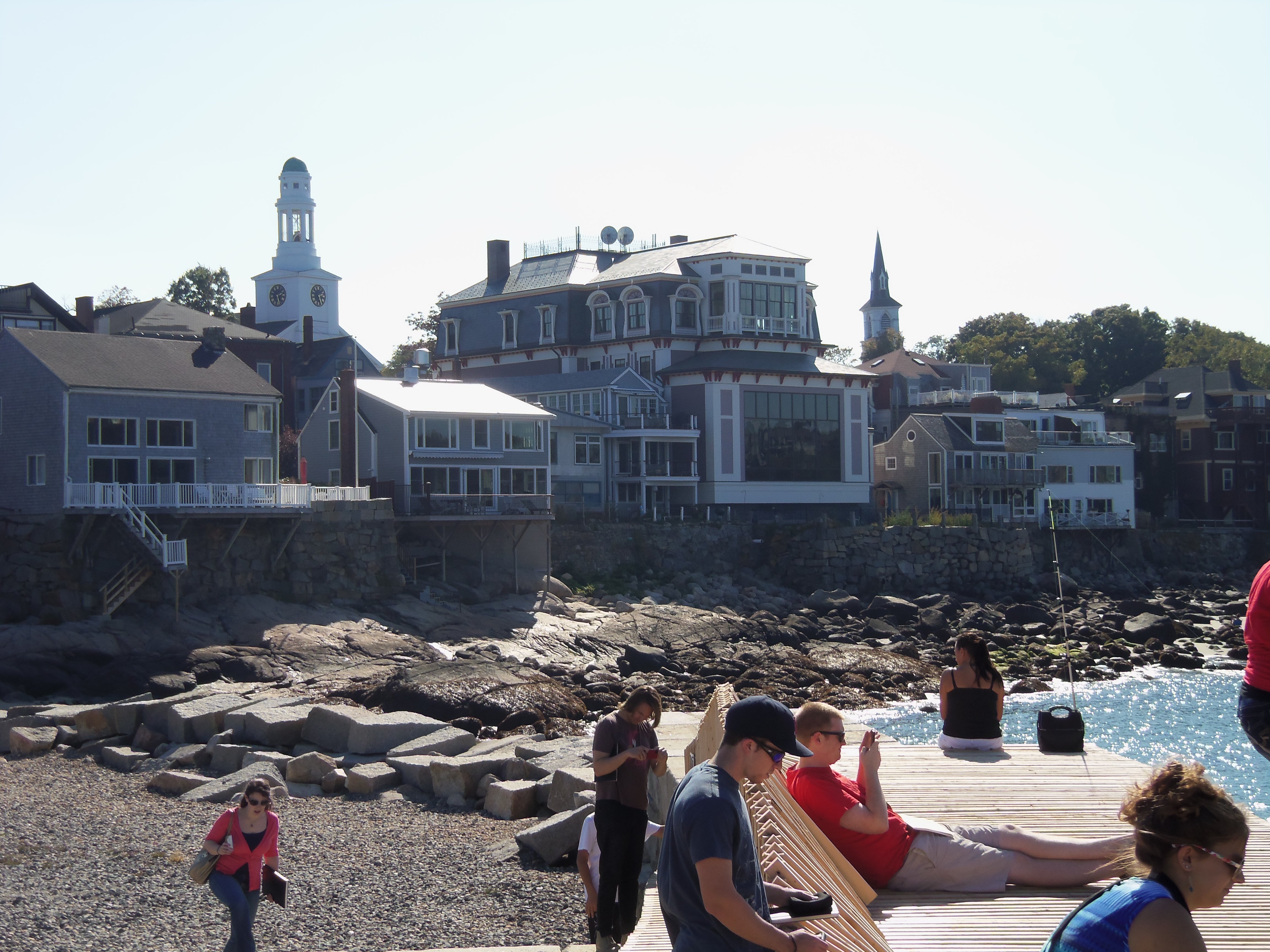
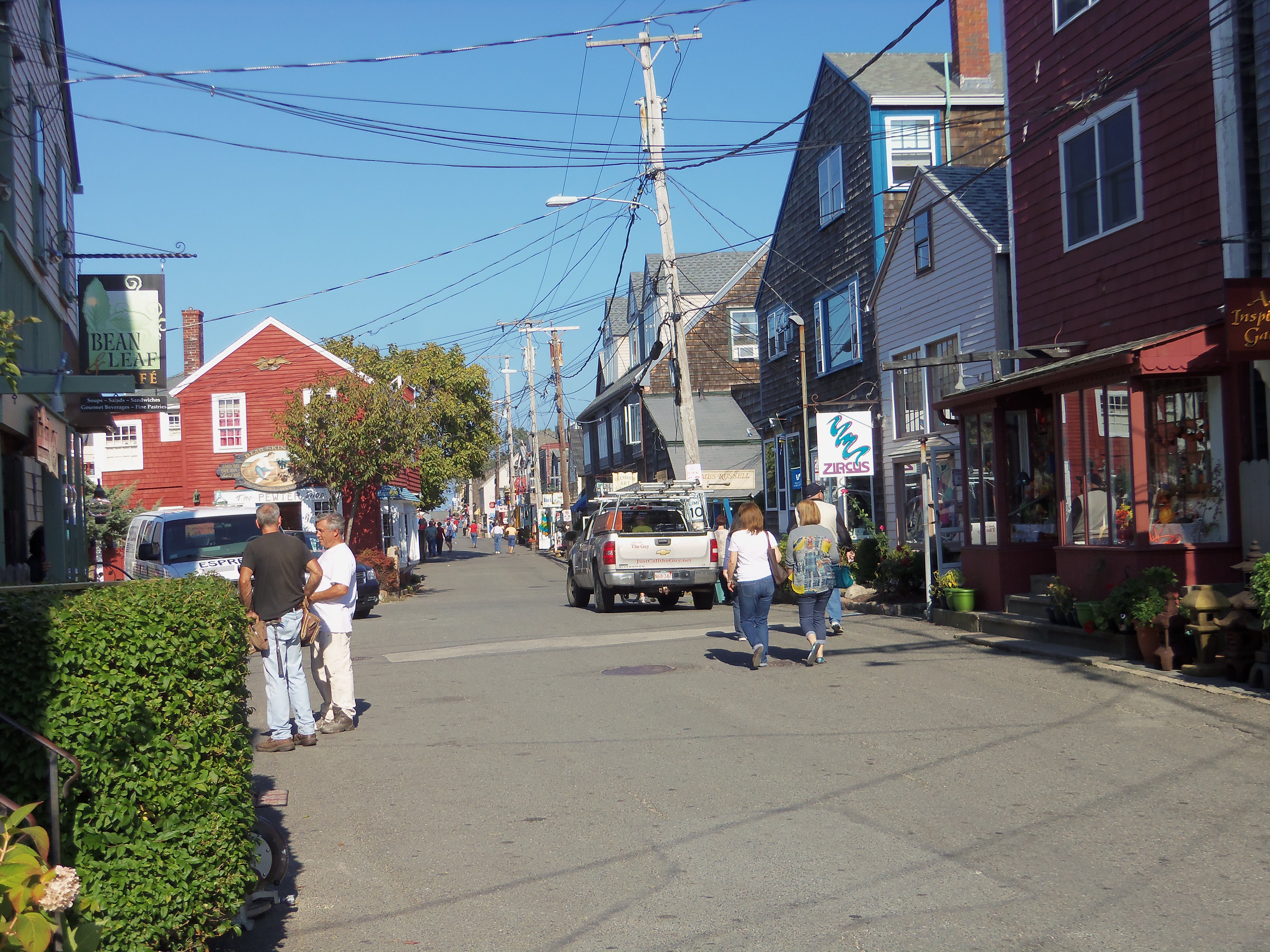
The big window in the largest building overlooking Rockport Harbor is the back of the stage at the Shalin Liu Performance Center. By the way, the tide’s out. We were among a crowd enjoying an art installation that doubled as sunny seating on one of the stone wharves.Downtown Rockport has a traditional blend of resort retailers … and shoppers to match.
By the way, Massachusetts Bay Transit trains run from Boston’s North Station to Rockport, with Cape Ann stops along the way.
While I mentioned whale watches, I should note we prefer to venture out from Newburyport to the north, in part because the vessel there has the option of heading to either Stellwagen Bank in Massachusetts Bay or Jeffrey’s Ledge in the Gulf of Maine. When it goes to Stellwagen, though, it cruises around Cape Ann and offers fine views of the Straightsmouth Island and Thacher Island twin lighthouses – the 1861 replacements for the 1771 originals – closer to Gloucester Harbor.
You can name those who jump in quickly, volunteering to tackle any new task their supervisor proposes. (“Sure, Boss, we can do it.”) And you can name those who are more cautious, evaluating the time commitment and resources.
I’m thinking, too, of all the people who join a committee and then fail to follow through.
Or the coworker who’s muttering under his breath once we’re overloaded with the additional project. Or all the other tasks that get slighted.
Back when I was living in the townhouse apartments “on the hill,” the preschool tot next door was learning he could manipulate me presumably, any grown up into waving to him. All he has to do is wave first.
At first, he was pretty shy, wondering whether he should wave at all when I wiggled my hand or arm in his direction before driving off to the office or the grocery. In time he became more intrigued, hovering at their open front door or staying close to his mother if she were sitting at their stoop.
And then he became bolder. One morning, he parted their upstairs blinds and cried out from the window to me, just so I could see his smile and wave.
The next day, he told me as he rode his bike around the parking lot, “I runned into your car.”
“Oh, where’d you hit it,” I replied, not the least worried, not with all the rust spots that are appearing simultaneously on my well worn vehicle.
“On the tire!” he piped up as I performed a mock inspection.
And finally, he came charging out the door just as I was about to drive off, grinning and hailing me in huge motions. “Welcome!” he cried out. “Welcome to Walmart!”
“Well, say `hi’ to Sam for me!” I chuckled.
His father, a few steps behind, shrugged as they set off on their errands.
For much of its history, the Society of Friends forbid the use of engraved gravestones, deeming them vain and superfluous. Even so, another custom emerged, the drafting of memorial minutes for Quakers whose lives might serve as an inspiration for others.
The result was quite different from either the typical obituary or eulogy, and many of them prove surprisingly candid, as genealogists discover. If a eulogy celebrates the person, the memorial minute focuses on the individual’s spiritual life and service, especially in the ways these play out in the world.
Often, the minute would be approved by the local Quaker Meeting and entered into its records. If the individual had been active at a wider level, the minute would also be forwarded to the Quarterly Meeting (a gathering of local meetings that comes together four times a year), where it would be shared and, in due practice, approved. If appropriate, this would be repeated at the larger Yearly Meeting level.
As an example of the practice, here is the nearly finished draft of the minute for one Friend. As a member of the committee that prepared this, I’d like to show the “long” version that includes more of her remarkable career, in contrast to the shortened versions that were approved by the circles of Quaker meetings.
Alanna’s minute was approved by Fresh Pond Monthly Meeting and endorsed by Dover Monthly Meeting, and then accepted by Salem Quarterly Meeting, before being included in the minutes of New England Yearly Meeting’s sessions last month.
Alanna and me early in our friendship.
ALANNA CONNORS
September 25, 1956 – February 2, 2013
From an early age, Alanna Connors discovered a need and a capacity to trust her own compass. She was a mathematician at a place in time where women were seldom found. When her high school math teacher flunked her for excellent work, another teacher told her: “You know he’s giving good grades to boys and not to you, because you’re a girl.” Recounting the story in later years, Alanna said, “I didn’t need that; I knew I could do the math.” She held true to her course.
Long before finding Quakers, Alanna lived the testimony of experiencing God in everyone. While most of us have tight circles of caring – our family, friends, coworkers – Alanna’s circles were as unbounded as a wave expanding to all of space. It seems no accident her profession became looking at objects distant in the universe: across the many communities of her life’s paths, she welcomed all beings. Living with her was a joy; her love for others was never abstract but a centered flame close to her and everyone she touched.
Alanna was born September 25, 1956, in Hong Kong to Richard and Sonia Mitchell Connors. Her mother, who herself had a degree in mathematics and studied with Jean Piaget at the Sorbonne in Paris, ultimately worked as a font designer. Richard learned to fly in his youth and became a pilot with Pan American Airways, stationed in Hong Kong. Through his delight in sailing, his five children all learned to sail. Alanna took the lead, becoming a competitive sailor in her time at the Massachusetts Institute of Technology.
Returning to the United States in 1963, Alanna’s family settled in Greenwich, Connecticut. Living with four siblings – one older, Cynthia, and three younger, Kathleen, Noirin, and Patrick – in environments not always centered on these children’s welfare, Alanna developed an immense capacity to listen and extend empathy. Imagination shone through her grade school writings; her elaborate, award-winning gingerbread houses; and family-staged dramas.
Alanna was irrepressibly fascinated by math and science. She thrilled to the elegance of mathematics in expressing, revealing, and predicting physical behaviors. For her, mathematical physics was inseparable from the playfulness, color, artistry, and imagination by which she produced it. Whether it was classroom notes, derivations on scratch paper or napkins, or formal solutions, her handwritten analyses were crafted in flourishing script, vivid with colored pencil illuminations, and playfully annotated with such characteristically inventive words as “whatsit.”
Alanna’s dorm room hosted a wide array of human spirits. Her hotplate, washstand, handmade teapot, and mismatched cups provided hearth and an excuse for tea and convivial warmth at all hours of the night.
She met fellow student Phillip A. Veatch while they were both organizing MIT’s first on-campus food cooperative. After a year of courtship, they exchanged private vows of marriage in 1978, on a basketball court in East Cambridge. Alanna was opposed to the state-sanctioned institution of marriage because of its historical role in the oppression of women.
Communal living, conceived around Alanna’s dorm room, continued into her committed life with Phil through group houses with shared vegetarian cooking. While in Maryland during her doctoral years, they asked all prospective housemates: “Can you have: 1) too much garlic; 2) too much chocolate?” A no answer on both questions was mandatory for joining the group house.
With one housemate, Alanna went “church shopping.” While appreciating the wide span of worship experiences, Alanna gravitated to the Religious Society of Friends in 1982 in Adelphi, Maryland, dragging along her then-reluctant partner. A deep commitment to the Quaker principles of simplicity, peace, integrity, and justice soon enriched both of their lives. They continued at Dover Monthly Meeting in New Hampshire and finally settled at Fresh Pond Monthly Meeting in Cambridge, Massachusetts, in 1998.
Wanting to understand stars, she became a groundbreaker in charting the sky of X-ray sources. Being of a mind to “like thinking we are all professional visionaries,” Alanna’s deep searches into the distant sky uncovered new observations and questions. After earning her doctorate at the University of Maryland, Alanna made significant contributions to the Compton Gamma Ray Observatory as a research scientist at the Space Science Center at the University of New Hampshire. She introduced astrophysics to Bayesian methods of statistics, which start from an assumption that knowledge about a problem is always incomplete. Applying this rigorous data analysis to X-ray and gamma-ray astrophysics, she provided a foundation for statistical methods generally unknown to astronomers in the early 1990s.
As a banjo player, she encouraged use of the Rise Up Singing songbook, learning by heart its song “Julian of Norwich.” Original lyrics and tunes came to her, either fully formed or developing through writing. Alanna’s spirit still comes to us through the texts and music of the dozen songs she set down in composition.
Despite being an intense introvert, she harbored a lifelong belief in the importance of community-building. She cofounded an astrophysics statistical working group at the Harvard Smithsonian Center for Astrophysics. As a senior scientist, she was known for her support of young graduate students. She founded a singing group at Dover Meeting, and while living in Arlington, Massachusetts, enjoyed singing with Nick Page’s Mystic Chorale Singers. After the birth of her son, Roy, in 1999, she worked with other parents to reform special education in the Arlington public schools. She volunteered regularly at New England Yearly Meeting annual sessions working both in child care and the bookstore. She regularly attended the Women’s Group at Fresh Pond Meeting, where she spoke regularly about her concerns in raising her gifted son.
Alanna envisioned and encouraged public science education. She taught astrophysics at Wellesley College as a visiting professor, participated in university physics instruction at UNH and UMD, contributed to public education in science through projects at the Christa McAuliffe Planetarium in Concord New Hampshire, c0-organized family science days at her son’s elementary school, and encouraged exploratory science learning and teaching through many other avenues. She had an abiding interest in the history of physics and astronomy from its ancient origins, in welcoming women’s participation in physics, and in celebrating stories of diverse contributors to science.
Alanna was first diagnosed with breast cancer in 1995. She lived with the disease for 18 years. Characteristically, through its recurrences and treatment, she refused to be defined by the disease and conceived her son, Roy, born in March 1999. To her, the illness was but a single strand of her life. When Roy was 4, her disease recurred, and she took him with her to treatments, where he found the hospital’s high-energy accelerator intensely interesting. Whatever life brought her, she lived with it; she saw illness as no excuse to build walls. When her disease recurred for the last time, in an advanced form, Phil asked if she wanted to go on a special vacation. She did not, preferring to live in her callings.
At Dover Meeting, 1988-1998, she rotated through nearly every committee but also stayed long on Buildings and Grounds. During the first Persian Gulf War, Dover Friends called on her to write a compelling minute explaining the Meeting’s opposition to the invasion of Iraq and Kuwait. Phil and Alanna were lifelong advocates of same-sex marriage. When they decided for Roy’s sake to get legally married, they would not seek marriage under the care of Dover, as that meeting had not yet completed its process of hosting marriages for same gender (it has since done so).
During her time at Fresh Pond, her participation in committee work was limited by parenting and the recurrences and treatments of breast cancer. She was, however, a quiet and regular presence at Meeting for Business and an infrequent but powerful minister during Meeting for Worship, where her ministry was often structured around song.
Just as she knew not to take to heart a teacher’s censure that could have devastated a young mathematician, Alanna maintained integrity without ceding herself, her work, or others to be diminished. Mathematics was one route by which she independently investigated, questioned, and confirmed the truth for herself without relying on the claims of teachers and other external authorities. She stood up for discovering and expressing the full potential of one’s mind and heart, inspiring those around her to undertake aspirations and risks of which they did not suppose themselves to be capable. She knew greater being lies imminent within us all. Whether it was the rights of any couple to publicly live their committed love or a child’s mind emerging along ways and curiosities differing from the school norm, Alanna honored and worked for the fuller life she knew to be there.
Alanna’s spirit lives with us and continues to teach us. We remember her implacable but gentle striving to see the truth and to tell it. The women of Fresh Pond recall Alanna’s intense, powerful mothering, against all odds. Throughout her life she resisted the limits and distortions that social norms can impose on our vision of others. Knowing that a prism takes a beam of light and separates it into many separate parts, Alanna lived her life striving to bring the many separate parts of our world together into one shining beam.
Her memorial service was March 2, 2013, in the Wellesley Friends meetinghouse under the care of Fresh Pond Meeting. She was 56.
One of the most revolutionary concepts the Society of Friends has upheld is an understanding of “church” as a body of believers – not as the building (“the Methodist Church” beside the river) or the organization (“Presbyterian” or “Congregational”) or a hierarchy (“the Vatican” or even a nearby bishop I once heard quoted as saying, “I am the church.”) This sense of a gathering of the saints is the reason ours is a “meeting” of the church – of the believers – and why we gather in a meetinghouse, rather than calling the building itself the church. For that matter, early Friends typically referred to the gathering place of other denominations as a “steeplehouse,” thus emphasizing a distinction between the building and its users.
Keep your eyes and ears open, though, and you’ll observe the inevitable turns that try to fit us into those other concepts. Calling us, for instance, “the meetinghouse people” or our organization the Dover Friends Meetinghouse, rather than Meeting. While there is something quaint about referring to a “Quaker Church” down the road, it misses the point entirely. For us, a church does not burn to the ground – its martyrs may burn at the stake or we may burn with a passionate cause, but the church itself will be found everywhere, with many different individuals, and at odd moments. In fact, in this understanding, “church” even becomes a verb – something that can happen on a street corner or a field or our workplace as easily as in our historic meetinghouse. As I remember one couple saying, “We were unchurched and then we discovered Quakers.”
By extension, the Society of Friends was envisioned as being a people of God, modeled loosely on the Jewish people, with much of the teaching and practice coming down at home through generations of families. Whatever shortcomings Quakers have experienced in instilling the continued practice in their children, we remain a people of faith – one chosen freely, and experienced both personally and together. We meet, indeed, in many ways.
As I mentioned to her sometime back, I’d spent much time in a recent year reflecting on the jagged pathway that landed me here. Often I’ve felt I took one took many turns somewhere back there, and on some mornings after we moved into this house – well, some moments in my homes before that, too – I’d find myself wondering just where the hell I was, after all. In a bigger sense, I’ve been trying to envision how it all adds up. Guess it’s another version of the old “What is the meaning of life” conundrum. At least I finally figured out what I wanted to be when I grew up … retired! Meaning free to concentrate on the Real Work. (Now that I’m there, I’m finding more questions.)
In the round of reflection I’m discussing, I concentrated on high school and college – the emotional side, especially – meaning the time before I actually started keeping a journal, and a period that’s largely been a fog in my memory. I uncovered some wonderful prompts for revisiting this, especially letters from the sophomore high school English teacher who put me on the writing/strict grammar path, as well as a confession that despite all the contrary efforts, high school was a bummer. Unlike yours, my public school system was geared largely toward instilling conformity and retarding the growth of gifted students, unless you were a male athlete. Still, much has come back, making me wonder how I survived at all.
This round, I kept asking “What if” … for instance, one of those I saw as goddesses in high school had swept me away (or, more realistically, if I’d been able to say something close to what was really on my heart, or hormones, leading to some, shall we say, quality time together). Would I have continued at Wright State, rather than transferring to Indiana, and eventually stayed in Dayton, maybe even as a Republican? Or if either of my two girlfriends through the college years had led to marriage and home … both of them from Dayton, though neither ended up dwelling there, from what I can tell. Most of those goddesses wound up settling into mundane adult suburban lives, as I find from the class website and Internet – including our online class reunion site. I’m not kidding. (Who are all those old people in those silly photos? The ones holding beer bottles, especially.) (Note to self: Do not allow yourself to be photographed holding a beer bottle. Ever.)
On my part, what I keep finding is a sense of inevitability. Or, as Friends say, “As way opens,” if we’re faithful. There are good reasons I’m where I am, and for that I’m grateful, after so many seasons of sojourning. Even so, when your note arrives, there’s a tinge of sadness or gentle envy, as you live out what appears to be so close to what I had desired when I dreamed of being an independent writer living in my Promised Land, with a house full of my children and visiting friends and a quiet studio hut on the ridge behind. (My wife finds that vision humorous, by the way – finds holes in it all the way around, beginning with who’s going to clean up after the big parties I intended.)
Still, looking back, there are many things I don’t understand, and too many points where I’ve looked away or accepted a glib answer, rather than probing. I’ve always been prone to seeing what I want to see and overlooking the rest – usually, the warning signs and difficult details. (Again, my wife is good at bringing me back to the wider range of questions.) I’d say that trying to answer the inquiry of why you and I didn’t wind up together would be one of those. The astrological answer that you and I would never wind up together but remain prime friends fails to ask why. I believe there’s far more to be uncovered there, if we’re willing. Just why have you always made me feel better, for starters. Or feel special and elated.
So here we are. Who would have thought we’d be attending kids’ soccer and rugby matches? Not us!
Or dealing with declining parents. Your mother’s dementia must be difficult. You mention that she still remembers people and is in a wheelchair, which makes me wonder if she’s afflicted with Alzheimer’s or something different. My wife and the girls talk fondly of Grandpa Marion and how his Alzheimer’s brought out a sweetness in him, while another, with episodes in the past years, turns mean and paranoid. Parkinson’s is rough, too, with its long decline; I lost a dear Mennonite mentor last January, in Virginia, and one of my best friends here is in the early stages – so far, controlled by medication, when they get it right.
Galapagos? My elder girl will be very envious. At age 11, she went on a big Darwin kick, a passion that has never abated. A few years ago, we went down to the Boston Museum of Science for a special exhibit they had, and it was quite impressive. In all of the historical debate over his insights, I’m surprised we don’t hear more about the religious roots of his work – most of his encouragement and support seemed to come from clergymen. Me, I’m quite fond of his later affection with earthworms. Maybe it has to do with my monster composting.
Now I still want to hear how you distinguish between mystery and magic. I have a few ideas, but I doubt they’re as expansive or insightful as yours.
In the meantime, I’m hoping to get back to poetry by early fall. Why can’t I stick to just one kind of writing? Or be somehow easily identifiable? A good friend’s son, who is a successful serious novelist, seems to have the same problem. He, too, wants every book to be unique, rather than a continuation of or variation on his others.
Gotta run … time to commute, again. And tomorrow, another birthday. How can that be?
It’s hard to think 17 years have gone by since this correspondence! As I said at the time …
Your first letter had me repeating to myself, “She has to be a water sign — or at least have a lot of water influence prominent in her chart.” Now you blithely inform me you’re a Pisces. Ah-ha! Figures! Could that be why you’re so alive in your emotions, as astro-informed friends from my past would insist? (For Aquarian me, meanwhile, aloft in encyclopedic data and logical constructs, staying alert to my own emotions can be a real challenge — especially when retreating into my brainiac self became my way of surviving some pretty intense emotional abuse way back when.) So, in some wonderful ways you help me tap dance into some chambers of my soul. (Molto grazie!) As for the writing skills: do the nuns at dreaded Mother Theodore Guerin get any credit? (Mother … Theodore? And I doubted your age?)
And you wish you look older? Na-na-na-na! Listen to Swami Jnana, kiddo. Do you have any idea how … thoughtful you appear in that photo? It doesn’t get any better than that. Why can’t any of the women I know/have known appreciate being they way they are — which inevitably is much, much lovelier than they presume. (Assignment for future edition, probably when you’re ensconced in that high suite overlooking the Loop and Lake Michigan — I know that view, having been in Jeff MacNally’s eerie in the Chicago Tribune tower a time or two: interview Cindy, Nicky, Cristy, and the rest of the supermodel cult and see if you can find anyone truly satisfied with her looks; bet, deep down, they aren’t.) Ergo: enjoy your current condition while you can. (And may that be for a long, long time!) Most women I know would kill to have the body or the looks of an eighteen-year-old, or so they say. You have the rest of your life to look older. (And may you age gracefully, like Sophia Loren or Joan Collins.) Maybe it’s not really a matter of age, after all, but of self-confidence. Those who are radiant, no matter what, versus those who are wrapped up in their misery. Watcha think?
As for feeling one’s chronological age, you’re an excellent writer: that automatically makes you middle-age. (I know: part of me’s always felt old, too. Maybe it’s just ancient soul.) (My age, by the way, is ninety-two.) But, because you’re an artist, you’re also going to have to find ways of remaining fourteen or fifteen forever. I wouldn’t recommend adult orthodontics as a strategy, although it is an interesting trip and seems to be an good way to open conversations I wouldn’t otherwise have. (And you said something about rambling? Heavens!)
So here I’m looking through some Diane Wakoski volumes for a great insight on adolescence and find instead: “My search for the perfect man, the perfect love, Romance, sexual life, has always been emblematic of my search for something else, you know. In Pretty in Pink, a wonderful character played by an actress who must be thirty but still looks like she’s eighteen, the wise older woman in the film is nostalgically wearing her old high school prom dress and dancing to some golden oldie with the star of the movie (Molly Ringwald) and she says, ‘Wouldn’t it be wonderful if we could start old and get younger every year?’ I recall my elders always saying that ‘youth is wasted on the young’ … “
I very much enjoyed both the batch of poems you sent along. Do you write as effortlessly as it appears? You have some real knock-‘em-dead connections here: “sometimes she’s a ballerina/hanging by her neck/from the rafters/of some wretched dollhouse//sometimes she’s a little girl/with treasure chest eyes/and a bowl-of-pudding smile” is astonishing. Brava, brava, brava! (Envy, envy, envy!) Ditto: “the sky is pink lemonade.” And the line, “trees singing,” keeps triggering to my ears Isaiah 55:12b, “and all the trees of the countryside clap their hands.”
I, too, prefer direct language — although in my writing, it sometimes seems that by creating a deliberate short-circuit, I’m more able to get down into that painful raw nerve you talk about. I wonder if some of the “trying to hide behind huge words and flowery language” you object to (rightfully so) has more to do with a lack of a real emotional underpinning/experience. A few days before your big package arrived, I received two hardbound prize-winning volumes by those “professional poets” we’ve already defined—and I found myself annoyed. You’re right: there is a lot of hiding going on. And it feels like WORK, both the creation and the reading of it.
Then your latest edition came, and I found myself often laughing aloud with delight, because the pieces were coming from another place in the psyche. (Pieces I checkmarked: “Dead Horse,” “Yes, There Still Are Some Good Ones,” “Sam I Ain’t,” “I read a book about a woman …,” “Sardines,” “The Painkiller,” [hey, is that true about the Walibri???], your centerfold [sick! heh-heh!], your on-going adventures [really fine line: “my feathers are slowly being replaced by rocks … being covered by cold, gray cement”] — and the insights in the paragraph beginning, “i have always been on another planet.”
Please, please, please, send a copy of your chapbook. (What a marvelous title — I can almost taste it. A turnabout on Psalm 34, “O taste and see,” which Denise Levertov uses as a title for a wonderful collection of her own poems — so delicious it opens your eyes.) Watercolor nights, what a vivid linkage, almost a micropoem itself … softness, yet I wonder if night scenes can be done in watercolors: now you make me ask a watercolorist I know.
Was kinda curious about where your neighborhood is — thought maybe it was around Hyde Park, or some other brainy neighborhood. Was surprised to find it on my road atlas as being out toward Mother O’Hare instead. So I asked my boss, who says he’s spent a lot of time in Chi’town (he’s from western Michigan), and he said he thought it was mostly duplexes and bungalows out that way. And then Sunday night I was zoned out in front of the tube, not quite watching some dumb detective story set in Your Fair City, and there they went, ripping onto — you guessed it, your fair street, which may have been filled with some fair number of criminals by then or a fairly high-speed chase. Is life weird or what? Looked like ‘50s ranch houses, mostly. Some trees. Short front yards. Many bathtub Madonnas? (Couldn’t tell.)
I’ve done a lot of travel on maps. Some places I’ve never been I seem to know better than some people do who have actually been there. As Howard McCord has written: “A chest of maps/is a greater legacy/than a case of whisky.//My father left me both.” Another quote: “or what my father said/‘go along the coast as far as/you can without getting killed’/my saint is Hsuan-tsang/who got _ back.”
Well, hope you’re still enjoying that big old Dodge Diplomat (go along as far as you can and then come back). Assume college has started. Took me three-and-a-half years to figure out how they rig the game against you: the moment you walk into a classroom, you’re already a hundred pages behind. (Wright College? I went to Wright State University, then transferred to Indiana University in Bloomington.)
So here’s to a rewarding and eccentric friendship. None of my other editors get long letters like this. Actually, they’re lucky to get cover letters. But then, they rarely reply with more than a marginal scrawl, either. I wish I were having as much fun with the newspaper as you’re having with Indigo, but, hey, we don’t have centerfolds, either.