MORE THAN WE’LL EVER KNOW

I’ll have to leave detailed accounts of first-generation Greek immigrants to America to others who have truly intimate material to draw from. Simply portraying the relocation of my mainstream grandparents from a Midwestern farm to a nearby city would prove difficult to pull off.

Still, in my new novel, What’s Left, I find enough to suggest some of Cassia’s great-grandparents’ possible experiences and achievements. She has reason to take pride in what they’ve established for her extended close family. It was, after all, one place her father-to-be would fit well, despite his initial resistance. And now she’s struggling to make sense of it all, especially in her circle of siblings and cousins.

~*~

Not everyone who came to America dissolved into the melting pot concept. Still, they had to sacrifice something. The question just might be, How much?

Extend that to our own personal identities.

What’s your idea of “normal”? How well do you fit in?

~*~

A young Greek-American immigrant on Ellis Island, New York late 19th-20th century. (Hulton Archive via Wikimedia Commons.)

Cassia’s roots included scenes like this.

CHARTING THEIR COURSE

As Cassia reconstructs the household when her father-to-be first shows up, she sees multiple currents in motion.

As she observed in an earlier version of my new novel, What’s Left:

Dimitri’s primarily about family duty. Too many have worked too hard to get us here. For Barney, that’s steam and splatter and sudsy sinks. Tito and Manoula are essentially on hold, preparing for their own futures – college for her, law school for him.

~*~

In another version of the story, Tito and Manoula’s futures could have been thwarted at this point. Dimitri may have required their help in the restaurant and real estate ventures.

Something similar happened with my grandfather, whose classroom education ended at elementary school because he was needed on the farm. Later, though, he did learn the plumbing trade from his two older brothers.

With Cassia’s family, though, they were agreed on a plan. They all worked together to assure it.

What’s your No. 1 goal these days? What support do you need? How are you arranging it?

~*~

Ring dancing at Greek Fest, New Orleans. (Photo by Infrogmation via Wikimedia Commons.)

Cassia’s roots included inspiration like this.

COUSINS WHO COUNT

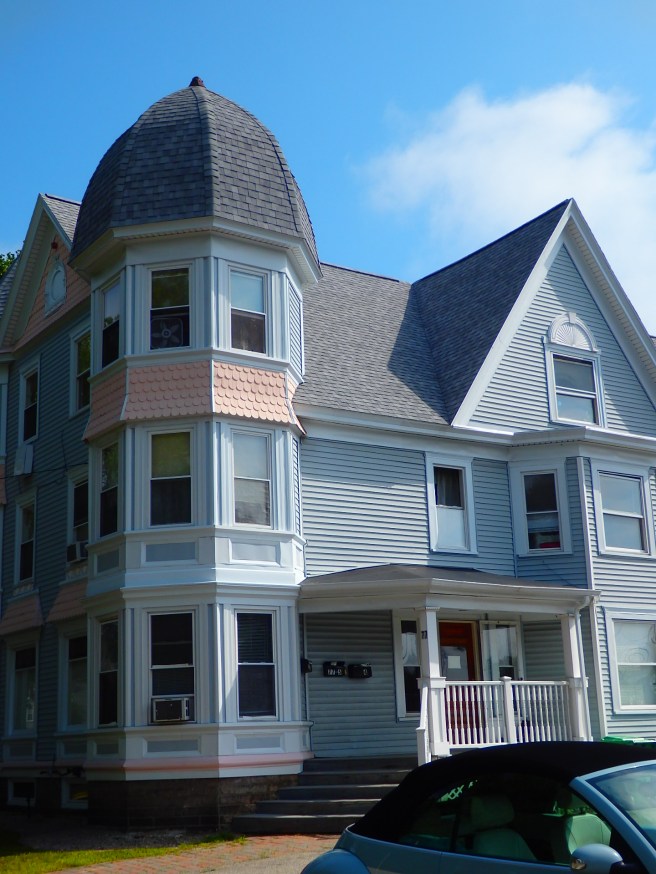
A large Queen Anne-style house with a distinctive witch’s hat tower something like this is the headquarters for Cassia’s extended family in my new novel, What’s Left. If only this one were pink, like hers.

Could I have directed my new novel, What’s Left, to move straight from her loss at age 11 into her subsequent growth within her close-knit circle of cousins?

Since so much of their group identity depends on the family restaurant where they all work at some point in their youth and the big Victorian house where they gather and many of them still live, this would nevertheless require some hints of the history of their being where they are – and who they are – pretty close to the top of the story anyway, plus far more detail about the cousins and their parents than I now need to engage in the opening chapters.

As a writer, I’m left wondering how I’d ever introduce all of this at once and still have you readers following the narrative. A related challenge would be any attempt to work our way back through the family history, like an archaeologist, layer by layer, rather than jumping down to the trunk of her family in the New World and moving upward from there. There are many sound reasons for presenting a history chronologically, after all. Especially when past events help us more clearly understand where we are and who we are now.

~*~

Well, you can check out the book as it stands.

The story, of course, turns toward the crucial decisions they’ll face. Will Cassia and her cousins ever live up to their family’s resourceful and romantic roots? Will they be able to take their legacy to greater heights?

What would you do in their place, given their resources? Stay and work in the restaurant and real estate? Start something of your own while living close at hand? Or head off for careers and family elsewhere?

WHEN THREE’S NOT A CROWD

For me, her uncle Tito originates as a problematic character. I have no idea what prompted me to create him nearly five decades ago in the closing chapter of my first published novel, but he does change the dynamic of the family that Cassia’s father-to-be joins.

Having five siblings rather than four avoids the symmetry of two brothers and two sisters, for one thing, and as an odd number, five pushes us away from possible gridlock. But advancing the story another generation, as I do in my new novel, What’s Left, means we’ll have more characters to follow, once we add spouses and children.

Without him, my new novel would be tighter, since all of Cassia’s close cousins would come from Barney and Pia. Well, maybe Dimitri and/or Nita would have to be recast, too, losing some of the story’s diversity and depth. The plot itself would likely pivot on the sibling rivalry of Dimitri and Barney, and I’m not sure we’d have the impetus for expanding the family enterprise that I, for one, find exciting. The status quo could continue, with the story’s focus on day to day interactions more than transformation of the larger community. The mantle of patriarch, too, would fall differently.

Continue reading “WHEN THREE’S NOT A CROWD” →

MAINTAINING THE BUZZ

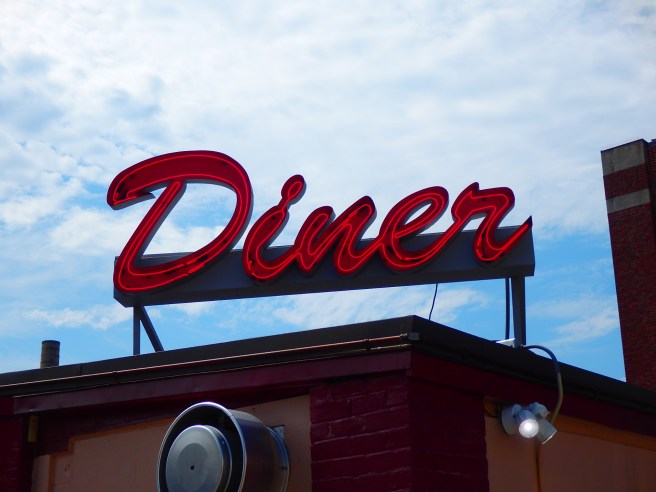
Carmichael’s, the restaurant her family owns in my new novel, has me looking more closely at others.

Successful restaurants, or so I’ve read, can go downhill overnight. The public can be fickle, on one side, and the operation itself, on the other, can implode. Oh, the stories we could tell!

In my new novel, What’s Left, her parents’ generation takes bold steps to anticipate changes in American food tastes. They brazenly agree to slightly re-position their landmark burger-and-fries restaurant (now called Carmichael’s Indiana) and the bar (the Taverna) while adding two new venues, one upscale (Carmichael’s Starlight), the other vegetarian (Bliss).

~*~

Though I cut this from the final version, I still love the taste of it on me tongue:

And the new Carmichael’s Stardust usually offered something daring, for our neck of the woods, depending on how we were feeling and how adventurous our customers were responding. Lamb shanks, anyone? Artichokes? Cornish hens? Brussels sprouts? We were expanding their horizons.

~*~

Well, that would have been pretty daring for the mid-’70s! We’ve come a long way since, something I’ll assume the Stardust menu has pursued. Vegetarian, meanwhile, has become both stricter and more innovative through its vegan adherents. I’m not at all surprised to find how often our meals fall into its range, even without trying. As for a late-night gathering spot? The Taverna strikes me as a step up from a typical bar. Makes me think, in fact, of the late lamented Barley Pub here in town.

Think of your own tastes. Which of the restaurants would be your first choice?

A WORKING MOTHER, ALL THE SAME

Cassia gets her name from the flowering acacia tree. The honey locust is a related species.

Bella is a grandmother Cassia never meets in the flesh in my new novel, What’s Left, but she’s a vivid figure in the granddaughter’s life all the same.

Bella comes to be the colorful face of the family restaurant, Carmichael’s, a woman who seems to know everybody in town and brightens their lives as soon as they walk through the door.

She may be the mother of five children, but somehow she manages to juggle both work and family – perhaps thanks to the older generation’s active support.

Continue reading “A WORKING MOTHER, ALL THE SAME” →

WHO CHALLENGES THE BOSS?

Carmichael’s, the restaurant her family owns in my new novel, has me looking more closely at others.

In his prime, as his parents and their siblings recede from the business, Stavros is free to operate largely as an autocrat.

Is that really such a good thing? Or does his wife, Bella, keep him in line?

As my draft once explained:

He’s not only preserved Papou Ari’s concept of our own Mount Olympus, he’s expanded and upgraded its holdings. The once neglected in-town blocks are gaining new panache.

~*~

I doubt Stavros would have seen his position as nearly so liberated. He probably would have seen himself hedged in by suppliers, prices, customers’ expectations, health inspectors, taxes – oh, can’t you just hear him rattling off a long list?

Imagine yourself as the boss in your own dream job. What would that be? And what policies or practices would you do uniquely your own way?

BARNEY ON THE BURNER

Her uncle Barney undergoes a remarkable awakening in my new novel, What’s Left. Instead of going to college, he stays home and soon finds himself fully responsible for managing the kitchen of the family restaurant.

He has, though, tasted the social upheavals in the wider world and quietly rebelled at the strictures of his parents. The status quo is endangered.

The return of his older brother, Dimitri, changes everything. Barney is pressed to expand the menu into dishes drawn from unfamiliar cuisines, flavors, and ingredients, and that requires mastering more demanding techniques and advancing his ability to taste subtle nuances. All of that puts him at the center of intense debate and experimentation, abetted by his wife, the lively Pia, plus the family circle of Graham, Nita, Yin, and Cassia’s father, even before their business expands into related food fields including a bakery, a brewery, and a natural foods grocery.

It’s a lot to put on his plate, but I know it can be done. Barney has that kind of curiosity, for one thing, and a tongue to match.

As Cassia discovers, in a passage that’s evaporated from the final version:

Barney’s into astrology and palmistry, through the grandmothers. When I ask about drugs, all I’m told is, Not the hard stuff. And even with the Buddhism, for him, hippie is about the music, more than anything else – as you’d hear in Carmichael’s kitchen, night and day.

~*~

Let’s get back to basics. Imagine yourself sitting down with this group for a night off. They’re phoning an order for home delivery. What’s your favorite pizza? Why? Who do you think wants the one with anchovy?

~*~

Kore in Acropolis Museum. (Photo by Ricardo Andre Frantz via Wikimedia Commons.)

Cassia’s roots included inspiration like this.

OH, FOR A HOME SO TRULY SWEET HOME

In my new novel, What’s Left, her uncle Dimitri sees qualities in her father-to-be that would fit in with her family – hard worker, loyal to the situation. And so he turns that, in an earlier draft:

You can object all you want, but I know that far down inside, you really don’t love that newspaper or that town.

Frankly, reading that again is personally painful. I’ve done a lot of good work in difficult circumstances. Let’s leave it at that.

~*~

If money – including a job – were no obstacle, where would you really like to be living?

~*~

Mousaka (bottom center), yahni (string beans, top center), pork souvlaki (kebab), and rice pilaf. Photo via Wikimedia Commons.

In the family, Cassia would have had Greek cuisine like this.

WHO COULDN’T LOVE GRAHAM?

Her uncle Graham certainly adds depth to my new novel, What’s Left.

For one thing, he’s a sign of the generational changes coming to the family and its business. Dimitri’s father, Stavros, never would have approved of Graham’s presence, had fate not intervened.

For another, he brings a type of gentle male to the story, a balance to Dimitri’s golden boy leadership. As a couple, they also help me narrow the number of cousins Cassia has close at hand – readers can handle only so many names, after all – and Dimitri and Graham weren’t about to adopt, from what I see. (Feel free to argue otherwise.)

I’m happy with the way Graham grows into the story. Like others who voluntarily join in the family – Cassia’s father and her aunts Pia and Yin – he’s crucial to its vitality and flavor. With the hint of 0ld-money comfort in his past compounded by a layer of black-sheep distancing, we find him rich in the social skills he applies as the face everybody in town comes to know in the family’s restaurant.

And then there’s the close friendship he and Cassia’s father build, based on their shared love of opera, especially.

~*~

Here’s how I portrayed him in an early draft of the novel:

Graham is another story. A year older than Dimitri, he’s far more experienced in the wider world. In settling with us, he no doubt gives up many sophisticated pleasures in exchange for small-town ambience and limitations. It’s not that he exactly needs a job, either. He’s free to work whenever and wherever he wants, or not at all, but here he throws himself into long hours just like the rest of us. If anything, he somehow takes what can be seen as our provincial ways as a personal relief from whatever he’s left behind, or even as some kind of cosmic humor.

~*~

I hadn’t thought about this, but about a year after drafting this, I met someone at a weeklong conference who has many of Graham’s comforting qualities, and we’re good friends now. It’s almost eerie.

Which character do you identify with more – Graham or Dimitri? Or should I ask, which one do you prefer more? And why?

~*~

Andy’s Diner (later the third home of Cafe Septième, demolished 2011), Broadway, Seattle, Washington, 1954. Seattle Municipal Archives via Wikimedia Commons.

In my novel, the family restaurant could have been like this.