More on the early Scots around Dover

The Scottish prisoners of war who had been deported in chains to New England and sold into indentured servitude were becoming free men about the time the Quaker movement came to the New World. It must have added to the volatile social, economic, political, and religious mix.

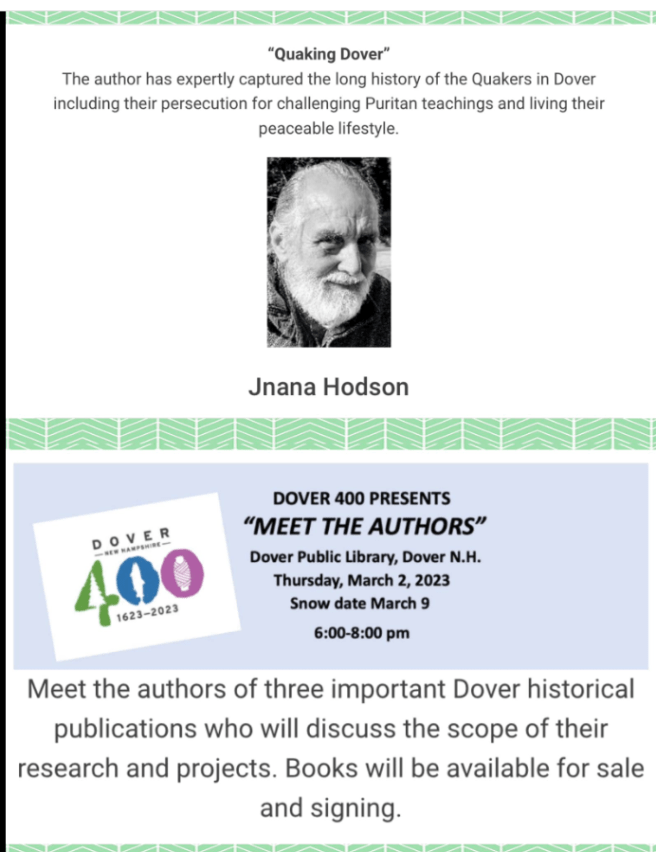
My book Quaking Dover examines the tensions between the traditions and values of the settlers from Devonshire and those of the Puritans originating from East Anglia. In the Piscataqua watershed, the Scots no doubt added another dimension to that culture clash.

Their number in a sparsely populated area is impressive – more than 50 men in Berwick, Maine, plus Oyster River, Exeter, and Hampton in New Hampshire. In short, they were a significant part of the inhabitants, even before many of them scooted off to places like York, Maine, or Boston.

~*~

A historical marker on Sligo Road in Rollinsford, opposite Berwick along the Salmon Falls river, summarizes the life of one as thus:

Near this place lived David Hamilton of Westburn born in the parish of Cambuslang, Scotland, in October, 1620; captured by Oliver Cromwell at the Battle of Worcester, England. September 3, 1651 brought to America as a prisoner in chains on the “John and Sarah” in the same year; settled near here and married Annah Jaxson of Lanark, Scotland; killed by Indians on September 28, 1691.

The marriage to Anna Jackson took place in 1662 in either Dover or Saco, Maine. She is believed to be the daughter of Richard Jackson, another Scottish POW. We are left wondering whether she had somehow managed to rejoin her father in New England or whether Hamilton knew her in Scotland and arranged for her passage. I’ve found little more about her father and nothing about her mother, although the fact that he died in 1691 in Berwick has me wondering if he, like Hamilton, fell in an attack by Natives.

David and Anna settled in Rollinsford and had seven sons.

He was slain in 1691 while working on his farm. His wife presumably predeceased him.

Today, Hamilton House can be seen across the river from the site of their farm.

That house gets its name from their great-grandson Jonathan, a wealthy merchant who built a manor overlooking a broad cove of the Salmon Falls. There, he had ships unloaded and repacked.

The site, with a classic Georgian house erected by later residents, is now maintained as a museum by Historic New England and open to the public.

~*~

The Oyster River connection brings into the picture an early settler who bought seven of the prisoners. He was Valentine Hill, who arrived in Oyster River in 1643 and established a large farm and saw mill at the falls. His 1649 house, now part of the Three Chimneys Inn, is one of the oldest structures in New Hampshire. His prominence is reflected in his construction of a meetinghouse in 1655 for the village, which was still part of Dover. Or should we say the Scots laboring for him did? The Puritan minister at First Parish held services there as well as at the Fort Meetinghouse on Dover Neck.

Through his first wife, Hill was distantly related to William Hutchinson, whose wife Ann had been banished from Massachusetts in a religious controversy and resettled in Rhode Island, where many of her followers later joined in the Quaker movement.

Valentine appears to have been thoroughly Puritan, but not so his likely nephew John, who settled in Oyster River in 1656; many of his descendants were active Friends in Dover. I’m assuming that John was the son of a John Hill who settled in Dover by 1639.

~*~

One Scottish POW who definitely had a line of Quaker descendants was John Bean, who settled in Exeter. As I describe in my book, Joel and James Bean and their two sisters left Dover to assist the growth of Friends Meetings in Iowa and then the West Coast, including roles in the founding of two colleges.

Their great-great-grandfather Bean was a recorded Quaker minister in Brentwood, New Hampshire, but stubbornly refused to submit to eldering from New England Yearly Meeting colleagues and was ultimately “disowned,” or removed from membership. Even so, he then led a splinter Quaker body in town. Was that the Scottish heritage at work?
 

There’s much more than one big story to touch on

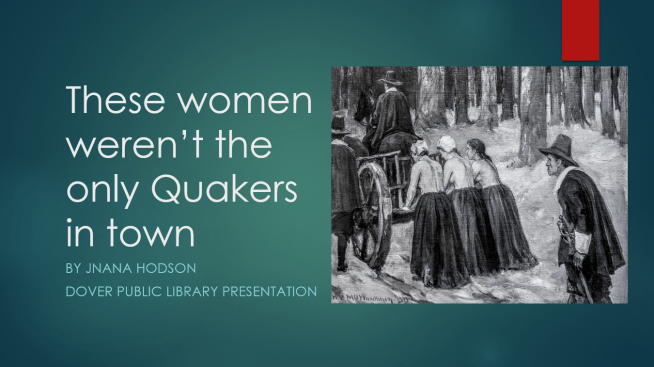
There’s more to the origin of Dover Friends Meeting than the three women who were whipped out of town in December 1662 in what would have been a death sentence, had it been carried out to the letter.

Still, it’s a big story, one that occupies a central place in my new book, Quaking Dover. The horrific incident is also the most frequently visited page at the public library’s online history site, and it’s the subject of one of Greenleaf Whittier’s most famous poems.

I’ll be using that to introduce other examples of courage and faith from the town’s Quaker experience when the Dover Public Library features me in a book reading in front of a live audience this coming Wednesday. I hope you can join me, perhaps even posing a question or insight.

The appearance will also be streamed live, but preregistration is required.

That’s 6:30 pm this Wednesday (March 22).

If it’s anything like the Dover400 new authors presentation earlier in the month, I can assure you it will be a blast.


What revelations will turn up in Dover’s early public records?

In preparation for Dover’s 400th anniversary, dedicated volunteers have been poring over early records. In many cases, these served both the town and its tax-supported church, back to the 1600s. Many of these have been digitized and posted on the City of Dover website, but they can be very hard to read.

Even so, they’re being transcribed for release as part of this year’s big celebrations.

Moreover, in the light of scholarly advances, these hold the potential of drastically revising an understanding of our legacy.

I think it will be exciting.

I’m having fun preparing PowerPoint presentations

In general, when it comes to new tech, I’m pretty much of a neo-Luddite. I prefer to stick to the tried-and-true rather than chasing after every new twist and trying to master it before it’s obsolete by the next wave.

I still haven’t stepped up to host a Zoom session, for heaven’s sake. And we’re definitely not E-Zpass users when it comes to highway tolls, either.

Preparing visuals to accompany my public presentations related to my new book, Quaking Dover, however, has me beaming.

The first leap was in learning to connect a laptop to a slide projector – you know, so folks could watch a slide show on a big white screen or a wall.

From that experience, I realized the shots really needed to be all of one size. Some pictures I was discussing ran off the screen, while others were too small. That led to the PowerPoint format.

My initial outing with PowerPoint was with the Whittier Birthplace Museum’s virtual lecture series back in January. There, I was amazed to discover how much I could enlarge a detail from a photo without having it pixilate. Individual signatures from a Quaker marriage document, for instance, could be displayed prominently. The size of the photo in hand wasn’t an issue, either. Up we go!

I’ve been at it again, this time for presentations at the Dover Public Library on March 22 and the Pembroke (Maine) Historical Society on April 18, as well as a third in July via the Falmouth Friends Meeting on Cape Cod. All will be streamed, by the way, if you’re interested in participating. (Do mark your calendars.)

It’s getting easier with each round, and I’m learning how to easily copy a PP slide from one production to another. Yay!

Fun? I’m finding it downright exciting. Hope you do, too.

Town meeting and grassroots democracy

New England’s annual town meetings are often hailed as an epitome of participatory democracy, but I have yet to hear an examination of how they mutated from the original Congregational churches’ model of self-governance, back when the town and Puritan parish were one.

As long as voting on town affairs was limited only to males in good standing with the local congregation, up to two-thirds of a town’s households were excluded from the deliberations.

In New Hampshire, that wasn’t the case, even after Massachusetts annexed the colony. What happened then, I’ll venture, is that the Quakers and Baptists tempered the deliberations in the future Granite State in ways that eventually seeped elsewhere.

Quakers, or more formally Friends, served as a loyal opposition, one that wouldn’t take up arms in its cause but that would nonetheless hold firm to its convictions. Like the Baptists, they also believed in a separation of church and state.

The Quaker practice of conducting community business in a monthly session meant seeking unity on an issue without ever taking a vote. A vote, after all, would create a minority. Instead, when differences arose, due consideration might produce a synthesis – not a compromise. The former would be superior to either of the earlier positions. The latter would mean settling on the lowest common denominator.

Crucial to this process was the Meeting’s clerk, carefully listening to all involved.

A skillful town moderator, so I’ve heard, needs similar abilities.

I’m curious to hear how this played out in Rhode Island and on the Cape, where Friends and Baptists were also an influence.

Do note, the Puritan colonies had none of the toleration of Maryland, New Jersey, Pennsylvania, or New York to the south and west, yet they lacked the town meeting heritage.

I do want to hear more.


‘It’s all fiction’

As my new book came together in its revisions, I began to feel some parallels to John Baskin’s 1976 New Burlington: The Life and Death of an American Village, a non-fiction opus based on what was then the new field of oral history.

The village he examined was largely Methodist and Quaker, the latter having come en masse from South Carolina as their rejection of living in a slave-holding countryside. In fact, when they relocated as a Quaker Monthly Meeting, they carried their treasured minute book with them and continued their records in Ohio.

His book became something of a classic and was even excerpted as a popular series in the Dayton Daily News.

While relying heavily on quotations from his sources, he did knit the interviews together with some heavy interpretation on his part. And here I was, becoming an active narrator in the action in my own work.

My book, as it stands, is heavily influenced by what I’ve learned writing fiction, in addition to my lifetime career as a newspaper journalist. I view the result as a story.

More to the point, when Quaking Dover came out, one longtime friend asked me if it was another novel. I bristled, I think, “No! It’s a history! Non-fiction!” While also thinking, “Didn’t you read the description? What did you miss?”

~*~

I am trying to remember the first time I mentioned Baskin’s book, probably in a Quaker circle in another part of the state, and hearing the response, “It’s all fiction.”

Huh? It seemed pretty solid to me, and the asides on Quakers were rather informative for a newcomer, as I still was then.

A decade or so later, visiting family back in Ohio, I ventured off to worship at the New Burlington Quaker church, which had rebuilt out by the highway after the village had been flooded by the U.S. Army Corps of Engineers.

At the close of the service, I was asked why I chose them rather than the more silent Friends in nearby Waynesville. Well, I had worshipped in that historic meetinghouse years earlier but, as I replied, I enjoyed visiting other branches of the Quaker world. And then I added, “Besides, I have the book.”

A moment of awkward silence struck the circle around me before the oldest person, a woman perhaps in her early 90s, softly pronounced, “It’s all fiction.” Obviously, they all knew what I meant by “the book.”

Oh? I was in no place to argue and accepted her verdict as literary criticism. In some ways, I took it as advice, not that anyone knew I, too, was a writer. Those of us in the news biz were already treading on thin ice in too many ways.

Still, as I retold the encounter to a reliable bud, he inhaled sharply and noted, “That’s strange. It’s the same thing Aunt Cecille said. Her words, ‘It’s all fiction.’”

Well, she did live in a town only a few miles up the road, one where the local Friends church had recently petered out. She, too, had Quaker roots and community creds.

~*~

As a journalist, I can relay one fine reporter’s observation that he knew he was on course with a controversial issue when he found both sides of the story were upset. Not that I want to go there. Still, I do know that we humans have a hard time accepting our own shortcomings and follies and that we view events through our own lenses.

I should add that Quakers, as a whole, write a lot. It’s a crowded field.

How crowded? The primary Quaker history journal takes this stand: if a book hasn’t been vetted by a peer review panel of historians, it’s taking a pass.

As they did on mine.


These events leave me feeling confirmed as an author

Being invited to speak about my book, either as a solo outing or as part of a panel, is something quite new to me.

It’s distinctly different from being the featured poet at a café reading or even having a chapbook in hand for sale.

Since Quaking Dover is a factual history, the narrative ties into much more definable readerships than my novels have. I’m even able to present PowerPoint slideshows of people and places appearing in the story, and then be surprised afterward to meet descendants the families or the current residents of houses I’ve touched on.

Having a presentation be recorded and made available on YouTube, as happened through the Whittier Birthplace Museum in Massachusetts, is personally thrilling.

My previous YouTube appearance was private, for a selected audience, largely a sequence of appropriate Scripture and related images. It even had an original, emotionally moving musical score from a talented collaborator.

My face wasn’t visible there, by the way. Yes, the invisible writer as witness.

Alas, it’s gone and I do wish I had a copy.

Remember, writing is a solitary activity. Rarely do we get feedback from our finished efforts. Are we writers simply navel-gazing or do we somehow reach others, especially one on one? Have we actually been wasting our time?

In blogging, I’ll assume you, too, are a writer and know what this means.

Humbly yours, all the more.

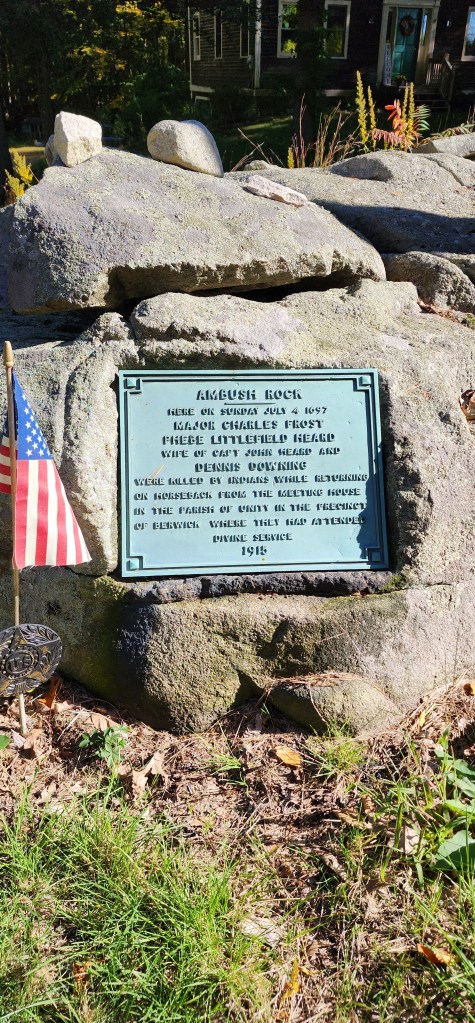
Ambush Rock

What the marker in Eliot, Maine, doesn’t mention is that Major Charles Frost and Dover’s Richard Waldron concocted the mock wargame that led to the hanging of Native men sent to Boston and the sale of about 350 Penacook women and children into slavery in the West Indies.

This was hardly an attack on an innocent party, then. The Natives waited years to extract revenge, and did it at a time and place that spared others.

My history Quaking Dover adds details.