The Hussey family and that anvil in the Quaker meetinghouse

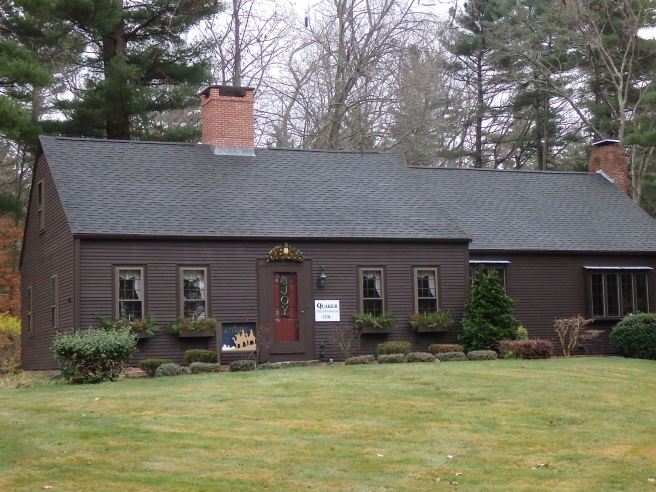
Hampton’s 1701 meetinghouse is now a private residence.

Through the first century of English habitation in New Hampshire, the other Quaker Monthly Meeting was at Hampton, and like Dover, it soon had satellite worship groups before coalescing in today’s Amesbury, Massachusetts.

Its full history is one that needs to be told. I’d like to know more about how it and Dover interacted.
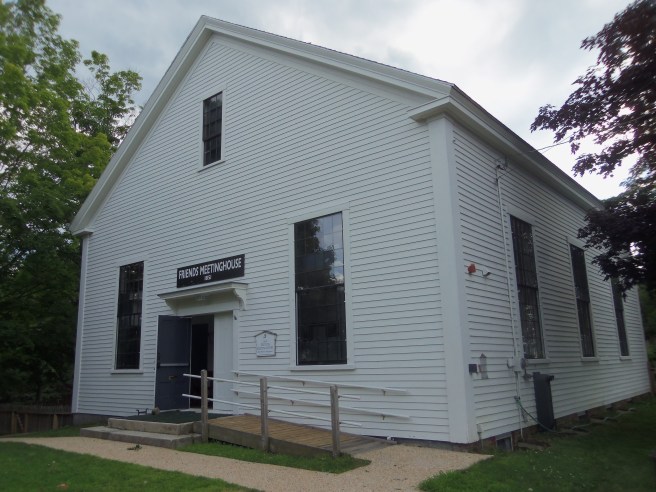
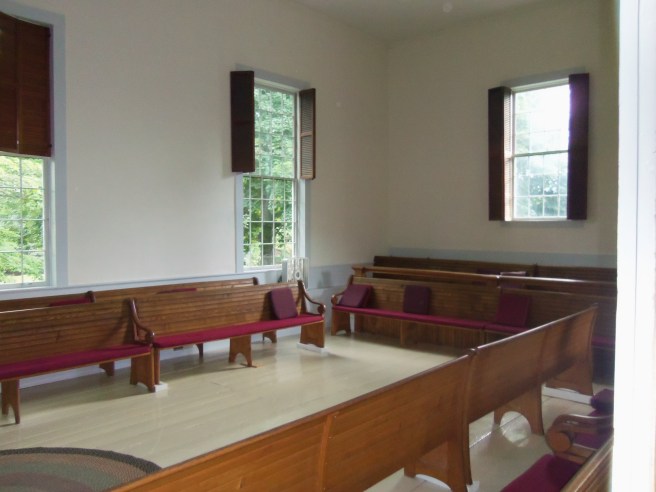
Amesbury, Massachusetts, Friends meetinghouse.
Its interior has been lovingly restored. After her marriage in Dover, Abigail Hussey worshiped in Amesbury, eventually living just down the street.

Its Hussey family was one that came to be part of Dover Meeting. The family had two well-know weddings that occurred in the present Dover meetinghouse – May 3, 1769, of Samuel Hussey and Mercy Evans, and October 3, 1804, of their daughter Abigail to John Whittier of Haverhill, Massachusetts – another of Hampton/Amesbury’s Preparative Meetings.

Dover’s Hussey farm was on Baer Road in today’s Rollinsford but Somersworth at the time of the second wedding. It’s some beautiful farming country.

John and Abigail Hussey Whittier became the parents of the influential poet and abolitionist John Greenleaf Whittier, who was a frequent visitor to Dover Friends. Her portrait, reproduced in my recent post about the Whittiers, hangs above the stairway from the main floor to the lower level of the meetinghouse.

Two stories are told about the anvil that sits in a corner of the Dover meetinghouse. One is that it was recovered from the ruins of the Otis house after the Cochecho Village massacre. Richard Otis was a Quaker blacksmith. The other is that it comes by way of the Hussey family, which turned Civil War cannons into plowshares.

The Hussey family has a significant presence in New England Quaker history. Settler Christopher Hussey, described as the most prominent man in early Hampton, was one of the purchasers of Nantucket Island in 1659, where son Stephen eventually moved as it became a Friends stronghold.

Though Christopher was not a Quaker, his other son, John, was severely fined and threatened as an early Quaker, as Elizabeth Hooton related from her American visits. He was a Friends minister, married Elizabeth Perkins from another distinctive Hampton Quaker family, and they had 17 children, mostly daughters, before migrating as Friends to New Castle, Delaware, in 1688 or 1692.

There is argument whether John and Rebecca Hussey’s son Richard (1660-1733) remained behind and moved to Dover or whether it was an immigrant. Either way, a Richard Hussey who was a weaver moved to Dover by 1691, wed Jane Canney, and had a dozen children. Among them was Joseph (1699-1762), who then married Elizabeth Robinson and sired Samuel Hussey (1714-1814), leading to the Whittier connection.

Some of the Nantucket line, however, reconnects in Berwick, Maine, complicating the picture, especially when a Hussey marries another Hussey.

Stephen Hussey’s second son, Bechelder, moved from Nantucket to Biddeford, Maine, which leads to son Stephen, who had 12 children, the last three born in Berwick.

More prominent among the Berwick Quakers were the children of Ebenezer Hussey, Stephen’s fifth son, who wed Abigail Hale.

What is known is that in 1770, James Hussey – possibly Richard and Jane’s grandson or great-grandson – moved from Dover to North Berwick. His son William (1800-1870) created an efficient plow in the 1830s.
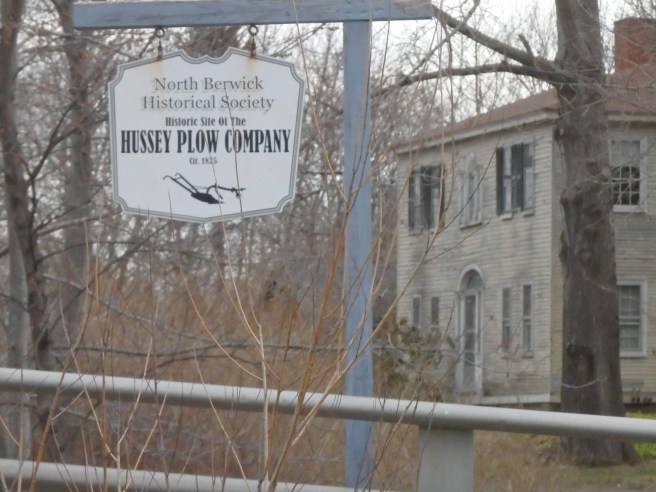
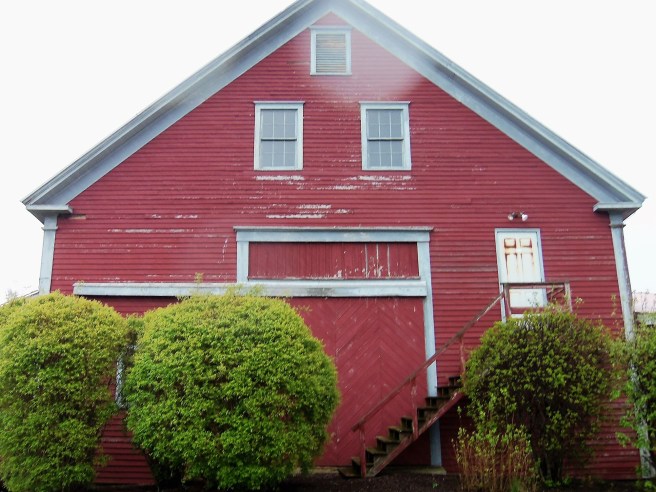
It’s right beside the millstream. The textile mills were owned by another Quaker.

The enterprise drew on Quaker connections, beginning with Joseph David Hoag’s relocation from Charlotte, Vermont, to North Berwick in 1825. The son of famed Friends minister Joseph Hoag, he brought with him a cast-iron plow created by blacksmith Jethro Wood of Scipio, New York, another Quaker. Wood’s mother, incidentally, was Diannah Hussey, a niece of Ann Starbuck on Nantucket.

Got all that? Just go with the fact it was a potent mix.

As a farmer, William Hussey felt that the plow’s moldboard was much too short. After pouring lead to make a rough pattern of a longer board, he had castings made at a foundry in Newmarket, New Hampshire. The results were carted by horses to North Berwick, where skilled carpenter Henry Estes made the wooden framework. William then traveled among his farmer friends to sell the plows.

With the distinctive size and shape of the furrow board, the plow could be pulled by less power than its rivals. As the company’s business envelopes proclaimed, “If I don’t hold easy, draw lightly, and turn a flat furrow, after five days return me.”

In his later years, William Hussey ran the N. Hobbs Inn at Bracey’s corner, but as a staunch temperance advocate, he refused to sell liquor. He was also an ardent abolitionist.

That led his son, Timothy Buffum Hussey (1831-1913), to establish the T.B. Hussey Plow Company, now operating as Hussey Seating and the oldest business in Maine.
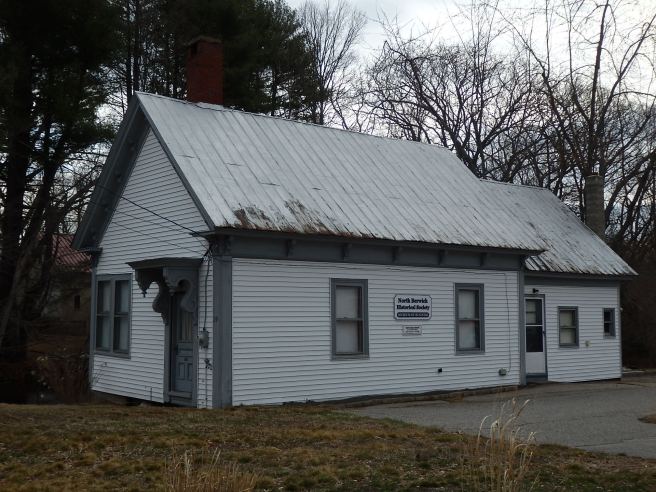
The company’s early headquarters.

After graduating from Friends School in Providence and teaching there, his son, Timothy Buffum Hussey (1831-1913), took over the business in 1855. With his younger brother, William Penn Hussey, he also operated a foundry nearby.

After the American Civil War, he bought up cannons and melted them down in the foundry to make plows – wryly upholding the swords-into-plowshares prophecy of the book of Isaiah.

After an 1895 fire nearly destroyed the firm, the Husseys refocused on building steel products including fire escapes and bridge supports. I like to think that the shift in focus came to their mind during Quaker Meeting.

Through much of this, Berwick was an independent Monthly Meeting – but it was still part of Dover Quarter and, thus, my history. Besides, when Berwick was laid down as a Meeting, its remaining members, including Husseys, once again were in Dover’s rolls.

~*~

Check out my new book, Quaking Dover, available in an iBook edition at the Apple Store.

Welcome to Dover’s upcoming 400th anniversary.
The ‘shadow Meeting’ extended beyond official members

I’ve long been fascinated by what I’ve come to call the “shadow Meeting” – people who continued to worship as Quakers and uphold many of the values after being “read out of Meeting” for violating its discipline, usually over marriage procedures.

It’s a fact for several generations of my own ancestry in North Carolina.

One place I see it in Dover is with the Varneys.

The patriarch of this prolific Quaker line was Humphrey Varney (1636-1714), a brickmaker who moved to Dover from Ipswich, Massachusetts. He married Sarah Starbuck, widow of Joseph Austin, as her second husband.

After the Dover’s disastrous massacre, their son, Ebenezer Varney (1664-1753), married Mary Otis after her return from captivity, and their son Peter (1666-1732) wed Elizabeth Evans.

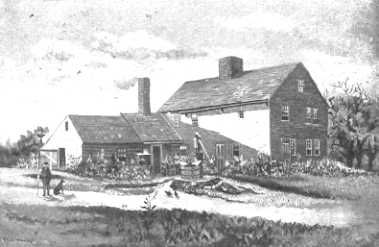
The Varney house, which stood near today’s Wentworth-Douglass Hospital, was once the largest home in Dover. After the massacre, it continued to keep its doors unlocked so that passing Natives could spend the night.

After that, well, it seems the Varneys married into all of the other Dover Friends families. Many of them also spread, most notably across Maine.

The family made its imprint on Dover, though I’m not sure how many remained Friends.

Jesse Varney was a morocco shoemaker when his store was consumed in flames in December 1810.

By 1837, Varney’s Block stood at Lower Square on Central Avenue near Washington Street. In 1844, a bigger building was erected.

In 1847, 99-year-old Eunice Varney died. She was the oldest resident and a member of the Society of Friends.

There’s Varney Road, extending Long Hill Road to Blackwater Road. And Varney Cleaners, founded by Fred Varney.

The Varney School on Washington Street, used from 1861 to 1953 and now as law offices, was named in honor of Judge John R. Varney. He died in an 1882 fire that destroyed the Washington Street Baptist Church building.

George Varney was a prominent merchant for more than 40 years and owned a drug store on Washington Street before retiring in 1920 at age 65 and passing the next year. He built a large home on Arch Street in 1913.

John R. Varney was co-owner of two newspapers – the Dover Enquirer, purchased in 1868, and the Dover Daily Republican, acquired in 1880.

My curiosity, of course, wonders how many of the Quaker values continued in their lives, as well as what directions their faith took. I like to think it worked like yeast.

The family also made a big impression in Manchester. The Varney School, now a private residence on the West Side, was named in honor of one of the city’s mayors.

~*~

Check out my new book, Quaking Dover, available in a Nook edition at Barnes & Noble.

Welcome to Dover’s upcoming 400th anniversary.


Gearing up for the official book release party

Moving the event back a month has allowed Dover Friends to spread the word more widely, and I’m definitely excited.

Well, it’s their history, too.

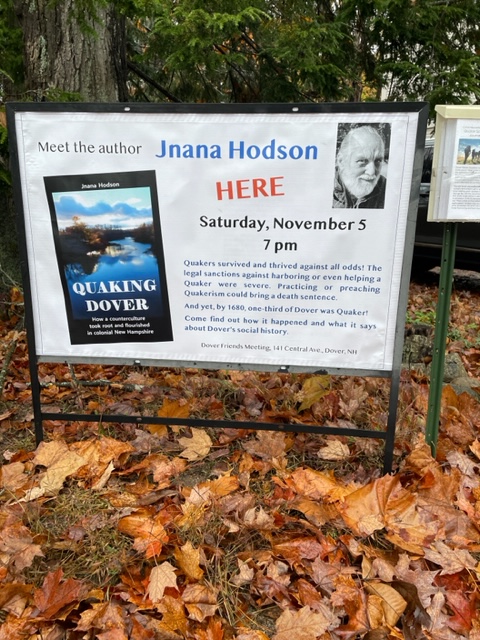
The official book release party for Quaking Dover is Saturday at 7 pm in the historic meetinghouse at 141 Central Avenue in Dover, and you’re welcome to join us, if you’re in the area.

In addition to the meet-and-greet, I’ll present an illustrated overview of the story and the ways this book came to be. I have to admit I was surprised by much I uncovered along the way.

Here’s me, above, with the meetinghouse.

Hope to see you!


What values continue after a family leaves a tradition?

One thing that fascinates me in regards to religion is the distinction between faith, based on a holy experience, and a culture, handed down within a family.

Among the Dover families that belonged to Meeting are the Tuttles, long known for their Red Barn market. Yes, Red Barn, like the name of this blog.

Three Dover Combination signers shared a tragic introduction to the New World when their ship, the Angel Gabriel, broke up in the August 14 “Great Colonial Hurricane of 1635,” either in the harbor at Pemaquid, Maine, or at the Isles of Shoals.

One was John Tuttle, who was about 17 years old at the time of the disaster. After their rescue, he arrived in Chebasco (in Essex or Ipswich, Massachusetts). By 1638 Tuttle settled in Dover, where he was known as Shipwreck John and had a farm on today’s Bellamy River – one that grew into what was long known as America’s oldest family-owned and operated enterprise. (Never mind that Thomas Roberts’ heirs nearby would have a longer claim.) Tuttle’s son Thomas was killed by a falling tree while still a young teenager, leaving John Jr. to continue the family name.

Tuttles’ Red Barn along Dover Point Road remains a landmark, even after the family finally sold the farm.

Shipwreck John’s grandson, James Tuttle (1683-1707), is believed to be the first Quaker in the family. He married Rose Pinkham (1682-1728) and they had two children before his death – Elijah Tuttle and Phebe, who married Moses Varney. Yes, these Quaker families quickly intermix.

The next four generations were very active in Dover Friends Meeting, according to William Penn Tuttle, who added that their home was always a resting place for visitors during Quarterly Meeting.

And some of the family even went abroad in missionary service.

Their farm on Dover Point Road, with its red barn, was long noted as a marketplace for fresh produce.

Across the river in Maine, one line still produces remarkable cider each fall – King Tut’s. Yes, short for Tuttle’s.

~*~

Check out my new book, Quaking Dover, available in an iBook edition at the Apple Store.

Welcome to Dover’s upcoming 400th anniversary.

A touch of Philadelphia, too

Business opportunities lured some Dover Friends to more lucrative destinations within the changing economy. With their many Quakers, Lynn, Massachusetts, and Philadelphia, especially, beckoned.

As a widely repeated quip goes,

Friends went to Pennsylvania to do good, and they did very well, indeed.

Among those who went to Penn’s Fair City was Lydia Brown Hanson’s nephew Moses Brown (1793-1878), who left Dover in 1815 to join his brother Jeremiah in the domestic textile trade. Moses, I should emphasize, was not the famed Rhode Island Quaker. These were the sons of William Brown and Abigail Peaslee, whose daughters Lydia, Alice, and Anna all married under the care of Dover Meeting. The brothers’ move to Pennsylvania came the year after the first textile mill in Dover was built – were the Browns selling its fabrics?

In Philadelphia, Moses had the good fortune to marry Mary Waln Wistar, a descendant of a socially prominent Quaker family, and their son Thomas Wistar Brown was born in 1826.

Described as a successful dry goods mer­chant who never went to college, T. Wistar Brown became a self-taught scholar and patron of education. A long-time manager of Haverford College and for 25 years its board president, he gave the college three professorial chairs and much of its old library and books, among his many philanthropic endeavors.

His profile calls him a quiet man of strong faith and convictions – including a refusal to succumb to the use of the telephone and automobile. As a young man he had followed Abraham Lincoln on horse­back on the way to the first inaugural, and he saw Lincoln’s Vice President, Hannibal Hamlin, spattered with mud after a hairbreadth escape from an assassin’s bullet. During the Civil War he escorted the wife of his cousin, General Isaac Wistar, through enemy lines to visit her husband at Fort Monroe.

He was also a founder, with other Quaker businessmen, of the Provident Mutual Life Insurance Co. of Philadelphia.

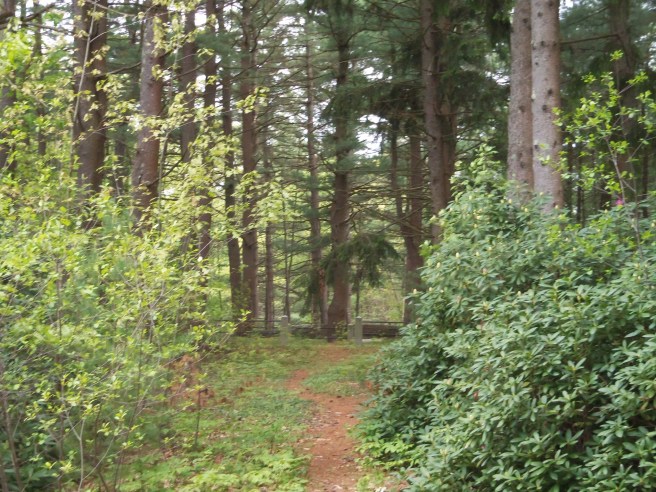
Brown and family members are buried in the plot at the end of the lane in Dover.


When he died in 1916, the Evening Post of New York in a long tribute said of him: “There was a blend of the stoic in his Christian resignation; he saw much and suffered much, gained much and lost much. He was one of the last of the old generation of Quakers who inherited from their forefathers discipline and patience, silence, and self-control. He faced life with quiet fortitude.”

He is buried with his wife, Mary Farnum, and other kin in the T. Wistar Brown Cemetery, now managed and used by Dover Monthly Meeting.

At times I do wonder if the City of Brotherly Love is reflected in the naming of some of Dover’s streets – Arch, Chestnut, Locust, Maple, Spring, Central, Broadway (from Broad) – as a result of the Philadelphia connections. A number of the city’s other streets carry Quaker family names, including Hill Street, named for a Varney and Hill land development partnership rather than its inclines.

~*~

Check out my new book, Quaking Dover, available in a Nook edition at Barnes & Noble.

Welcome to Dover’s upcoming 400th anniversary.
 

Witchcraft in New England before the Salem hysteria

Something I pretty much skip over in my history of Dover is the Puritan authorities’ close examination of the bodies of the early Quaker women missionaries for any signs revealing them to be witches, from 1656 on.

That was down in Boston, for one thing, and I’ve seen no indication of similar actions along the Piscataqua watershed in New Hampshire and Maine, the center of my new book.

But it has come back to haunt me.

Much of my argument regarding the readiness for a significant portion of the Dover population’s joining Quakers has to do with the ways they differed culturally from the Puritan majority in the Massachusetts Bay colony and Connecticut. What David Hackett Fischer terms “folkways.”

For example, in all of their fearful piety, what made the Puritans so morbidly curious about the naked female flesh, anyway? And just what, exactly, were they looking for? This gets weird, doesn’t it? I’m not sure I want specifics, as in details, much less in those parading through Salem, Massachusetts, these days in preparation for Halloween. I’ll have to admit that part leaves me feeling queasy.

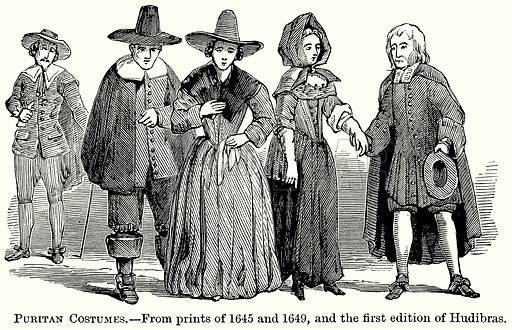
Puritan Costumes. Illustration from The Comprehensive History of England (Gresham Publishing, 1902).

Just consider the stereotypical presentation of witches in pointed hats and black capes and then recognize how much that resembles the dress of Puritan women in New England at the time. As for flying on brooms? How strange! Just how did that conflation happen, anyway? Put another way, witches didn’t dress differently than anyone else. As for the brooms? Every housewife had one.

Well, maybe that points to the male authority role in all of this, something I’m perceiving as a gender power play.

Back to the Quakers. As historian Arthur J. Worrall explains, “Two groups of Quakers arrived in 1656. The first, led by Anne Austin and Mary Fisher, came to Boston in July. The Massachusetts government promptly imprisoned them for five weeks; after checking them for signs of witchcraft, they expelled them in August. A second group of eight Quaker missionaries came to Boston two days after their expulsion,” aboard the Speedwell.

“Massachusetts imprisoned this group for eleven weeks and expelled them also, after the clergy had examined and debated with them.”

For perspective, Fischer notes that from 1647 to 1692, the Puritan colonies accounted for ninety percent of the accusations and eighty-five percent of the executions for witchcraft in English-speaking America. That is, almost ALL of them.

Moreover, “In England, every quantitative study has found that the recorded cases of witchcraft were most frequent in the eastern counties from which New England was settled.” Specifically, the Puritan heartland, in the motherland and then in the New World.

“Even white magic was regarded as a form of blasphemy. In 1637, for example, Jane Hawkins was punished for selling oil of mandrakes in Boston. Many other magicians and sorcerers were treated in the same manner.”

So just what defined a “witch,” anyway? Anyone who drew on folk remedies? Or even a midwife who knew more than she was supposed to?

Fischer goes into ways the Puritans’ Calvinist teaching and likely their earlier folkways combined to make them especially fearful.

As I observe, Salem itself was a cauldron of controversy from early on and a place where the Puritan invasion clashed with the existing population. Like Dover, the Puritans were latecomers there.

I’m still curious about the zealot ferocity of the Puritan outburst at the time of the infamous mistrials in Salem, 1692, in a perfect storm that may have fused an outbreak of hallucinogenic ergot in rye, a clash between traditional ways of examination versus newer ones, a gap in the governorship and jurisprudence, and a drive to curb the influence of the now well in place Friends by attacking their servants instead. Many, many other factors, perhaps even the weather, likely also come into play. All of the other angles I’ve heard point in the same direction.

One of the overlooked aspects in all the controversy is how the witch persecutions in Salem solidified the collapse of the rigid Puritan reign in New England. In a way, the old guard overplayed its hand and had to bear the consequences. With widespread revulsion at the executions and their abuse of the court system, a new strand of teaching and emphasis emerged in the Congregational churches. In another century-and-a-quarter, many of them would even become Unitarian, a far cry from the Puritan orthodoxy.

What makes witches so romantic for so many today?

Did the accused “witches” have their revenge in the end?

This side of being an author is all new to me

Eastport’s senior center has invited me to talk about my new book, and that’s what I’ll be doing Friday, October 21, at 1 pm.

I’ll be focusing on Maine’s Nicholas Shapleigh, who was not a Quaker but played a crucial role in sheltering the missionaries who came to Dover. As a powerful lumber merchant, magistrate, and leader of the provincial militia, he was an important figure in what would become the Pine Tree State. His manor on the Piscataqua River sat directly across the water from Hilton Point, where the action began 400 years ago.

The overall content of Quaking Dover has been generating interest in a way I haven’t encountered with my novels or poetry. Having a handsome paper edition from the start is another plus. As much as I love aspects of ebooks, they are much harder to promote than a physical copy in your hand.

Dover may be a five-plus hour drive from Eastport, but there have long been connections.

The center’s at 9 Boynton Street, where I’ll be greeting friends and neighbors.

It’s the first in a series of presentations I’ll be announcing over the next few months. Please stay tuned!

There’s even an old gray wizard and his conjuring book

My favorite – and least expected – story from Annie Pinkham’s historical sketch of Dover Meeting includes a profile of Ambrose Bampton, who appears in Whittier’s “Snow-Bound” in the couplet, “We stole with her a frightened look / At the gray wizard’s conjuring book.”

Friends carefully avoided anything smacking of superstition, yet Bampton (1717-1790) had a local reputation for possessing “certain powers of disclosing the unknown and declaring the coming of future events with remarkable accuracy. To him resorted farmers who had lost their cattle, matrons whose silvers spoons and other treasures had disappeared, or maidens whose sweethearts were among the missing.”

Known as the Sorcerer, he may have been a continuation of traditions handed down in Devonshire, England, possibly through his mother, Hannah. “The meek-spirited old man received them all kindly, put on his iron-rimmed spectacles, opened his conjuring book, and after a season of deliberation, gave the required answer without money and without price,” in Pinkham’s telling.

Devon, a county southwest of London, is the origin of many of Dover’s early settlers.

Once, when a group of young people came to him for advice, he said to one of the girls,

“If ever thee marries anybody, thee will marry me.” She replied, “I would marry the devil first.”

A clue to her reaction might be hinted at in a notation that at the time of his death, he was said to weigh 400 pounds. I have no idea where Whittier had him already gray at this point.

The girl was a Quaker, Rebekah Austin, the daughter of Nathaniel Austin and Catherine Neal. Contrary to the prediction, she wed in 1745 with Simeon Hill in the manner of Friends. But five years later, as a widow, she did in fact marry Ambrose, again in a Quaker service. He had left First Parish and rejoined Dover Meeting. She predeceased Ambrose in 1802.

Ambrose’s father, John, was a member of Friends by 1705, so there were Quaker threads to build on.

Besides, I look at him as one more confirmation of my sense that some Friends are far more psychic than we’d let on.

~*~

Check out my new book, Quaking Dover, available in a Nook edition at Barnes & Noble.

Welcome to Dover’s upcoming 400th anniversary.

And now in paper!

Taa-tah! My Quaking Dover is officially out as a print-on-demand paper book around the globe.

Check it out through your favorite bricks-and-mortar bookstore.

It does mean going to your favorite book retailer for a copy, but there we are.

Independent bookstores and libraries have their own insiders’ routes to obtain it. Go to them to keep these channels alive.

As for me, I’m stocking up for copies to keep in my car, wherever I go.

How about you?

Come to the book release party!

If you’re anywhere near Dover, New Hampshire, on Nov. 5, feel free to stop by the Quaker meetinghouse for the official Quaking Dover book release party.

The meet-and-greet event takes place at 7 pm at 141 Central Avenue and is free and open to the public. As a Covid precaution, we will be masking.

Copies of the book will also be available for purchase and author signing.

In the meantime, it’s release date is coming up on Saturday. Check with your local bookseller to order a copy.