Learning of the length and bloodshed of border warfare between New England and New France comes as a surprise to many Americans.
One of the more startling facets is the tales of English hostages who were taken to Canada by Natives receiving payment for each person they brought north.
Some captives were ransomed by family and returned home, leaving the impression that the French were interested mostly in added revenue. You know, like legal piracy, or a landbound privateering. Maybe even as a kind of generous sympathy on behalf of the captors. Many, as I’m seeing, were wives.
Others, though, never returned, leaving the mysterious impression that they chose to remain, perhaps indulging in a more sensually rich culture than the Puritan world of their past. And perhaps some did.
The French were, however, at a distinct disadvantage in the colonial warfare and settlement. They were outnumbered by the British four to one, by many estimates. Or five to one, from another I’ve encountered.
One way for the French to build up their population was by immediately baptizing the Protestant captives into the Roman Catholic faith. For single women, this could soon be complicated by marriage and childbirth – she would not be allowed to take her children if she was “rescued” or “redeemed” and returned to New England, perhaps as a widow. Becoming a nun was another option.
Yes, further complicating the picture is the fact that some of the captives did in time become Catholic priests or monastics. As a consequence, there would be no place for them in New England without their renouncing that faith.
So far, I’ve come across no indications that the kidnapping ran in the other direction.
~*~
The definitive examination of the cases seems to be Emma Lewis Coleman’s two-volume New England Captives Carried to Canada between 1677 and 1760 during the French and Indian wars (published in 1925).
My book Quaking Dover presents two of the attacks, though there were other serious incidents in the town.
For most of the first century, Dover dominated both New Hampshire and neighboring Maine.
It was the core of population, for one thing, as well as the oldest continuing settlement.
It also had significant water power, unlike Strawbery Banke, the future Portsmouth.
But Portsmouth, in turn, was closer to the Atlantic and had a viable harbor, leading it to become a center for adventure capitalists and merchants plying the ocean for trade at the same time Dover’s fishing focus diminished, in part a consequence of the sawdust in the water from the lumber trade.
Hampton (1636) and Exeter (1638) were both founded by men seeking religious freedom from Massachusetts. How’s that for a turn of affairs as well as a challenge to the argument that the latter was established in a quest for religious liberty while New Hampshire folks were interested only in lucrative gain?
Hampton long remained the most agricultural of the lot. Exeter did have water power for mills both there and in today’s Newmarket, yet it soon aligned with some powerful Puritan families. As did a elite portion of Hampton.
There were even the poor collected off the streets of London and shipped to New England, who may have then drifted northward.
Maine, meanwhile, began to coalesce around York, one town over from Dover.
Today, each of them remains somehow unique, within a New England identity.
Hampton, for instance, has a suburban sprawl feel with colonial touches. Exeter, with its prestigious Phillips Exeter Academy, could easily be one of the old towns abutting Boston but yet isn’t. The novelist John Irving calls it Gravesend. Continuing on, Portsmouth is a magnet for wealthy residents and resembles wealthy port towns all along the New England coast. George Washington, after all, did both sleep and worship there. It definitely has a superiority complex. And Dover, once a major textile mills and railroad center, is taking off as a family-friendly town with a viable, pedestrian-welcoming, downtown. It has, to me, the most practical yet visionary community spirit.
The differences are a subject well worth investigating. In the meantime, I’m keeping my focus on everything touching Dover.
It is, after all, the center of my new book and the city’s 400th anniversary as the oldest of all.
More accurately, I’ve become acutely aware of how much I still don’t know. Or even, does anyone see this fully?
The adage, “Write about what you know,” had me starting with my Quaker experience. But the adage should add, “Write about what you don’t know.” Frankly, that’s the part that’s exciting.
Think of it as working a puzzle, trying to figure out what goes in the gaps. You just don’t know without some hands-on trial and error. And perhaps a few friends or family members’ help.
From the other direction, I know a professional historian who quotes his mentor saying that if you think you have an answer nailed down, you’re badly mistaken.
I’ll spare you my list regarding the Quaking Dover project, for now.
Not only is Dover the oldest permanent settlement in New Hampshire, it’s also the largest city in the Seacoast region today, with more than 30,000 residents. The region, however, adds to way more.
An hour northeast of Boston and with proximity to both Atlantic Ocean rugged shoreline and beaches as well as New Hampshire’s White Mountains, Dover has also become the fastest-growing city in the Granite State.
The town originally encompassed what’s now Durham (home of the University of New Hampshire), Barrington, Lee, Madbury, Rollinsford, Somersworth, and parts of Newington and Rochester. It also interacted heavily with the earliest settlements of Maine across the Piscataqua River, back when fishing was a leading business, followed by logging and sawmilling.
Still, there has also been a longstanding rivalry with Portsmouth just downstream, ever since its enterprising merchants rose to the fore. You know, uppity. Well, they do have the Music Hall.
Dover, I’ll insist, has been more modest. I’ll refrain from adding more for now.
For perspective, the region today has more than a half-million residents.
I like to think the center of gravity is shifting back to Dover. We’ll see. In the meantime, there’s that big 400th anniversary to celebrate.
In case you’re wondering how things are going with Quaking Dover, here are some early reactions:
“The book purports to be merely a history of the Quakers at Dover, New Hampshire, but it is much more than that. It is a history of the beginning and spread of the Religious Society of Friends (aka Quakers) in the USA, the best exposition of their faith that I have read so far, a history of their persecution by the Puritans, and of the bloody conflicts between the Puritans and the native peoples. …
“Most of all, I had not previously been exposed to the reality of the Quakers’ faith, revealed in their own words. Jnana Hodson, himself a Quaker, has done extensive research in old records and journals and includes extensive quotations that bring the faith to life. Including their peaceful acceptance of persecution, their prudent approach to courtship and marriage and their belief in the work of the Holy Spirit in the heart.” – Bob Goodnough, Saskatchewan
(For his full review, visit his Flatlander Faith blog post of Dec. 12, 1922.)
~*~
“I enjoyed your conversational writing style – sharing the research that you did — and confidentially whispering (in your writing style), ‘This is what this finding means and how it should be interpreted.’ … To ascertain what really happened you checked primary documents, read previous accounts of Dover, New Hampshire – triangulated your sources and showed us readers how you reached your conclusion. A very enlightening read – well researched, well written.” – Joe Clabby, author of A History of Eastport, Passamaquoddy Bay, and Vicinity
~*~
“Love it!” – Susan Wiley, Sandwich, New Hampshire
~*~
“Deftly told. I really like your voice. It’s engaging, light, and easy to read.” – Jim Mastro, science fiction novelist
“A rich feast of a book.” – one of my favorite authors and fellow Maine resident
~*~
“I truly appreciate all the work and careful thought and interpretations you put into it.” – Canyon Woman, New Mexico
~*~
“I enjoyed your book very much. I particularly liked relearning about early life in Dover and surroundings, and was impressed by how much research you did to fill in details. Not only about the life of early Quakers and their trials and tribulations, but the connection they had to the rest of New and Old England. I did not understand how important the settlement of Dover was compared to Portsmouth, Exeter, and other towns.” – John Dawson, Lee, New Hampshire
~*~
“Thank you for writing this record of Dover Friends Meeting. The ‘Children of the Light’ had me on the verge of tears as I read it to Andrea.” – Harvin Groft, Berwick, Maine
In timing my book for Quaking Dover for the 400th anniversary of English settlement in town, I gave myself a deadline that ensured it would actually be done. Otherwise, I’d still be researching it.
In some cases, that meant I didn’t simply follow a conventional account but came to my own original conclusions. In others, post-publication findings confirmed in what I’ve deduced. Besides, in a period of Covid restrictions plus my own relocation to the other end of Maine, opportunities in the archives were limited.
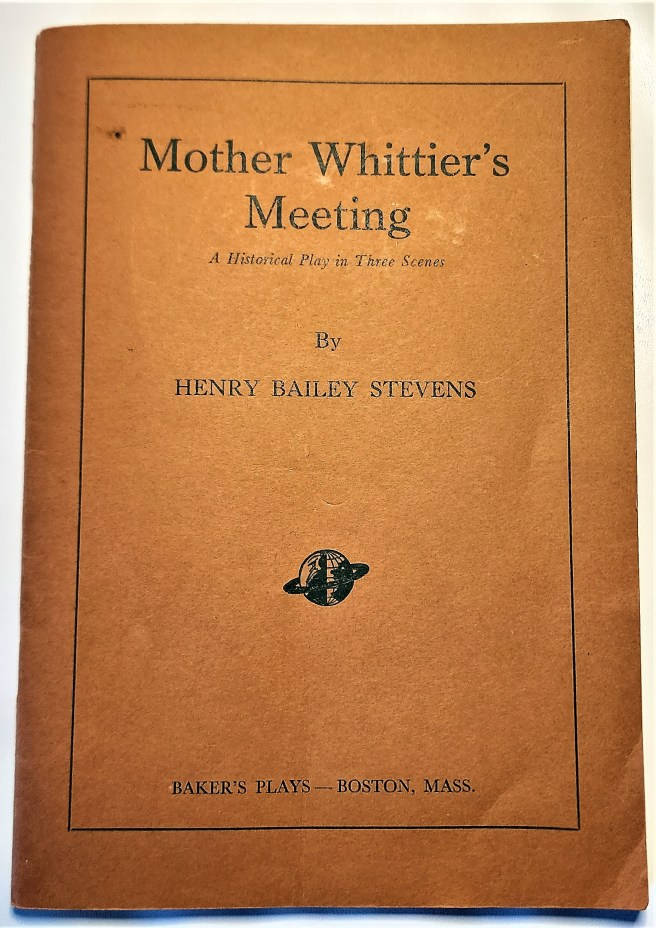
One of the works I’m glad I waited to read until my own work was done is Henry Bailey Stevens’ three-scene play, Mother Whittier’s Meeting. It was premiered outside the Dover Friends meetinghouse on August 17, 1963, to mark what he thought was the 300th anniversary of the Quakers’ presence in town. As I now see, the celebration was four or five years late.
Had I read the play first, I might never have written my own take of the history. He covers the heart of the plot in 200-some fewer pages.
Stevens himself is an interesting character who turned up around the time that the Dover meetinghouse was reopened for regular worship in the 1950s. He was the head of the Cooperative Extension Service at the University of New Hampshire in neighboring Durham but also harbored a deep interest in both history and dramatic literature, as well as an ardent vegetarian and pacifist. He even penned a series of Quaker family profiles for Dover’s daily newspaper.
The play itself is what we’d call “talky” – more dialogue than action. There’s no dancing or sword-fight scenes, as it were. The central focus shifts between Meeting as the community and as the house itself, or even turns to Abigail Hussey Whittier herself. Not that you really notice as you follow along.
There are points I’d heatedly contest. The first meetinghouse, for instance, was most likely not a log cabin.
But then I feel like cheering when Annie Pinkham shows up as a character. Her mimeographed brief history contained tidbits that would otherwise be lost to oblivion. She had every reason to believe she’d be the last Quaker in town once she locked the meetinghouse door.
Not so, as things turned out.
As for Stevens? His play, published by Baker’s Plays in Boston, isn’t his only significant book-length publication. Finding those, though, can be a challenge.
Join me online from the Whittier Birthplace Museum in Haverhill, Massachusetts, on Thursday, January 26, at 7 pm.
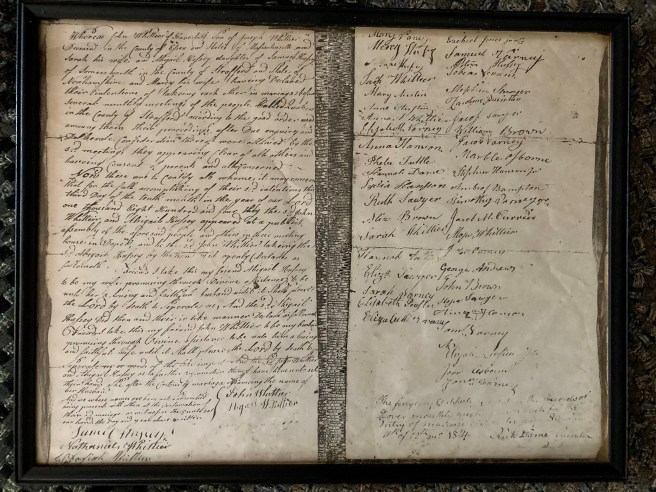
My presentation in their virtual lecture series via Zoom will explore the celebrated abolitionist and poet’s many connections to Dover, starting with an examination of his parents’ certificate of marriage in the Quaker meetinghouse in 1804. His mother grew up in the Dover Quaker community, and his Whittier uncle, Obadiah, was already living in town at the time of the wedding. In fact, Whittier Falls and Whittier Street weren’t named for the poet but his uncle and cousins.
There’s a lot packed into this historic document. Join me to find out.
Once we’ve gleaned insights into seemingly quaint Quaker practices of the time, we’ll turn to the signatures of the witnesses – that is, all of the Friends in attendance – and learn about some of them, too, as well as a few who weren’t present but were still members of the Meeting living in a town to the west and definitely of interest.
And then it’s your turn to ask questions or make comments.
The event does require preregistration and a suggested donation of $10 per household. Go to whittierbirthplace(dot)org and click on Events to learn more.
Here’s hoping you can make it. Putting this together has been a blast.
As improbable as it would seem now, Dover was a throbbing center of dissidents and misfits in its early years, at least from the perspective of the Puritan authorities to the south in Boston.
Nor would I have expected a settlement inland from the ocean to be the one that took root, rather than the companion complex facing the ocean, but the Dutch trading post at Albany, New York, was even further up a river and survived.
There are good reasons that Dover became the center of action north of Salem, Massachusetts, and of Boston further south, not that you were taught any of that in your history classes.
I have to admit, it’s taken a while for the fact to sink in. Dover was the heart of the New Hampshire province, not that we see that today. Still, the roots remain.
My book, Quaking Dover, looks at the history from a minority viewpoint that leaves most of the last 200 years pretty wide open. Yes, there’s so much more to examine and include in the full picture leading to the rebirth of the community in recent years.
But what I’ve found is still pretty remarkable.
To think, it was such a humble and audacious start 400 years ago and counting.
Among other things, I would love to know more about the livelihoods of Dover’s Quaker families, especially as they evolved over the generations. How did they acquire new skills, for one thing, as the town went from being a fishing and shipbuilding center to timbering and sawmills and then milling in general, even before its emergence as a calico capital?
New England farming, of course, underwent its own permutations, especially after wool was displaced by cotton in the early 1800s.
As Dover shifted from a rural village with agricultural roots and fishing and shipbuilding to an industrial city depending on an immigrant workforce, the Quaker presence shrank to a mere thread. Even so, as I like to think, some of the Friends’ values continued in the descendants of the Meeting’s earlier members, even when the family was no longer Quaker.
Many had moved north or east in search of new farmlands, and others were about to head off to Minnesota and Iowa.
Dover Friends Meeting was already declining when the textile mills started changing the character of the community. Moreover, the new arrivals brought new churches and ethnic identities, and these are stories waiting to be told in the upcoming celebrations. I’ll be all ears.
As the ownership of the mills passed to out-of-town investors, the profits being generated in Dover prospered an upper crust elsewhere, most likely the famed Boston Brahmins. In contrast, Dover became a largely working-class neighborhood. The same can be said for the busy rail lines passing through town.
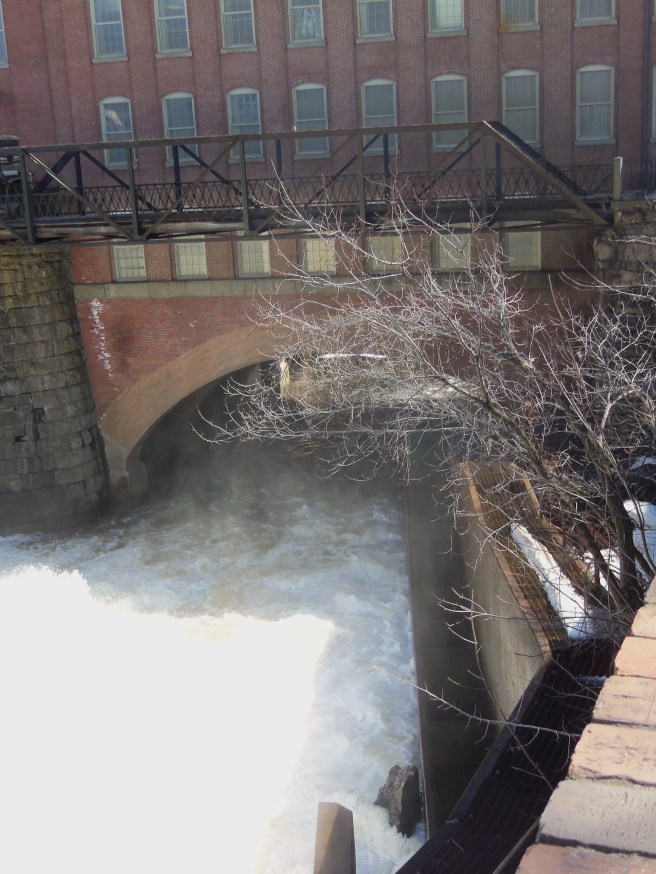
The centerpiece of Dover is the Lower Falls of the Cochecho River, capped by a dam that increased the waterpower to the textiles mills. Here, water from the river rushes into the tidewaters below and runs through an arch in the mills that define the downtown. Who can’t be inspired by such a sight, whether the river’s running high or low, in season?
Although a visitor to Dover today would have no problem seeing the town’s character as New England, its identity today comes from the brick mills erected at the falls four-and-a-half or five miles north of the Hilton settlement. There is no town common, a wide green square surrounded by imposing Colonial houses and white church under a lofty steeple. The same can be said for neighboring Portsmouth, formed around the harbor, and Exeter, with the elite academy. Yes, there are the iconic church spires and rooster weather vane but not the central green common. Hampton, which remained largely agricultural, does have a tiny green, not that it would pasture a single horse.
As my new book and these blog posts note, David Hackett Fischer’s Albion’s Seed: Four British Folkways in America explains that the stereotypical New England arises in the customs and culture of East Anglia, the region of England that produced most of the Puritan migrants who shaped Massachusetts and Connecticut. He sharply counters that with the Quaker migrations from the Midlands into Pennsylvania, and from the Royalist cavaliers who predominated the Virginia planter society, as well as from the Borderlands people in northern England who share commonalities with the Scots-Irish settling the Appalachian spine from Georgia to Maine.
Fischer examines these complex workings in a set of specifics that include distinctive speech, architecture, geographic patterns of settlement, family, marriage, gender, sex, child-rearing, naming of children, attitudes toward aging, religion, magic, learning and education, food, dress, sports, work ethics and practices, use of time and recording, ideas of social order and institutions, authority and power, and more, including differing concepts of liberty and social restraint.
Quite simply, there was no generic Englishman. Even the dialects could prove incomprehensible when taken from one part of the country to the other.
While the new settlers to the Piscataqua settlement were primarily Puritans, imbued with its Protestant ethos, they were also overwhelmingly from Devon, with folkways quite distinct from their East Anglia brethren.
I suspect these contrasting folkways play a major, though previously undetected role, in the deep conflicts about to emerge in the seeming isolation along the Piscataqua as well as elsewhere in other pockets of New England.
Far from being a homogenous nation, Britain was a patchwork of many long-buried identities, some of them resurfacing in new guises. The country had never suffered an Inquisition, either, to suppress them. Its Christianity had been imposed from the conversion of the regional kings, whose subjects might publicly worship one way but another in private.
English Quakers, too, had never suffered the trials of sustained violence with New France and the Indigenous American tribes or racial slavery or a Revolutionary War, as their American coreligionists did, especially in New England. Little wonder the English Friends were baffled by the separations that ultimately divided Quakers in the New World.
It was a rich brew. And, frankly, still is.
~*~
Though Dover Quaker Meeting was reborn in the ’50s after a hiatus, its viability is challenged, but so is much more of contemporary American society. Besides, I’m not comfortable in considering the period as “history,” much less examining it systematically or comprehensively, though I tell what I can. Some early readers think it’s the best part of my book. I won’t argue.
I will say that our Quaker Meeting is a beautiful community, one I love dearly and invite you to experience.
As well as Dover.
~*~
Check out my new book, Quaking Dover, available in your choice of ebook platforms at Smashwords.com.
This morning, as so many Christians celebrate the birth of a divine baby, I find myself reflecting on another child who intersected my life many years ago.
Not my beloved stepdaughters, who arrived later, but a Kenyan introduced to me during the AIDS outbreak.
Along with a plea for help.
As clerk, I was able to respond, that first year without the approval of the Meeting, which has fortunately followed. We’ve all been enriched as a consequence. In fact, I find myself viewing much of the world through her lens.
As I wrote to her, years later, through one of our more or less annual letters:
It’s been more than a few years since I’ve communicated with you, but you have been on my heart and mind all along, plus those of many other American Friends. You’ve met a few of them, and I’ve felt comfortable leaving you in their embrace, though I haven’t forgotten about you. Far from it. When they bring news of you, we’re always heartened.
Through all of this, you’ve been an inspiration to me. You have what we call grit, or courage, and a lot more. When I was working as a newspaper editor, I had a shortcut to two of your portraits on my computer desktop, yes, right there in the newsroom, and when things got especially rough, like I was about to do something unQuakerly, I’d click on it, and your smile and determination kept me going on the right track. Thank you, simply for being you.
Once, when a Nigerian official was walking through our office, he stopped by my desk and I told him I knew somebody very special in Africa and brought up your triumphant face.
His reply? Yes, she’s Kenyan, and he grinned in appreciation. I guess being Kenyan is something special.
We do live in a small world!
You have many reasons to be proud. And, yes, we Quakers can be proud (for the right reasons) as well as humble. (You can ask me about the humility part later, if need be.)
I feel very deeply you have greatness ahead of you, though it will never be easy. What I do know is that Jesus will always be at your side, as he has been through your hardest sufferings, even though you weren’t necessarily aware of it.
Now, take a deep breath! And, as we Quakers say, Mind the Light!