Care to look at people around you carved in stone?

What would your obituary say about you? What would you say there, if asked? Before you reply, pay attention to everyday stuff and your aspirations, especially what you love. Note as well how others see you. Besides, how do you fit into your neighborhood or wider community? Feel free to exaggerate, reflecting everyone else.

As a human, you assume a cluster of identities – some of them chosen and changeable, others immutable. My grandfather, for example, proclaimed himself Dayton’s Leading Republican Plumber, invoking a host of other identities as well: Protestant, Freemason, middle-class, married. “Grandfather” wasn’t high up in his awareness, from my perspective. Being male or female or teenaged or elderly, on the other hand, are simply givens. And the history of what we’ve done or failed to do cannot be altered, except in our own perceptions and retelling.

The range of identities is astounding. They include but are not limited to race, religion, nationality and locality, occupation, family (household and near kin to genealogy itself), education and educational institutions, athletics, hobbies and interests, actions and emotions, even other individuals we admire, from actors and authors to athletes, politicians, and historic figures. They soon extend to the people we associate with – family, friends, coworkers, neighbors. And, pointedly, our phobias and possessions.

Curiously, it becomes easier to say what we are not than what we are specifically. That is, set out to define yourself in the positive and you’ll find the list rapidly dwindling, while an inexplicable core remains untouched. Turn to the oppositions, however, and the list becomes endless. I am not, for instance, a monkey. At least, most of the time.

Sometimes, moreover, a specified negative becomes truly revealing: “I am not a crook,” for instance, as the classic revelation.

Behind the masks of public life – our occupations, religious affiliations, social status, economic positions, family connections, educational accomplishments, and so on – each of us engages in another struggle, an attempt to find inner balance and direction for our own life. As we do so, we soon face a plethora of interior and exterior forces that must be reconciled. We get glimmers into this struggle – both within ourselves and within others – in statements that begin “I am” and “I am not,” as well as “I have been,” which recognizes the history and habits we accumulate and carry with us. There are also the voices – “he remembers” or “she insists” – that also recur in our lives, defining and redefining ourselves both within, as conscience or the angel or devil on our shoulders, and without, as any of a host of authority figures and friends or family members.

All that brings us around to my latest poetry collection, Hamlet: A Village of Gargoyles. There, many of the imaginary individuals profiled are identified by occupation while their confessions typically reflect the more  intimate concerns of their lives – relationships, activities, even the weather. These are, then, overheard snippets more than public proclamations.

Hamlet, of course, is a small town or a village as well as a famed play. In this collection, the inhabitants are profiled in five acts of two scenes each, plus intermissions and intermezzos. They’re even exaggerated, the way a stone carver would in creating gargoyles and grotesques.

Listen carefully – especially when others talk of their romantic problems or other troubles – and another portion of a mosaic appears. This collection of poems builds on such moments, constructing a community as a web of each its members. Sometimes, a place appears; sometimes, a contradiction; sometimes, a flavor or sound or color. Even so, in this crossfire, we may be more alike than any of us wishes to admit. We may even be more like the part we deny. Our defenses wither. Our commonality, and our essential loneliness, are revealed.

Just think.

Having originally appeared in literary journals around the globe and then as chapbooks at Thistle Finch editions, this collection of poems is now available in your choice of ebook platforms at Smashwords.com and its affiliated digital retailers. Those outlets include the Apple Store, Barnes & Noble’s Nook, Scribd, and Sony’s Kobo. You may also request the ebook from your local public library.

The move unites the poems in a single volume, rather than a series of ten smaller chapbooks and ten broadsides, and makes them available to a wider range of readers worldwide.

Welcome to town, clown.

As an inspiration for considering gargoyles

How would you answer the question, “Who are you?”

It can be harder than you think, especially when it comes to getting past the superficial answers.

Now, look in the mirror and try to imagine yourself carved in stone. Some features will be exaggerated, of course, but at some point, an angel or other truth may also be released.

This is prompted by the release of my collection, Hamlet: A Village of Gargoyles, which can be found in the digital platform of your choice at Smashwords, the Apple Store, Barnes & Noble’s Nook, Scribd, Sony’s Kobo, and other fine ebook retailers. You can also ask your public library to obtain it.

In the meantime, a wonderful gallery is available for your viewing at the fine New England-based blog Gargoyles and Grotesques.

There you’ll see that these sculpted images aren’t confined to cathedrals or Gothic castles. In fact, they’re all around us.

They could even inspire another set of poems.

How are you feeling about the trial’s revelations?

You know the one I’m talking about. Even before getting to the others just ahead.

Let’s just say I’ve been watching this building up, step by step, for decades. The corruption by big money and trickery, the erosion of the middle class, the polarization, the sleaze, the breakdown of the checks and balances or a loyal opposition.

Working in the newsroom, I was bound to give both sides their voice, though one was doing everything it could to discredit us and those distortions went unchallenged. There was more, of course, going on in the dark, things we sensed but couldn’t prove outright.

Let’s just say I was outraged but had to keep it bottled up. But then, after retiring, I let it out by indulging in a stream of poetry I usually steered clear of – the polemic rant akin to Dr. Bronner’s Moral ABC or Allen Ginsberg’s The Fall of America collection or Phil Ochs’ protest folksongs.

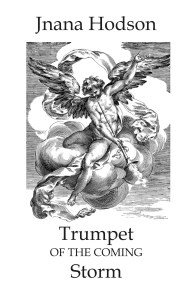
The result is Trumpet of the Coming Storm.

While the pieces that spewed forth in my collection may look like history from the Reagan years through the Bushes, they do reflect the origins of what’s coming to a head today. Even the poems that can be considered sophomoric seem prescient.

There are good reasons I subtitled it Blasts of Alarm and Rage, 1976-2008.

Do take a look.

It’s available in the digital platform of your choice at Smashwords, the Apple Store, Barnes & Noble’s Nook, Scribd, Sony’s Kobo, and other fine ebook retailers. You can also ask your public library to obtain it.

If you like people-watching and eavesdropping, check out this

Today’s the release date for Hamlet: A Village of Gargoyles, and I’d love for you to check it out.

The 200-plus off-beat poems of my collection were composed well before I relocated to a real-life village and, by then, many of the pieces had appeared in literary journals around the globe. What I’ve seen since comes as confirmation.

And now they’re together in one volume, as originally intended.

The pages present candid, surreal, often humorous confessions by various community members who span the generations and occupations of an imaginary locale. They’re the kind you may chance upon in a comic strip, support group, or while walking the dog in your own neighborhood.

Opening the book can be like opening their door, for that matter.

You can find it in the digital platform of your choice at Smashwords, the Apple Store, Barnes & Noble’s Nook, Scribd, Sony’s Kobo, and other fine ebook retailers. You can also ask your public library to obtain it.

Just in time for the new political season

My series of polemic political poems – they’re not exactly protest songs, but I wouldn’t complain if they were – has moved from Thistle Finch editions to Smashwords.com, where they’re now available in a range of ebook formats, hopefully for a wider readership.

In the transition, the poems are now presented in a single volume rather than six shorter chapbooks.

These blasts of alarm and rage, 1976-2008, are an emotional mirror of events leading up to today, a not-so-distant past that’s been intensifying toward devastation. Let them stand as a call for personal honesty and engagement, too.
Take heed, if you will.

For me, this also presents the excitement of my first book release since September/October ’22, when Quaking Dover appeared. It comes with an admission that these poems are largely spontaneous, as in combustion, and sometimes sophomoric. I’ll ride with that, considering the fervor of adolescence, including ambitions.

While the poems are rooted in recent history and its headlines, they’re more pertinent than ever.

Having originally appeared as six short chapbooks, this collection is now available on your choice of ebook platforms at Smashwords.com and its affiliated digital retailers. Those outlets include the Apple Store, Barnes & Noble’s Nook, Scribd, and Sony’s Kobo. You may also request the ebook from your local public library.

Please take a look.

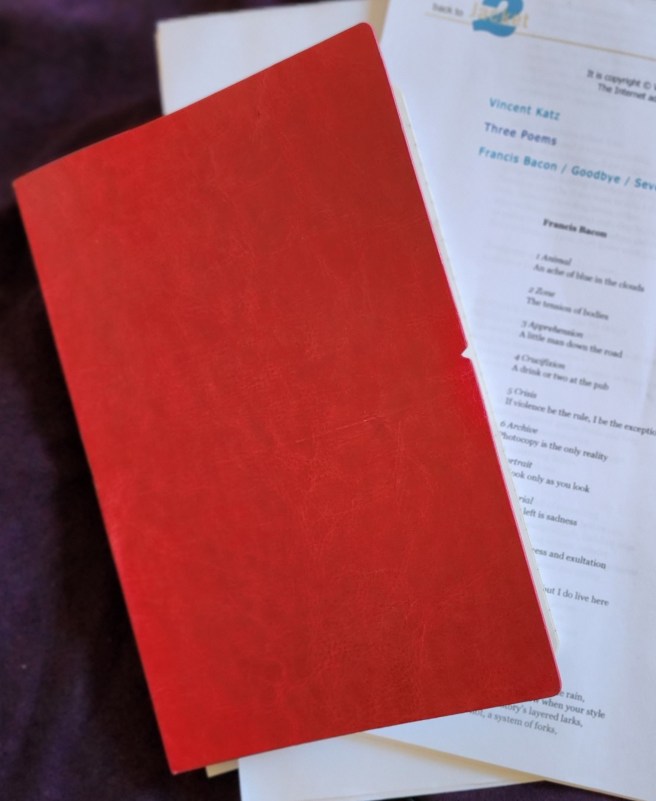
Vincent Katz and my little red journal

When I set about planning and packing for a week on the water last year, I knew I wouldn’t be bringing my laptop. The electrical power on the schooner was mostly from some powerful batteries and two small solar panels. We could charge our cell phones and had small lights in our cabins, but that was about it.

I did pack a Paris Review and a Harper’s magazine, should I feel like indulging in reading, but the heart of my “literary” life focused on a small red journal I had picked up a year or so earlier plus a few printouts of Vincent Katz poems that set a direction that has intrigued me.

Katz, like his father, the American painter Alex Katz, can look at mundane things in a seemingly flat tone that feels seminal.

Consider the line, “I wish I lived here but I do live here,” from “Francis Bacon.” It’s a feeling I know.

As he says in “Back on 8th Ave.”:

The job of the poet is not easy:
be utterly observant, tracking,
and to note down, in plain language,
with minimal emotional distortion,
what s/he sees.


For me, it had been ages since I’d sat down before a blank page and started off without any idea of where the words would be going. My usual journaling at least has a calendar full of events to catch up on, plus notes I’ve scribbled out, maybe even emails. And my more public writing has been things like this, with a purpose.

My goal was to fill the little notebook in a week. Quality or substance was not the measure. Just look and listen and try to be very much in the present moment.

It was a harder assignment than you might think. But it did provide much of the text for many of the posts you’ll be seeing this year.

Here are a few samples of what I entered:

looking for the obvious can be a challenge

 ~*~

Yellow house
behind a brown one
on a hill
flagpole and staircase
down to a wharf

the dreadful verses
you attempted
page after page
of aspiring youth
reached and fell

that stuff now is flatter
but more secure

likely no more profound
or less

don’t worry, Jnana, nothing’s happening
you’d think I could fill this small notebook with drivel in a week
but I’m halfway short

I did end the entries

[to be continued]

Hopefully, on an upcoming cruise in late summer.