Dealing with the off-season in a tourist town

Come the first touch of chill here, and three-quarters of the population begins to vanish. Those folks quietly pack up and return to their primary residence, as have the many tourists. It rather reminds me of living in a college town, but in reverse.

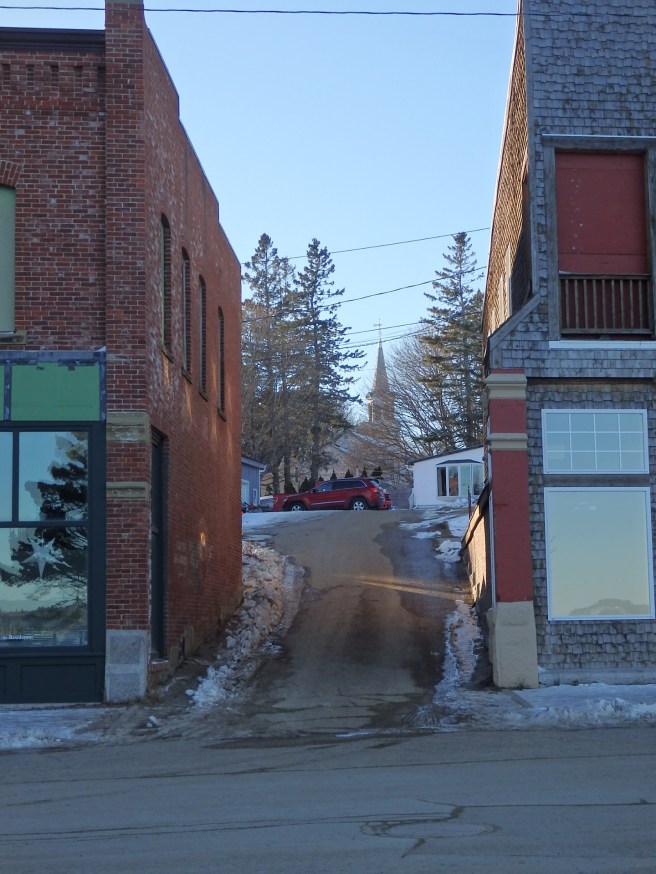
Downtown Eastport in the off-season. The Tides Institute and Museum sits in the old bank building in the center of the scene.

The waterfront and downtown are no longer crowded and festive. Many of the stores, galleries, and eateries are closed up, as are the whale watch, water taxi, and passenger ferry to Lubec. By Halloween, roughly two stores, a diner and a restaurant plus a gallery or two remain open downtown, plus the IGA, two banks, and Family Dollar over on Washington Street.

It makes for a challenging business model, trying to pay the rent and all on a four-month retail prime time. Here the highly watched Black Friday, the make-it-or-break-it financial hurdle of American retailing, doesn’t wait till the day after Thanksgiving but probably hits sometime around the beginning of August.

I have to admire the entrepreneurs who manage it anyway, especially those who stay open through the slim volume of the two-thirds of the year when Eastport’s remote fishing village nature is most prominent.

It also means a lot of do-it-yourself involvement. If you want to see movies, you join the film society. Music? Pitch in with the choir or orchestra. Theater? You guessed it. Dining out? One of the neighboring towns must be having a church supper. Seriously.

And you turn out for others.

Yes, it means more work than just sitting on the sidelines, and with a small population, keeping things going can be a struggle.

But one thing I’ve noticed. It doesn’t take long to be appreciated when you take part.


Tides wait for no one

This three-ring clock made for a really appreciated Christmas gift. Its dials (not digital!) track the phases of the moon as well as the rhythm of the tides, which are truly impressive where I’m now living and change every 6 hours and 13 minutes or so. I can know before setting forth what to expect along the waters, especially if I’m thinking of tide pooling or looking for sea glass.

For their part, moon cycles are supposed to be related to mood swings and creativity and, as I’ve heard, even artificial insemination of cattle, whether the calf is going to be male or female. (I got that from some very scientific farmers, by the way.)

Since the night sky around here is often clouded, I do like not being ignorant of what lunar phase we’re in, even if I might scoff at its significance. It’s kinda like having X-ray vision.

All in all, these revolutions make me feel more connected to my place in the universe. Wherever that is.

Ring around the Shead gym

I used to joke that I swam laps to keep my doctor happy, but that ended with the outbreak of Covid. And then I moved to the remote fishing village, one without even an outdoor pool, and, in a routine checkup, my new doctor expressed concern about my blood pressure readings. On reflection, I realized I wasn’t getting enough physical exercise. I wasn’t even climbing stairs the way I was in the old place. And then I learned that the local high school gym is open to walkers on weekday mornings through winter. Voila! I’m now joking that I walk the black track around the gym floor to keep my doctor happy.

Why walk around the mall, even if we had one?

Better yet, there’s a rumor that we seniors are even going to get some exercise machines here, once the basketball season’s over. Remember, nearly half of the school’s enrollment is on the boys’ and girls’ teams.

How many other high schools are that inclusive?

By the way, keep this up, we just might start referring to the place as the Shead Seniors and Senior High School. Those kids should be honored.


Terrain can be mountainous without stunning heights

Somehow, much of Downeast Maine feels mountainous, even without the loft. The highest points in Washington County, for instance, are Lead Mountain, at 1,479 feet elevation in Beddington, and Pleasant Mountain, 1,373 feet, in Devereaux Township, mere foothills in some other places I’ve lived. Yet the terrain has steep slopes that still challenge motor traffic, as well crests that offer long views of seemingly unending forest.

In that way, it has a lot in common with the Allegheny range in Pennsylvania or neighboring West Virginia, which touts itself as the Mountain State.

The elevations here can be misleading, since much of the landscape is only 20 or 30 miles from the ocean. The town of Wesley, for example, population 98 or so, occupies a highland reaching only 226 feet above sea level, but that’s also a windswept blueberry barren with far horizons. The drifting snow piling up on State Route 9 there can be treacherous, as I learned the hard way.

View while driving State Route 9 through T30 MD BPP, one of the unincorporated – and uninhabited – townships in Washington County.

The highway itself sometimes runs along ridges as long as it can before dropping to a streambed below and then climbing to the next crest. I’m struck to see the next landmark cell-phone tower on my route not off in the distance in front of me but rather far to my right or left with a chasm and lake in-between.

The contrast in colors during summer helps. In winter, this would all blend into variations of white.
Approaching Pocomountain and lake in Princeton, as viewed across a blueberry barren.

Much of the land is boulders and exposed bedrock rather than rich loam.

There are reasons, then, those hills are named mountains. Pay heed.

Just from one storm

We had generally cleaned up from earlier snowfalls, with only a light covering left in town, before last weekend’s blizzard blew in. And, oh, my, did it!

Officially, we had 19 inches, though stiff wind and wicked gusts left some patches surprisingly bare, along with most roofs, but then piled the offset precipitation in the lee.

We were also hit with a widespread electrical outage, which fortunately was repaired in about only an hour or a bit more. I was braced for two or three before getting worried. Oh, I do miss having a wood-fired stove, though one is in our plans. And we do have a generator on order, one that would have been in by now if only we weren’t trying to relocate its proposed placement to allow for a tiny future full-sunlight garden, which is, in fact, now buried by the snow plow driver. Life gets complicated.

Shoveling out the front entry allowed for lighthearted conversations with passers-by, not all of them walking dogs. One woman even showed me a phone picture of her son or son-in-law’s back door, which was floor-to-ceiling snow when they opened it. Yes, I was deeply grateful ours wasn’t anything like that theirs.

So far, according to the weather service, we’ve had about 48 inches so far this season, but this last storm was the doozy, as you can see from our digging out. But, wait, there’s more, as the cliche goes. Tomorrow and the day after are expected to deliver another foot or so, the figures are still bouncing around. Dial up, scale back. Yeah, folks around here are skeptical of the forecasts, for good reason, but not stupid, either.

Reminds me of the guy behind me at the IGA checkout before the last blast. He had baby spinach and some related healthy ingredients followed by an impressive selection of wine. And you thought it was always milk, bread, and canned soup that got cleaned out?

Now, the big question is this:

If we get hit by this much snow in the days ahead, where we will put it?


Note the raised porch.

Traditionally, February and March can bring the big whammies in New England and neighboring Upstate New York. This could get interesting. Or even tedious.

Restoring a one-of-a-kind Civil War mural

Now owned by the Tides Institute and Museum of Art, the post is being renovated to include a significant Civil War-era collection and display.

Eastport’s Civil War veterans had good reason for naming their Grand Army of the Republic post after Major General George G. Meade. Not only had he commanded the successful Union troops at the Battle of Gettysburg, he was stationed in Eastport after war to curb the Fenian Rebellion, an Irish liberation attempt that had organized in the United States and conducted raids in neighboring Canada.

During his time in Eastport, he caught pneumonia and nearly died, and some residents got to know him first-hand. One – the wife of the owner of the house where he was staying – complained bitterly for years afterward about his poor aim in spitting tobacco juice all over her home. Let’s hope he was better with a firearm.

The local post wasn’t the only one named in his honor, by the way, and the organization itself became a powerful force within the Republican Party, helping to elect at least four its members to the White House and pressing for progressive legislation.

In 1881, the local post took over a two-story frame structure at 6 Green Street as its meeting hall. As its membership – limited to Union veterans of the Civil War – died off, the building passed to the local Veterans of Foreign Wars for its post. The building next door included a bowling alley, roller skating rink, and dance hall all fondly recalled by youths of the time.

Nobody knew these were overhead.

The murals and ceiling were long hidden by a dropped ceiling and rediscovered only shortly before 2014, when the building was gifted to the Tides Institute and Museum of Art.

The mural runs the length of the roughly 40-by-25-foot room and includes images of eight Army corps badges.

Tony Castro of New Gloucester, Maine, has been renovating the murals. Despite severe water damage, they may be the only surviving interior of their kind in the state.

The patch at upper right shows how this section looked before its restoration.

The Tides Institute has also been gifted with important Civil War artifacts and documents, which may be displayed as the museum adds gallery space.

A sign from the hall’s later use as a Veterans of Foreign Wars post.

Come on down to where the town really connects

Locally, it’s known as the Breakwater, rather than the town pier or wharf or dock or safe harbor. And it’s the heart of Eastport, the centerpiece and focal point, as well as the home of the commercial fishing fleet and U.S. Coast Guard station.

It’s snuggled up right next to our small, struggling, and potentially quaint downtown. Here’s how it looks from the walkway this time of year.

It even broke down and collapsed in the winter of 2014, taking a few fishing boats with it.

Rebuilding was another matter. Officially, it reopened in September 2017, though details may have been completed later. The versions differ, up to “two winters before last.”

Eastport has the deepest natural harbor in the continental United States and is said to have rivaled New York’s in shipping at one point. I’ve seen photos of a cruise ship tied up here, and it truly overwhelmed the dock and town in its size.

The waterfront has – and had – other piers, with pilings that can still be seen – the old vaudevillian appearing steamship dock, for one, or the more recently gone Northeast Marina and Fuel Depot, as prominent examples. And, yes, definitely, what was once the world’s largest sardine cannery, as well as a solitary brick shell from the era still standing over the water with some folks hoping for a redevelopment before it caves in.

Significantly, there is the Cargo Terminal, our industrial shipping complex at Estes Head just around the bend. It has both high security and tractor-trailer traffic, so you don’t stroll around there.

Still, the breakwater at the end of Sullivan Street beckons us, even with its seemingly perilous heights above the water at low tide.

And here’s how downtown looks from the Breakwater.