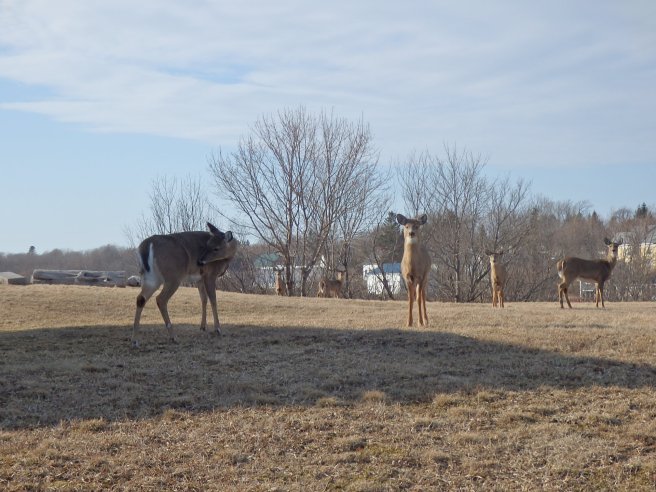
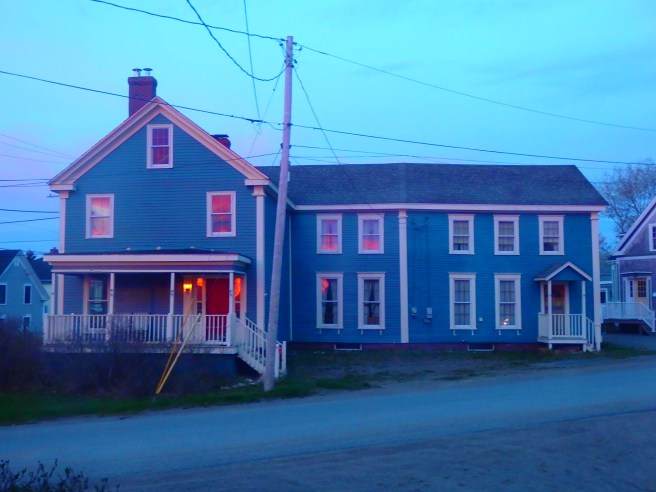
Eastport is a city, after all, and many of the homes are packed in close together. Not that it matters to our local wildlife.
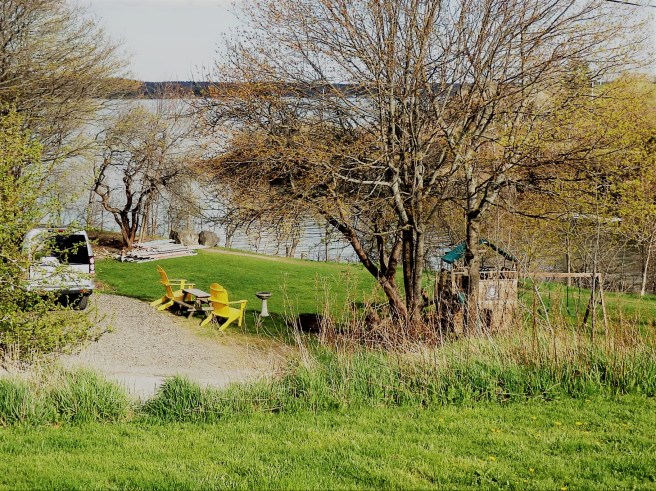
Here’s one in our driveway.And crossing over to our neighbors.They frequent a large lawn overlooking Shackford Cove and the sea.This yard’s only a few blocks from downtown.And these critters are just a block from the Breakwater.
They’re so much a part of the place they even have their own Facebook page, Deer Eastport, and it is very active.
No matter how cute, though, they’re a gardening challenge. As are the raccoons.
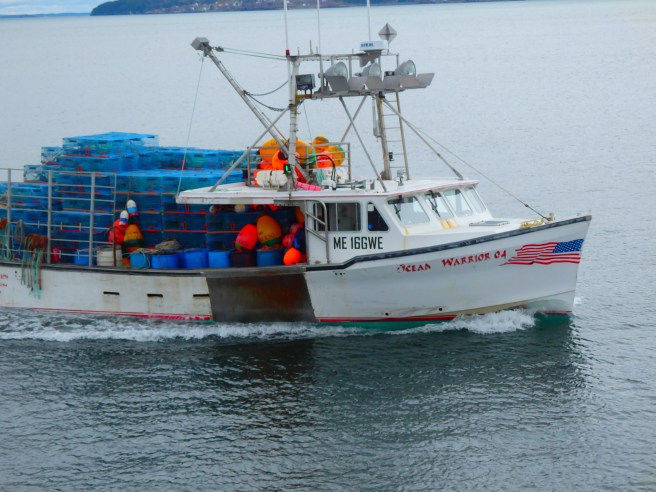
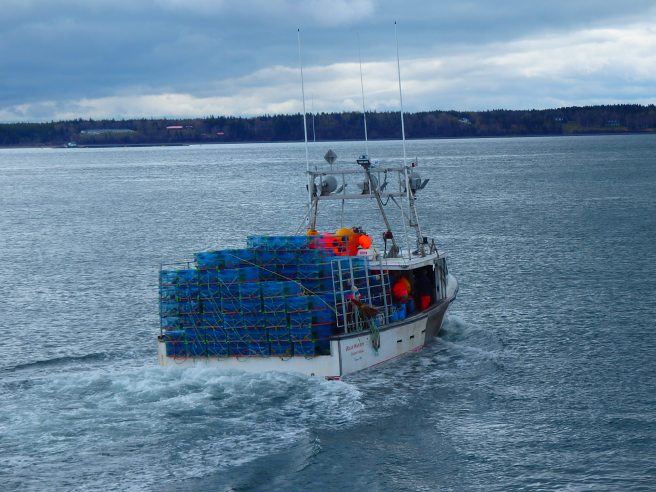
Sailing forth loaded with lobster traps.And off to set them. After waiting years to get a commercial lobsterman’s license, you want to make maximum use of opportunity it allows.
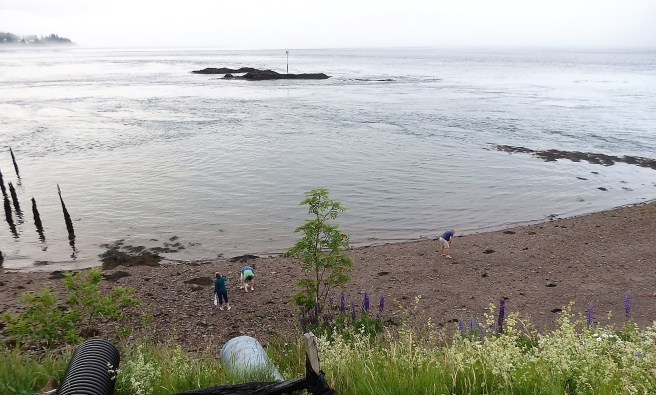
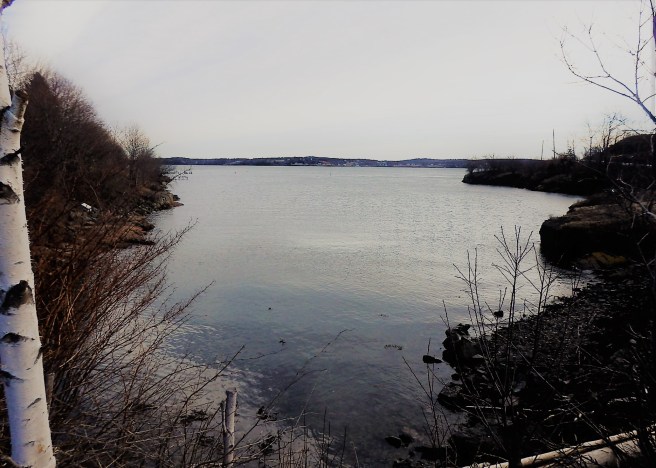
This cove is where Caleb Stetson Huston became Eastport’s most noted shipbuilder and marine architect. Here he created more than one hundred vessels from 1840 to 1870, surpassing the number of his father, Robert Huston, had built. He was no doubt responsible for repairing many more.
A third-generation shipbuilder, C.S. Huston at one point owned four shipyards on Shackford Cove – his father’s, on the south side of the water, and the William H. Hall and Jacob Shackford yards on its north side, as well as Aymar’s spar shop at the South End bridge, which has long since been filled in.
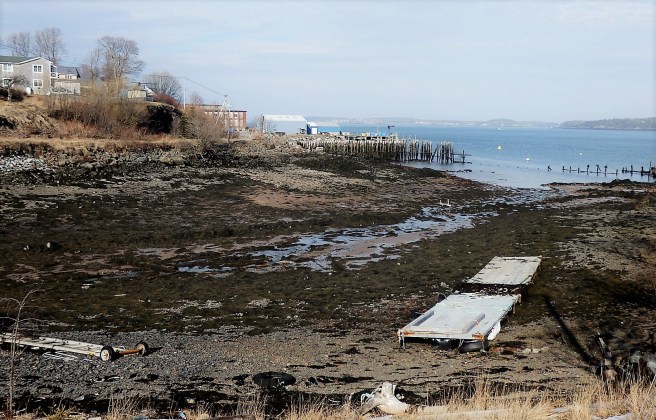
And how it can look six hours later.
As an innovative entrepreneur, he early on erected a steam capstan to haul boats out of the water, along with a 600-foot marine railway made of thick beams set up as interlocking boxes filled with stones.
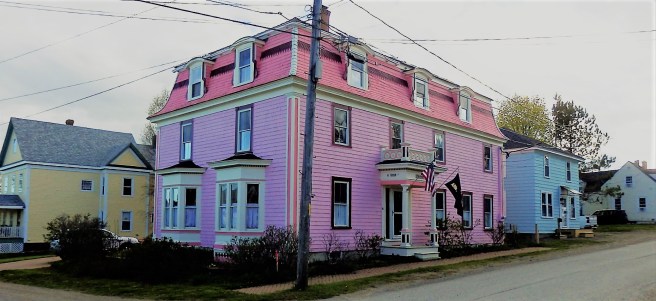
Huston lived in a Second Empire style house overlooking the yards, which he purchased from Hall in the late 1850s.
Part of the C.S. Huston house on Third Street incorporates a section of the “Red Store” that John Shackford erected in 1787 at the foot of Shackford Street.
The shift to ships built of steel rather than wood changed everything. Maine had seemingly endless lumber at hand, but not steel. That also allowed for bigger vessels, meaning fewer could suffice for shipping. Finally, with the advent of the automobile, passengers stopped relying on steamships and that, too, ceased at the corner of this cove. But not before the world’s largest sardine cannery extended from its shore – a building 250 feet long.
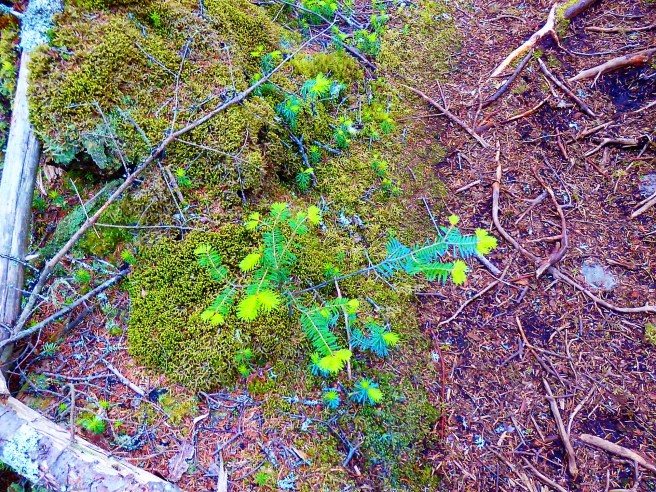
Many of the forests around here rise in beds of deep moss – and much of that is actually beat bogs.Soon the evergreens will be showing bright new tips like these.Openings like this in the forest provide habit for snowshoe hares.
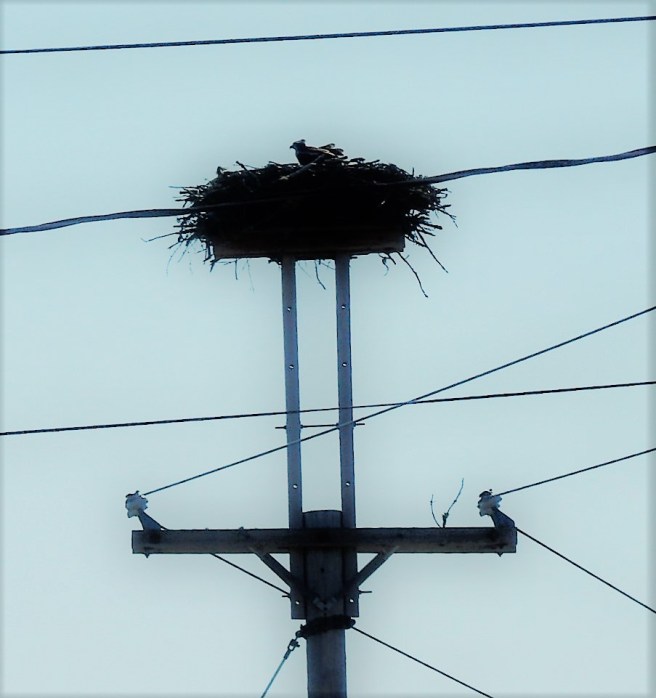
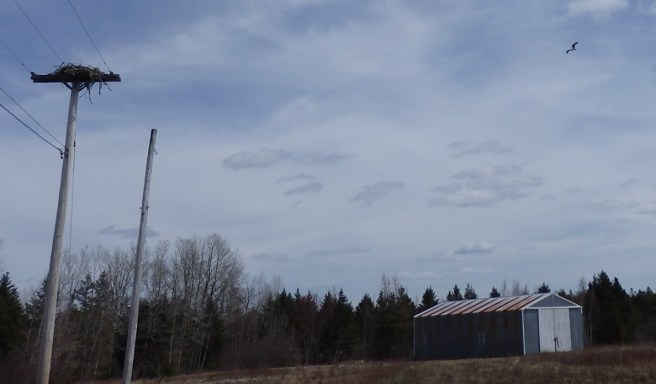
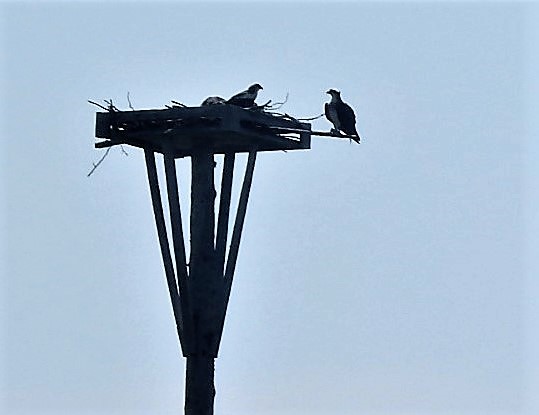
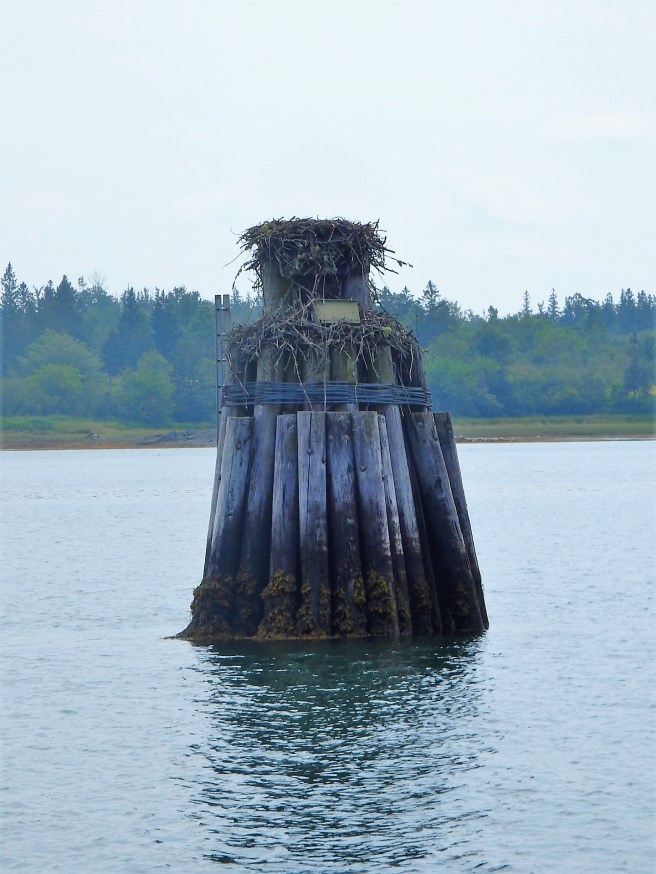
Mama’s head keeps a vigilant watch. For some reason, osprey often build their big nests atop power poles. This one is in Cutler.Once alarmed, she’ll take flight, raise a racket, and threaten to attack. So beware. As I learned in East Machias.Here’s an active nest in Princeton, atop a post in a human family’s yard, actually.In Pembroke, there’s this impressive nest atop a piling at a landing. Almost looks like the structure was built for these majestic birds.
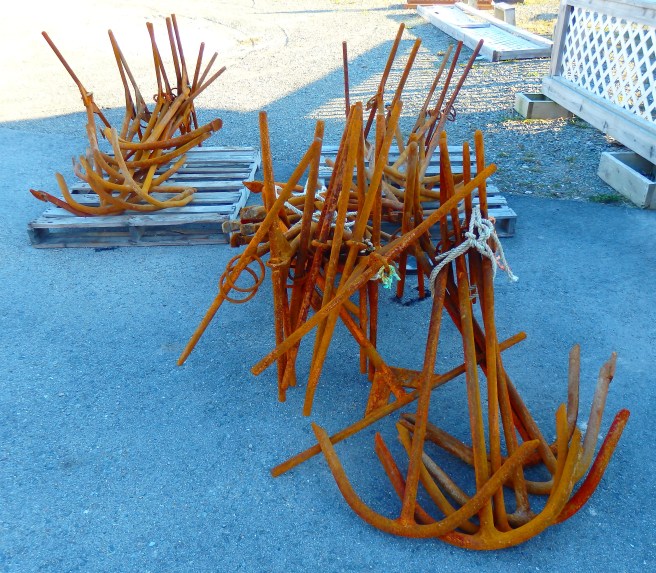
There they were, down by the lobster pier. I’m assuming they’re used in the new system of stringing traps in a row along the bottom, rather than lines going straight down from a buoy, to reduce the possibility of entangling whales.
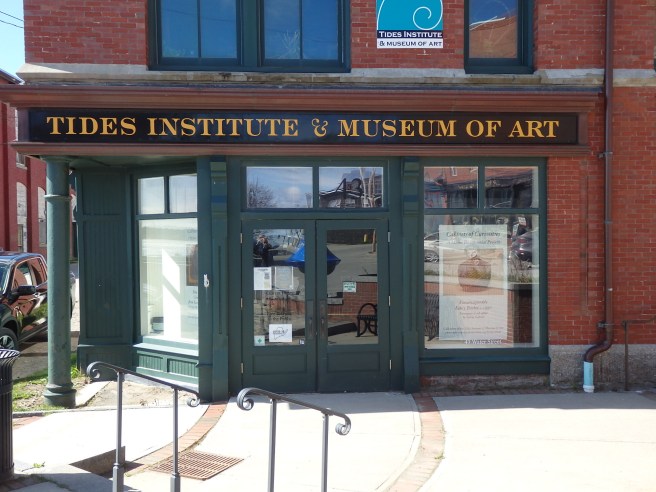
The catalyst of re-envisioning Eastport is the Tides Institute and Museum of Art, founded in 2002 by director Hugh French. Its mission has been in acquiring and presenting wide-ranging collections of artworks and historical documents reflecting the coastal region, as well as educational and preservation efforts that include eight significant buildings in the town – four of them in the downtown district – and guest artists residencies each summer.
The leadership is rounded out by French’s wife, Kristin McKinlay, who is director of exhibitions and the StudioWorks residency program, and by Jennifer Dolanski, Artsipelago/program specialist, plus eight trustees, only one of them living in Eastport. The others reside in places like Boston and New York City.
There are also concerts in its 1818 church that housed the Free Will Baptists, plus other events at its 1828/1829 Seaman’s Church, which housed the Congregationalists.
Oh, yes, every New Year’s Eve there’s the maple-leaf drop at 11 pm Eastern – midnight for our Canadian neighbors – followed by the giant sardine an hour later. Both the maple leaf and sardine were commissioned creations.
I suppose TIMA was inspired in part by the Island Institute, founded in 1983 to help Maine islands from Portland to Acadia tackle pressing environmental and socio-economic issues. The Rockland-based organization’s impressive publications include the annual magazine, Island Journal, as well as data analyses to guide public policy. Its focus is on sustainable livelihoods and communities in changing times that include rising sea levels, bringing together marginalized communities, and economic survival.
The heart of the enterprise is in a former bank on Water Street downtown.
In contrast, for now, TIMA’s focus seems to be more on art and architecture, principally – especially the small downtown on the National Register of Historic Places.
In essence, it’s building a future rooted in the past but not stuck there. It’s really the way every art moves, too, no matter how revolutionary some of the leaps may seem.
Renovation of the former Masonic lodge downtown is designed to house additional exhibition space and perhaps mixed use upstairs.
I do have to wonder whether TIMA has taken on too much. The restorations appear to have stalled, perhaps before Covid set in, and both of the churches need significant repair, inside and out. The institute has, all the same, helped distinguish Eastport as a fine arts center in a visually stimulating setting in Maine, an identity that may attract new residents in a time of national population change.
Frankly, it was one of the things that lured me here, as well as my wife and elder daughter.







 Jnana's Red Barn