You never know what we'll churn up in cleaning a stall
Inscribed on gravestone of John P. Hale (1806-73) in Dover:
He who lies beneath surrendered office, place, and power rather than bow down and worship slavery …
He was the first United States senator to take a stand against slavery.
Earlier, while serving in the federal House of Representatives, he refused to follow the New Hampshire legislature’s directive to support the admission of Texas as a slaveholding state. In the following election, barred by his party from running under its banner, he ran as an independent; none of the three candidates won a majority and the district went unrepresented.


At a party one night in our Smoking Garden, a friend was telling about a fundraiser her church youth group had done back in Massachusetts.
“That’s a great idea,” I said. After all, she was a United Church of Christ pastor with all kinds of connections. “UCC,” for short.
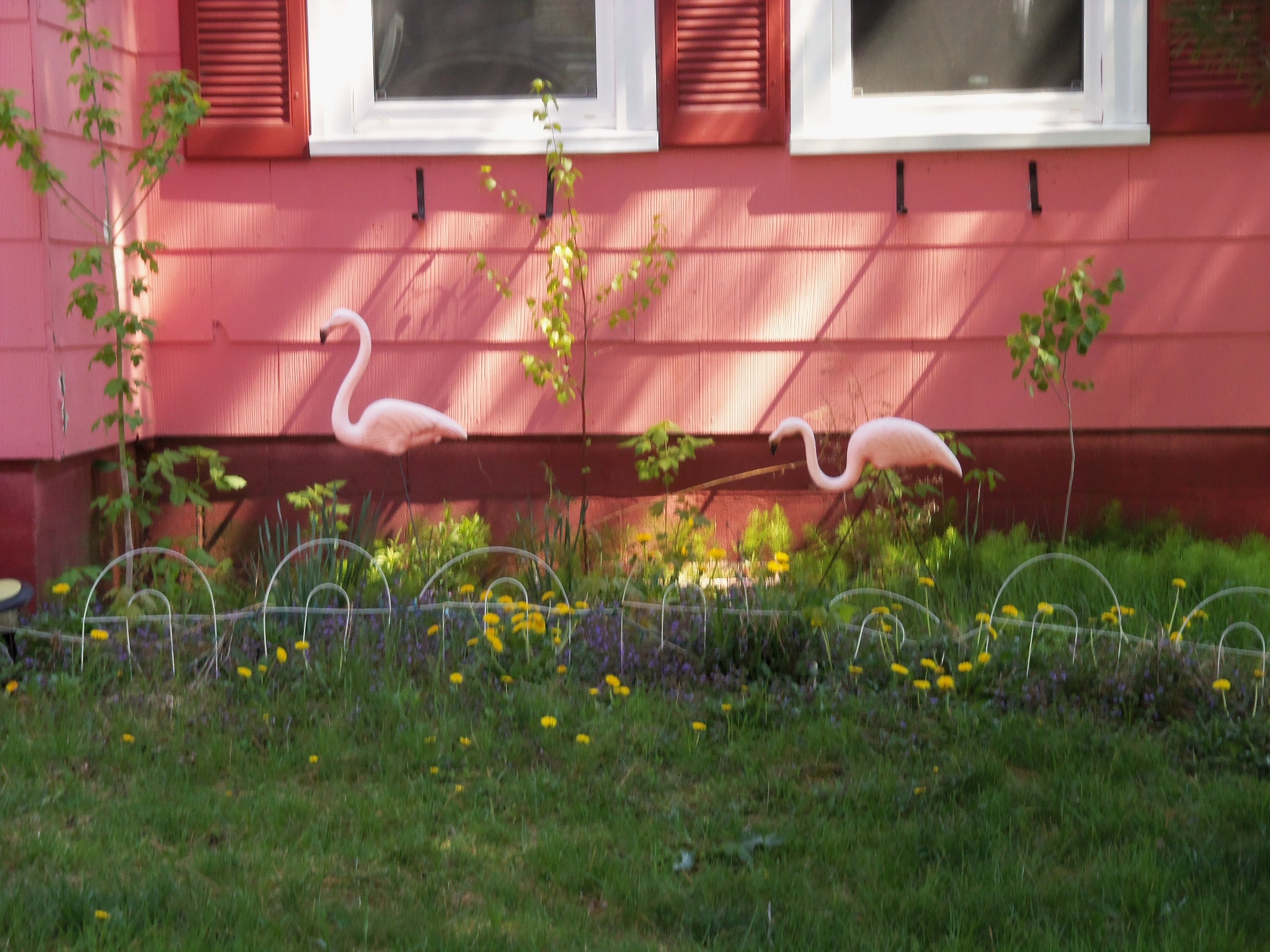
Next thing I knew, a big sign and box appeared in our Quaker meetinghouse, warning Friends to buy flamingo insurance. This is New Hampshire, remember, not Florida.
One night after our party, our renowned sculptor Jane and her husband had come home to find her flock of pink flamingos missing from their yard and garden, but a sign stood in their place: “They needed to be quarantined.”
Uh-huh. I was as baffled as anyone that Sunday as we entered the meetinghouse and faced that big sign and its box of warning.
Here’s how it worked: you could donate any amount for insurance, but if someone else trumped that figure by offering more, you could still get flocked. And if you were flocked, there would be an envelope for another donation for their removal. In other words, you could get hit coming and going.
Then the plastic birds – and wooden cutouts – began appearing in Friends’ lawns. Folks living in apartments weren’t immune, either: the birds showed up strung around balconies or in the backseats of cars left unlocked or wrapped around cars that had been locked.
For the most part, it was great fun – even for the police officers called out to investigate rustling sounds in the night. We had no idea who was in on it, and nobody from our Smoking Garden party guest list was looking guilty.
When we were hit, one of our neighbors laughed and explained why she knew we hadn’t selected the birds as permanent decor: “You’re too organic.”
(Ouch!)
The Sunday morning the operation came out in the open, a guest to Meeting told me, “We did the same thing, down in Connecticut.”
“UCC?” I countered.
“Yes, how’d you know.”
“Just a lucky guess.”
So it had been the Meeting’s kids who were keeping the secret, along with a couple of very, very discrete adults. The money we raised went to the Heifer Project. Our children had to decide what kind of animals they’d send to the Third World – something big, like a cow, or something smaller, like a lot of chickens? And then they took a field trip to the project’s New England farm to check out all the options.
It’s a much better story than the one about my ex-wife’s two birds – the ones a friend of hers stole from my yard after the separation.
our Lady of Pink Flamingos keeps taunting
“Have you been flocked?”
where’s it going, our summer of plastic flamingos?
poem copyright 2014 by Jnana Hodson
Asked what I consider the most essential tool for the yard and garden, I’d answer “my wheelbarrow.” A six-cubic foot wheelbarrow. Even more than my heavy-duty loppers.

It’s not just because we have gardens on either side of the house, either. I use it to move newly delivered firewood as well as shrubbery cuttings. Compost. Harvests. As well as trash. Building and filling the raised beds for square-foot gardening. Spreading seaweed and mulch. The list goes on. And on.
It even serves as a platform for working. Or, in the past, for giving the kids rides.
There’s an abundance of stealth maples, of course. Should we want the yard to revert to maple forest, we’d leave them untouched. Otherwise, they’ll overrun – and overshadow – everything we intend to garden. This is New England. Our yard has too little open, full sunlight as it is. Just ask my wife.

Unless one is a truly dedicated weeder, a triage sets in: aim at the most damaging species and go after it, rather than everything at once. Thus, the maple seedlings, before they establish deep roots that are impossible to pull up. Or concentrate on specific beds each year: the asparagus and ferns, for instance.
There’s a list of common invasive species. We have them all.
Others that are welcome, within limit: honeysuckle, on the cyclone fence; mint, at the back, for mojitos and iced tea. Maybe even poison ivy, tolerated to ward off pedestrians or to establish boundary.
Dandelions (tooth of the lion) are no longer a weed now but daily greens for our rabbits and our own table, at least at the beginning of the season. After that requires vigilance.
The wild rose hips are becoming another matter altogether.
Come springtime every year, there’d be a predicable domestic spat. I’d say the compost was ready. She’d look at it and retort, “No, it’s not: you can still see bits and tell what it’s made of.” (Actually, two shes – mother and daughter.) “Then you’ll have to wait another year for it to finish to your specifications,” I’d shoot back, only to be told we couldn’t wait that long. And so on.
Part of this seemed to question my very manhood. I was, after all, the one doing all the work, from collecting the bags of leaves around the neighborhood and dumping the kitchen garbage in the covered bins to changing the rabbit cages, in large part for their precious, nitrogen-intense pellets.
Well, most of the work. The red wigglers would also do a large share.
Still, I suspected that if we waited as long as they wanted, all of our organic matter would evaporate.
At last, I had a flash of genius. I’d slowly sift the pile, trowel by trowel, and whatever came through the screen turned out beautiful. They approved and used buckets of it on the square-foot garden beds as fast as I could provide them. The part that didn’t fit through the screen was also beautiful, along the lines of woodland detritus with flecks of brown eggs. I put that aside to decay further, perhaps to be spread as mulch in July or August.

The motion of sifting itself can become a kind of Zen practice as you admire the material before you and the thoughts flitting through your awareness.
This movement’s like panning for gold, as I found washing my dishes in the glacier-fed river below Mount Shuksan. Back and forth, back and forth, with all that matter getting smaller and sparkling more in each round of swirling.
All the peach stones are tokens from our cheap peach bonanza after Hurricane Irene ruffled nearby orchards.
The squirrels plant a lot of our wild black walnuts.
Listen to all the cardinals and mourning doves.
Plastic, in flecks, is inescapable.
How loud, those geese overhead! Me, I’d be more stealthy.
We eat a lot of eggs.
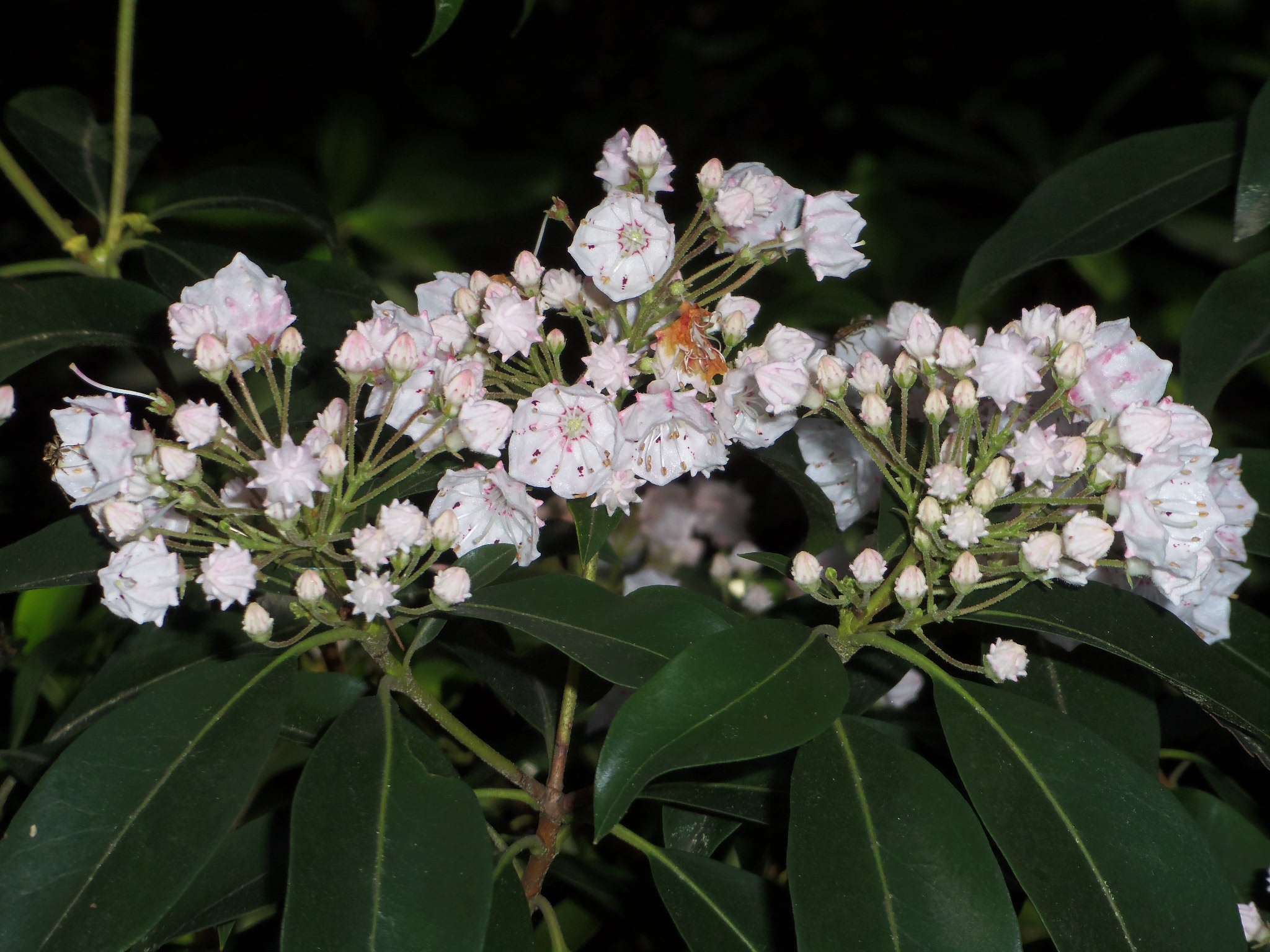
My fondness for mountain laurel springs from my days in the ashram in the Poconos. Those tiny white clusters like origami that open into tiny teacups are, I was told, the state flower of Pennsylvania, and protected by state law.
My fondness for rhododendron goes back even further, to backpacking a section of the Appalachian Trail as an 11-year-old Boy Scout and coming upon Roan High Knob in full bloom in North Carolina.
Joe Pye weed is something I’ve learned to appreciate here, after we bought our annuals at the Conservation District sale.
Add that, as it thrives, to our azaleas.


