The old Foster’s Daily News newspaper plant on Central Avenue is getting quite a makeover, now that the paper’s published elsewhere.
Just a block south from the waterfalls, the former Foster’s Daily Democrat newspaper plant is becoming mostly apartments. The newspaper office and printing press moved out to an industrial park a few years ago, leaving the triangular site vacant. One side is on busy Central Avenue, where the original building sprawled out onto some curious additions. The other side, on Henry Law Drive, was an uninviting cement-block wall, which in effect turned its back on the neighbors.
That backside is being opened up with doors and windows facing Henry Law Park and the river itself.
For added excitement, the park now includes a state-of-the-art playground as well as the New Hampshire Children’s Museum and a band shell for summer concerts.
In becoming Foster Place, the redesign includes new construction atop the old, rambling building. I’m curious to see how it plays out.
The repurposing has a parallel in my novel What’s Left, where Cassia’s family transforms a nondescript building into their expanded restaurant complex. I didn’t picture hers quite like this, but opening the wall and building more on top are part of the story. Much of the new design hinges on windows and doors carved out of the earlier walls.
Three blocks southwest from the Cocheco waterfalls, a cluster of dilapidated storefronts have fallen to make room for an imposing five-story mixed-use building. The design makes high-impact use of a somewhat triangular site and, in a deal with the city, a traffic bottleneck on the busy Chestnut-to-Locust streets connection will be eliminated, hopefully lessening congestion on Central Avenue as well.
Named for a small, long-gone movie theater in one of the storefronts it’s replacing, the Orpheum is adjacent to two landmark buildings of similar height. It shifts the center of gravity in the central business district from buildings facing Central Avenue, repositioning the center around the Lower Square intersection with Washington Street. City hall, the post office, public library, community center, and a new parking garage are all within a one-block orbit.
Visually, it’s also filling in the skyline – not one of high-rise towers, but one of some substance.
In contrast to what’s happening in Boston and, I assume, many other urban centers, Dover’s renaissance is small-scale. For me, that’s part of what makes all of this so exciting.
Visually, I like the way it looks like two buildings from some angles while giving a backdrop to lower buildings along Central Avenue when seen from others.
It looks like two buildings from this side. Or, from the rear, like a small courtyard. City hall is to the right.
Three blocks northwest from the Cocheco waterfalls, this development is arising on a former narrow, triangular parking lot sitting between active railroad tracks and the downtown.
Having stores on both sides of the street should be more inviting to pedestrians and definitively anchor the north end of the downtown. The two buildings already make the street look more urban rather than fading away to one side.
It also gives the central business district more width than the Central Avenue spine alone. I am curious to see how it will appear fully clothed.
The Amtrak station is a block to the left, just out of sight, across from St. Mary church.
The walkway between the two buildings suggest a narrow European street to me. It does break up what might otherwise feel like a monolithic wall.The view along Third Street.
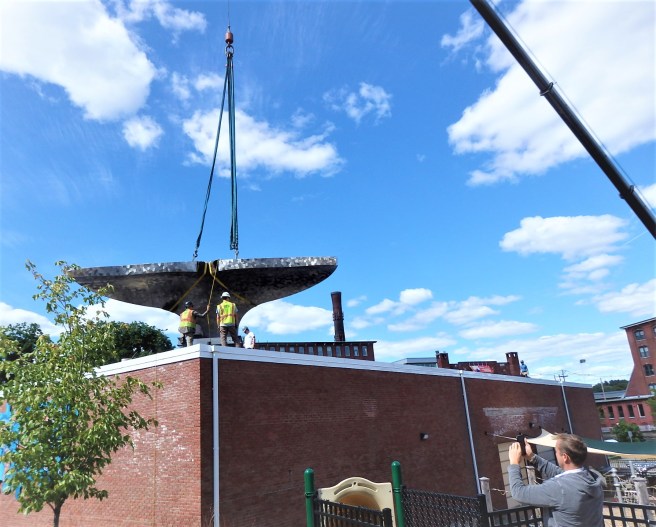
Marti, a 26-foot-long, 10-foot-high whale tail sculpture, is shown being installed last week on top of Dover’s indoor swimming pool. The artwork by Dale Rogers of Haverhill, Massachusetts, is the crowning touch to the city’s Adventure Playground in Henry Law Park beside the Cocheco River..
A block upstream from the waterfall, Riparia went up a few years ago touting luxury apartments beside the Cocheco River. The project’s still looking for the right tenant on the ground floor, a restaurant or function room, most likely. These things take patience.
Riparia rises from what had been a parking lot along the river that bisects the downtown. I suppose it’s supposed to resemble an old mill – I’ve seen several in Maine that could be inspiration – but a vital downtown requires a critical population mass, and this is one more step in the right direction.
For the most part, Dover’s downtown sticks to Central Avenue parallel to the historic textile mill straddling the river. With its waterfront pathways, Riparia gives some pedestrian-friendly dimension to a sidestreet.
There were times when this would have been the ideal location for me to reside in. Just imagine, sitting on the deck on a summer evening and then stepping out on the town, for some live music or conversation, just a few blocks away. Back when I was single.
As seen from the Central Avenue bridge crossing the Cocheco River.
Cocheco Falls sits at the center of my small city. The tide rises and falls eight to ten feet at its base twice a day, connecting the downtown to the Atlantic Ocean 15 or so miles downstream. The river once provided the power to run textile mills that turned out world-famous calico in the 19th century. Dramatically, the river itself runs through an arch in the long building before turning sharply into an extended oxbow on its way to the sea.
Recently, the retaining wall on one side of the falls and a dam on top began to sag. The wall had once been overshadowed by another large mill that fell to fire years ago and is now a bank parking lot. Something had to be done before a cavein.
What’s going in is a whole new design, one that apparently will give people closer views of the cascading waters and the fish ladder beside it.
It’s a dramatic touch, one that reflects the magical attraction of waters in motion through the shifting seasons. Sometimes merely a trickle comes over the flashboards on the dam. Other times it’s so gushing so forcefully the entire mill building shakes.
In winter, deer have even had to be rescued from the rocks, or we’ve watched otters swimming in openings above the dam.
Who wouldn’t want to stop here for a moment?
What helps is having a vision of what a downtown can be. What’s unique to each place?
Dover’s been fortunate to have an economic development director and a city planner who find ways to get things done – often small things – as well Kiwanis and Rotary clubs and a Main Street organization that keep stepping up with improvements.
Crucially, the planning has the concept of pedestrian friendly. Or, as my wife likes to say, “civilized.” We can walk to downtown for a drink or a snack.
Not every town has a waterfall, after all. Let’s make the best of it, then.
Gone is the retaining wall that gave passersby a view of the falls from above. I’m hoping the new walkway will follow the fish ladder to the tide below.
The Robbins Block storefronts are now gone and a five-story Orpheum is rising in their place. The hardware store, lower right, is still there. From the top left are the library, community center, and district court.
When I moved to New Hampshire 32 years ago, downtown Dover – like many other city centers across northern New England – had definitely seen better days. The old textile mill dominating the heart of the city was largely boarded up, and the retail stores that remained did so out of faith and loyalty and family tradition. How could they hold out against the big-box stores at the mall?
And then along came some visionary developers like the late Joseph Sawtelle and David Bamford, as a turnaround slowly took hold. Sawtelle restored the mill as it welcomed offices and incubated entrepreneurial businesses, while Bamford rebuilt mixed-use retail and housing on Central Avenue – some of it tastefully looking more natively New England than what it replaced.
Now that I’ve been a Dover resident the past 19 years, let me say it’s wonderful living within walking distance of a living downtown, one with a small-town feel. As I tell my wife, when we venture out for a weekday brunch, many people drive halfway across the continent for this.
Big change is in the air, though. That center is shifting from being primarily a financial, retail, and office center to more of a residential destination, presumably for young adults, child-free couples, singles, and retirees – people looking for an urban setting close to the ocean and mountains.
Part of the shift has already happened with the top floors of the two biggest mills being converted to apartments, a reflection of soaring residential demand in our part of the state. But now it’s getting serious.
For a city of 30,000, having four significant and mostly residential buildings going up in the central business district is exciting, even before we get to the waterfront development about to unfold across the Washington Street bridge. (Admittedly, some of us do miss the quaint covered bridge for children and other pedestrians that was there when I moved to town 19 years ago, but I’ll go with the tradeoff – landing the children’s museum was a definite coup.)
This doesn’t just happen by accident. A lot of incremental steps over the past two decades have made this a more desirable place to live. And now it’s kicking in big time.
The former Strafford Bank building sits at the corner of Lower Square. The Barley Pub is gone, replaced by the Thirsty Moose.
These T-shirts worn by members of Durham Community Church (UCC) at a Jericho Walk around the federal building in Manchester uphold the perspective of the church as the body of believers rather than the house of worship or the organizational structure. This was at a vigil opposing the deportation of refugees.
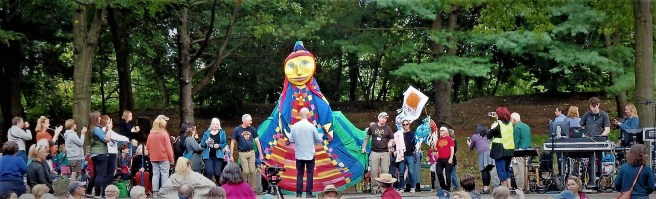
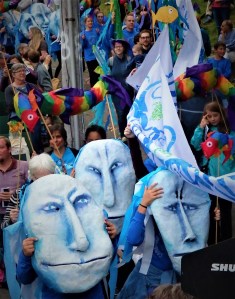
It’s not yet warm enough for New Englanders to return to the outdoors quite like this, but we’re feeling the stirrings. Many of the Boston Revels’ performances celebrate the changing seasons, and the annual Spring Sing concert just took place in the United Methodist church in Watertown, Massachusetts. This scene with Mother Goose preparing to float toward the stage is from last fall’s equinox RiverSing in the Herter Park amphitheater along the Charles River in Allston.The kids in the procession were lots of fun. We had two excellent children’s choirs participating.
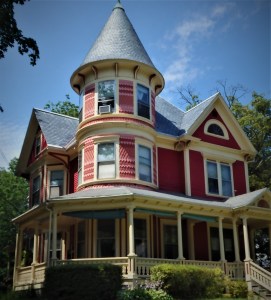
I can easily imagine a large extended family like Cassia’s living in a big house like this. Throw in a constant array of guests, too. If it were only pink, like the one in my novel What’s Left!