Look for my books, sharply discounted. A few are even offered for free.

You never know what we'll churn up in cleaning a stall
Look for my books, sharply discounted. A few are even offered for free.

In my novel Nearly Canaan, Joshua and Jaya settled into a place unlike anything they would have imagined. It was (and still is) desert, for one thing, where nearly everything has to be irrigated, for another. Quite simply, it’s a lot like Yakima, in the middle of Washington state.
But they did repeatedly visit the Queen City of the Pacific Northwest, over where the endless gray and its rains were. The enlightened residents had a propensity for dark German movies in some unique art film houses, and I doubt that I’d recognize the place if I ever go back. Remember, I left well before “Sleepless in Seattle” or Dr. Frasier Crane’s arrival from Boston, not that I’d been there, either.
That said, here are ten high points to consider.
They are a memory, more as an emblem and ideal than creature. I never tasted elk flesh, though I heard praises. Nor have I stroked the fur. What I’ve known has appeared only on the forest floor as track and scat – no ticks on the neck or patchy summer skin like the moose where I now live. That, and winter encounters viewed from a distance.
The deer who frequent our yard these days are so small by comparison.
Will I ever revisit the Pacific Northwest where I lived? Would I even recognize most of it?
Or was it all gone in the divorce?
My second brace of fiction, ultimately three books in all, addressed the dozen years in the aftermath of the hippie outbreak, though I’ve tried to fudge the era precisely. I do think much of it is continuing.
Naturally, for me, they were semi-autobiographical, even though the protagonist is now a woman named Jaya who winds up with a much younger lover who becomes her husband.
The pivotal piece is Yoga Bootcamp, with her now as a central character, along with the guru they sometimes called Elvis or Big Pumpkin. My residency in the ashram was a transformative period in my life, even in the face of details I’ve since learned. We were a rogue outfit in the period when yoga took root in America. This down-to-earth story will probably scandalize your local yoga studio instructor, but the experience did reshape many of our lives, hopefully for the better. I’ve certainly carried many of its lessons far through some other faith traditions.
The central piece is now compressed into Nearly Canaan, originally an ambitious triptych that comprised the hefty novels Promise, Peel: As in Apple, and With St. Helens in the Mix. At the outset, a sense of place was central as Jaya relocated from a small town on the prairie in the American Midwest to the hardscrabble Ozarks to the apple orchard country in the desert of the Pacific Northwest, but the central theme now condenses as the question of how much influence one person can extend over others, hopefully for the better. I can ask now whether it would have been more compelling if she’d been conniving and manipulative.
The third book, The Secret Side of Jaya, is a set of three novellas, each one set in the places she lived after leaving the ashram. Each one, quite different, is premised on hearing and seeing figures in a locale that others don’t. Maybe you encounter them, too, where you are.
You can find these books in the digital platform of your choice at Smashwords, the Apple Store, Barnes & Noble’s Nook, Scribd, Sony’s Kobo, and other fine ebook retailers. They’re also available in paper and Kindle at Amazon, or you can ask your local library to obtain them.
Let’s consider fourth place, as far as length in time. That is, realizing that I’ve been dwelling in Eastport four years now strikes me as a bit of a shock. I’m finding it difficult to make sense of the fact, at least in light of earlier landings.
Quite simply, I’m still settling in here, even if it’s in my so-called sunset years. And, yes, I’m still feeling this is it, a very suitable end of my road, even if I am being greeted by name by people I don’t recall knowing, this is in sharp contrast to earlier locales.
For perspective, those shorter spans were in my early adulthood: Bloomington, Indiana (four years in two parts); Binghamton, New York (1½ years, in two parts and three addresses); the Poconos of Pennsylvania (1½ years); the town in northwest Ohio I call Prairie Depot (1½ years); Yakima, Washington (four years); a Mississippi River landing in Iowa (six months); Rust Belt in the northeast corner of Ohio (3½ years); and Baltimore, my big-city turn and turning point (three years). You’ve likely met many of them in my novels and poems.
Looking back, each of those addresses was filled with challenging turmoil and discovery, soul-searching yearning as well as glimmers of something more concrete and fulfilling just ahead.
In contrast, my longest period of living anywhere was Dover, New Hampshire (21 years), my native Dayton, Ohio (20 years), and Manchester, New Hampshire (13 years).
Stephen King has advised novelists to have only one Big Idea in a book, but I came across that way too late to put it into practice. (Maybe if I ever tackle another novel?)
As I hunkered down in my self-imposed sabbatical in Baltimore – or was it self-incarceration or even cloistered? I did little else – my attention eventually turned to a more recent span of my life than the Kenzie novels covered. It was time to consider my nearly ten years of marriage and its breakup. If only I really knew how to star in it.
I thought that this next book would be about the most heavenly time and place imaginable, but as I typed and would eventually see, the real story was about a deeply troubled marriage, with me holding the debris after it blew up and a whirlwind romance afterward left me in a fog where I was.
So courtship, marriage, and relationship per se were one big subject. (Idea, in King’s expression, feels too refined.)
The other was the Pacific Northwest as seen from the other side of the Cascade mountains in Washington state, a land that is essentially desert rather than rainy gray Seattle.
One was something many people had some familiarity with, but the other was what I found more enticing as a writer. Besides, I had written many landscape poems I could draw from. Swami’s insight from her first visit to India, that the reason Hinduism had so many gods was a reflection of the ways each locale had a distinct vibe. The Yakima Valley and the Cascades were unlike anything I had experienced in the eastern half of the U.S. Especially the vast spaces you never see in a movie or read about in a book. And there I was with my new bride.
My inner drive was to better understand – and remember – the events leading up to what I thought was near perfection, my Promised Land. Except that it all blew up after four heady years, and we retreated eastward in haste. Now, six years later, I was trying to make sense of everything, and writing is my primary tool of thought.
One big hurdle was that I still had too many unresolved issues to provide clarity on the relationship struggles. I couldn’t see that the darling I thought every reader would find fascinating was, in a wider view, dislikable.
The plot – and the manuscript – kept growing by the proverbial pound.
Baltimore for me was so many lonely nights broken periodically by sex that wasn’t with my beloved. The whirlwind who came after the marriage. The one others have called my one true love. If only she had been true.
~*~
I really should go back to my journals to get a clearer sense of what I was going through both as I drafted it and also during its revisions. I suspect the reality would be painful, even embarrassing, and as I write this, those volumes are wrapped in plastic under the house renovation. Maybe that’s for the better.
What was I even originally calling the manuscript?
What coalesced for me was the many dimensions of the word “promise,” including the wedding vow, potential, and what I saw as our Promised Land. And then I had the flash of ending the book on a shocking note.
Well, so had much of my life.
I suspect that I spent far more effort than I’ve thought on the novel that now stands as Nearly Canaan.
Somehow, I even had a round with a real literary agent, who ultimately passed on the project.
During later revisions in New Hampshire, the big blob of material I had in hand turned into three parallel volumes – Promise, Peel (as in apple), and St. Helens in the Mix. And I was wondering about my subsequent engagement and the young woman I thought was a perfect subject for later. (I now see how banal that would have been.)
Would the project have been any easier if I had all the facts rather than empty denials and evasions? What if I had steered this more into the fantasy realm, perhaps having the earth magically speak directly to Jaya? Or broken it into a sequence of short books, each with a sharper focus?
A very bruised journalist, alas, was still at the helm, one still engaged in a difficult, painful exile and trying to report on the facts before me.
~*~
I’m trying to recall books and authors I was reading at the time, especially ones that might have nurtured this project. What comes to mind are Ann Tyler (I can smell the back entry of some homes in her Roland Park section of Baltimore); the Random House Vintage Contemporaries series edited by Gary Fisketjon and writers like Jay McInerney (Ransom more than Bright Lights, Big City) and Tama Janowitz; beyond that, Larry McMurtry, Tom Robbins, and Joan Didion; as well as Calvin Trillin’s U.S. Journal letters from here or there in the New Yorker. I also had John Nichols (Milagro Beanfield Wars), Ken Kesey (Sometimes a Great Notion), Edward Abbey, and Ecotopia.
~*~
Promise came out as an ebook at Smashwords but went nowhere. Rather than pay for covers for two companion volumes, I released them as PDF freebies at my Thistle Finch imprint, only to find nobody was downloading anything that big. Ditto for the full-length poetry collections. There would be a major refocusing of the offerings.
cow skull and elk vertebrae from ridges above the Yakima Valley
Maybe if I had a camera at the time, the trip would have wound up as photos rather than a poem. The weeklong camping trip was a turning point in my life, though, and the poem that emerged from the experience was initially accepted by a prestigious Northwest literary press but then declined – they’d lost a grant, they said.
Had it appeared at the time, my path as a poet would have advanced, definitely more securely than it did. But the effort definitely solidified my growth in the craft.
Poem? It’s my attempt at what William Carlos Williams advocated as a longpoem, where the challenge is “to find an image large enough to embody the whole knowable world about me.” About, in this case, having meanings as both the immediate world around the poet and his own autobiographical revelations. In his case, the image was the Paterson, New Jersey, the river city where he practiced medicine and lived.
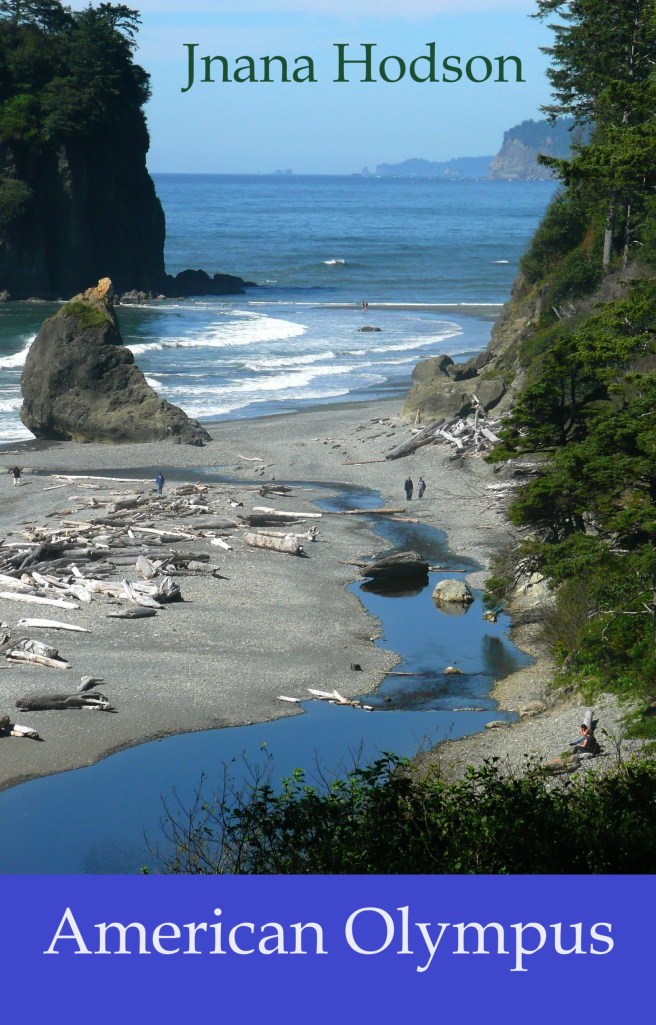
For me, it became about the Olympic Peninsula of the Pacific Northwest, bugged, perhaps, by Basho’s wanderings in ancient Japan.

Having originally appeared in Thistle Finch editions, this collection is now available on your choice of ebook platforms at Smashwords.com and its affiliated digital retailers. Those outlets include the Apple Store, Barnes & Noble’s Nook, Scribd, and Sony’s Kobo. You may also request the ebook from your local public library.
Do take a look.
I’ve long been fascinated by major metropolises, or at least the concept of a downtown as a pulsing power center buzzing with fashionable activity. My hometown, while a thriving city at the time, never struck me as “big.” As for glitz? Forget it.
In the list I’ve assembled, each of the cities has at least one professional baseball team, and today also an NFL team, not that sports were a big factor for me. Great symphony orchestras and art museums, however, definitely were. And later, I came to see subway systems as another measure; the majority of the cities here have them.
All but one of these locations is somewhere I’ve been more than once, and we’re not even counting connecting flights at the airport. While I’ve resided inside only one of these hubs, I’ve lived within the gravitational orb of another seven.
That said, here goes, presented more or less in the order in which I experienced them.
I realize how much the experience of most of these places is based on walking. Pedestrian-friendly was a key element separating them from others.
Honorable mentions: Worcester, Saint Louis, Toronto, Philadelphia, Montreal, Detroit, Providence.
works if you know
the proper pronunciation