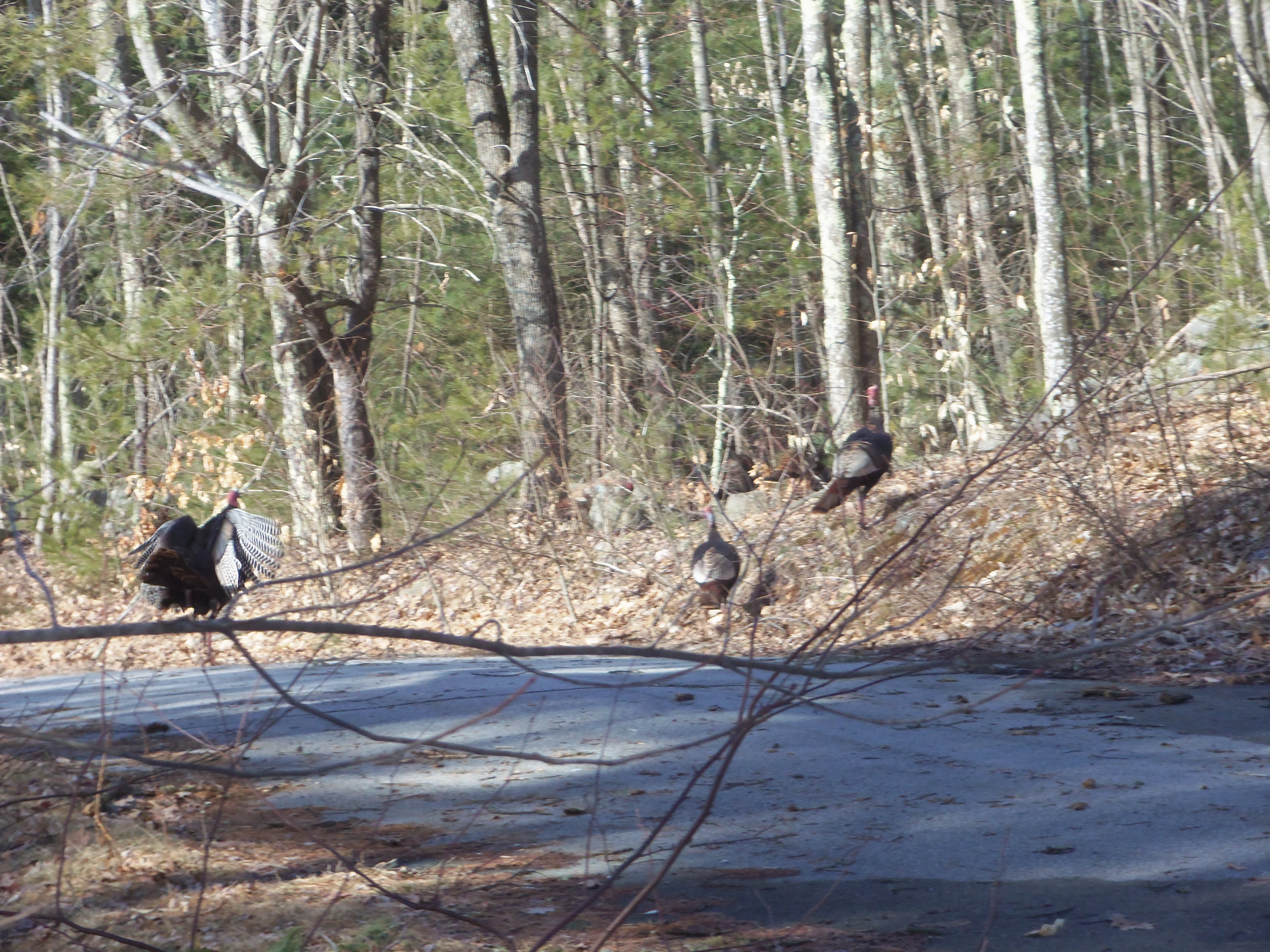
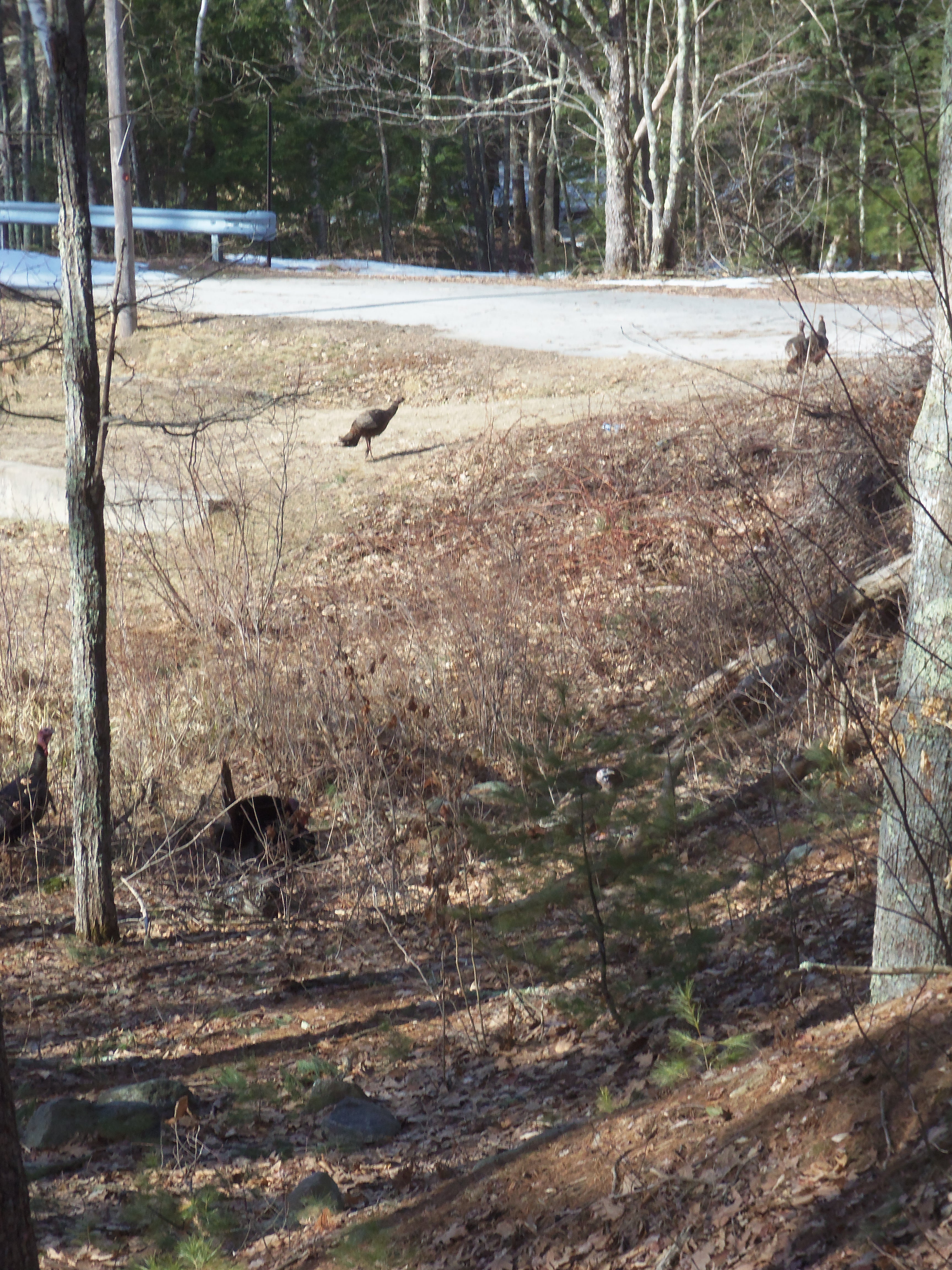
I pulled over to photograph some ducks on a pond, or so I thought. When I turned around, this is what I found.
There they go.Unruffled.
Wild turkeys have made a remarkable comeback in New England. The other day, I had to stop behind a stopped car on the road. That’s when I saw the gobbler stroll off the pavement. There was even one in our yard, we’ve been told.
I was on my way to the Metzlers’ farewell reception in the Grange hall as they wrapped up 19 years’ service in a rural community. As I often do driving solo, I slipped into a meditation and jotted down random thoughts and observations on the five-hour drive. Here they are.
31 May 2009, unexpectedly staying over and returning Monday, before an evening shift at the office:
Wells, Maine, en route – so long since I’ve gotten AWAY! (Excepting Ohio.) The commute … toll … York … driving a lot, same old loops for starters. And then beyond the usual fringe.
A pilgrimage. Saturday night major revisions to “On the Broad Penobscot,” which I would read at the reception – and see at that time it’s as much about marriage as kayaking.
Summer in New England:
When the air temperature
finally reads higher
than the open-roadway
speedometer.
Driving the Maine Tpk. same time as Meeting for Worship: a driving meditation.
Tide way out, Fore River and Casco Bay – mud flats.
Seems so natural now.
No CHECK ENGINE light on for the past month or two, and then, sometime around Brunswick, on a tank of Mobil rather than Irving, on it comes again – and stays on.
Losing another Friend: Heather Moir. (Morning e-mail.)
Just before Bangor: What the hell am I doing? This long, gust-torn drive? So many emotions and memories stirred up! So I’ve been here almost 22 years now – NH from Balto – and they’ve been part of it most of that time. The one lover’s wounds still fresh and intense, then another.
Their efforts to establish a medical practice and to be ordained. The kids. So much time, so many lost years! The barn they took down, the crowded kitchen, the introduction to homebrewing, the treehouse. The trip taking Megan to China Lake and then R and I continuing to an overnight in Orono – and Carolyn’s “She’s a keeper.” (Our canoeing across the lake and, on our drive home, the long loop up through Rangely and down through Berlin.) Much sadness here, this transition.
I find myself running way ahead of schedule. Stop at the Weathervane in Waterville, and find the contrast between their fish and chips and those at the Shanty in Dover a revelation; the later doing everything right, the former cutting every corner. At the next rest area, I phone R and tell her she’s spoiled my appreciation of food – it’s like discovering great champagne, I tell her.
I skirt a serious thunderstorm, get only sprinkles, and then it’s sunny again.
Stop at Borders in Bangor, find a collection of Andre Dubus stories and Henry Miller’s Tropic of Cancer, as well as a Keith Jarrett trio CD.
In Enfield, I kill time along the Penobscot, where the sky has turned gray and the wind is kicking up whitecaps.
Clouds reflecting
in the pollen-covered
Penobscot current
(the river a mile wide in places?)
Passadumkeag
water striders
and sedge (reeds)
– the public access landing
river mussels
(A few days earlier, Sherry told of attending Andre Dubus’ funeral: he had insisted on being buried in the backyard, which created a controversy in the town. The coffin had a copper plate on top, which all of those present at the graveside service were to sign before the burial. It was all quite strange, she said, but there was lots of food.)
In the Grange hall, their motto: Unity in essentials, liberty in non-essentials, charity in all things – the Pilgram Marpeck!
In one conversation, a man was telling about his three-year-old grandnephew’s first reaction to the paper mill in Lincoln: Who farted! (How accurate! Who am I to complain, writer – user of paper?)
Only a portion of paper mill production is newsprint, office paper, or book/magazine stock. So much cardboard, tissue, etc. instead. Just for perspective.
Before entering the Grange hall, I drove down to Cold Spring Pond, looked across. R and I canoed that far? Amazing. With all of its clarity that day and the big boulders 20 feet down.
Their Jesse was in Budapest, but Margaret was quite present. As were Bill and Barbara – both after all these years. Other than that, I knew no one.
Was surprised D wasn’t present. Didn’t get a chance to inquire, either.
Good thing I went. Sense of closure. The poem went quite well.
Carolyn’s sister, Marsha: “You’re a deep thinker.” She should see what happens with Carolyn.
Raining during the gathering and through the night.
But next morning clear and bright.
A perfect day for driving – after the rain.
How dramatically the drive changes from Portland south – no more of the same rural quality.
~*~
How vivid all this, these years later! And how precious the friendships and memories!
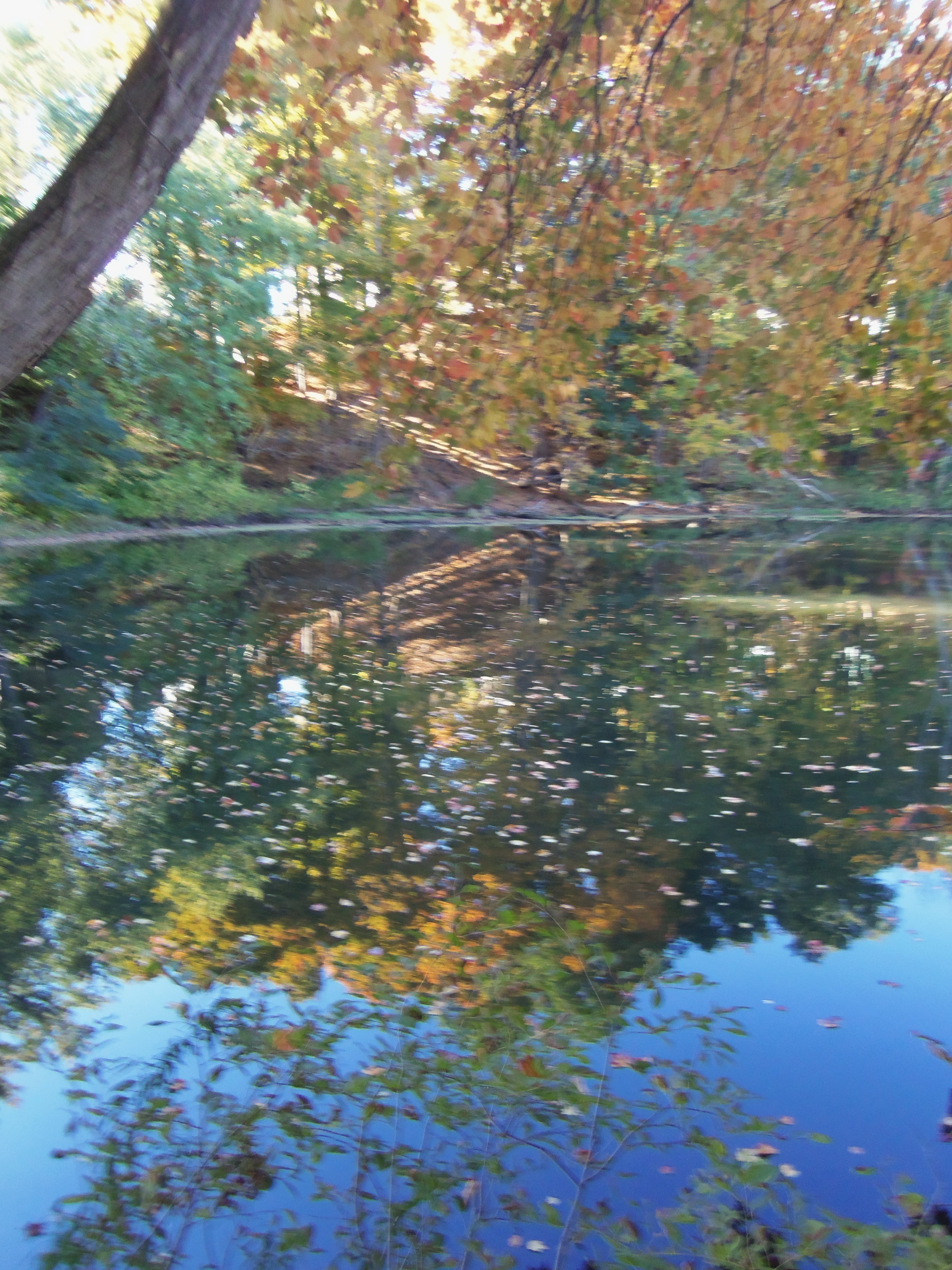
After a particularly heavy rain, a small pond forms in the bottom corner of the side of our lot we call the Swamp, over by the far neighbor’s driveway. When we first moved in, that meant Ernie, a retired pipe-fitter who’d built the tidy house and large garage a half-century earlier.
Somehow, we dubbed the puddle Lake Ernie and learned to watch it as a warning. Whenever Lake Ernie appeared, I needed to check on the cellar – make sure the sump pump was working.
Soon now, the ground will freeze and likely become snow covered. It comes as a relief, at least until the melting, when I have to start checking the cellar. Especially if heavy rains melt the snowpack.
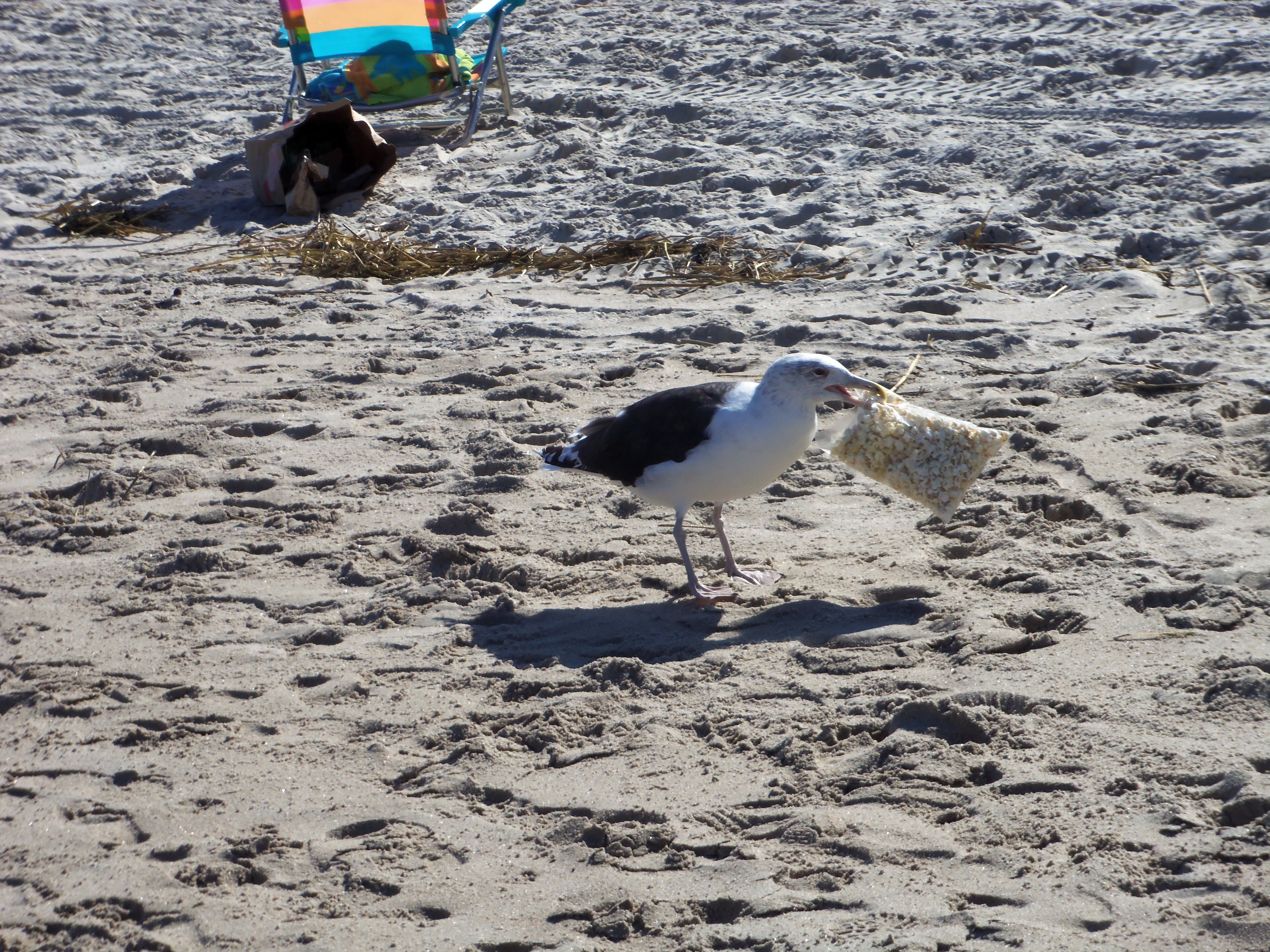
When you go to the beach, you need to secure your snacks from the marauding gulls. Here one makes off with a bag of popcorn, which the bird promptly ripped open before a host of rivals flocked in.
On my Monday free of the office, I drove up the palisades to nose around a picturesque river city in dull, mid-October weather. Looked at the signs. City Fish Market – Fresh or Smoked, down along the water. “Bill’s,” one door said; the other was “Private.” Down the main street from Doug’s Steak House, which was supposed to be THE place for Mississippi catfish, the town school stood in front of Lock and Dam No. 10.
I pulled into the Corps of Engineers parking lot as the Jack Wofford pushed its barges into the lock, noticed an observation tower, and climbed up to a deck occupied by mostly married retirees. But in the corner, more my age, was a woman in a London Fog trench coat and big boots, her long, black hair blowing in the cold wind. For a while I wondered if she was part of the pairs and quartets of older folks with their cameras who had come to view the autumn foliage and poke around the gift shops and galleries. She turned her head, noticed me briefly, turned back several times. Between twenty-five and thirty-two, I guessed. Proper makeup, classy.
Then, on the riverboat, a cook appeared at a door and fired back with his camera. She laughed.
Once the retirees beside her left, I asked her how the crews got their three lengths of barges – 3×3, for nine in all – out of the locks. “I don’t know,” almost a question. “I’ve never been here before.”
This time I noticed her crooked teeth. Began to wonder about games.
The cook emerged again, this time from the pilot house, and threw something, calculating for the wind. The object curved sharply at the last moment, into her fine catch. She unwrapped it a bit, saw it was a brownie with a phone number and address inside. She giggled to another old couple: “I think he’s had a lot of experience.”
Once the riverboat churned out of the lock, she descended to a powder blue Ford Torino, donned kid gloves with little holes for driving, and drove off.
The wrapper around her plates left me wondering if she was from the Henry County in Iowa or the one up in Minnesota.
I was left wondering, of course. Why so dressed up? And free on a Monday? That wasn’t a typical single person’s car. A professional, between stops? An art major, who gave it up for money? A government worker, with Columbus Day free? Off to a sweet rendezvous? Delightful divorced? Bored, with kids?
Me, at the time, with my own wife a thousand miles to the west, presumably finishing college.
Unlike the rest of my family, I have an aversion to onions. Or maybe it’s the other way around. It’s not pretty. I’ll spare you my rant. Likewise, I could cite a long history, with heavy childhood quagmire, but we’ll just leave it there.
Leeks, on the other hand, create no problems. They’re marvelous and so beautiful in and out of the garden. So it’s a glorious compromise, all the way around. (Shall we say that potato-leek soup is one of my favorites?)
And I’ve developed quite the love for garlic. In and out of the garden.
Rockport, Massachusetts, sits at the end of Cape Ann.
Mention “the Cape” anywhere in New England and people assume you’re talking about Cape Cod, that marvelous arm extending from southeastern Massachusetts. (Well, it does have its own dictionary entry.)
Mention “the Other Cape,” and a few knowing heads will nod or smile in recognition of Cape Ann, jutting from Boston’s North Shore.
It’s not that those are New England’s only two points of land extending into the ocean – the definition of a cape. For perspective, two of Maine’s most photographed lighthouses are on Cape Elizabeth and, close to us, Cape Neddick.
What Cape Ann and Cape Cod share is a certain ambience, a feeling that – well, you’re in a unique place and not just anywhere in New England.
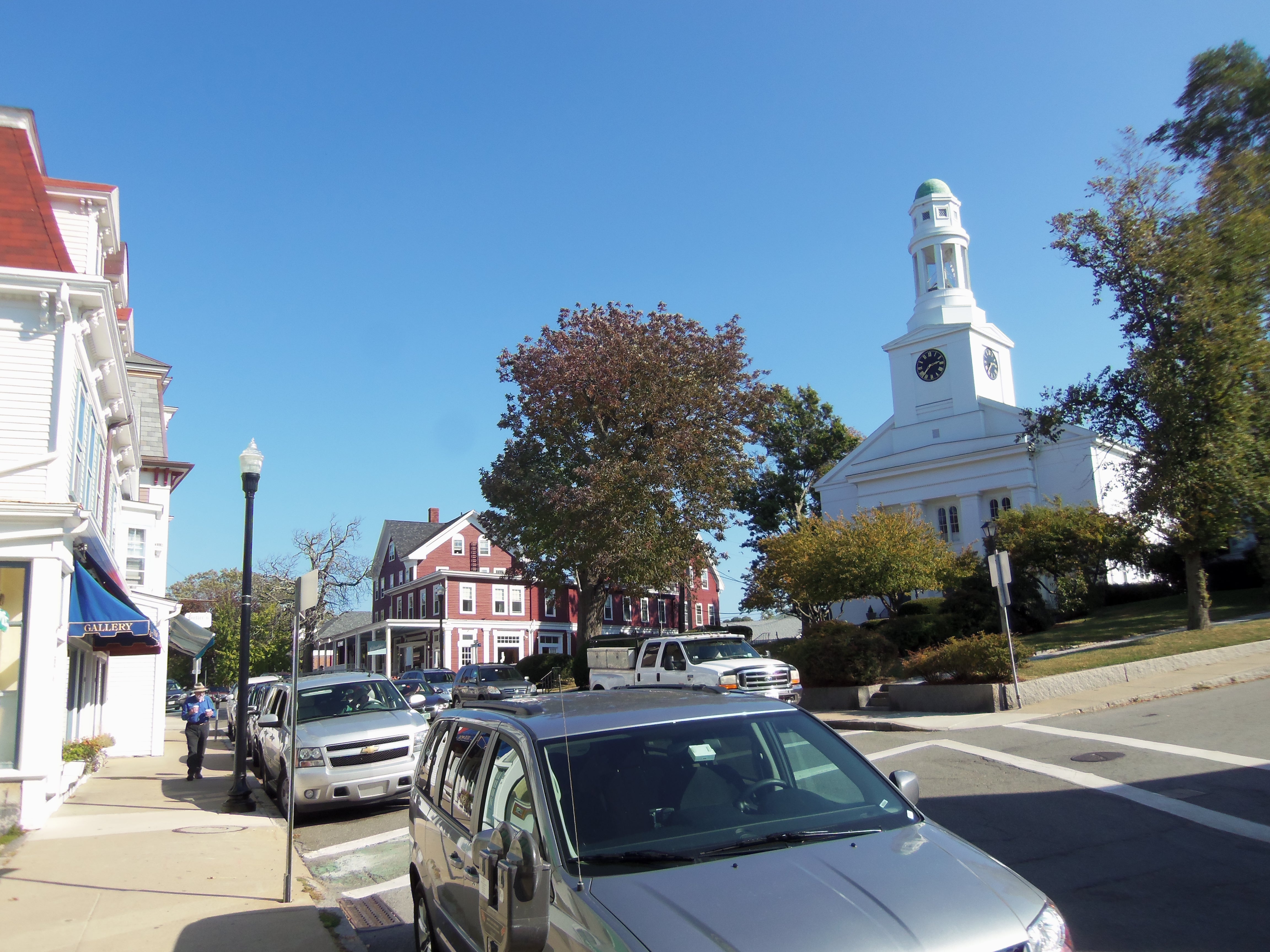
If you’re not familiar with Cape Cod, let me say there are many fine guidebooks that describe the experience. Today’s gallivant, though, takes us ever so briefly to Cape Ann, which by its most generous definitions (probably mine) can be no more than a third the length of its famed rival. While Cape Cod is neatly demarked by the Bourne and Sagamore bridges, Cape Ann is a bit more diffusive. Since we come down from the north, we find that “Cape” familiarity in the air as we come into Ipswich, which claims more “first period houses” (1625 to 1725) than anywhere else in America – 58 in all. It’s a charming community and, like most of Cape Ann itself, has a more varied mix of social classes than you typically find on the bigger peninsula.
My introduction to the town came last fall when K. Peddlar Bridges invited me down to do a poetry reading on his Roadpoet cable-access television show – and we had a blast. Before the taping, I went for a walk through some lovely year-round neighborhoods that could stand as textbook tours of American architectural styles. I crossed a stone arched bridge as geese took V-formation and honked low above me. Turns out the 1764 Choate Bridge is the oldest double stone arch bridge in continuous use in the country. (I don’t make this up, nor do I challenge the accuracy of the claims.) Leading to an impressive Colonial-era garrison house, the span connects to Turkey Shore and Labor in Vain roads. You get the picture. And, yes, you don’t get a better sense of that Puritan outlook than “Labor in Vain,” do you?
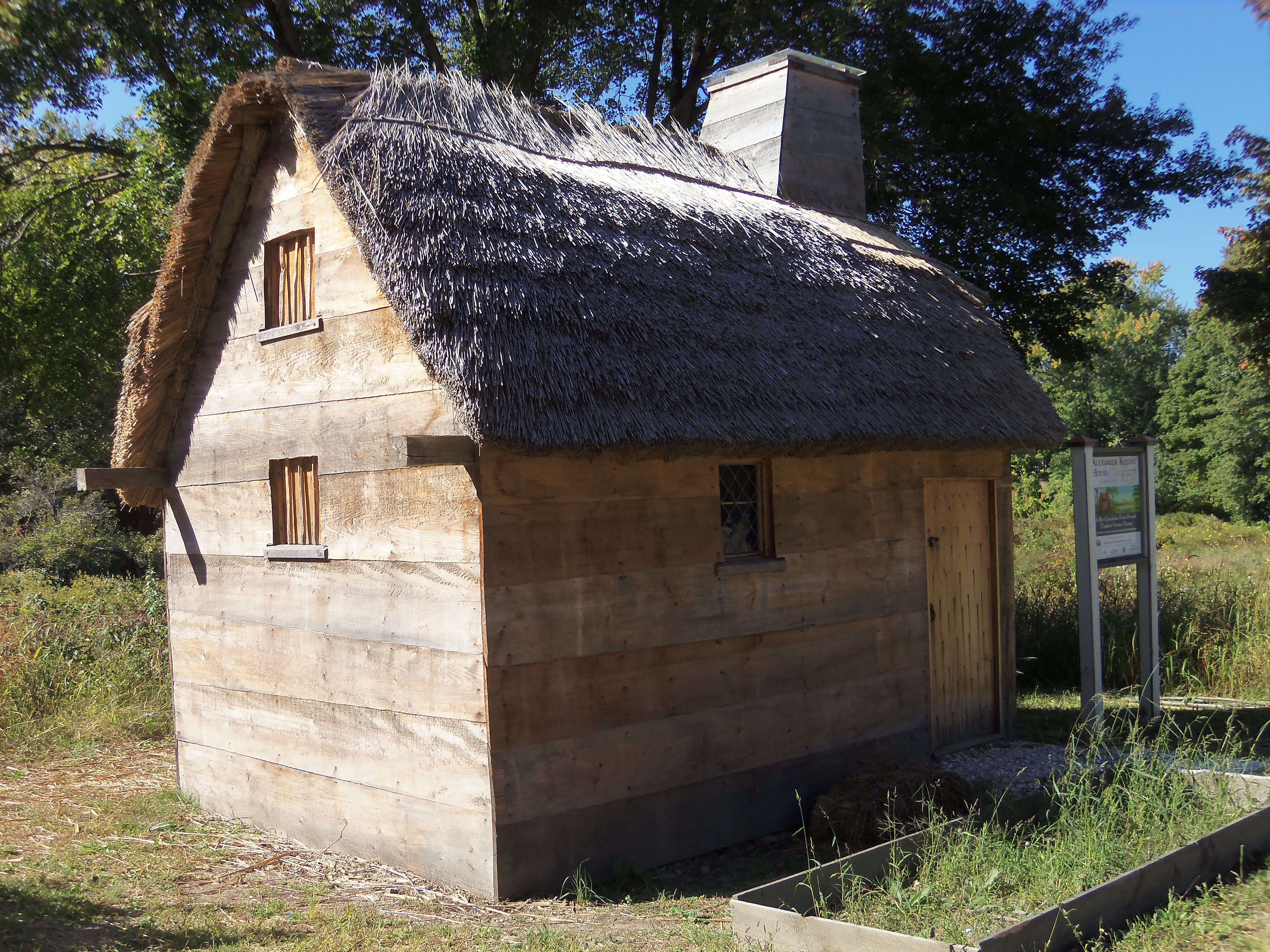
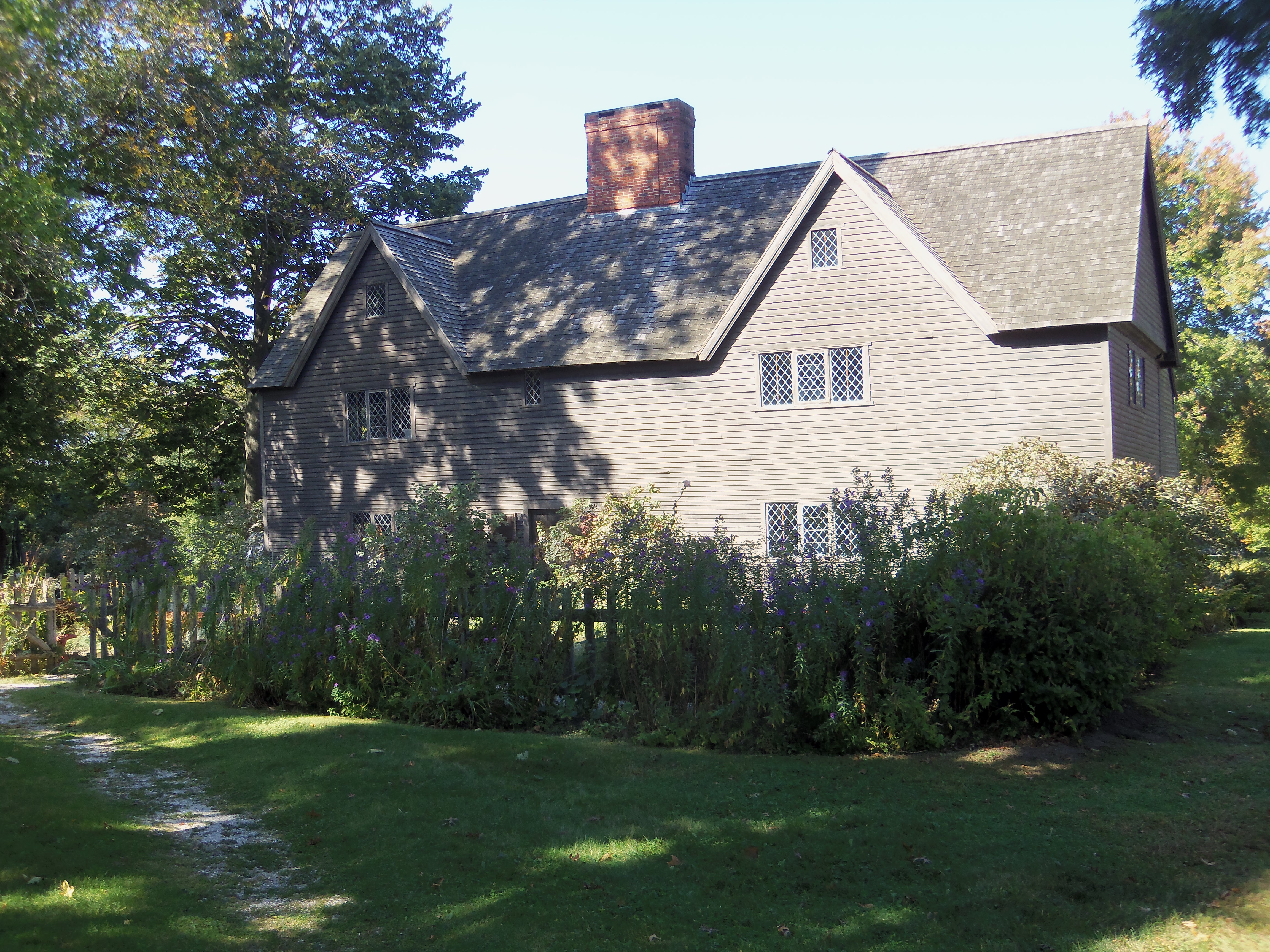
The reproduction 1657 Alexander Knight house in Ipswich, Massachusetts, suggests the difficult life facing the early settlers, especially through a New England winter.The elegant 1677 Whipple House in Ipswich is considerably smaller than the House of the Seven Gables in Salem but similar in style.
So the next week, my wife and I took off for a fuller exploration. We headed on down the road through gentleman farms and veered off for Crane Beach, passing long vistas of salt marshes where prized hay was once harvested. (It was high in mineral nutrition but gave the milk a salty taste, according to the tales.)
The beach itself was once part of the Crane family’s Castle Hill summer estate, which is another destination. The estate, the 1,234-acre Castle Neck dunes and beach, and adjacent 700-acre wildlife preserve are part of the Trustees of Reservations holdings. (Be advised, there’s an admission fee to the park – $8 a car when we went; up to $25 a car on summer weekends.)
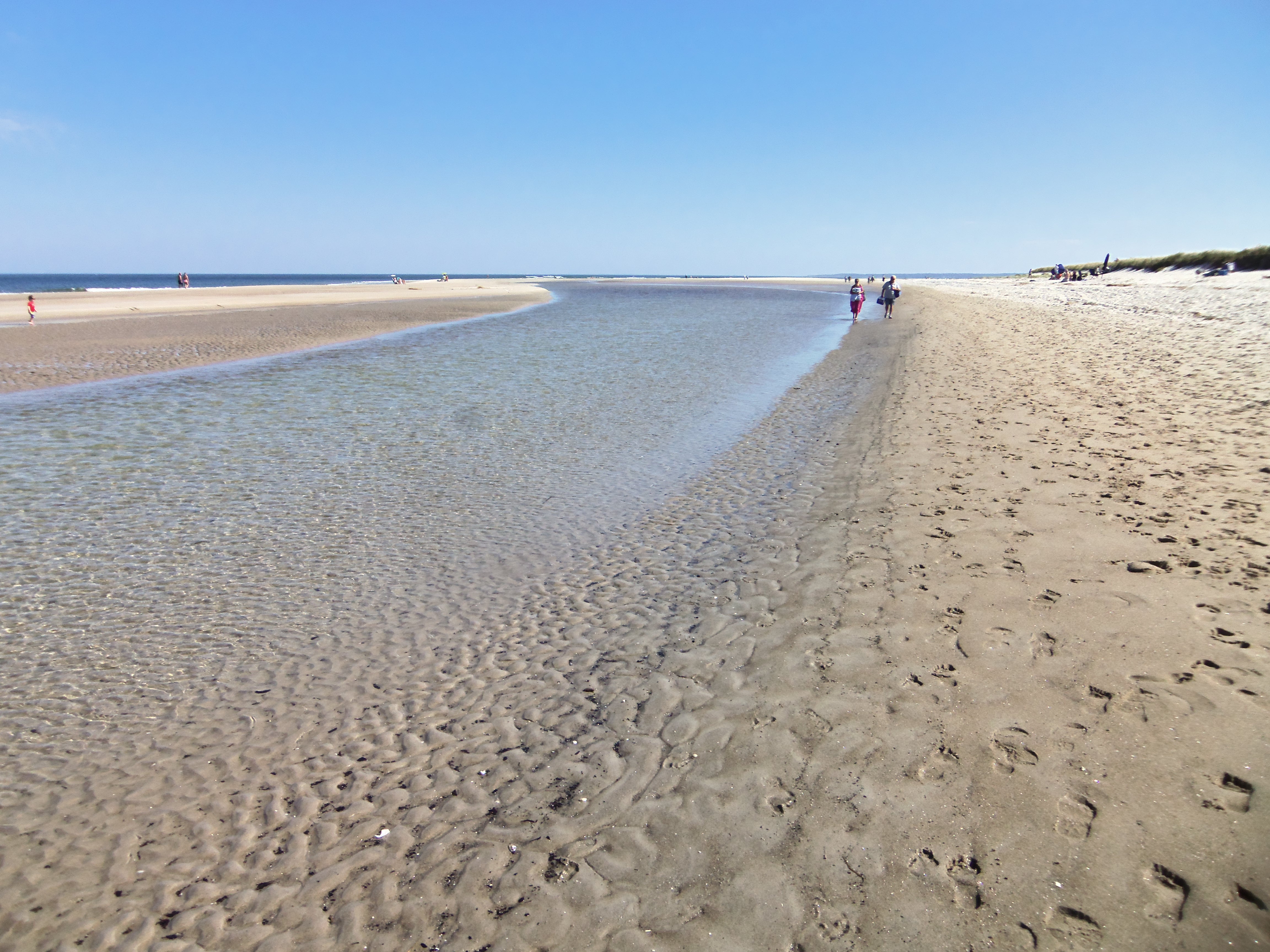
But what a beach! My wife was overjoyed to see white sand, like those of her native North Carolina, rather than the usual gray or brown of New England. And that sand seems to run on forever, with fascinating patches of rippled washboard, tufts of sea oats, and an array of shells we don’t find in our usual rounds of the coast. It may have been October, but our nostrils were greeted with that distinctive Coppertone aroma, and our eyes viewed an array of sun worshippers extending their tans as well as a few daring souls in the water. We walked and walked and, well, might still be walking if we hadn’t felt hunger kick in.
We’ll be back.
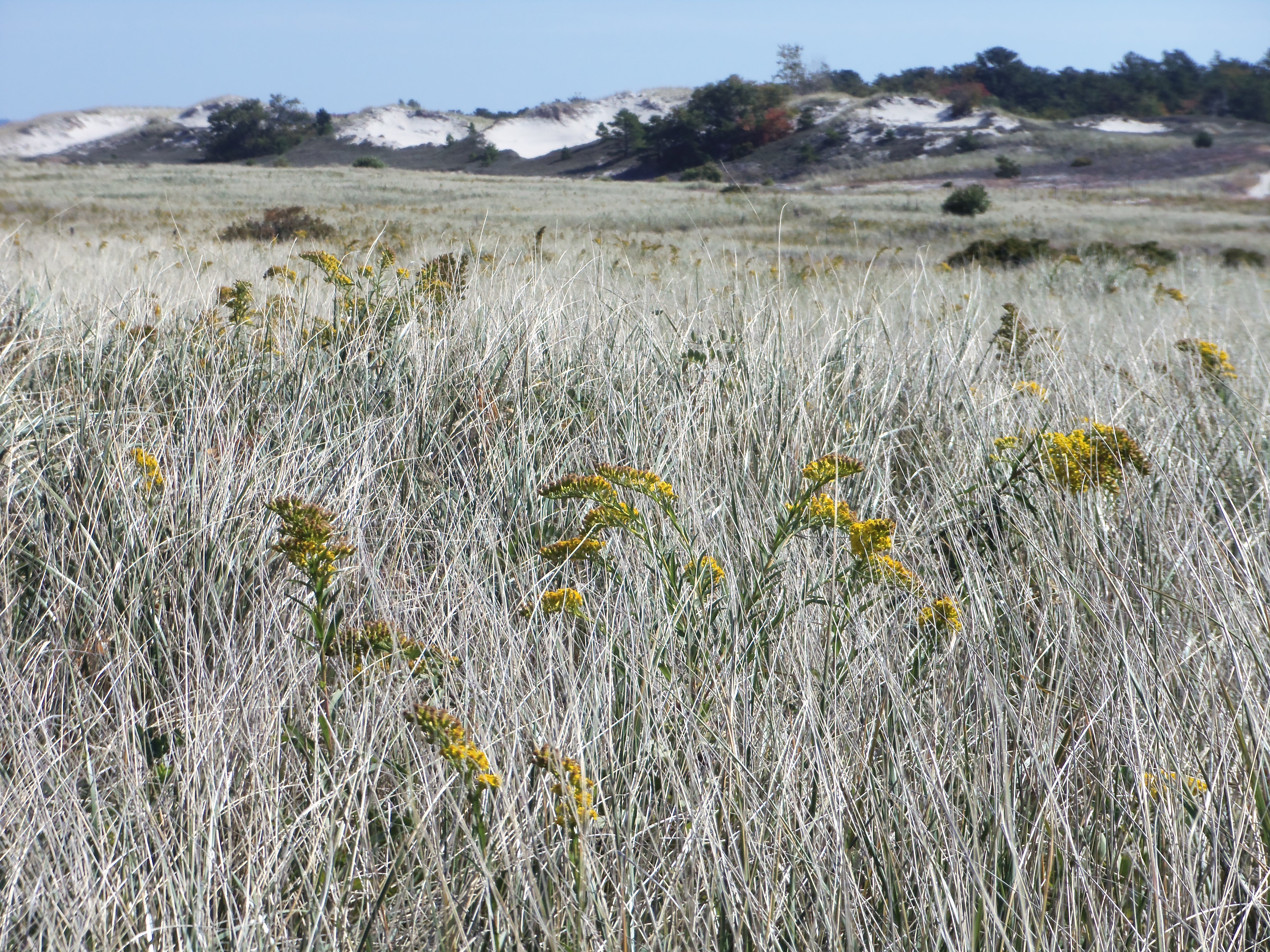
Washboarding and footprints decorate the sand at Crane Beach.Here’s a view looking into a dune behind the beach.
Venturing on, we came into the small waterside village of Essex, where we poked into Woodman’s “in the rough” for a seafood lunch. “Rough,” which is also in the name of an outdoor haunt we love in York, Maine, seems to indicate ordering and picking up from a counter rather than wait staff service, as well as a picnic-flavor rustic decor. As we looked at the blackboard and its prices, we nearly left for cheaper fare, but Rachel caught a posted review by food gurus Michael and Jane Stern – and I knew we weren’t leaving. I’m glad we stayed.
It was fun and filling – they don’t skimp on their portions. We can see why it’s a classic destination for the traditional regional seafood, especially of the “messy” sort. And, as she said, they “know how to do batter.” That’s a high compliment on her part. (Onion rings, anyone?)
The heart of Cape Ann is the city of Gloucester and its varied neighborhoods around the waters. It claims to be from the same year as Dover, although unlike my city, it was abandoned for a period, and is about the same size, roughly 29,000 residents. It lays claim to being America’s oldest seaport and has always been a busy, often brutish, fishing harbor. Gorton’s Seafood uses the city’s sea captain sculpture as its emblem. The Perfect Storm movie captures some of this legacy. These days it’s also the home to a number of whale-watch operations, due to its proximity to the famed Stellwagen Bank fishing grounds. In the 1950s and ’60s poet Charles Olson sought to capture the local spirit in his Maximus series, drawing on Ezra Pound’s literary foundation.
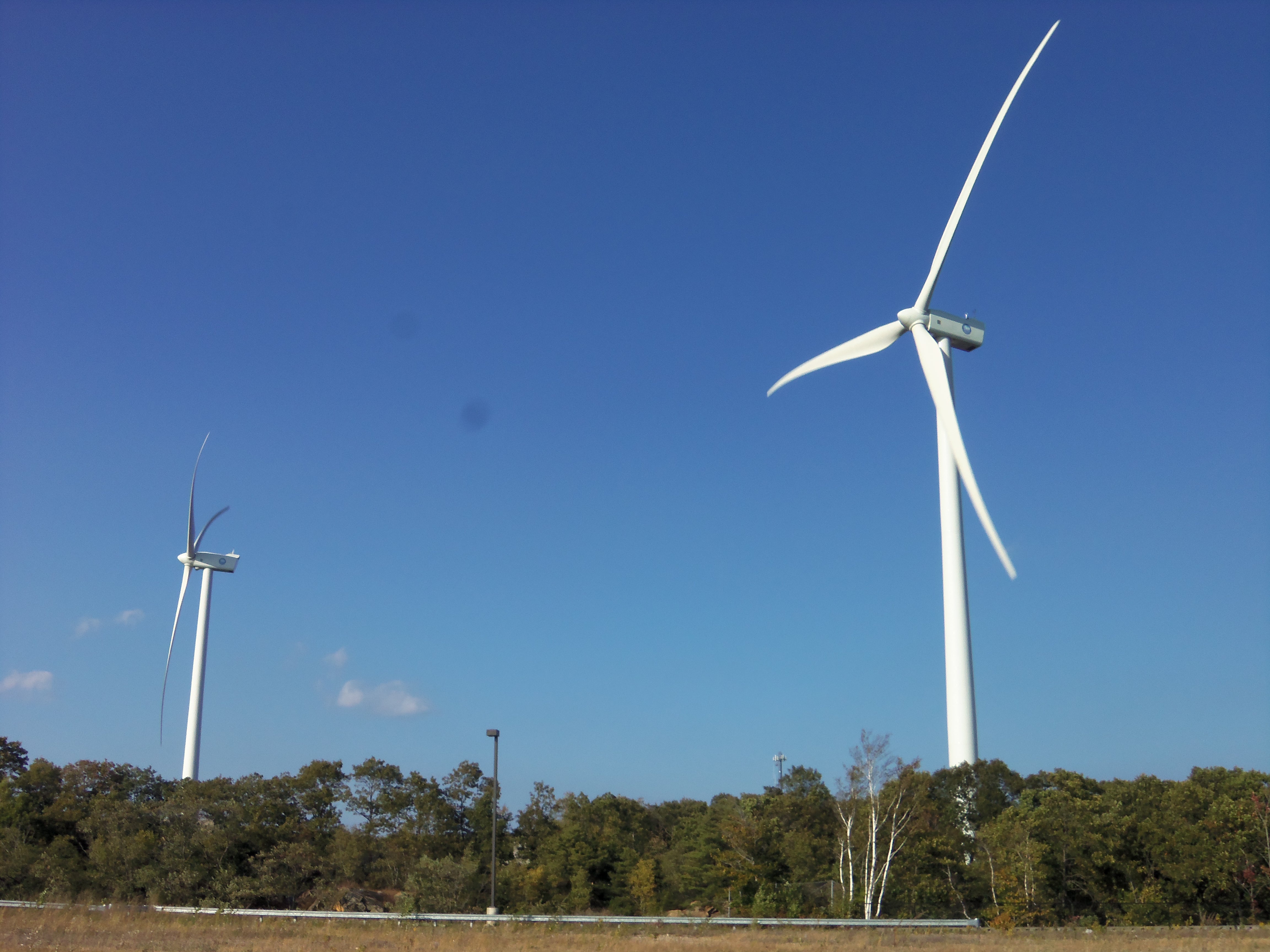
For us, though, the glory of the place is its three large wind-generator turbines rotating gracefully from the highest points along Route 128. They are immense works of art, comforting, landmarks. How anyone can oppose their construction baffles us. And, yes, they do sing … softly.
The trees might give you an idea of the scale and majesty of these Cape Ann landmarks.
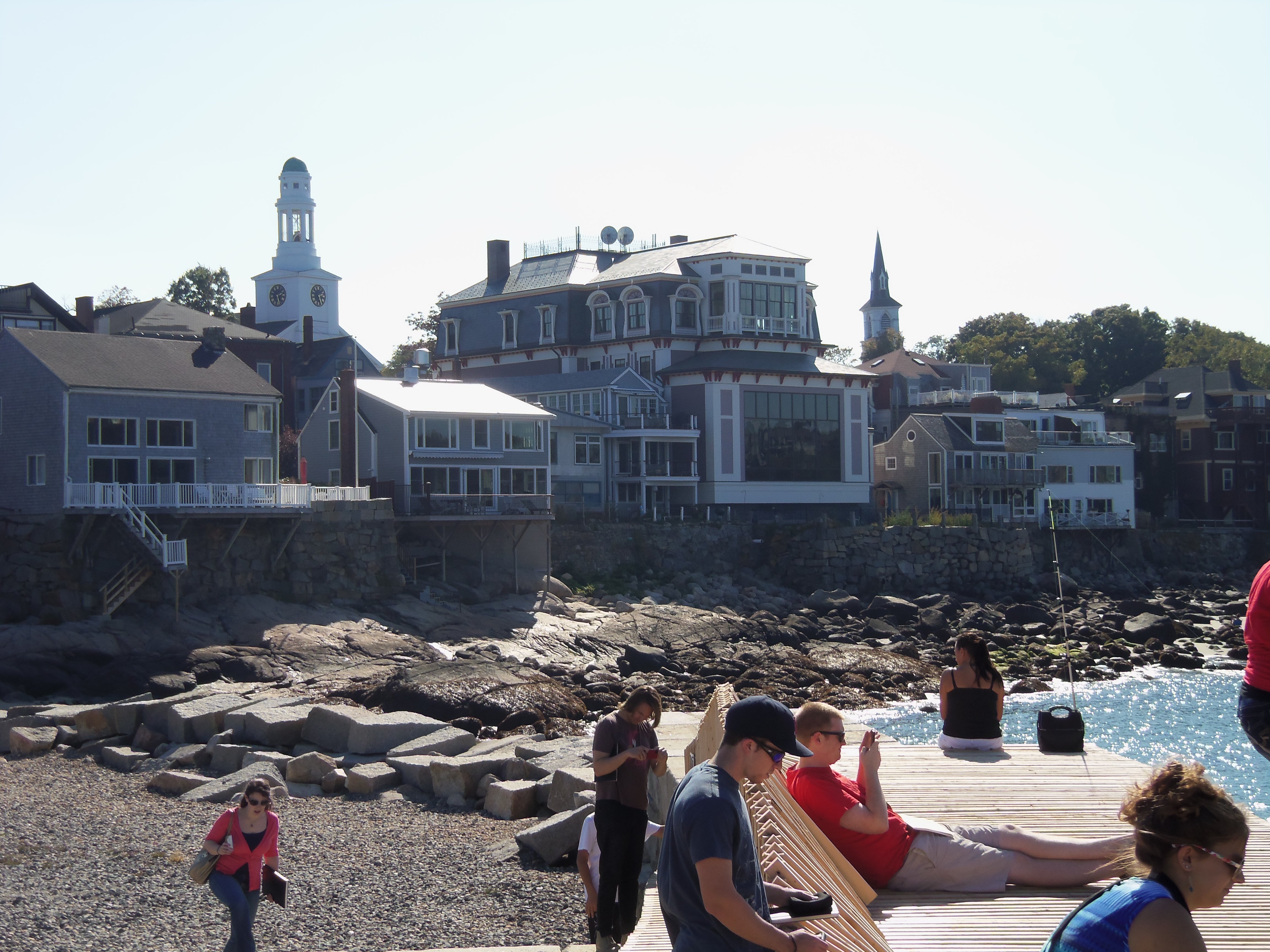
Cape Ann culminates in the town of Rockport, which has long attracted summer artists to its shores. More recently, the three-decade old Rockport chamber music summer festival has developed a loyal following, which led to the 2010 opening of the 330-seat Shalin Liu Performance Center and its year-round offerings that include classical, folk, blues, and jazz. When they say “intimate,” it’s true. What makes this hall truly amazing is that the back of the stage has wooden panels, for acoustical purposes, that roll away to reveal a panorama of the harbor. Maybe the Santa Fe Opera surpasses the view, but I bet you can find folks who can quibble.
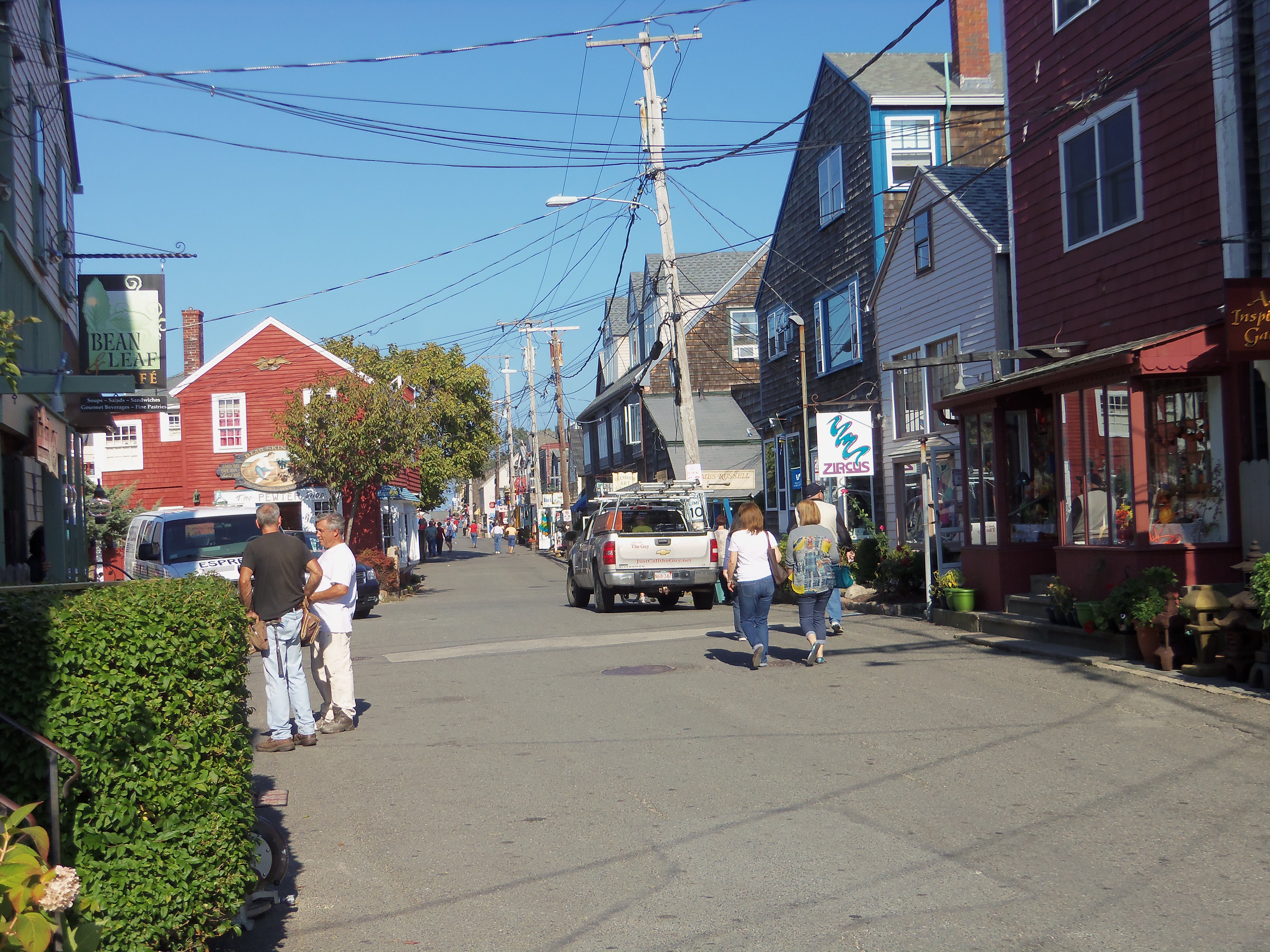
The village itself has much of the Cape Cod shopping flavor of boutiques, restaurants, artist galleries, jewelers, and so on – especially in its Bearskin Neck district.
The big window in the largest building overlooking Rockport Harbor is the back of the stage at the Shalin Liu Performance Center. By the way, the tide’s out. We were among a crowd enjoying an art installation that doubled as sunny seating on one of the stone wharves.Downtown Rockport has a traditional blend of resort retailers … and shoppers to match.
By the way, Massachusetts Bay Transit trains run from Boston’s North Station to Rockport, with Cape Ann stops along the way.
While I mentioned whale watches, I should note we prefer to venture out from Newburyport to the north, in part because the vessel there has the option of heading to either Stellwagen Bank in Massachusetts Bay or Jeffrey’s Ledge in the Gulf of Maine. When it goes to Stellwagen, though, it cruises around Cape Ann and offers fine views of the Straightsmouth Island and Thacher Island twin lighthouses – the 1861 replacements for the 1771 originals – closer to Gloucester Harbor.
The stupidity of some people never fails to impress. You hear of those who refuse to leave the path of disaster or see pictures of families standing by an ocean churned by an approaching hurricane. You know, the foolish ones who then expect emergency personnel to come to their rescue (at personal risk and public expense).
I’ve learned to respect the moodiness of the ocean and its quick changes – the summer thunderstorms that come out of nowhere, for starters. If the Coast Guard or lifeguards say “Get out of the water,” just do it rather than ask questions. If the captain of the boat says “Get down under,” just do it.
Even before the hail or power outages.
How quickly it all passes, too, and everything looks perfectly serene again, with no hint of what just happened.
My wife and I once watched a deluge approach, strike, and return to normal all in the course of a seaside lunch. Fortunately, we were indoors, our table beside the window.
One of my first lessons came a few months after the 1991 Halloween nor’easter now known as the Perfect Storm. In New England, a nor’easter is akin to a cold-weather, slow-moving hurricane. One moonlit night three or four months after this one, I was driving along Cape Ann in Massachusetts and was awed by the depth of sand still piled along the roadway – like plowed snow, in fact – up on ridges out of view of the ocean. Such was the impact of the Perfect Storm.
But this was a calm night and coming to an overlook, I pulled over, got out of the car, and walked out on a ledge a good 20 or 30 feet above the water. I was still back from the edge when a large wave crashed up behind me and swirled off just to my side. I realized the current could have knocked me off my feet and into the brine below. I’m a good swimmer, but fully clothed in icy water driving into rocks would be a fatal combination.
Yes, I’ve learned to respect the ocean and be wary.

 Jnana's Red Barn