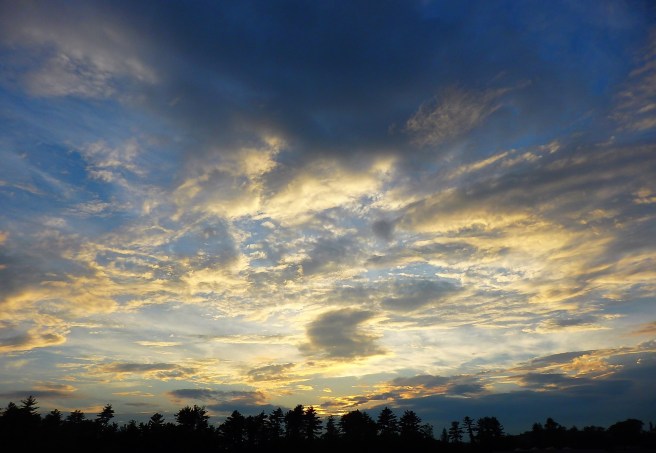
Summer sunset
You never know what we'll churn up in cleaning a stall

The pileated woodpecker is one of the largest members ot the family, rather comical and awkward looking, at that. It’s also not commonly seen, so sightings are always exciting, at least if you have an eye for birds. (Pronounced PIE-lee-ay-tid or PILL-ee-ay-tid, by the way.)
I remember one of my first encounters was while having dinner with the Ostroms at their house perched atop a wooded ravine outside Bloomington, Indiana. One alighted just outside the window, to our shared surprise and wonder.
More recently, as I was driving with my elder daughter down a road in Maine, one was flying just ahead of us but veered off before she could look up.
A week later, on a different road, the same thing happened.
She accuses me of making those up.
So the other day, after a meeting at the Unitarian-Universalist Fellowship in Durham, I noticed two people in the parking lot who were staring at something in the trees just beyond. I caught the red head and then the full bird. Yup. Amazing, considering this was an urban neighborhood.
And then, on another trunk, I spotted on more red head and big body, which then swooped down to join the first.
The pileated ‘pecker is a large bird – 16 to 19 inches long with a wingspan up to 30 inches, as I’m reading, likely the largest of its family in North America – and they can do some serious damage to trees they decide to nest in. Think of a beaver with wings. Again, from some quick referencing online, I’d guess you can look for a nest based on the pile of wood chips below.
My companion, in her early 90s, apologized that she’s never been able to really see birds, not even as a child. “My eyesight’s always been poor,” she apologized. So much for a witness. At least she could attest that two others were also commenting on the birds before us.
As for said daughter? She insists I’m making this up, too.
For the record, I don’t think I ever seen more than one classic redheaded woodpecker in my life. Hairy woodpeckers and downeys and flickers, of course, are another matter. Old friends, I’d say.
Of course, the Woody Woodpecker cartoons don’t count, do they?

Once again, I’ll be in the choir along the Charles River as part of a free concert to welcome the autumn equinox and to praise the extraordinary cleanup of the once noxious waterway on its way to Boston Harbor.
For its 15th annual RiverSing, Boston Revels is moving the family-friendly event upstream from Cambridge and into the Allston section of Boston on the other bank.
We’ll be performing on a Saturday night, rather than Sunday, and it is part of an ongoing series of performances the park hosts, so we’ll have more publicity support than usual for a one-off event in what’s otherwise simply a good place to sunbathe in season.
But the change also means we won’t have our usual gaudy parade down a congested street from Harvard Square to the makeshift stage beside the John W. Weeks Footbridge. That procession has always been glorious and joyfully chaotic, but greatly annoying to any number of drivers waiting to continue on the busy thoroughfare we were blocking. Not all of them are amused, believe me.
On the other hand, free parking won’t be scarce, either, and we’ll be on a permanent stage at the Herter Park amphitheater, which also includes seats for the audience rather than bring-your-own-chairs or blankets on the ground.
For me, it’s always been memorable. Imagine looking down from the back row and watching a pianist in the guest group with us and thinking, “He’s an incredible keyboardist” – and then hearing he plays in the Boston Pops Orchestra. Or singing behind Noel Paul Stuckey of Peter, Paul, and Mary. That’s even before the sunsets, which we get to see from the stage but are behind the audience. This year, it will be off to the side of everyone. Get the picture?
Join us tonight, if you can. For details, go to the Boston Revels website.
Anyone else felt pretty AWOL all summer?
fingers stiff, numb
on ice-encased rigging
any fire in the hull
a hazard
tend the footing, Jack,
and stay dry, if you can
steering around the storm
* * *
hell comes without
flame
without smoke
under the prow
* * *
impressed
by chance misfortune
or the flight from somebody
gone astray
rolled together, creaking
skin to crab shell
all the same
lost, for the cold duration
Poem copyright 2016 by Jnana Hodson
To see the full set of seacoast poems, click here.
Ever been in a hot spring?
I come to the sea a stranger
a person of a different religion
learning to eat at one table
these days, one who dwells inland
as far as the tide retreats
the passion of the moon
with its heartbeat and home and
those who have been torn and uprooted
will sense this
no image holds the tide
the moon, then, must do
somehow resembling the moon I knew first in Ohio
and later, in sagebrush desert
all things who move furtively in the night
Poem copyright 2016 by Jnana Hodson
To see the full set of seacoast poems, click here.
My awareness of the importance of forested trails of my own sanity and balance has evolved slowly. I see two parts at work here.
First is the aspect of locomotion. I could begin with the fact I’ve never been an athlete. As a youth, I delighted in speed — as in running or riding a bicycle — or in swimming, with its parallel of flying suspended in space. But I’ve never enjoyed the repetition of exercise for its own sake, gym class was a bore, and team sports have largely eluded me. Since I existed largely within mental activities, such as science or the arts, the idea of doing something that involved a mindfulness to my own body in motion did not register with me, at least until I took up yoga after college. I could add to this a recognition that I’ve also been filled with nervous energy and general restlessness. Sitting still — and focused — is something I’ve had to learn in the course of practicing meditation and attending Quaker meeting for worship.
Second is an encounter with natural history. Somehow, at an early age, I was introduced to geology, birding, tree identification and the like. I’ve also been interested in maps and map-making. Human history, too, which often turns up as discards in places returning to the wild.
What I’ve come to appreciate, though, is largely an esthetic response in walking through places of repose. If forest trails are the symbolic ideal here, I must admit they are not the only examples. Walking miles along the Atlantic on the outer Cape Cod shoreline, for example, serves well (although walking on sand always presents an effort) or trekking above treeline or through wild meadow can be heavenly. Even a stroll through a wooded cemetery or a city park can be recommended. But I speak of forest because of its timeless nature, in both senses of the phrase; this is what this land would remain at climax, forever. Everything is in balance or harmony. There are, of course, seasonal changes, but these are within a rhythm or cycle of returning, much like the movements of a symphony played over and over. Somehow, this begins to merge with the rhythm of walking, which itself begins to pace my own thoughts and emotions. Nothing too rushed, too overwhelming: everything, one step at a time. Uphill or down, all within reach. Walking along a city street or even a country highway can induce some of the step-by-step rhythm, but the balance is off: traffic rushes past, always as a threat, especially at intersections; there’s too much commotion or stimulation; my soul’s not at rest. Look around and notice all the trash and discard, all the waste as a social illness. The wilderness, in contrast, is continually healing. “Come to the woods for here is rest,” John Muir counseled. “There is no repose like that of the deep green woods.”
For more insights from the American Far West and Kokopelli, click here.
 Jnana's Red Barn