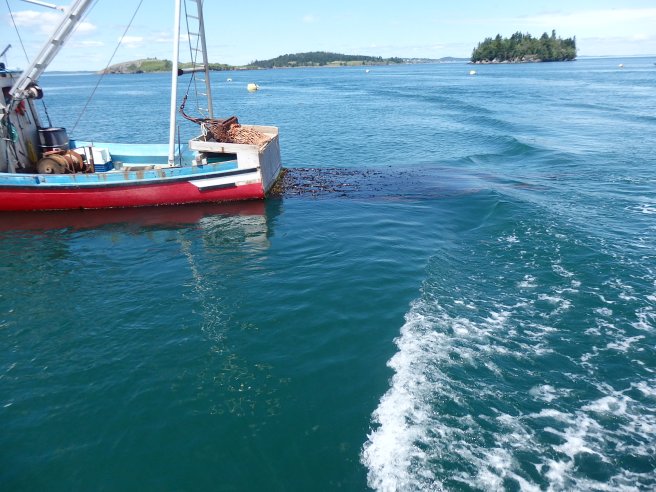
Just back from a hike

No ticks, thank God!

The black flies, meanwhile, were in swarms.

~*~

Supposedly the island’s infamous red ants keep the tick population at bay here in Eastport. Fire ants?

Another pestilence.

Still, I’ve learned to inspect carefully for ticks after any outing inland. Somehow, I hadn’t had to face them prior to New England.

Black flies, though, are particularly nasty. They’re tiny and attack first individually around the mouth and nose and then as swarms or small clouds that leave nasty bites from mid-April through mid-July, especially when there’s no wind or you’re away from the sea.

Yes, that sea seems to keep them away from Eastport.

The skeeters will come later.

You don’t see any of this in the L.L. Bean catalog version of Maine.

In the “Black Fly Song” by Wade Hemsworth, made famous by folksinger Bill Staines, the action is placed in northern Ontario, though it’s of little comfort to know the pests range so far across the northern forests.

The lyrics nail the misery so well, For I’m all but goin’ crazy.

The reason, of course:

It was black fly, black fly everywhere
A-crawlin’ in your whiskers, a-crawlin’ in your hair
A-swimmin’ in the soup, and a’swimmin in the tea

As the chorus goes:

And the black flies, the little black flies
Always the black fly, no matter where you go
I’ll die with the black fly a-picking my bones
~*~

It’s true, no joke.

Staines, by the way, lived one town over from Dover, where I was. Small world.

And I should note the bumper sticker: Black Flies, Defenders of the Wilderness.
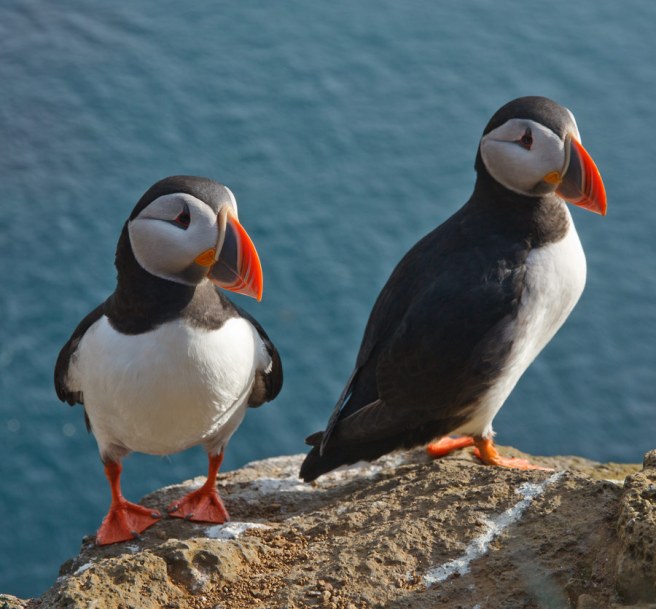
Regarding those photogenic cute puffins

Photo by OscarV055 via Wikimedia Commons

The distinctive seafaring bird is on any serious bird-watcher’s bucket list. Here are some things to know.

  1. They don’t make muffins, contrary to the children’s ditty.
  2. Apart from their nesting time on North Atlantic or Pacific cliffs, they spend all their life at sea, resting on the waves when they’re not flying. They’re essentially an arctic bird, though they come south to breed. Considering where I’m living, maybe I’ll take the boat tour and see some, too, if the outings aren’t already booked solid.
  3. These birds can dive underwater for a full minute and are fabulous swimmers.
  4. As a group, they’re a colony, a puffinry, a circus, a burrow, a gathering, or – get this – an improbability.
  5. They’re quite social, with one colony in Iceland reported to have more than a million nests.
  6. They can flap their wings in a blur of 400 times a minute, reaching a flying speed of 55 miles an hour. At least they’ll evade cops with radar guns.
  7. Two opponents in flight can lock beaks and then beat at each other with their wings and feet. OK, that’s ugly but still impressive.
  8. They generally stay with the same mate for life, returning to the same burrow nest.
  9. Sometimes they’re called Sea Parrots or Clowns of the Sea.
  10. A puffin’s beak changes color during the year.


At low tide, you can walk out to Matthews Island

The population of Eastport lives mostly on Moose Island, with a few more on Carlow. Both are connected to the mainland by a 1930s’ causeway running to the Passamaquoddy’s Pleasant Point Reservation in the township of Sipayak. Before that, the connection was a toll bridge to Perry.

But these aren’t the only islands within the city limits.

Treat Island is within Eastport’s city limits but you can get there only by boat. And nobody lives there anymore.

The Maine Trust Heritage Trust includes Treat Island among its preserves open to the public. Settled in 1784 at the juncture of Passamaquoddy and Cobscook bays, it became home to a fishing hamlet of 50 or so families and then a Civil War artillery battery before being acquired by 1935 for a tidal power project that was later abandoned. Treat’s open meadows, cobble beaches, trails, and spectacular views are, however, accessible only by boat – and kayakers are advised to hire a local guide before venturing out on the challenging tidal currents.

Eastport also includes small Dog Island, which once had a lighthouse, but is tucked away in a tony part of town. Again, you get there only by boat.

But you can walk to smaller Matthews Island if you time the tides right.

Fourteen-acre Matthews Island, however, sits along Carrying Place Cove and Cobscook Bay, not far from the municipal airport. And you can walk there, if you time it right, while the tide’s out. Just make sure you don’t get stuck by the incoming tide. Another of the Maine Coast Heritage Trust preserves, it’s accessed through a right of way on private property and then an exposed bar.

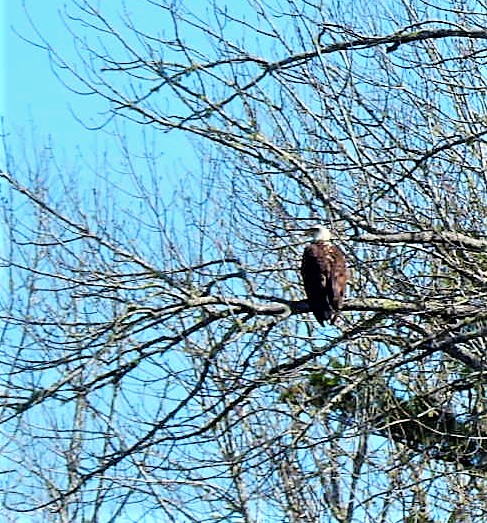
In the early 1800s, Capt. Charles Matthews raised his eight children here. Today, eagles are raising their own on the north side of the island.

Matthews has some stunning views of Cobscook Bay as well as berry-picking and nesting eagles.

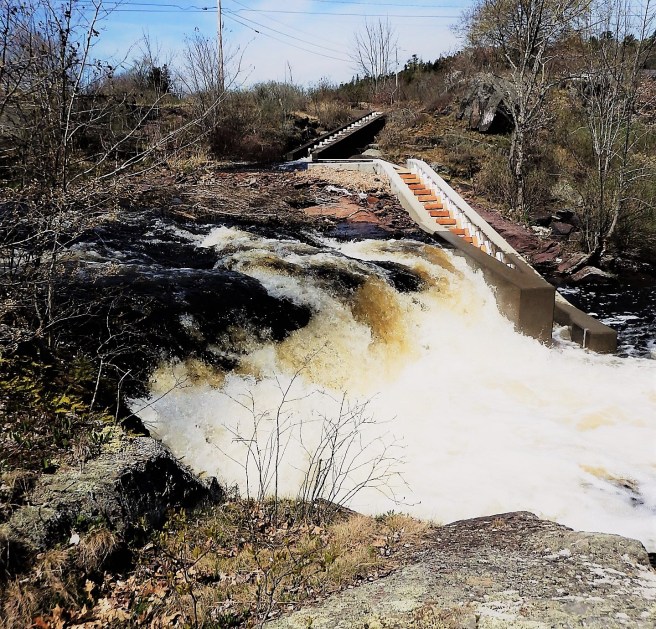
Pennamaquan falls and fish ladder

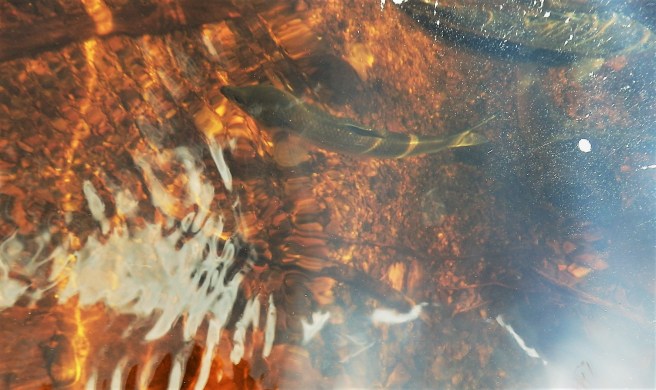
During their three-week run each year, 30,000 alewives a day press up this fast-moving fish ladder beside the small dam and waterfalls on their way to breeding grounds upstream.
The current is strong but the six-inch fish are stronger.
The added touch of the birdhouse makes me smile.
The Pembroke United Methodist Church overlooks the lake just above the dam, with some much bigger ones miles ahead.

A few life lessons

Pack light, run, get out of the way.
I learned that in Boy Scouts.

Much later, that you have to take care of yourself first
before all the complications in whatever role as a parent.

Much less the seed catalogue
midterms or finals.

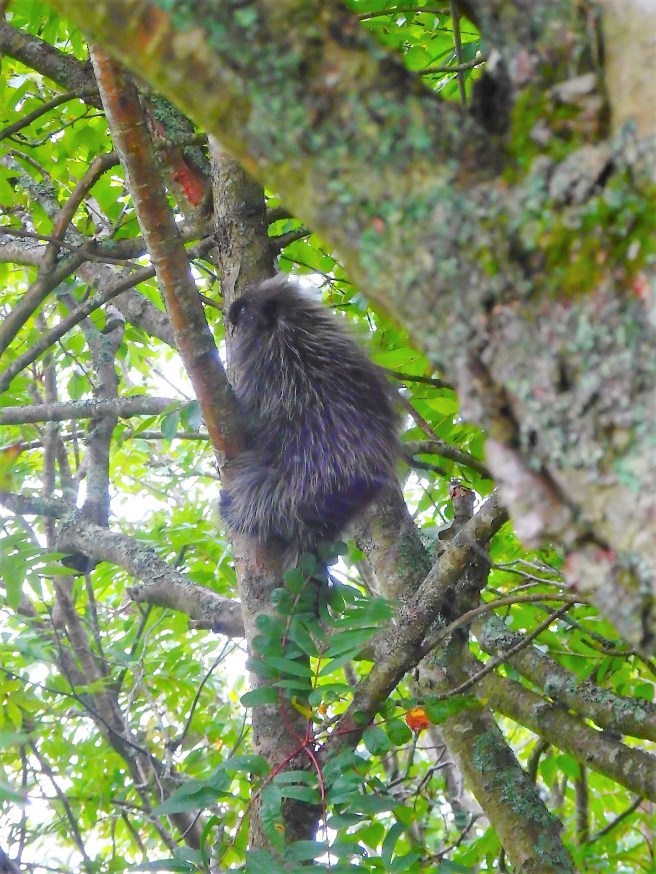
Porcupine climbing a tree at Quoddy Head State Park. Seems to embody a few life lessons too.

When the alewives run

Around mid-May across the New England coast, the alewives migrate en masse upstream to freshwater breeding grounds. Sometimes identified as river herring, they have played a role in the region’s heritage, from Indigenous peoples on.

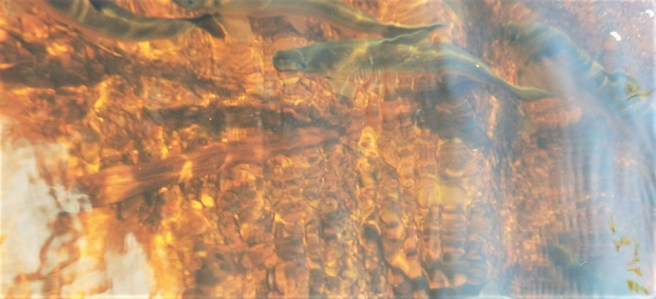
They’ve made it halfway up the ladder. They’re also quite strong, considering the speed and force of the rushing water.

They still attract fishermen to the riverbanks and bridges, as well as eagles and osprey overhead.

And here’s a bald eagle that’s about to catch another of them. The osprey weren’t about at the moment.

And though bony, many folks consider them a seasonal delicacy, often worked into an appetizer. More commonly, they’re a common lobster bait.