Look for my books, sharply discounted. A few are even offered for free.

You never know what we'll churn up in cleaning a stall
Look for my books, sharply discounted. A few are even offered for free.
I’m excited to announce that my lineup of ebooks is available as part of a promotion on Smashwords for the month of July as part of their Annual Summer/Winter Sale. This is a chance to get my novels, poetry collections, and Quaker volumes, along with volumes from many other indy authors, at a discount so you can get right to reading. Some of mine are even free, as you’ll see.
The sale begins today, so save the link:
https://www.smashwords.com/shelves/promos/

Please share this promo with friends and family. You can even forward the news to the avid readers in your life.
Thank you for your help and support.
And happy summer reading!
cow skull and elk vertebrae from ridges above the Yakima Valley
Maybe if I had a camera at the time, the trip would have wound up as photos rather than a poem. The weeklong camping trip was a turning point in my life, though, and the poem that emerged from the experience was initially accepted by a prestigious Northwest literary press but then declined – they’d lost a grant, they said.
Had it appeared at the time, my path as a poet would have advanced, definitely more securely than it did. But the effort definitely solidified my growth in the craft.
Poem? It’s my attempt at what William Carlos Williams advocated as a longpoem, where the challenge is “to find an image large enough to embody the whole knowable world about me.” About, in this case, having meanings as both the immediate world around the poet and his own autobiographical revelations. In his case, the image was the Paterson, New Jersey, the river city where he practiced medicine and lived.
For me, it became about the Olympic Peninsula of the Pacific Northwest, bugged, perhaps, by Basho’s wanderings in ancient Japan.
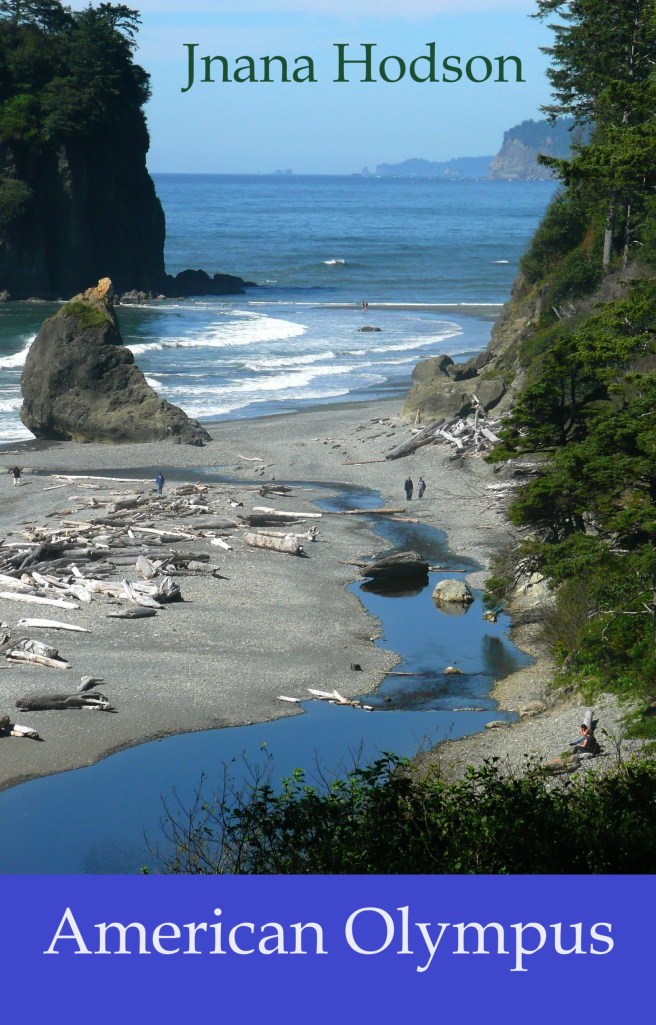
Having originally appeared in Thistle Finch editions, this collection is now available on your choice of ebook platforms at Smashwords.com and its affiliated digital retailers. Those outlets include the Apple Store, Barnes & Noble’s Nook, Scribd, and Sony’s Kobo. You may also request the ebook from your local public library.
Do take a look.
works if you know
the proper pronunciation
Well, more like Puget Sound.
We have plenty of foggy mornings, often with cold damp air.
Turns just about everything gray, even monotone, a lot like I remember Seattle.
I like to think that natural beauty can be found anywhere, but I have to admit that too often, what’s happened is that brute ugliness has prevailed in far too many places, typically as a result of greed. There’s no excuse for much of that, either. A little extra expenditure could have added grace to any development, created visual intrigue, lessened the harshness. Urban or rural or what’s in-between, alas.
Whenever possible, I chose career moves that opened me to natural or artistic settings and inspiration – along with opportunities to shine professionally. It’s meant avoiding suburbs, for one thing. Sometimes, though, it’s also meant invoking a sliding scale of value – you know, finding pockets of serenity within otherwise harsh localities. And then there were some other postings that principally industrial, even when it was mostly farmland. So it’s been a mix.
Still, as I’ve said, I came to realize that had I remained in my native corner of Ohio, I wouldn’t have been able to write poetry, the vibe was simply wrong. Or, if I had, it would have been much different from what I’ve done.
On the other hand, the four years I lived two hours east of Mount Rainier, back in the late ’70s, gave me repeated access to one of America’s greatest national treasures, often from lesser-known perspectives. What memories! And that’s before I turn to much of the back country and wilderness that was closer to our home. I even came to love the beauty of the desert where I was living, a landscape that initially struck us as hideous.
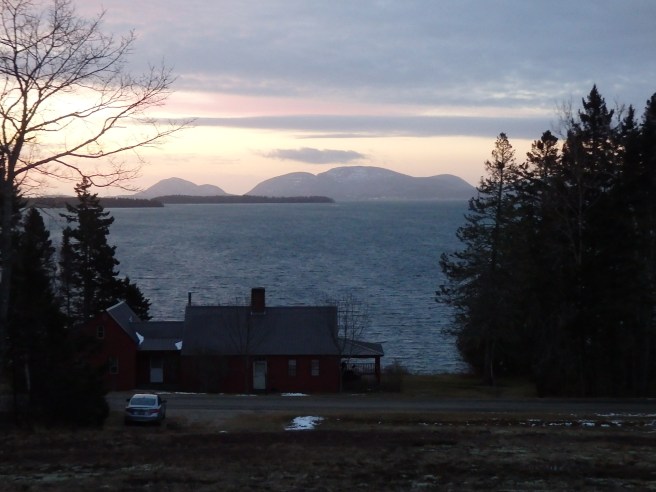
Now I’m finding myself dwelling two hours east of an even more popular natural park, Acadia. Already, I have glimmers of many backwoods and remote rocky shores to explore in-between.
Technically, all of Downeast Maine is also Acadia, the French name of the region. For most folks, though, Acadia means the park.
The biggest land mammal out west was the elk, while here in northern New England, it’s the moose. Just as the celebrated shellfish here is lobster, rather than Dungeness crab.
The fact is, for many people, either place is about as close to paradise as you’d find on earth.
And, yes, I’m feeling lucky – or especially blessed – that way.
When Jaya and Joshua set of for the Pacific Northwest in my novel Nearly Canaan, what they expect to find is something very much like the Olympic Peninsula rather than the fertile desert where they land.
Here’s some of the alternative.
~*~
Hope that serves as an introduction. We haven’t even touched on Port Townsend.
In my novel Nearly Canaan, Joshua and Jaya settle into a place unlike anything they would have imagined. It’s desert, for one thing, where nearly everything has to be irrigated, for another. Quite simply, it’s a lot like Yakima, in the middle of Washington state, where some of the world’s best hops are grown.
Did you know …
~*~
Cheers!
Many of the Pacific Northwest’s most prominent features are known by the names of Europeans or their descendants, rather than their earlier Native designations. Since the tribes on one side of the Cascade mountains had a different language stock than those of the other side, the names could be quite different.
~*~
There’s some rich mythology involving these names and their personalized characteristics. For instance, the brothers Patoh/Klickitat and Wy’east, after traveling down the Columbia River from the far north to resettle, entered into some heated rivalry for the fair maiden Loowit/Louwala Clough. Their volcanic eruptions of jealousy and earth quaking even resulted in the collapse of the Bridge of the Gods across the river, producing a series of rapids.
There’s plenty more, if you chose to investigate. Any to share from where you live?
 Jnana's Red Barn