Towers and turrets make for a room with a view.
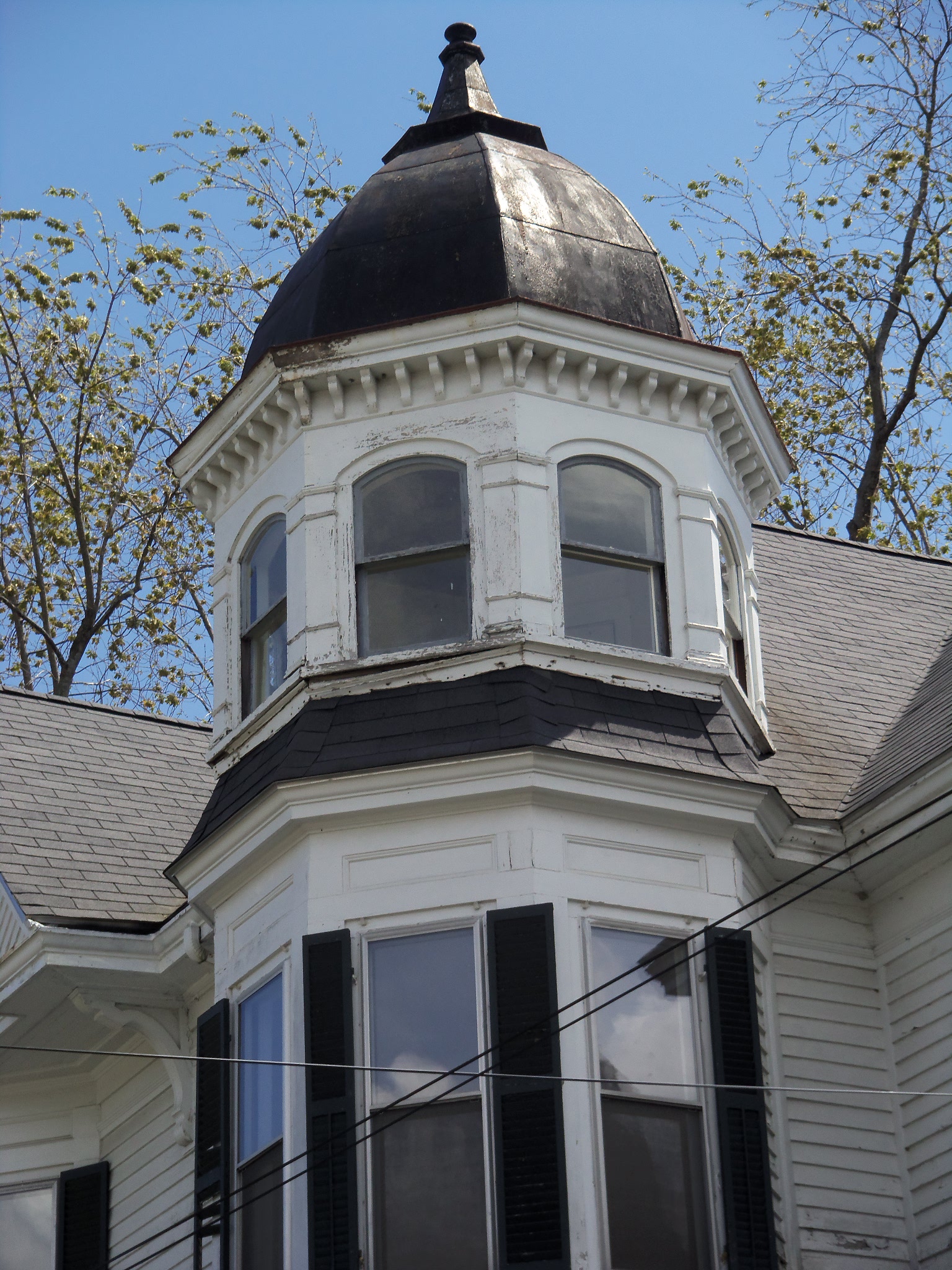 Strolling Dover: for more, click here.
You never know what we'll churn up in cleaning a stall
Towers and turrets make for a room with a view.
Strolling Dover: for more, click here.
This morning’s newspaper had a headline that sent an “Oh, gee, I haven’t seen that before” running through my head. As I mentioned the other day (Why Woodpecker Can’t Keep Up, June 14), so much of the news can be same-old, same-old variations on a theme. But this one really was new:
As I also mentioned (Harley Heaven on Lake Winnipesaukee, June 16), we just had the nine-day Laconia Motorcycle Week, which attracts swarms of bikers to the Granite State, and racing along mountainous roads is one of their joys. Every year the event is accompanied by accidents and usually a few fatalities, but I don’t ever remember seeing one involving a bear. This one happened in the afternoon. Broad daylight on a perfect day.
Unlike moose, which are slow and dumb, convinced they can continue ignoring oncoming traffic, bears can be fast-moving, when necessary, and alert. Moose-car accidents are, in fact, commonplace throughout northern New England, while bear-car encounters are also a standard news item, though less frequent. I suppose I’ve seen a few moose-motorcyclist crash stories over the years, or at least should have.
This time I found myself recalling a report I’d edited and written the headline for back on my first news desk position right after college. We were Upstate New York, which has its own mountainous terrain. That time, a motorcyclist ran into a porcupine on a dark highway, and the results were fatal. As a city-boy, porcupines were still a curiosity, rather than a critter I often acknowledge in my journeys.
In this morning’s dispatch, the driver was airlifted to a hospital and reported to be in critical condition.
~*~
Another item making the rounds also seems to slip over from one of the routine categories — in this case, political survey results — into the I’ve-never-seen-that-before status. In the race for the White House, a Democrat, and a woman at that, is polling evenly with Donald Trump in the overwhelming Republican state of Utah.
~*~
This reminds me of another reaction I often have as a novelist: “This wouldn’t work in fiction.” Accompanied by “You couldn’t invent this if you tried.” Life really does take some bizarre turns if you look.
Really.
Laconia Bike Week – more formally, the 93rd Laconia Motorcycle Week – comes to a climax this weekend, and in New Hampshire the annual event opens the summer tourism season. Even where we live, more than an hour away, you can hear it in the air, especially if your windows are open at night. Let’s call it a buzz. Everybody who can wants to be out on the road with the wind in their hair – New Hampshire is, after all, one state that does not require helmets be worn by either the driver or the passenger. Some wags do, however, suggest the state motto should be changed slightly, to Live Free and Die. A bit of risk does have its attraction.
Always scheduled to end on Father’s Day each year, the legendary name Laconia lands somewhere between Daytona, Florida, and Sturgis, South Dakota, both on the map and on the calendar of avid motorcyclists. The Weirs Beach landing in the small city of Laconia is the centerpiece of the gathering, promptly teaming with black-clad riders and vendors of all sorts. Since local schools are usually making up for days that were closed for snowy weather, families don’t arrive for vacation any earlier than the Fourth of July anyway, and any earlier than mid-June, the weather can be a tad too cold or wet for other folks. So the thousands of bikers who show up are a welcome boost to the hospitality industry, not just in the mountainous Lakes Region but across the state as they seek meals, entertainment, and lodging in the midst of roaming the wooded landscape.
It wasn’t always so. Before motorcycles became respectable, fights and even riots could break out. I’ve heard plenty of stories.
Now, however, things have mellowed out to the point many of the activities are labeled family-friendly. A majority of the iron horses seem to carry two, one clutching the one proudly clutching the handlebars. That, in itself, may have a calming influence. And then there are others who simply want to show off their impeccably polished machines. We were passed on the highway this morning by a small trailer carrying two such Harleys from New Jersey. The owners obviously weren’t going to subject them to the long road itself.
Unlike many of the names in the region, Laconia is not one given by the Native peoples. Rather, it’s originally a city in Greece. That might not be the only reason for the New Hampshire city’s name, though. In 1629, a partnership called the Laconia Company organized to prepare much of colonial New Hampshire for development; while I’m finding much of that history hard to follow, it does appear that one of the partners soon became a pirate. Really. I’m sure you can find many pirate flags and images at Weirs Beach this week, so maybe there’s an underlying connection. Who knows?
For those who do ride into the Granite State, a reminder: when you’re on your way home, be sure to pull over and put your helmets on before you cross the state line. It’s a safe bet the Massachusetts troopers will be waiting for those who don’t.
Let summer begin.
Here’s a local example of the Queen Anne style, which flourished 1885-1910.
New England housing got comfy with this expansive style reflecting the region’s prosperity.
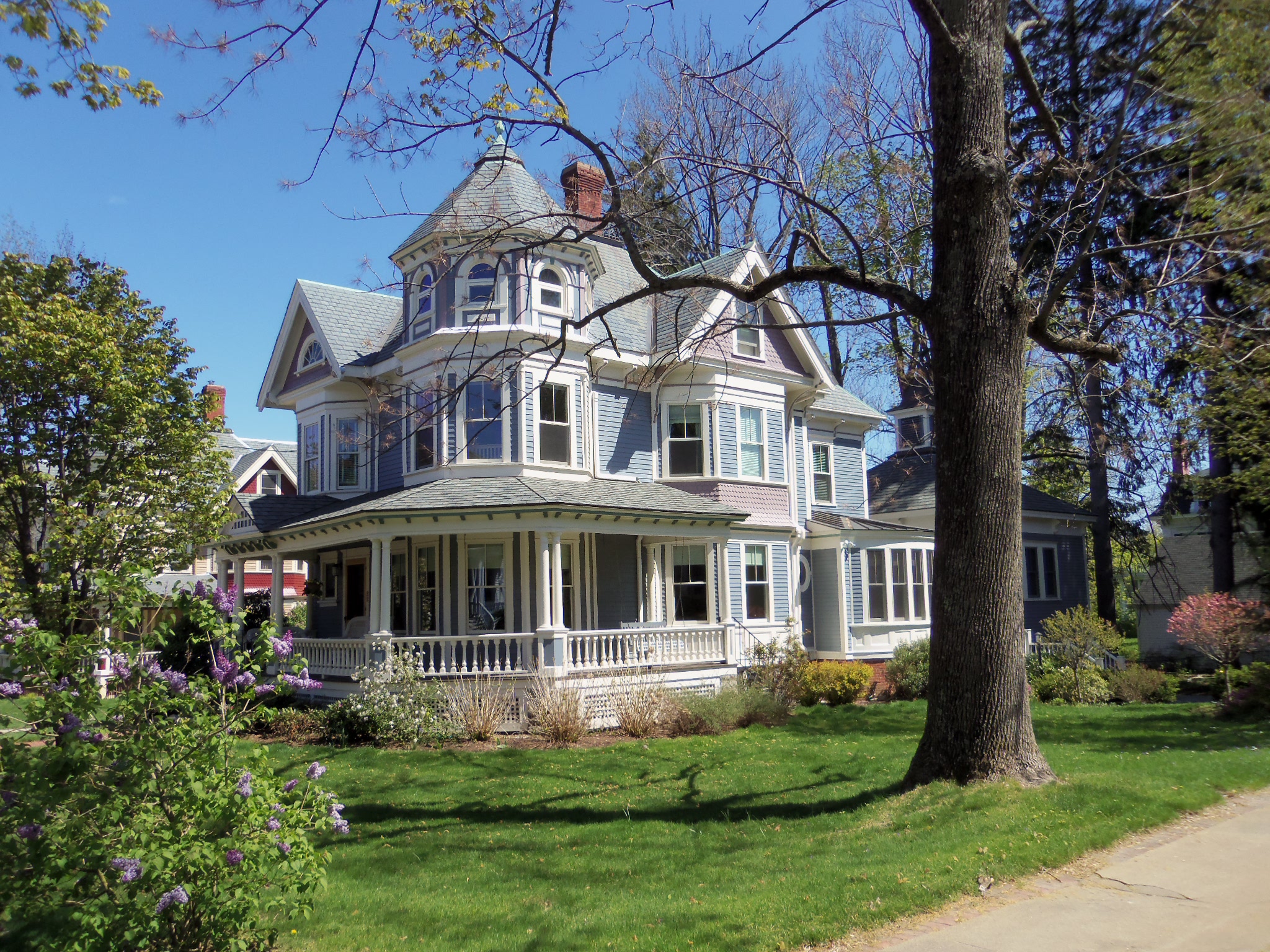 Strolling Dover: for more, click here.
In a same-day announcement, Donald Trump cancelled a rally planned for late this afternoon or early this evening about dozen miles from us. (These things never start on time.) Said he had to work on a speech. Something more than a tweet?
We’re relieved, for several reasons.
First, it’s good to know he won’t be stirring additional pollution into our local air. There’s enough toxic bigotry, self-delusion, horse hockey, cruelty, and hatred gushing out from his mouth as it is. Reasoned criticism is one thing, but that’s not what we get with this candidate. Won’t ever be, either.
Even if it weren’t Trump, we already know how these campaign appearances snarl already congested rush-hour driving. What was he thinking when he picked rush hour, anyway? Real people — the kind who have to work jobs for a living — know about this, unlike Trump and his supporter Chris Christie. Living in the Granite State, you soon discover how the enhanced security force can muck up traffic at any hour, clustering around intersections, especially, even before halting a freeway for the comic-opera parade of motorcycle cops, candidate in his limo, staff in theirs, Secret Service, and trucks of news media in tow. We’d already changed our plans to avoid all that. I even visited a clinic down that way to pick up a prescription first thing this morning, thank you.
Now, thankfully, it looks like we’ll have our highway connection running normally after all.
Another conflict, though, is more existential. Did I want to join in a short-notice truth-witness vigil near the event site? Conscience said yes, but a look at my to-do list (including the garden) said not really. To venture forth to the protest line would mean entering all that traffic I’d resolved to dodge, while the to-do would mean staying home, maybe grilling dinner to soothe my aching muscles while failing to respond to the call of Liberty. Looked like I’d feel a pang of misery either way.
Well, we’re off the hook for now – all of us. As for the next question, will I be more in gear for the next opportunity?
Here’s a local example of the Second Empire style, which flourished 1860s-1880s.
Here come the Mansard roofs.
 Strolling Dover: for more, click here.
Here’s a local example of the Italianate- style, which flourished 1850s-1860s.
Lavish, if possible. Why stick with rectangular windows?
 Strolling Dover: for more, click here.
This summer we’re participating in a program that’s introducing us to varieties of fish caught off the New Hampshire coast. Once a week we trot down to the natural foods store in town to pick up our delivery – our location gives us a three-hour window – and we return with a pound of very fresh seafood. Every week it’s a different variety (11 are likely over the season), and we get an email earlier in the week notifying us what will be on the way, allowing the cook in the household to begin considering menu options. Or we can go to their website for links to suggested recipes.
It’s not cheap – you pay when you sign up, in our case for the 15-week program – about twice what we’d normally shell out for what’s featured at Market Basket, but there are other factors to weigh in. For one thing, living in the Seacoast Region of the state, we’re very aware of the plight of the once vital fishing industry across New England and the struggles to sustain both a way of life for families and communities and the fishing grounds themselves. While we’re not militant local-harvest activists (it just isn’t economically viable for our part of the world, not with its long winter), we are inclined toward small-scale economics wherever possible (just consider the banks, for starters). So we feel good about our token support for our neighbors. In a way, it’s like a farmers market, except that we’re committed to taking the week’s delivery, the way you are in a community-supported agriculture (CSA) setup.
That leads us to another consideration, the fact that the program itself arises in an attempt by the commercial fishermen sailing from Seabrook, Hampton, Rye Harbor, and Portsmouth Harbor to counter the negative impacts of a practice begun in 1976 that directly sold the local harvest in international auction. Rather than having their fishing practices driven by global market pressures, they wanted a more sustainable alternative, a strategy to better manage marine resources and fish more selectively. In response, four years ago the harvest coop they organized was given an ownership right to collectively manage the federal groundfish fishery. In other words, there’s a strong environmental component here, including a more efficient use of high-cost fuel along the way. As they say, their fish catch hasn’t been sitting on the boat for a week – it comes to port the same day it was caught. Good for them!
Of course, all of that still needs to come together at the dinner table. This isn’t charity, after all, but a win-win deal we’re looking for. We can start with a sense of adventure as we explore previously unknown types of fish. (Acadian redfish, anyone? Or dabs? Or dayboat dogfish shark?) Let me rave about the monkfish on that front – as I ate, I kept thinking this could be lobster tail. So what else is swimming in the same water with me each summer? My curiosity is heightened. What they’re delivering isn’t everything in the local catch, but it is a way of supplementing their income and providing more balance in their cash flow.
We’ll admit this is our splurge, the way our weekly wine tastings were, back when I was duly employed, or the half-pig we ordered from a farm in Maine, two other examples that allowed us to learn more of the range in taste and satisfaction in our world. Admittedly, we couldn’t do the fishery program when the kids were still living in the house – they can be picky that way, with one easily upset by the mere whiff of fish cooking. Oh, my.
Initially, too, I thought a pound would be on the skimpy side when it comes to our dinner, but we’re finding the enhanced freshness in flavor satisfies in smaller portions – we can serve three and still have a bit left over. Actually, it’s about what we’d get in a restaurant while spending much more.
Reading the profiles of the participating fishermen on the website has me wondering how long I’ll go before making a list of their boats, just so I can identify them when they pass by in the water or tie up at dock. They seem like nice guys, too. Maybe we’ll wave. It does change my perspective, doesn’t it.
Now I’m wondering about similar alternatives being developed around the world. Pipe up, if you wish, along with your own growing awareness.
~*~
New Hampshire Community Seafood is a cooperative of fishermen and consumers that has 18 pickup locations with deliveries spaced from Tuesday through Saturday.
Gardeners in New England – especially in its northern realms of Maine, New Hampshire, and Vermont – soon discover the month of May can be a frantic stretch. (Or, for those of us with short memories, the word should be rediscover. I keep hoping for something more orderly than what feels dropped upon us each year.) For much of April, even apart from the threat of killer-frost nights or piles of lingering snow, the ground can be too cold or too wet for planting, and that’s if rain’s not falling. With our clay-based soil, I’ve learned not to turn it when wet, lest it form brick-like clumps. For that matter, in a typical year our large compost bin can still be frozen at heart, posing another obstacle to preparing the garden beds themselves.
When it comes to these projects, I often find myself in a bind. We simply don’t have enough room to “park” something while waiting for something else to open up or be moved to another spot. Compost is a case in point, though hardly the only one.
So when May hits, we’re rushing to get as much in the ground as soon as possible to maximize a relatively short growing season and, frankly, to try to beat the weeds to a solid start.
And that’s where we are at the moment.
I feel pretty good about a lot of the pace. Two of our raised beds have received new wooden frames, the compost bin’s been emptied and refilled with a new round of leaves and garbage, black plastic and a soaker hose are in place on what will be this year’s nightshade bed (tomatoes and peppers), the pea frames are up as are the seedlings below them, the bean tripods are in place … and we’re dining on what I think’s the best asparagus ever.
Let me add that my wife’s scheduling here means a few other outdoor projects I thought I’d be addressing are put off for a few weeks, and that’s frustrating. I hope they don’t get pushed back for months, because, well, that would affect other projects in the pipeline – and that touches on yet another issue she raised today. What if we just moved to a condo with a deck and a small garden bed about the size of our dining room table?
I could see that if we did square-foot gardening as intensely as we once envisioned, we might raise enough to keep us smiling at dinner. But my beloved asparagus bed’s larger than that. Ahem.
~*~
So we finished our first round of morning coffee and headed outside for the day’s task, the fourth of the raised beds in what we call the Kitchen Garden, the one on the far side of the driveway. The one we’re tackling is a perennial bed of bee balm (which attracts hummingbirds as well as bees), sorrel (which makes for an excellent sauce on fish), and chives, all of which we’d hoped to salvage. Unfortunately, a bout of lemon balm’s gone invasive, along with grass, plus our ubiquitous ground ivy, dandelions, vetch, and several familiar weeds I have yet to identify.
In short, this has meant uprooting most of the bed, attempting to save what we could, including some hyacinth bulbs, and admitting we’d have to start from scratch with much of the rest, including new bee balm.
So here we are, ripping out, grubbing, turning, cursing, adding compost, wondering how this got away from us, anticipating, what?
I have to admit I’m not the gardener, the one who plans the arrangement using page after page of grid paper or reads up on the options or orders the seeds or starts the flats indoors under the grow lights I set up or waters them daily while envisioning the results or anticipates the way they’ll wind up in tasty dishes or fill the freezer for dinners next winter. (I admire the one who does all this, in more ways than one. After all, I married her.) At the moment, though, I’m more concerned with what goes into the wheelbarrow, shovel by shovel or handful by handful, and where it goes from there.
And then, there will be one more thing checked off my to-do list … while adding to hers.
Selecting the examples of historic architectural styles that are running in the Red Barn’s Strolling Dover series on Wednesdays, I have to admit one thing.
Often, more impressive houses can be found in some of the neighboring cities and towns, meaning those a bit closer to the ocean.
Unlike more prosperous settlements around nearby Atlantic harbors – Portsmouth, New Hampshire; York, Maine; and Newburyport, Massachusetts, all spring to mind – Dover was essentially a blue-collar mill town. Or, as the ditty went,
Portsmouth by the sea;
Dover, by the smell
referring to the tanneries needed to keep the mills supplied with leather belts that conveyed power from the falling water to the looms and related machinery above.
Rich merchants and sea captains didn’t retire here, and even though we were a seaport, we were a dozen or so miles from the open ocean downstream. As a result, our housing was more modest, less refined than some of the magnificent specimens found clustered overlooking the prime wharves and customs houses of our tonier neighbors.
That doesn’t take away from my pleasure of strolling through Dover or of sharing details observed along the way. Just want to put it all in perspective.
 Jnana's Red Barn