 Strolling Dover: for more, click here.
Tag: NH
STEPPING OUT OF THE PRESENT
Strolling around older neighborhoods of a community like mine, it’s quite possible to feel yourself moving through another era. Imagine horses instead of cars and let the utility lines overhead fade from sight. I find a tinge of time travel is especially likely to kick in around dawn or sunset.
Mentioning that to my wife prompts memories of her own experiences while working in a museum comprised of a district of historic houses in nearby Portsmouth. For her, the sensation would settle in during late afternoons in the tourism shoulder season as she’d step from the kitchen into the outdoors. No wires in the air, no traffic, no tourists to spoil the perfect scene. Truly harmonious and timeless.
Maybe even a vision of the future in an eco-friendly environment.
BRICK RATHER THAN WOOD
Despite all of the clay soil in the city, one of the puzzles is the prevalence of wood construction. The downtown, with its mills, stores, and churches, is an exception.
 Strolling Dover: for more, click here.
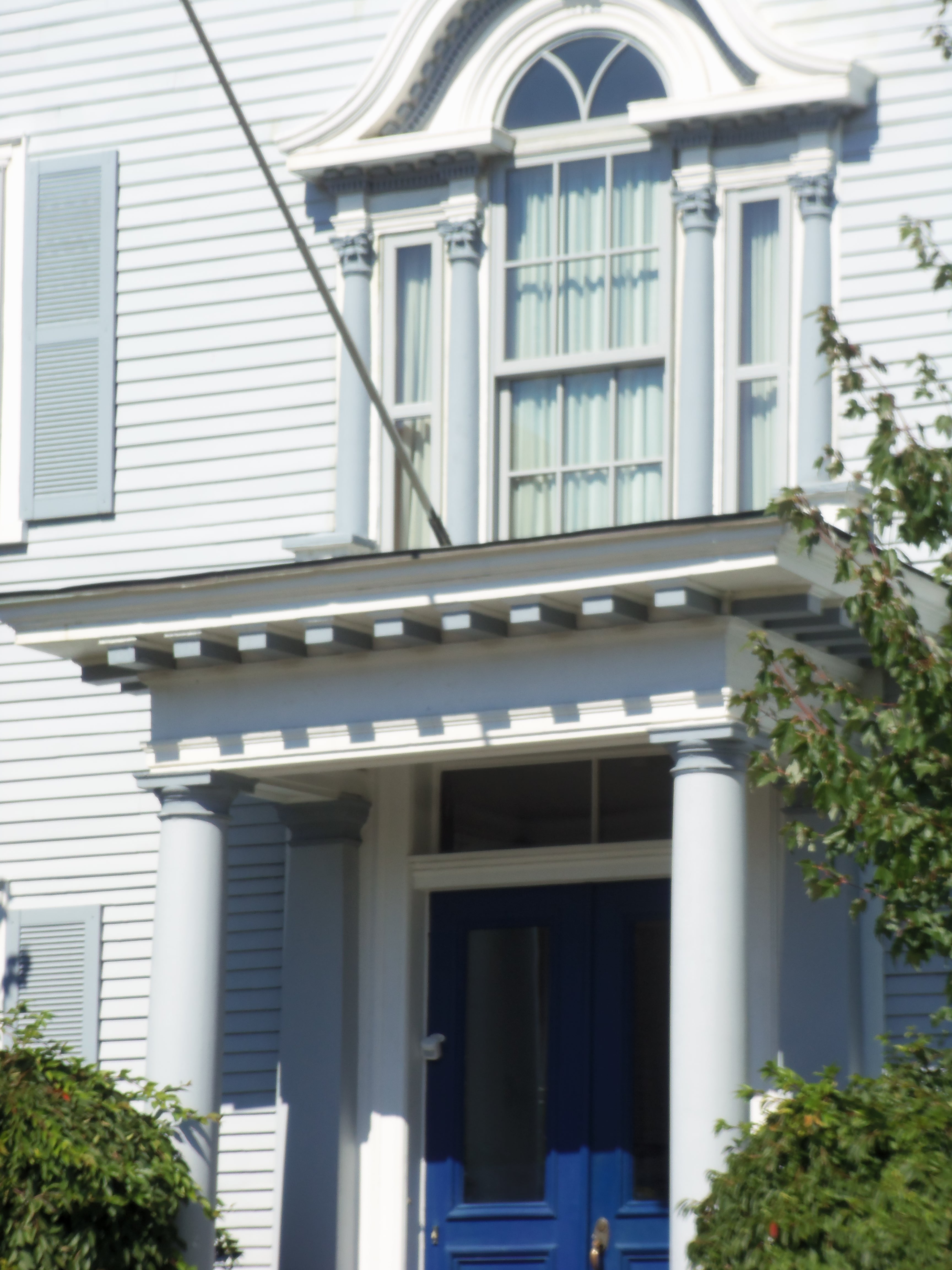
PALLADIAN WINDOW
High style in the region from the mid-1700s. This example is from Portsmouth, New Hampshire.
For more, click here.
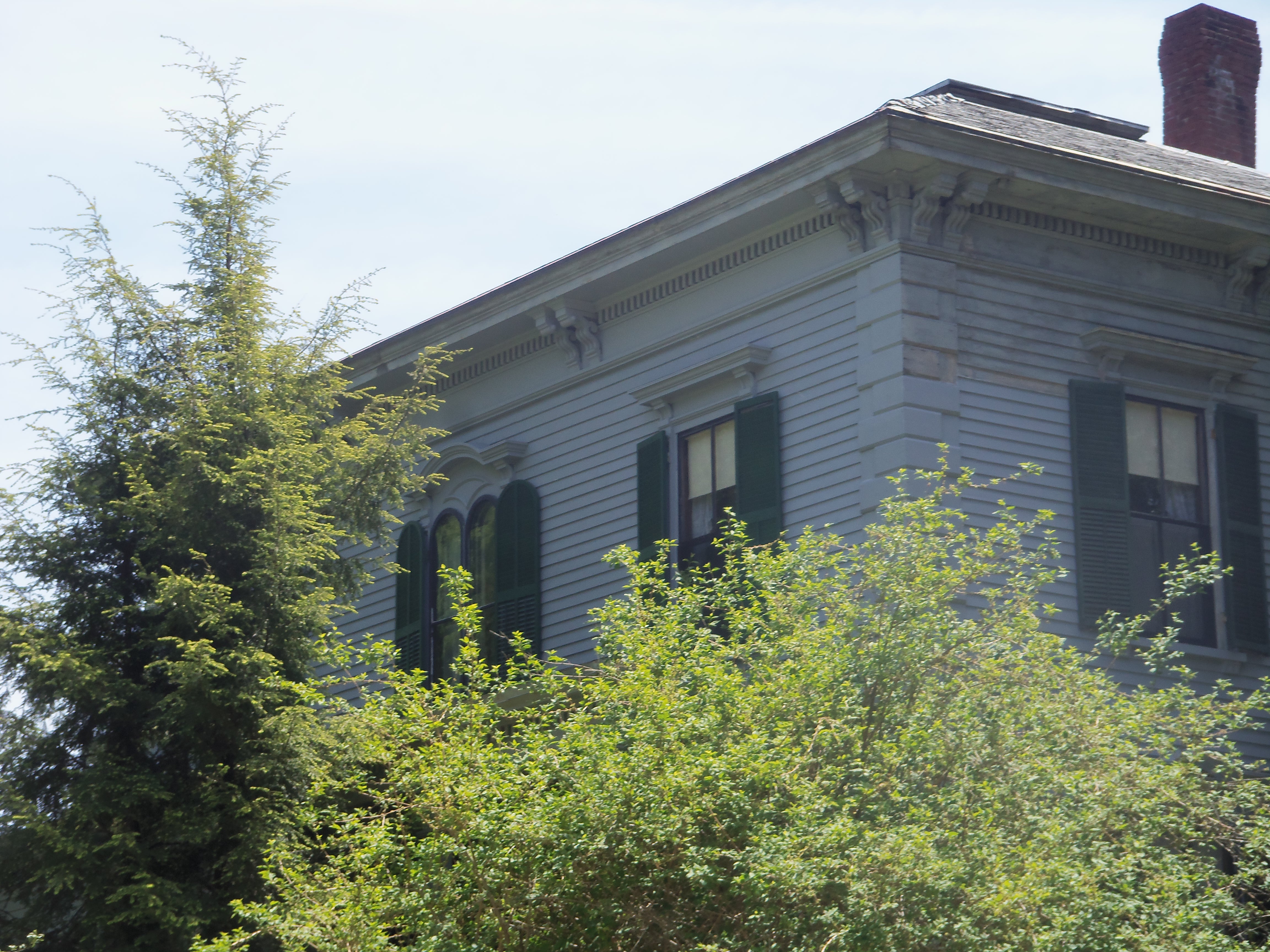
SHADED REPOSE
 Strolling Dover: for more, click here.
TOP NOTE
 Strolling Dover: for more, click here.
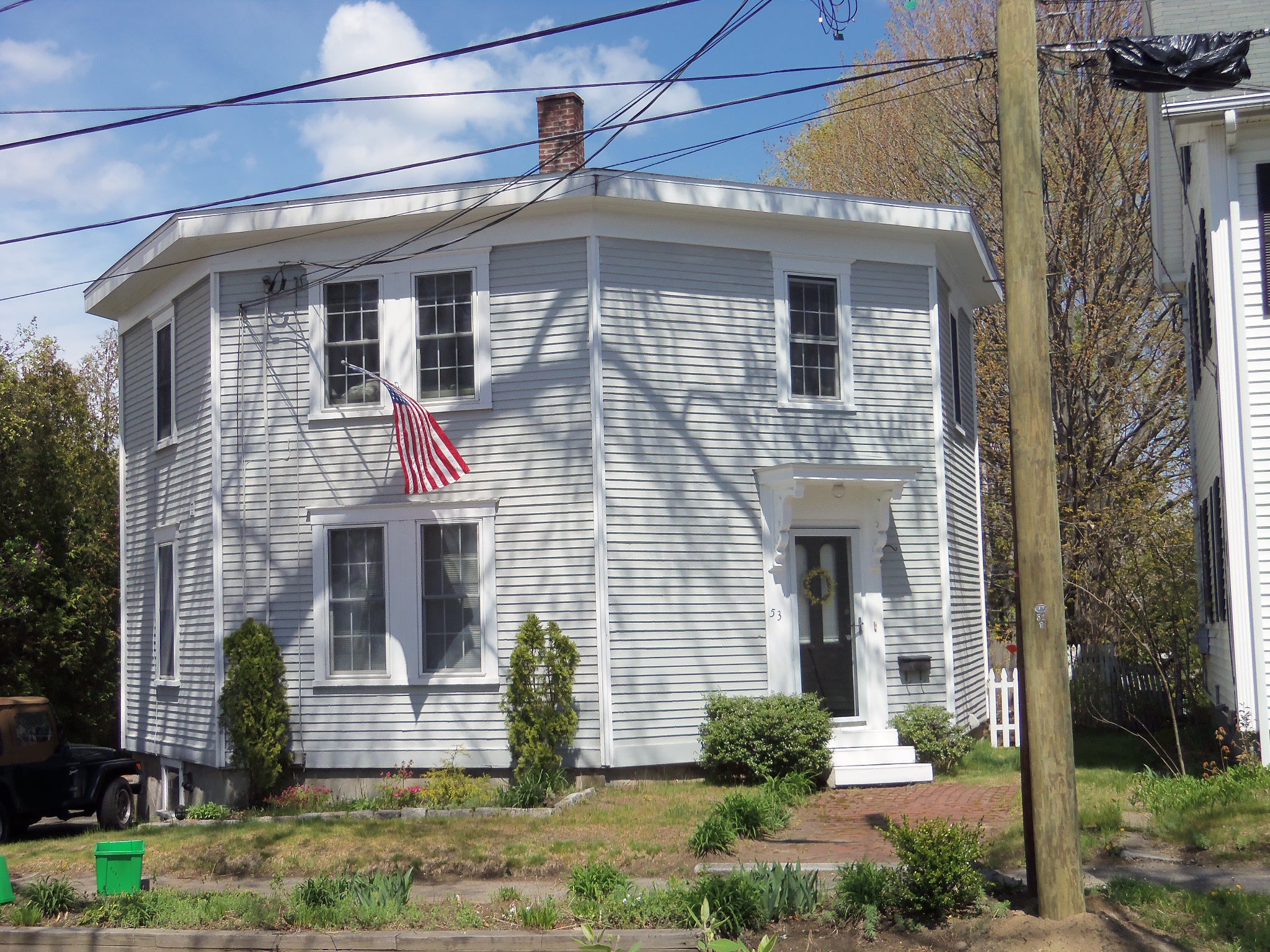
OCTAGON HOUSE
Eight sides rather than four, to approach circular perfection.
 Strolling Dover: for more, click here.
IN THE ROUND
Or maybe it’s just a nest?
 Strolling Dover: for more, click here.
IN THE WEB OF COLONIAL DISSIDENT HISTORY
As I reviewed of Dover’s early (and admittedly tangled, hazy) history recently, I was struck by a reference to several early settlers who had been banished from Massachusetts Bay Colony amid the Antinomian Controversy to the south.
In a flash, my mind leapt from 1638 to 1662 when three Quaker women arrived, preached, and were banished by Major Richard Waldron.
The Colonial histories traced an underlying religious tension in the New Hampshire settlement arising between the Anglican affiliation of the colony’s charter holders and the Puritan convictions of many of its earliest settlers. That, in itself, suggests serious political and social differences as the two institutions of belief and action conflicted. After all, the Parliamentarian armies that would defeat and eventually execute King Charles I were largely Puritan, as was Oliver Cromwell, who ruled Britain as Lord Protector from 1653 to 1658.
Beyond the Anglican/Puritan rivalry for power in New England, however, was another struggle, the role of a trio of dissident voices and their followers in New England in the mid-1630s.
The new readings did change one of my premises. Rather than having all three of the dissident voices being from Salem (closer to Dover than is Boston), their residences were more diverse. Only Roger Williams (c. 1603-1688) had a Salem connection, and that was as a controversial pastor between his tenancies in Boston and Plymouth. He was banished in 1636 for “sedition and “heresy” (note the linkage of politics and religion) and left to establish the colony of Rhode Island and the Providence Plantations to the south, as well as the first Baptist church in the Americas.
Next was Samuel Gorton (1592-1677), banished in 1638 after ministry in Boston and Plymouth. He fled to Portsmouth, Rhode Island, before settling Warwick on the other side of Narragansett Bay. My postings at my Orphan George Chronicles blog about Robert Hodgson and his wife, Alice Schotten, take place largely in Portsmouth, and Alice, as a descendant of a Gorton follower, inherited a large parcel of Warwick. So these histories begin to overlap and even get personal for me.
The third dissident voice was Anne Hutchinson (1591-1643), the daughter of an Anglican cleric and the wife of a prominent businessman. She was banished in 1638 after leading home Bible study groups for women that were both popular (even among the men) and, to the ministers, “unorthodox.” Her theology became the focus of the famed Antinomian Controversy that challenged the conventional Calvinism held by most of the Puritan clergy. Reputedly, the “Veritas” in Harvard University’s crest comes from the cries of the judges, asserting their orthodoxy over her offending testimony, as she was taken from the courtroom at her banishment. She soon settled Portsmouth, Rhode Island, where Robert Hodgson would land in 1657 as an itinerant Quaker minister and remain when many of the Hutchinson’s followers joined in his Quaker faith. Hutchinson, however, had already moved on to the Dutch colony on Long Island to avoid continuing Puritan persecution before she and most of her family were slain in an Indian attack.
All of this ran through my head when I came across the reference in John Andrew Doyle’s 1887 The English in America: The Puritan Colonies, Vol. I: “After the persecution of the Antinomians, some of the victims took refuge at Cocheco,” an early name for Dover. Could this have provided fertile ground for the three Quaker women 24 years later? I think so.
The plot thickens when looking at the history of First Parish Church (United Church of Christ) in Dover, which divided into two hostile camps when one side of the congregation preferred two of the Antinomians as ministers over the more orthodox alternative. This was one the courts had to settle. Add to that an Antinomian leaning in nearby Exeter, and I’m left wondering all the more. Throughout its history, New Hampshire has always been at odds with Massachusetts – and here’s one more example.
The fact is that a third of the population of Dover quickly joined with the Quakers after their initial exposure to the new movement. Resentments do, after all, linger, and those chafing under an imposed authority just may break away, given an alternative. As much as we Friends like to think our early message and witness alone were sufficient to sway new adherents to our cause, I’m left considering how much of the attraction came from altogether different motivations. Think, for instance, of finding yourself always outvoted at town meetings; how much of a threat is actually felt when your right to vote is taken away as a result of your religious affiliation?
For that matter, how much of a similar situation is unfolding in the current political scene we’re viewing today? Are there lingering hostilities that have been buried only to resurface today? I’d say it’s worth considering.
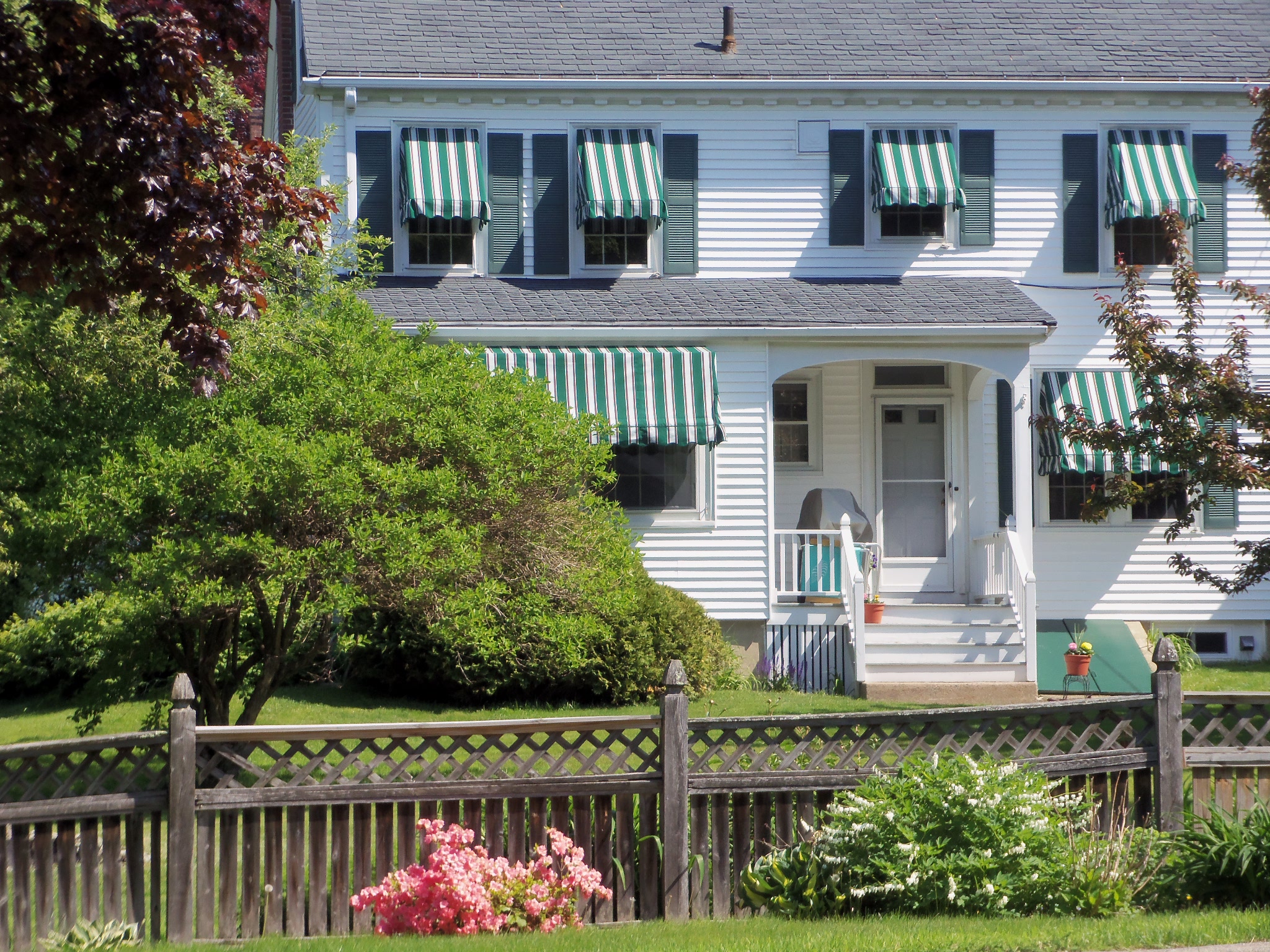
AWNINGS
Summer comfort.
 Strolling Dover: for more, click here.

