The persecution wasn’t consistent

Had the Puritan persecution of dissidents been consistent, the Quakers and Baptists likely wouldn’t have survived. Instead, it came in waves aimed more at the traveling missionaries as well as to constrain the political and business prowess of resident Friends.

Further, there were relatively few congregations or ministers in New England. Despite required attendance at worship on the Sabbath, the buildings couldn’t hold them all, had they showed up.

Who was keeping attendance rolls, anyway?

Down at the dock

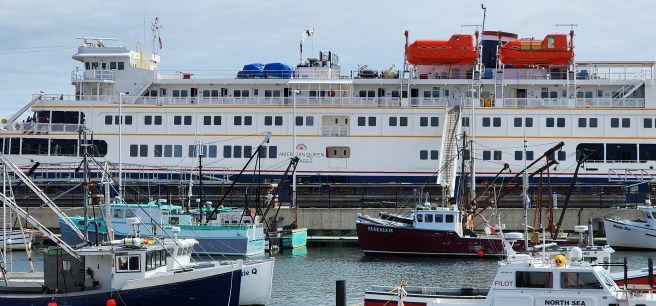
The Ocean Navigator, a 216-passenger cruise ship, has been docked at Eastport’s Breakwater pier while preparing for its sailing season, which starts Wednesday in Portland, Maine, and ventures north into the St. Lawrence River and Great Lakes for much of the summer.

You can get an idea of our local tides by comparing the photo above, at high tide, with the one below. Note the difference in the angle of the gangway for an idea of how much the elevation can rise or fall in four hours or so.

Or for a similar comparison, take the two shots below.


In the fall its itinerary shifts to Fundy Bay and New England.

Under its stern exterior, Puritan polity was fragile in nature

No, I didn’t expect to be feeling some sympathy for the Puritan authorities in America.

In fact, I had assumed they were a pretty formidable front.

But then, in researching my new book, Quaking Dover, I was rather amazed by the range of developments they faced in the 1630s, their first decade in the New World. It’s like they were being hit on all sides.

In addition, they had no direct representation in Parliament. And they didn’t necessarily represent the majority of the residents in their own towns.

In their tribulations with the Crown, the place was ripe for Revolution from the very beginning, rather than having to wait for Paul Revere’s midnight ride.

The Quaker challenge of the late 1650s hit at some intrinsic flaws in the Puritan mindset. As one challenge voiced it, the flaws were essentially theological rather than focusing on the unfolding news events. The title of the pamphlet?

An examination of the grounds or causes which are said to induce the Court of Boston in New England to make an order or law of banishment, upon pain of death, against the Quakers

As also

Of the grounds and considerations by them produced, to manifest the warrantableness and justness both by their making and executing the same; which they now stand deeply engaged to defend, having already put two of them to death

As also

Of some further grounds for justifying the same, in an appendix to John Norton’s book (which was printed after the book itself, yet part thereof); whereof he is said to be appointed by the General Court

And likewise the Arguments briefly hinted, in that which is called, “A true Relation of the Proceedings against the Quakers, &c.”

Whereunto somewhat is added about the Authority and Government Christ excluded out of his church; which occasioneth somewhat his true Church-Government

By Isaac Penington, the Younger

[1660]

~*~

It’s a remarkable document, actually, well worth reading, even in light of the headlines and news flashes we encounter. It argued, essentially, that the Puritans were falling far short of their true goals and potential.

As for the full title?

It would never sell today.

The Puritans do get a bad rap

Oh, it’s hard for me to admit that, at least in light of the early persecution of Friends. I started out with my new book, Quaking Dover, assuming the Puritans were a monolithic opponent of religious liberty for others.

I did know, however, they weren’t always as uptight as they’ve been portrayed. In some ways they were liberal, with high literacy rates for men and women. Startlingly, a woman could divorce her husband if he didn’t sexually satisfy her. Besides, in England their Parliamentarian armies were the vanguard of the radical World Turned Upside Down that toppled the king. And they did love their beer.

As I researched my book, I began to sense that the old adage about coming to America for religious freedom but not extending it to others wasn’t exactly on target, nor was the part about neighboring colonies like New Hampshire being founded purely for monetary gain. As for Rhode Island? You see, it complicates.

For starters, the Puritans’ Massachusetts Bay charter was a commercial document, like the one for the East India Company, with their brilliance coming in immediately moving the annual stockholders meeting to the New World rather than London, under the King’s eyes.

The Pilgrims at Plymouth, too, had come under a commercial charter, one that left them strained by heavy debt. The majority of the first settlers at Plymouth weren’t even fellow Separatists in faith, but here for economic opportunity.

What the Puritans envisioned was a utopia, one within an economic, political, and religious worldview. While it’s sometimes described as a theocracy, ministers were banned from town office – not so elsewhere in the colonies.

Two of New Hampshire’s first four towns, meanwhile, were founded by ministers fleeing Massachusetts. That’s Hampton and Exeter.

And then, the Puritan fundamentalism somehow evolved into a liberal Unitarian strand and more mainstream Congregational wing, now part of the United Church of Christ denomination.

I’ve previously noted an essay by Marilynne Robinson in the August 2022 Harper’s Magazine, delineating ways Massachusetts was far more liberal than Virginia or the Carolinas when it came to religion and liberty in general. In early Virginia, for instance, missing church three times or speaking ill of the King merited a death sentence. Let it be noted, too, that Puritans, along with Presbyterians, Baptists, Quakers, and Roman Catholics, were unable to gain much of a foothold anywhere in colonial Virginia, with its ruthless Anglican state denomination.

There are even arguments that the persecution of the upstart Quakers in both New England and the southern colonies was based more on political and monetary motivations than religion.

The historian at First Parish church in Dover had me seeing that the opposition in New England wasn’t nearly as monolithic as I’d assumed, and then that New Hampshire’s four local congregations had somewhat different characters from those in Massachusetts.

More recently, I’m facing Carla Gardina Pestana’s contention in Quakers and Baptists in Colonial Massachusetts that Friends went out of their way looking for trouble. It does rather thicken the plot. The Baptists somehow found ways to fit in more agreeably.

Considering current attacks on freedom of speech (and printing), some of it under the guise of religion, I do wonder about the status of the separation of church and state.

Sometimes history isn’t so far back there as we’d like to suppose.


Dover was on the frontier of Friends

For much of its first century of settlement, Dover was on the frontier of English settlement. Tenuous outposts clung to the coastline as far as Pemaquid and Monhegan Island in Maine, but after hostilities broke out in 1689, European settlement was pushed down to Wells, just beyond Dover.

During this time, Dover Friends were both the furthest north and furthest east Quakers in the New World. Did they feel isolated or vulnerable? They did get some strong visiting ministry during those years.

Only when Casco Bay, or today’s Greater Portland, was resettled around 1740 did that begin to change.

The number of Dover Friends relocating to new Maine lands by 1800 continues to astound me. After all, the traditional historical focus tends to look south, to Boston and to the west beyond.

I’m sensing that there’s a much richer story looking in the other direction, involving Dover families of all stripes.

A chilling example of American genocide

In reviewing passages I deleted from my draft version of Quaking Dover, I found this troubling detail. The conflicts with the Indigenous people, after all, are not the focus of the book. And yet …

After “the Indians renewed their ravages on the frontiers in small parties [in 1711, with several of the attacks detailed] in consequence of these ravages the House of Assembly passed the following vote: ‘Voted for Incouragement of Volunteers to Kill and Destroy the Indian Rebels in the province of New Hampe for every man shall be paid sixty pound, for every woman forty pound, for every child thirty to be paid out of the Treasury, and that the said Volenteers shall Remain in that service at least four months, not leaving any Garrison unnarmed, but have the consent of the comitte of Meletia for there so Inlisting … by order of the house. Sam’l Keais, Clark.”

~*~

That’s it, a bounty for killing children, and another, their mothers. Men might be considered warriors, but not necessarily.

Even if this was never paid, it’s inexcusable.

And the English considered the Natives barbarian savages?


A few key provisions made all the difference

I had initially dismissed them as inconsequential, but when Massachusetts annexed New Hampshire, it allowed two crucial exemptions in the Live Free or Die province.

The first let all free males vote in town affairs, not just those in good standing in the tax-supported church. And it let them hold land.

What that meant for those joining the Quaker and Baptist movements was that they wouldn’t be disenfranchised for their faith.

That wasn’t the case in the Puritan colonies of Massachusetts and Connecticut.


They weren’t always ‘innocent’ victims

Among the stories I deleted from the draft of Quaking Dover was one dealing with the fate of a grandson of Dover founder Edward Hilton.

While both of the immigrant Hilton brothers eventually left Dover, Edward’s family married prominently.

I still feel that the story illuminates the tensions of living on the frontier of early New Hampshire, as you’ll see. It just didn’t fit into the emerging thrust of my book.

Take a look:

In the summer of 1706, Winthrop Hilton led a work crew of 17 men into the forest of Epping, which was then still part of Exeter. Across New England, all white pines of two-foot circumference or more were reserved for the Royal Navy to use as masts, and the provincial surveyor recorded and marked these as the King’s pine. Hilton’s task was called limbing, in this instance the removal the limbs and bark from mast trees felled the previous winter.

“Their only tool was an ax,” Joy True, curator of the Epping Historical Society, explains. If the bark was not peeled off these tall, straight, majestic trees, they would become damaged by worms.

Hilton was also the highest-ranking military officer in New Hampshire, a position he filled after the death of Major Waldron in 1689. The family homestead in Newfields, also then part of Exeter, was a fortified, manned garrison.

“In 1706 the natives kept careful watch,” True writes. “They attacked and killed any man that left the shelter of the garrison. By the summer of 1710, the ravages of the war had greatly exhausted the people of the upper New England villages. Many of the men that were fit for military service were away at Port Royal in Nova Scotia defending settlers from Indian attacks. In the meantime, small bands of Indians in this area were making forays into the white settlements with increased daring.”

Colonel Hilton made for an exceptional target. As a leading figure in the expeditions to the eastern frontier, he had taken in the raid against the Indian settlement at Norridgewock, Maine. “As a result, he became the object of bitter grudges by the enemy,” True observes. “He was above average size, of muscular physique, and of resolute character. He was one of the best, a leader in his community; and he was respected by friends and neighbors. But Hilton had a darker side; he thought nothing of killing the enemy, man, woman or child. On Indian raids, he often spared the women and children, taking them into captivity. Hilton and his band of men, traveled far and near, pursuing the enemy. Is it any wonder, the Indians hated him, and plotted their revenge?”

He thought he had enough men to avert trouble, but it was, as True notes, “a wet and stormy day, and all their powder was wet, so of little use to them in an emergency. The attack was so sudden; they never had a chance to respond.

“Colonel Hilton had determined many years before that he would not be captured by the Indians. He would fight to the death rather than being captured. The enemy was aware of this, and after all their planning, they knew they could steal closer to Colonel Hilton and give him little opportunity to defend himself. Then they struck, their first target was Hilton, and then two other men were quickly killed, and two men were captured. The rest of the men fled for Exeter, and safety.”

One of the captives “was probably Dudley Hilton, brother of Winthrop. His body was not recovered at the massacre, and he was never heard from again.”

~*~

Let me now ask:

Does any of this fit into what you had envisioned as early New England?


White supremacy was there all along

Maintaining a unique group identity can be perilous, no matter how necessary.

The necessity side, at its best, has to do with trying to make progress, improve justice and physical comfort, live healthier, counter the corrosive forces of status quo and lethargy, be smarter, and so on. Put it any way you want, things in general could be better, and even thinking something like that will set you apart from the status quo of broader society.

On the other hand, humans are social animals. We need others as family, friends, colleagues, cohorts. We even need them to share our stories, histories, songs, and place on this earth. Relax, right?

It’s a complex calculus, then, around the world.

What I started to see in researching my book on a Quaker community in New England, though, was a blatant arrogance within the Puritan wave of immigration. I suspect similar sides are apparent in the Spanish settlers to the south or the French to the north, or, well, back in the Old World, all the way to China. Even one tribe over another.

I’m trying to look at this clearly.

The English, of course, knew they were superior to the French, who I gather saw it the other way around. (Insert proper expletive and spit appropriately.) And they were both superior to the Spanish or Portuguese or Italians, according to this scenario.

Germans? Not really on the scene in earliest settlement in America, far as I can tell, though the Dutch of New Netherlands add their own twist.

Remember, the English also looked down on the Scots and Irish, as well as the Welsh and Cornish.

Sounds to me like the old game, King of the Hill.

The comedian Eddie Izzard has an insightful riff on this where he says it all comes down to a flag. If you have no flag, you have no claim to your country or land. So, here, I’ll stick mine in the ground and this place is mine.

That does make for a short ride on the papal Doctrine of Discovery. Look it up, if you must.

What I’ve seen in my research is how this air of superiority made equitable dealings between the Europeans and the Indigenous peoples impossible. There was no eye-to-eye even exchange. Even the concept of farming was viewed as more productive, and thus superior, than the Native hunting and gathering use of a piece of land.

Well, I could argue that God preferred a wild-game offering over grain in Cain vs. Abel, Genesis chapter 4.

You know, quality over quantity.

As for equality? We have our guns and Bibles.

Which points to another distinction: written language. I’m a writer and a reader. You expect me to not take sides here?

Still, in the New England story, the English weren’t shy about labeling the Natives as “barbarians,” “savages,” and “heathens.” Never mind many of the practices of the English and French, who not only offered bounties on scalps – Native and the other side’s European – but also indulged in the practice themselves. As for heathen? For the Puritans, with their Calvinist inclination of proclaiming themselves God’s Elect, most other Christians were also lumped in that group, perhaps at a slightly lesser degree.

Many of the consequences, however, have been tragic, for all sides.

In some theology, pride is a sin, right? Ahem. (Hopefully, in contrast to justifiable self-esteem.)

Well, as some among us might note, I’m proud to be a humble Quaker. Not that we didn’t fall into that trap of feeling superior, too.

There’s plenty of work for all to do on this issue. I’ll leave my end of the discussion at that, for now.

When we’re havin’ a heat wave

When the temperatures around here start inching into the 60s, the locals complain of a heat wave. Seriously.

Well, maybe complain is too negative, but they are vocal.

Convertibles will have been cruising around with their tops down for some time, at least when it’s not raining. Or maybe not.

I even saw some tables on the Old Sow restaurant’s outdoor deck blithely occupied at night when the temps sat in the lower 40s.

I won’t even mention the guys who go around all winter in shorts.

This definitely ain’t California, Texas, or ‘specially Florida.

How does seasonal change kick in where you are?