SO MUCH FOR THAT PICTURESQUE IMPRESSION

Looking at all of the old red-brick mills remaining along the waterways of New England, you’re likely to see them as strong, serious, silent enterprises in their day. Something like a library, perchance.

The reality is something quite different. They were beehives, for one thing, where workers were subject to wide fluctuations in hot and cold (no heat, which could spark fires, along with some brutal summers) – in addition to cotton lung, like the black lung suffered by miners.

As for the quiet? Forget it. These factories were powered by leather belts that ran in relays from the groaning, splashing waterwheel to squeaky overhead rollers on each floor which in turn led to all kinds of clacking machinery. The whole building shook.

Not all of them wove cotton, either, but the mechanics were the same.

The leather belts, by the way, would wear out and break. They alone led to a unique art of construction and maintenance. The city where I live had tanneries to supply the mills, unlike the next city downstream, which was involved largely in shipping.

As the ditty went:

“Portsmouth by the sea,
Dover by the smell.”

As I was saying about that initial impression? These were the nitty-gritty realities.

BY DAY, BY NIGHT

1

I admire a lighthouse more than a ship
without masts, as a qualifier

anchored in some upstanding foundation

I, who have roved the continent
and no further
gaze from the shore

or out, from the water,
to peer at each obelisk
instructing the coastline

yet masts, in open sail
could make this a wash
or a wish-list

2

I look in vain for a painting or photograph
of ocean only
always some shoreline
or ships – naval battle
conflict or simply
what attempts to bridle wild space

the lighthouse, as a genre, especially
countering the fabled variations of blue

at last, O’Keeffe’s large canvas of clouds and sky
comes closest
even more than her cross by the sea

3

costly as a ship
to construct and to run

this marker
of commerce, progression, and change
made obsolete, still

a warning as welcome

faithfully alludes to danger
in homecoming

a way around obstacle
a passage through the mouth
to safe landing

as much as the other abode
sailors justly dread

4

in daylight, a solitary standing figure
a sentinel
upright numeral one

a spire, a prayer
shrine, stupa
gravestone

defiantly erect penis

by night, its repetition
insisting
“Here! I’m here!”
as much as “Beware!”
in a tally of shipwreck

once with its whale oil and great lenses
arrayed on a crystalline comb
investment in life

such magnification
casting its spark
so far

this rock, uttering its expletive
to death

pinprick of light

Poem copyright 2016 by Jnana Hodso
To see the full set of seacoast poems,
click here.

JUST TRYING TO KEEP PACE

Just a taste of what’s popping up. In case you were looking for a prompt.

~*~

  1. March, with its upheavals, has any bouts of single-digit lows unable to hold long. Typically, it’s the month most prone to heavy snowfalls, especially when temperatures hover around freezing. Country roads get their “frost heaves,” too, for bumpy travel. And bits of green begin trying to break through.
  2. “Why are you getting so upset, so defensive,” she asks after I encounter a setback that makes a mess on the counter. “It’s the sort of thing that happens to everybody” Except I want to shout, “No! It doesn’t! It only happens to me!” Actually it’s an echo of the childhood reaction after being accused, “Why did you do this to me?”Or more accurately, “How could you do this to me?” Mother blaming the Golden Boy once again.
  3. Making photocopies at our computer printer has me remembering one of my definitions of “making it” as a writer, back when – the desire for an IBM Selectric typewriter and my own Xerox copier. Just think, our computer keyboards are a vast leap forward from any typewriter, at least for klutzy typists like me, while our kids take the copier for granted. Oh, it’s just the beginning of a long list of good gear rendered obsolete in our lifetime.
  4. Been harboring a lingering notion about selecting a “top 100” or “best 100” or “favorite 100” compilation of my poems. Not that I really want another project to tackle, but looking at the range of my work over the past half-century sometimes leaves me surprised. Yes, much of it has a graffiti-like imperfection, once I decided to write on the run and revise along the lines of jazz improvisation more than aspiring to a perfectly formed artifact – or whatever. Let me say there are more rough edges than I’d like. Still, that 100 cutoff would mean an average of just two poems a year from what’s been a prolific output, even without the novels and essays. I’m still wondering how I ever did it while working full-time elsewhere.
  5. Rereading Walden with an appreciation of Thoreau’s pervasive satire. It’s a refreshing perspective.
  6. Can the question “Who are you?” be addressed by “Whom do you hate?”
  7. As an acquaintance was told at the office one Monday morning: “You have a billion dollars to reallocate.” It’s something that happens in a corporate buyout. Not that she saw any of it.
  8. Gotta try praying rather than worrying.
  9. Stay balanced and rested.
  10. We’re big on putting the lentils back in Lent.

~*~

Yes, this days our Tibetan prayer flags are frayed and thin.
Yes, these days our Tibetan prayer flags are frayed and thin.

SWIMMING WITH PISCES

Why wait for the dust to settle? Here are 10 bullets from my end.

~*~

  1. Would love to get back to another personal routine that’s somehow fallen by the wayside: sitting abed and “simmering” each morning with a cup of coffee to accompany some reading or just my own thoughts. Rather than popping right up and getting in gear. Theologian Howard Thurman was a big advocate of the practice and its reversal in the evening.
  2. Do have the indolent luxury of hiding out in our third-floor guest room (a.k.a. crafts room), opposite my studio, maybe even allowing a whole thick novel to wash over me as I read if I’m not napping there. It’s the room up there that gets direct sunlight, unlike my north-facing studio.
  3. Forsythia, which she insists are as hardy as weeds, are in danger of blooming too early. One more sign of disaster we’ve observed. We’re watching them, all the same, to bring a few sprigs in to force into flower sometime approaching Easter.
  4. Returning to the memory of hitchhiking – giving a lift to others when you can or extending their generosity, in some manner – suggests compiling a long annotated list of our experiences and what we learned, pro and con. Maybe as Letters to Youth from a retired hitchhiker or a way of finally gleaning some wisdom in reflecting on the era. Yes, it could be giddy but also risky. And I’m not the one to see it from the “hippie chick” perspective. Anyone else want to rise to the challenge?
  5. We’re well into sauna season, the little cabin at the edge of the pond. I’m still not breaking the ice for a dip. Let the younger, more foolhardy guys to that. No, there’s no reason for us geezers to tempt cardiac arrest.
  6. Curiously, I don’t seem to be getting any more done in my personal pursuits than when I was working fulltime. Or was I really neglecting a lot more then than I remember?
  7. February is such a short month, especially for those of us who have legal obligations to fulfill – car inspections and new tags, for instance. And then there are all those monthly payments coming due the equivalent of at least a weekend earlier.
  8. Quakers traditionally eschew a liturgical calendar, preferring instead that every day should be holy. Not that we commonly manage that. But that doesn’t preclude some of us from voluntarily taking up disciplines that would be mandatory in other denominations. For example, my wife and I customarily delve into Advent and Lenten readings and abstain from alcohol for those periods. (As a practice, it’s good to be able to say “No” and stick with it, especially when it comes to temptations like my martinis.) This past Advent we engaged Eastern Orthodox “fasting,” realizing a vegan diet would fit the rules if we eliminated oil on Mondays, Wednesdays, and Fridays, apart from the fish allowed on weekends. The avoidance of meat was no problem, but we really missed the cheese and eggs, which many vegetarians allow, and I nearly added milk to my coffee more than once. Almond milk, by the way, is a fine substitute, but I also gained an actual fondness for black coffee. So much for the sugar. Still, it’s surprising how many labels I began reading – cookies, chocolate – and found offending additives. With Orthodox Lent beginning February 27, we’re looking at even stricter rules. It’s what she describes as being a tea-totaling vegan with no olive oil. We really have to admire all those who take this in stride.
  9. And any day now we’ll be invaded by ants. They seldom wait for mid-May.
  10. We’ve seen too many who shout “law and order” turn out themselves to be lawless and disorderly.

~*~

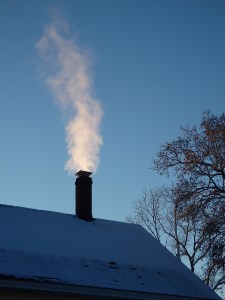
You know it's a cold morning when you look out the window and see this. Especially when all the other neighbors are in the same boat.
You know it’s a cold morning when you look out the window and see this. Especially when all the other neighbors are in the same boat.

PARADING THROUGH THE PUBLIC GARDEN

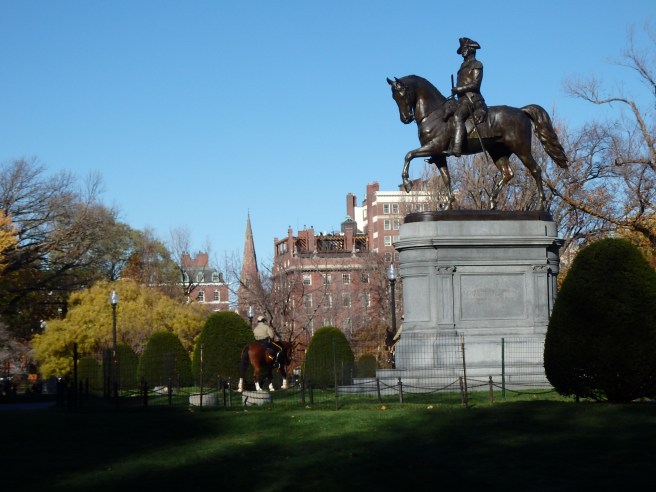
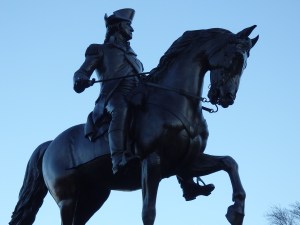
Happy birthday, Mr. President!

George Washington rides in full splendor at an entrance to the Public Garden. Sometimes he’s not alone, no matter how much he overshadows mere human equestrians.

Boston is a rich and varied destination – the Hub of New England, or the Universe, as they used to say. Living a little more than an hour to the north, we’re well within its orb.

The horse really adds to the impression.

JUST HOW BIG IS THAT TOWN WITH THE MILLS?

When I began drafting Big Inca versus a New Pony Express Rider, I was coming off a two-year stint that had me traveling across the Northeast, including the Atlantic Seaboard from Maine through Virginia. I hunkered down in Baltimore to concentrate on a handful of major writing projects in a very intense year of self-imposed sabbatical. (No university support, if you were wondering.)

While Big Inca marked a sharp departure from my other works, moving into dark subconscious realms and mysterious meanderings, it did incorporate castoffs from some of the other projects. The prompt, though, was a vague dream of restoring landmark mills beside a river, a project that could have happened just about anywhere in the region I’d been traveling.

We think of them as textile mills, and many of them were. But the water power could be employed for just about any kind of manufacturing, as I’ve since learned, from machine-making itself to shoes to clothespins to locomotives, as well as the grain and sawmill operations I’d been introduced to on our trips to historic sites in my childhood, starting with the overshot wheel and grindstones in Carillon Park in Dayton and the reconstructed Spring Mill village in Indiana.

As a youth, I’d also owned a gorgeous volume the duPont company had published to celebrate its history, and my favorite parts were the illustrations of its early mills and supporting waterways and lands in Delaware.

So there was already a degree of romance in my thinking about the use of old-fashioned waterpower.

Then, in my first job after college, I was introduced to the ruins of cigar factories beside a dam in the Susquehanna River, a tangled patch I returned to frequently, as I describe in my set of poems, Susquehanna. Just how would the mills have looked, anyway? And how would they have shaped the adjacent neighborhood, a setting reflected in Riverside, another of my poetry collections?

My more recent employment had me calling on places like Fall River, Massachusetts, with its array of vacant stone mills, as well as towns incorporating the more common red brick versions, large and small.

Add to that mention of the entrepreneurial impact of the many mills that once stood along the Jones Falls in Baltimore itself, before the freeway wound through the sites, and I was quickly writing.

Since releasing the novel, though, I’ve been wondering about scale. Just how big a town are we dealing with? And, for that matter, how big a mill yard?

In the back of my head I’d imagined something along the lines of Binghamton, New York, a city of roughly 50,000 – large enough to move about in inconspicuously but not too big to be, well, anywhere in the corporate radar these days. Or, more accurately, the recent past when the action takes place.

That’s had me looking more closely at old mill towns, of course, and asking if this one or that could be the right setting. Security, by the way, adds another consideration – I wouldn’t want the novel’s mills sitting right downtown, as they do where I now live or in several of the neighboring towns. Somersworth, to the north, has train tracks separating its old mills from the rest of the town, and Binghamton had a freeway.

A smaller town, in contrast, might simply have too many nosy neighbors who would insist on knowing everything about a newcomer like Bill, and that wouldn’t do. Still, there are some beautiful sites for imagining as you move about.

LEVIATHAN, AS AN EMBLEM

1

now to see
North Atlantic
in my sphere

landlocked
till twenty-eight

that week, camping tide-to-tide
beside North Pacific

and you speak of turning to Christ?

2

who found the eagle in the desert canyon
and high mountains
before the Upper Mississippi
or Great Falls of the Potomac?

still, moose fail to inspire me
as elk did

3

whales, then
rather than moose
in contrast to elk of the Yakima Valley

this mirror of historic economy

besides, moose and whales do not leave tracks
everywhere we trek here,
unlike the elk out west

to say nothing of ticks

4

water, defining land
defining water
and the overlap

I want to know what the ocean voices
in its repetition
addressing the absent moon
or distance, even in the erasure

bank of fog
curtain of resounding
fog horn or bell

or vast silence
before

the hundred thousand variations of nor’easter
just off this point

no need to circle the planet

we have our fill of floundering
agents of change

Poem copyright 2016 by Jnana Hodson
To see the full set of seacoast poems,
click here.

A FEW MORE NOTES IN THE SCORE

The mind dances here and there, rarely in a linear fashion. So what’s on my mind these days? How about counting on these fingers?

~*~

  1. Even before she argues I’m regressing to adolescence, she has many reasons to ask: Am I still emotionally … 15? Maybe this time I’ll get it right. Or just FINALLY.
  2. How is it so many people see me as masked, restrained, even inhibited? All these years. Will the real me please stand up?
  3. Like a pack of cards, “shuffle the deck,” the way of the Red Barn – or my all too rambling life with all of its competing interests! Don’t we need a job or children as focus? Or God?
  4. A jazz guitarist asks me between sets, “Are you a musician? You listen like one.” I take it as a compliment. As for my choir?
  5. Too easily I find myself retreating for too much of the day (and night) in my attic studio, apart from the rest of the house. Call me a third-floor hermit. That’s where I think I write best.
  6. I’d dreamed of having Molly Ringwald join in a movie I’d scripted: 61 Candles. We’d all grown up. Or something like that. Even I was younger then.
  7. It’s a familiar goal in revising a piece of writing and, as I’m finding, in making music. Think of the visual arts, too, and any number of places in daily life. Gain lightness in what had been blocks of density.
  8. Inscribed on the tower: “Maybe he was the love of my life … but I wasn’t his.” (Which interpretation do you prefer?)
  9. How is it I got so old? Even within an old soul?
  10. My overcoat, still tinged with city grime, needs cleaning.

~*~

This is it, indeed.
This is it, indeed.

INDUSTRIAL AGE BIRTHPLACE

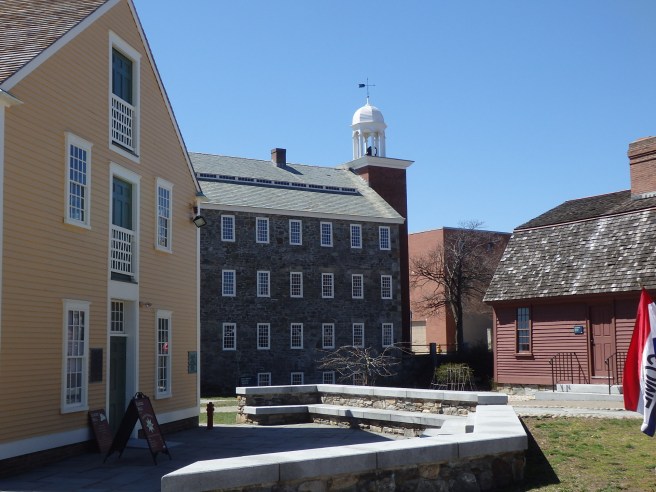
This is where it began.
This is where it began, starting with the Slater Mill on the left and building into the Wilkinson Mill, center.

The modest Slater Mill complex in Pawtucket, Rhode Island, is honored as the birthplace of the American Industrial Revolution.

The operation originated when apprentice Samuel Slater slipped through British security with secrets for textiles manufacturing and was hired by Moses Brown to replicate them in America, with the mill opening in 1793.

The fact that Brown, a Quaker, and his partners advertised for what was essentially stolen information troubles me – I do wonder how they justified their actions when questioned by their Friends meetings. The English, meanwhile, had long before enacted barriers that penalized fellow citizens in Ireland and America. Perhaps that was sufficient inspiration, even before the American Revolutionary War. Perhaps one action apologized for the other.

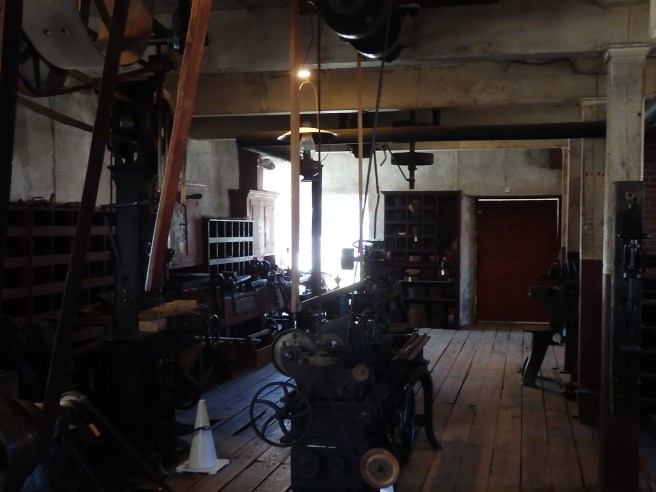
I was resting my finguers on this waterpowered lathe when I realized it was the origin of mass-production.
I was resting my fingers on this water-powered lathe when I realized it was the origin of mass-production. Without uniform parts, each item would have to be handcrafted from scratch.


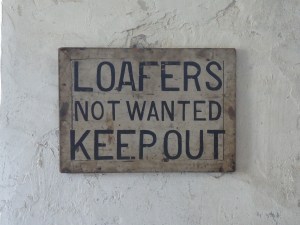
There were differences between the Quaker Work Ethic and the Puritan Work Ethic, but they would have agreed on this sign.

More remarkably, though, Slater’s assistant, David Wilkinson, then provided the next leap – a lathe that produced large screws that were far more uniform than those painstakingly made by hand. Whether he or Henry Maudslay in England was the first to produce such precise work can be argued, but the results were the foundation for the innovative precision toolmakers who would transform industry. This was, in effect, the foundation for mass production. The thinking behind Wilkinson’s model inspired a league of New Englanders to advance the technology in applications across the region.

I doubt this was the origin of the phrase “Yankee ingenuity,” though it certainly fits.

My fondness for old mills, by the way, did prompt a novel, Big Inca.