You never know what we'll churn up in cleaning a stall
Why wait for the dust to settle? Here are 10 bullets from my end.
~*~
~*~
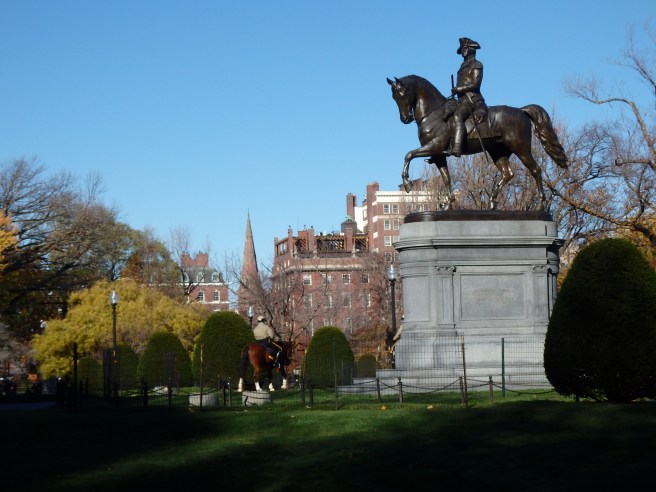
George Washington rides in full splendor at an entrance to the Public Garden. Sometimes he’s not alone, no matter how much he overshadows mere human equestrians.
Boston is a rich and varied destination – the Hub of New England, or the Universe, as they used to say. Living a little more than an hour to the north, we’re well within its orb.
When I began drafting Big Inca versus a New Pony Express Rider, I was coming off a two-year stint that had me traveling across the Northeast, including the Atlantic Seaboard from Maine through Virginia. I hunkered down in Baltimore to concentrate on a handful of major writing projects in a very intense year of self-imposed sabbatical. (No university support, if you were wondering.)
While Big Inca marked a sharp departure from my other works, moving into dark subconscious realms and mysterious meanderings, it did incorporate castoffs from some of the other projects. The prompt, though, was a vague dream of restoring landmark mills beside a river, a project that could have happened just about anywhere in the region I’d been traveling.
We think of them as textile mills, and many of them were. But the water power could be employed for just about any kind of manufacturing, as I’ve since learned, from machine-making itself to shoes to clothespins to locomotives, as well as the grain and sawmill operations I’d been introduced to on our trips to historic sites in my childhood, starting with the overshot wheel and grindstones in Carillon Park in Dayton and the reconstructed Spring Mill village in Indiana.
As a youth, I’d also owned a gorgeous volume the duPont company had published to celebrate its history, and my favorite parts were the illustrations of its early mills and supporting waterways and lands in Delaware.
So there was already a degree of romance in my thinking about the use of old-fashioned waterpower.
Then, in my first job after college, I was introduced to the ruins of cigar factories beside a dam in the Susquehanna River, a tangled patch I returned to frequently, as I describe in my set of poems, Susquehanna. Just how would the mills have looked, anyway? And how would they have shaped the adjacent neighborhood, a setting reflected in Riverside, another of my poetry collections?
My more recent employment had me calling on places like Fall River, Massachusetts, with its array of vacant stone mills, as well as towns incorporating the more common red brick versions, large and small.
Add to that mention of the entrepreneurial impact of the many mills that once stood along the Jones Falls in Baltimore itself, before the freeway wound through the sites, and I was quickly writing.
Since releasing the novel, though, I’ve been wondering about scale. Just how big a town are we dealing with? And, for that matter, how big a mill yard?
In the back of my head I’d imagined something along the lines of Binghamton, New York, a city of roughly 50,000 – large enough to move about in inconspicuously but not too big to be, well, anywhere in the corporate radar these days. Or, more accurately, the recent past when the action takes place.
That’s had me looking more closely at old mill towns, of course, and asking if this one or that could be the right setting. Security, by the way, adds another consideration – I wouldn’t want the novel’s mills sitting right downtown, as they do where I now live or in several of the neighboring towns. Somersworth, to the north, has train tracks separating its old mills from the rest of the town, and Binghamton had a freeway.
A smaller town, in contrast, might simply have too many nosy neighbors who would insist on knowing everything about a newcomer like Bill, and that wouldn’t do. Still, there are some beautiful sites for imagining as you move about.
now to see
North Atlantic
in my sphere
landlocked
till twenty-eight
that week, camping tide-to-tide
beside North Pacific
and you speak of turning to Christ?
who found the eagle in the desert canyon
and high mountains
before the Upper Mississippi
or Great Falls of the Potomac?
still, moose fail to inspire me
as elk did
whales, then
rather than moose
in contrast to elk of the Yakima Valley
this mirror of historic economy
besides, moose and whales do not leave tracks
everywhere we trek here,
unlike the elk out west
to say nothing of ticks
water, defining land
defining water
and the overlap
I want to know what the ocean voices
in its repetition
addressing the absent moon
or distance, even in the erasure
bank of fog
curtain of resounding
fog horn or bell
or vast silence
before
the hundred thousand variations of nor’easter
just off this point
no need to circle the planet
we have our fill of floundering
agents of change
Poem copyright 2016 by Jnana Hodson
To see the full set of seacoast poems, click here.
The mind dances here and there, rarely in a linear fashion. So what’s on my mind these days? How about counting on these fingers?
~*~
~*~

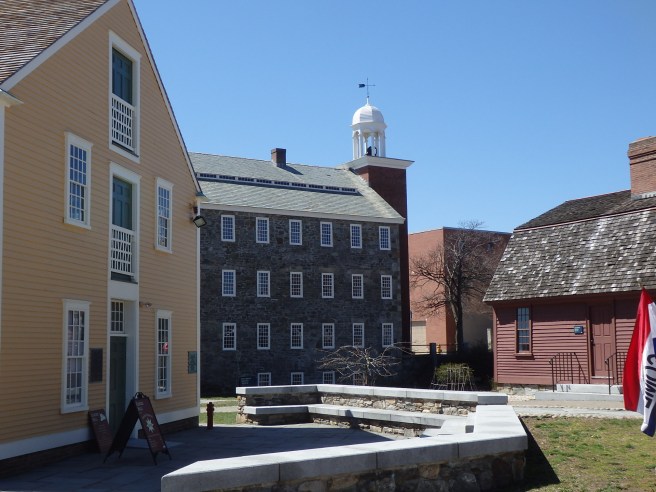
The modest Slater Mill complex in Pawtucket, Rhode Island, is honored as the birthplace of the American Industrial Revolution.
The operation originated when apprentice Samuel Slater slipped through British security with secrets for textiles manufacturing and was hired by Moses Brown to replicate them in America, with the mill opening in 1793.
The fact that Brown, a Quaker, and his partners advertised for what was essentially stolen information troubles me – I do wonder how they justified their actions when questioned by their Friends meetings. The English, meanwhile, had long before enacted barriers that penalized fellow citizens in Ireland and America. Perhaps that was sufficient inspiration, even before the American Revolutionary War. Perhaps one action apologized for the other.
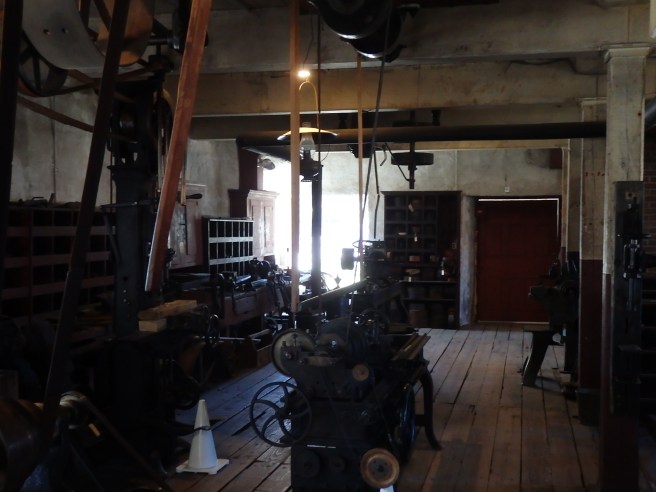
More remarkably, though, Slater’s assistant, David Wilkinson, then provided the next leap – a lathe that produced large screws that were far more uniform than those painstakingly made by hand. Whether he or Henry Maudslay in England was the first to produce such precise work can be argued, but the results were the foundation for the innovative precision toolmakers who would transform industry. This was, in effect, the foundation for mass production. The thinking behind Wilkinson’s model inspired a league of New Englanders to advance the technology in applications across the region.
I doubt this was the origin of the phrase “Yankee ingenuity,” though it certainly fits.
My fondness for old mills, by the way, did prompt a novel, Big Inca.
Why Inca, anyway? For starters, when it came to conceiving my novel Big Inca versus a New Pony Express Rider, I seem to recall an attraction to the wordplay, Inca for Inc., befitting a story about corporate intrigue.
Maybe there was even a sense of llama and alpaca wool as raw materials for the abandoned waterpower textile mills that instead become the front for covert business activity.
I was already aware of how much indigenous lore remained lost or buried in the American inheritance and wondered how much more might be festering somewhere. Even before issues of illegal immigration entered the picture, I was curious about the alternatives lurking in the imagined jungles of Latin America. Maya and Aztec, for example, also had rich imperial cultures that contrasted with the Spanish invaders.
The novel takes on its own meandering along the edges of consciousness and subconscious currents. Just what are we doing in our careers, anyway, at least in the face of ultimate existential purpose? And what is the allure of corporate politics, strategy, and gamesmanship, at least in the higher offices? Bill may be out in the sticks, but he is a puppet of sorts for the Boss. A player. Or maybe just his apprentice. Either way, he’s green and supple.
Here we encounter, however dimly, a darkness conquered by another darkness, perhaps crueler under its Christian veneer. Yet a New World Native undercurrent runs counter the peasantry of Old Europe, and pagan influences infuse both sides in the millpond of Bill’s labors. As for the company paying his Bill’s bills? It’s at least as mysterious as the Inca itself.
Being mindful of what’s right in front of us can always be a challenge. Here are 10 new items from my end.
~*~
~*~

“They already were like gods
made in Yahweh’s own image
and didn’t even know it.”
“I could see the Woman would be easier
to convince. She appreciated color and
the bouquet, where the Man noticed
only the fruit’s heft and taste.”
Every snake has its own hole.
Sometimes a snake is just as snake,
Doctor Freud.
And the Serpent went on to make a fortune
developing shopping malls lined with retailers
promising to cover everyone’s nakedness.
* * *
God creates a Helper for the Man
and she helps him, all right:
helps him get into trouble,
helps him to the forbidden fruit,
helps him get ejected from Paradise.
Not only that, but I’d venture
she believed she was doing something
beneficial for him all along,
something for his own good.
(And it was very good)
* * *
Where has Eden gone? Maybe
it’s now ahead of us, down
the road, rather than behind
with its gates shut tight.
As for Original Sin,
life’s not fair.
Some parents gamble
away the mortgage,
their children’s
college tuition.
Others get to be boss
through the injustice
of genetic roulette.
But that’s not really
part of this story.
* * *
Where do the other people come from?
Maybe the question becomes, for us,
where do other people COME FROM?
You! My neighbors! My antagonist,
my friend, my spouse, my children?
Perhaps they come from that other couple
God created, in the first creation story,
just before Eden. Perhaps they, too,
are ejected from their own Eden.
Perhaps there were other gardens
that were also released –
the ones whose stories we’ve forgotten.
Poem copyright 2016 by Jnana Hodson
For more, click here.

