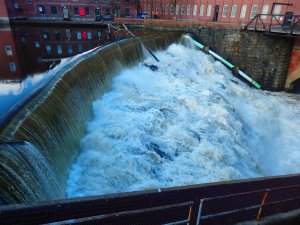
Meanwhile, downtown
You never know what we'll churn up in cleaning a stall
From the deep past
then/now contrasts.
Just a heads-up, if you haven’t heard. Look up in the sky tomorrow night for our second full moon this month.
Two full moons in one month, the definition of a blue moon. Not again till 2037, if I’m searching right.
Well, there’s a more common type … an extra moon in a season.
Even though I grew up in a northern environment and its deciduous trees, autumn color was pretty much peripheral. We lived in town, after all, and I was essentially indoors at school or the like. Besides, much of the rural landscape around us was open farmland, with here and there a woodlot or riverbank.
My foliage awareness really took off a few months after graduating from college, when I lived in a small city surrounded by forested Appalachian foothills that turned ablaze at the end of September. Like Kenzie in my novel Pit-a-Pat High Jinks, I was working a job that allowed me to get out of the office at mid-afternoon, when my free daylight hours were soon devoted to exploring the visions along backroads in what became a daily epiphany.
From town, it appeared the hills caught fire at their summits and the flaming color then ate its way downslope. And, as I heard, the forests themselves were a blending of New England varieties and those of the South, so we had the best of both worlds for foliage.
In the years and wanderings since, that’s been my standard, though I should question if it was really quite as vivid as my memory would boast. Having lived in northern New England now for 33 years, I’ve often thought our fall foliage was more subdued than its legend, perhaps apart from some spectacular locales like Sugar Hill here in New Hampshire.
This past week, though, has changed my opinion. In driving about, I’ve come across large swaths in full color – not the usual mixed green and bare mixed in – and properly illuminated, even in an early morning mist and fog, not that my camera would capture that. It soon becomes almost too much, too rich, for one’s eyes to handle.
~*~
That first autumn Upstate, I didn’t have a camera, alas. Later, living in an orchard, I was disappointed that the apple, peach, and pear trees turned mostly dun. Finally, what I attempted, with film, my first years in New Hampshire came out so-so, partly a failing on my not knowing quite where to go, when. Only when I took up digital photography, about the time I launched this blog, did I start shooting earnestly, especially my first autumn after taking the buyout at the office and heading into the hills a little north of us.
As I’ve revisited those shots, I’m struck by how often utility lines mar the image – that, and other things our eyes overlook, though the camera is far less forgiving. Those lines stick out like the proverbial sore thumb. Thus, in the past month, as I’ve been shooting, there have been many fine examples of color I’ve out-and-out passed by for that reason.
Another difference this time is that I’m using my second camera, which has a “magic” auto-setting that intensifies the color. In alternating my shots with that and a more subdued tonality, I’m finding that the “hotter” one grabs more of what I’m feeling as I look, while the “cooler” option is closer to the reality … until the sun turns just the right way, which is what’s been happening the past week.
I am surprised our hundred-year drought hasn’t deeply limited the foliage. There was a walnut tree across the street that turned yellow one afternoon – maybe within an hour – but I postponed the shot. The next day was dull and wet, the light was just wrong. And the following day? The leaves had all fallen.
Well, it will all be gone soon. The phenomenon is a lesson in attentiveness and acceptance in the present.
In my novel Nearly Canaan, Joshua and Jaya settle into a place unlike anything they would have imagined. Though they live in desert, it still spawns salmon.
Oh, what a fish.
~*~


Fellow blogger Mark Bialczak’s recent posts about his romantic getaway from his home in Upstate New York to the Cape (as we New Englanders refer to Cape Cod) kinda guilted me into giving myself a day off and taking a few hours at a beach a bit over a half-hour’s drive from my little city farm.
Yeah, I know I’m retired (or was, before signing on as a Census enumerator … yesterday was a day off for me). Still, somehow, I get tied down at home. Haven’t swum in the ocean in the past three years, for that matter, not since getting the city pool pass. I always think there’s too much other stuff to tend to.
So yesterday, telling myself the season’s running out, I hopped in the car a tad before noon and simply took off. I thought about heading north to the mountains, but I’d already done a work-related drive in the direction earlier in the day, so I veered east into Maine and settled on Fort Foster, a Kittery town park situated at the mouth of the Piscataqua River.
Regular visitors here at the Red Barn have seen many images from this tranquil alternative to the more popular beaches just up the coast from it. For us, it’s closer than the beaches in New Hampshire, and always less crowded. During the summer, there’s an admission fee, which limits traffic, and for several seasons I opted for a season pass, sometimes spending an afternoon in the water before heading an hour inland for an evening shift in the newsroom. Even so, as I said, for the past several years, I’ve just been more of a homebody, with writing and revising as a top priority.
After Labor Day, the park gate is open only on weekends through September, but it is possible to park outside and walk in, which was the case yesterday. Despite the number of cars lined up along the road, I encountered few people in the park itself, most older couples or individuals walking a dog.
En route, I stopped at the Chauncey Creek Lobster Pier for raw oysters on the half shell, which is always a rare treat for me. It’s a lovely setting, a deck over the water in a narrow tidal passage off Pepperell Cove, and typically crowded. Some diners even arrive by boat. After Labor Day, though, the tourists thin out, making for a perfect time to enjoy our local attractions. Maybe it has to do with Covid somehow, but the oysters yesterday were smaller than usual, especially for this time of year, when they’ve fattened up for winter. No complaints, though, they were still tasty. If only I could learn to shuck them myself. It’s a skill, one that can lead to emergency-room stitches for an amateur.
‘Nuff background. Here’s a sampling of what I enjoyed a mile or two later.


 Jnana's Red Barn