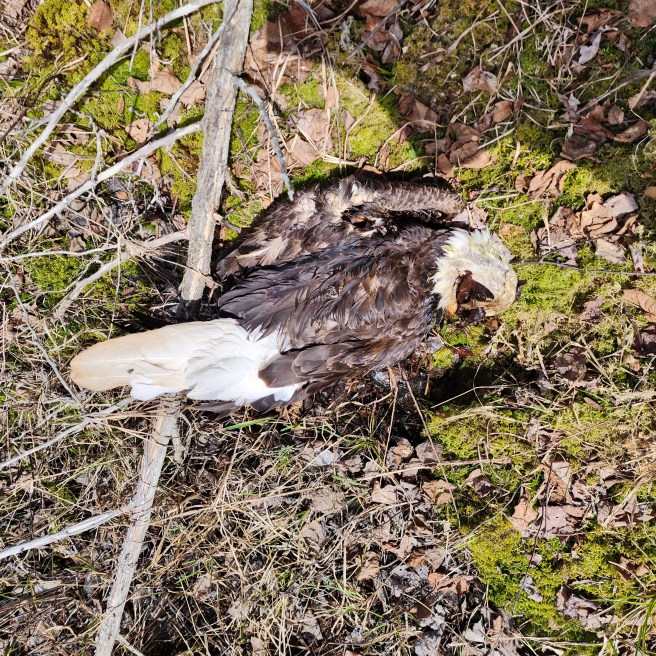
Chanced upon in a culvert in Edmunds Township. Those feathers, by the way, are both protected by federal law and valued in Native American culture.
You never know what we'll churn up in cleaning a stall
Chanced upon in a culvert in Edmunds Township. Those feathers, by the way, are both protected by federal law and valued in Native American culture.

The world of wooden sailing vessels has many devotees, and they have a trove of stories linking captains, ships, first mates, cooks, builders, designers, and much more.
Dr. T, as Garth Wells dubs him, is a passionate Penobscot Bay habitue each year from San Francisco. He has a sharp eye for the waters, too, as well as some strong opinions.
Sailing with him aboard the historic schooner Louis R. French has been a delight.
For more schooner sailing experiences, take a look at my Under Sail photo album at Thistle Finch editions.

They’re a landmark for much of Penobscot Bay. Sometimes, though, they appear more distinctly than they do as one broad outline.
For more schooner sailing experiences, take a look at my Under Sail photo album at Thistle Finch editions.
 Yes, autumn is in the air.
Here it’s seen on Penobscot Bay from a cruise aboard the historic schooner Louis R. French.
For more schooner sailing experiences, take a look at my Under Sail photo album at Thistle Finch editions.

The first French attempt to colonize North America took place in 1604 on this island in the St. Croix River but ended disastrously. The historic site is now an international park between Maine, USA, and New Brunswick, Canada.
Access to the island itself appears to be problematic.
Here it is seen from Ganong Nature Park (east of St. Stephen, New Brunswick) at the confluence of Pagans Cove, Oak Bay, and the Waweig River while the St Croix River veers off to the west and quickly narrows before continuing the international border.

Garth Wells is the man in the pink hat aboard the Angelique as the Louis R. French comes into dock at the end of a cruise.
He owned and operated the French before passing the duty to young Captain Becky Seawright. He even officiated at her wedding.
For more schooner sailing experiences, take a look at my Under Sail photo album at Thistle Finch editions.
 A Penobscot Bay windjammer cruise typically includes a lobster bake, though technically the crustaceans are boiled or steamed with corn on the cob. The event takes place on any of a number of uninhabited islands along the way.
It does mean going ashore, of course.

For the record, last summer I ate 3½ lobsters – hey, they were small chix – but a shipmate managed 6½, just shy of the Louis R. French record of seven. Had she known, I would have cheered her on.
For those of a more squeamish nature, hot dogs and other hot goodies are offered, along with gooey s’mores, as long as the wood fire continues.
For more schooner sailing experiences, take a look at my Under Sail photo album at Thistle Finch editions.
Even this far north, we’ve had our moments. Among the things to consider:

Not everybody on North Haven island has a basement, as we saw on a jaunt ashore. Think of it as local color, as seen from a cruise aboard the historic schooner Louis R. French last summer.
For more schooner sailing experiences, take a look at my Under Sail photo album at Thistle Finch editions.

As seen from a cruise aboard the historic schooner Louis R. French last summer.
For more schooner sailing experiences, take a look at my Under Sail photo album at Thistle Finch editions.
 Jnana's Red Barn