
You never know what we'll churn up in cleaning a stall
Quite simply, she’s the coolest woman I’ve ever known. Warts and all. Now for some details.
When it comes to finding your way about town, you need to know more than just the names of the streets.
Eastport’s a city of islands, with Moose Island the biggest and most inhabited. It’s roughly six miles long and three wide, at the most, but that still adds up to 20 or so miles of shoreline, I’m guessing.
So people will refer to Buckman Head or Estes Head or Todd Head or Kendall Head or, for variety, Harris Point, punctuated by coves.
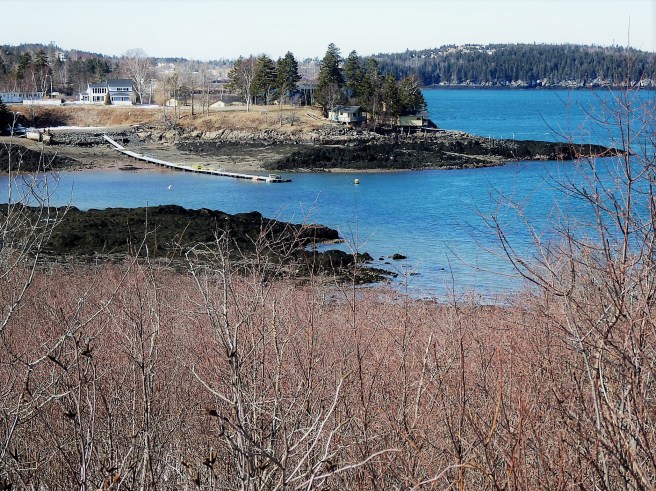
So there’s Broad Cove or Deep Cove, which flank Shackford Head, or Prince Cove, for instance. As well as Carrying Place, Half Moon, and Johnson coves. Plus a few more. And that’s before we get to the neighboring towns, up and down the coast, which also name places this way.
Welcome to my new world.
I have to confess to how many of America’s national parks remain on my to-visit list. But I still have some favorites among the ones I’ve explored. They don’t have to be massive to still be impressive.
~*~
There are many more, awaiting personal discovery. So what are your favorites?

Maine is larger than the rest of New England combined, and except for much of Vermont, it was settled much later than the rest of the six-state region. That is, the parts of the state that were ever settled at all. Half of the Pine Tree State has no year-round population at all, for good reason.
The result is that there are paved roads where you can drive for miles and see nary a utility line or a mailbox, much less a house. Often, the only human activity you detect is timbering or mining. Hunting and fishing are a way of life. It wasn’t that far out of Bangor I used to see the bear-hunt guide sign.
Those roads remind me of driving from town and out toward a mountain pass on my way to trails in the high country out West.

Downeast Maine’s open blueberry barrens on the ridges, meanwhile, give me a sensation of the Big Sky Country of Montana or the Horse Heaven Hills of Washington state, except that the blue overhead isn’t the same deep intensity.
I believe that the presence of Indigenous peoples is another part of the mix. Eastport is adjacent to the Passamaquoddy’s Pleasant Point Reservation, as we’re reminded every time we drive to or from our island. They’re one of the four tribes comprising the Wabanaki Alliance in the state.
Yes, there is a kind of frontier feel around here. I’d suggest calling the area the Far East, but that name’s already been taken.
Fact is, many of the old ships that sailed to the Far East were built along these shores rather than those of the Far West.
What, you were expecting sexy lovers? That’s a whole different story, maybe best left for my fiction.
~*~
What do you really love? Make that who, if you desire.
~*~
Now, to inhale deeply … and hold it.
Have you ever wondered how some individuals, liberated from the daily 9-to-5 or similar constraints, manage their lives? I mean, just everybody I’ve known has always envied that “free from it all” possibility, but what does that mean in reality? Even retirement?
As for someone who’s “financially set,” how do they arrange their lives?
The last thing I’d want to do is squander my time in front of a TV screen. The computer monitor, by the way, is a different matter. It’s more like a command post, not that my doctor would agree. You know, the new form of “couch potato.” If you’re reading this, you’re likely also guilty. Maybe we need to join ranks.
For years now, there was always the paying job to contend with. In addition, I’ve always had a big writing project at hand, as well as the rhythm of Quaker Meeting. There was also contradancing. Retirement added blogging, daily swimming and then Spanish drills, along with weekly choir rehearsals, at least before Covid.
SOMEWHERE IN THE PAST two or three decades I had an annual year-end practice of blocking in my goals for the coming year, as well as a five-year plan. That’s faded away since my leaving the newsroom, but when my wife first came across those, she was both amused and annoyed. Seems I left out a lot of important things, even in a single day, meaning the plans weren’t especially practical or entirely focused.
I’ve recently come across a file of those aspiration but find I’m unable to get very far in rereading them. My plans were grandiose, ambitious, regimented, even militant, and besides, I no longer have the energy to keep up that kind of pace.
On the larger scheme, I broke out each season with Personal items like birthdays, vacations, auto inspections and license renewals, routine medical affairs, maybe even a reading binge or a recognition that I needed to get some exercise, at least by hiking or some such. There was a Domestic category to remind me of getting the furnace cleaned, paying insurance, tax deadlines, setting aside time for snow shoveling or getting garden stuff moved, even ordering firewood. Creative was the one that set goals for writing, revision, and submission. Spiritual was mostly Quaker activities. And, for a while, there was even Astro, to keep me apprised of what the heavens indicated I should be aware of.
Retirement was when I was finally going to be able to go Literary in a big way.
On the smaller scale, I tried envisioning daily and weekly routines in which I would block out so many hours for each of my larger categories and goals.
The problem was that there were never enough hours to work it all in.
RELOCATING TO EASTPORT was initially a writer’s retreat where I could focus on the Dover Quaker history book, but now that the project’s wrapped up, apart from getting it published and promoted, I’m feeling adrift.
No matter what time I wake up, anywhere from 3 to 6, usually, I can’t get away from this keyboard and screen until after 10. So much for the early morning meditation and study I originally envisioned! Well, these are the hours I’m finding clearest for writing and corresponding.
But from there? That’s the problem. Nothing feels structured, much less directed.
The introduction of an hour of walking in the school gym may change that, though it means moving some of my computer “butt time,” as writer Charles Bukowski put the practice. OK, back in college, I was a night owl and found midnight to two or three to be prime time. (Not so any more! Eastport is in the “land of the dawn” or Sunrise County.)
A big cooking day? Say, Wednesday? As for cleaning? A set amount of time daily or instead a big round on a specified day?
Well, that’s what I’m looking at now. The one big difference is whatever emerges will be more flexible than the earlier incarnations.
Any advice or specifics, especially things that work for you?
Looking at the low temperature here and then the ten-day forecast, I observe a turning point in the season. This may be the last day of the year that our low reading is near zero, much less in the negative range. We’re heading upward into the teens and above as the minimum.
It may be cold, but no longer bitterly so.
Not that we’re anywhere near getting warm.
What’s the equivalent where you are?
My awareness of microclimates – ways weather conditions in small spots differed from the wider scene – came early one spring when I was dwelling in an orchard in Washington state. There were critical hours once the trees began blossoming when a frost could devastate a year’s crop. Cherries were particularly susceptible, but the apricots, peaches, pears, plums, and apples were also at risk. Remember, a whole year’s income could be wiped out in a few hours.
Frost-fighting measures, such as smogging pots, propane heating lines, airplane propellers pulling the slightly warmer air aloft down into the groves, or spraying the trees with water to form a protective ice coating around the blooms, were all costly. Essentially, it was a gamble. The orcharists relied on alarms sent out on special radio frequencies, usually in the wee hours, before taking action. Sometimes three feet of elevation made the difference in whether to act or simply ride it out – or, in the other direction, whether any action would be futile.
Years later, in New Hampshire, I encountered something similar, where a band somewhere between Manchester and the seacoast could vary by ten degrees within a mile or five. It could mean setting out in shorts and being uncomfortably cold on arrival. Or setting out in long pants and sleeves only to be sweating.
Once, in Dover, I saw an 11-degree drop – plus a cloud bank – between one side of the bridge into Newington and the other. Another time, I left for work in 39-degree favorable conditions only to encounter freezing rain and a hill that took a half-hour to go down midway to the office.
Now that I’m living on an island in Maine, I hear a common saying that our temperature is typically ten degrees cooler in summer and ten warmer in winter than it is even at U.S. 1 on the other side of the causeway, just seven miles away.
The differences were even more dramatic one morning when I checked last month. Our reading was plus 4, but inland had minus 8, on one ridge an hour’s drive away, or minus 14 at a lake a few miles away. Close by us but inland only 15 to 20 miles away were readings of minus 12 and minus 15.
A few days later, we had a minus 3, but Calais, 25 miles north and on a tidal river, was minus 25!
Do you experience anything similar where you live?
Add or subtract 22 degrees from 70 to get an idea of how much the impact can be. I mean, the 90s are usually miserable while the 50s mean keep the furnace running and maybe the car windows rolled up. Unless you’re a native New Englander. (I’m not.)
Well, it is Groundhog Day, which is really the end of Solar Winter, by one calendar, or the halfway point of Calendar Winter, another. Either way, we’re entering a stage when things warm up a tad but can produce some horrendous snowfall in my part of the universe.
Once again, I’m ever so glad I’m no longer having to commute to an office, day or night.
 Jnana's Red Barn