Join us in a free concert for Sanctuary

Dover Friends Meeting is presenting a free evening of song, scripture, and reflection on the essence and intention of Sanctuary as we seek to build and sustain unity in our leading to offer mercy and love to those in need.

The hour-and-a-half celebration takes place Saturday, March 13, from 7:30 to 9 p.m., and you are welcome to join with us via Zoom.

For years, our community of faith has enjoyed an annual Arts & Letters gathering around this time each winter, an event where we could enjoy the wide range of artistic abilities among us, both amateur and professional, by Friends of all ages. Visual arts and crafts, dramatic readings, original poetry and prose, dance, video productions, gymnastics, even self-defense, and of course music have all been abundant. And this year, as a consequence of Covid, the occasion is taking yet another turn, one with a theme and a venue that will allow folks from all around the world to meet with us in our little corner of seacoast New Hampshire. I already know of one song written especially for this occasion.

Welcome to Dover Friends …

Remember, it’s free, but registration is required. Click here!

How about a running soundtrack for a food story?

Think of the names of bands and singers having a food tag. (Will Red Hot Chili Peppers or Smashing Pumpkins get your thoughts bubbling?)

Throughout my novel What’s Left, her uncle Barney has rock playing prominently in the restaurant kitchen. Does this provide a good counterpoint to his thoughts and actions? Do you find it amusing? Annoying? Confusing?

Who would you like to add to the food-themed playlist?

~*~

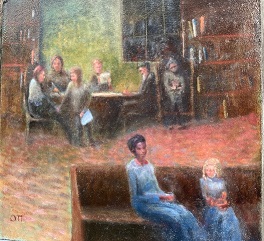
The old church Cassia’s family buys in my novel might have looked like this … before the wild rock concerts begin.

What are your favorite Christmas hymns and carols?

Frankly, I can do without all of the secular holiday music, or at least most of it. I want something less contrived and commercial. Even Tchaikovsky’s Nutcracker score wears thin.

I’m not entirely insensitive, though. Here are ten I enjoy singing, especially in a choir.

~*~

  1. People, Look East: this 1928 Advent carol by Eleanor Farjeon is a joyous accompaniment when making preparations ahead of Christmas.
  2. In the Bleak Midwinter: I want to think of this as a plaintive folksong, but the words are by Christina Rossetti and the music’s by English master Gustav Holst. It catches the blue side of the approaching winter, but also the hope and comfort to be found therein.
  3. Once in Royal David’s City: If you can, go for the fully celebrative midnight mass with a full pipe organ and all five verses sung in the Anglican style that alternates soft and loud.
  4. There Are Angels Hovering Round: It’s an old call-and-response hymn that seems to have hundreds of verses, if you want to keep going. There’s no escaping the sense of togetherness when you’re singing.
  5. Fairest and Brightest (Star of the East): I first heard this in a recording by Kentucky folksinger Jean Ritchie, but it also works in formal arrangements. The text is a protest song befitting the suffering classes of the story.
  6. Nouvelle Agreable: by Swiss composer Jean-Georges Nageli, the bouncy music almost sounds like Mozart though even Native Americans near the Arctic will sing and dance to it, too. (Check it out on YouTube.)
  7. La Valse Cadienne de Noel: words and music by Jeannette V. Aguillard. What, you don’t waltz during the Twelve Days of Christmas?
  8. Traveler’s Carol: A traditional Catalan carol of coming together for the holiday. We use English by Susan Cooper in an arrangement by George Emlen.
  9. The Coventry Carol: a haunting sense of Herod’s slaughter of the innocents and of the crucifixion to come infuse this lullaby.
  10. The Old Year is Dying: a cheerful Welsh piece to welcome the New Year. Again, New Year’s Day falls in the Twelve Days.

~*~

What are your favorites?

Hey, Figaro!

How is it the young Figaro, in “The Barber of Seville,” is so worldly-wise, especially in the ways of attracting women, while a few years later, in the “Marriage of Figaro,” he’s so confounded by the Count’s moves toward his own beloved? And, oh, yes – what happened to all that business savvy?

Well, it was a French theater comedy series originally. One obviously without a continuity editor.

I’ll give the author, Beaumarchais, some slack, since he was busy on many other fronts. And give him lots of credit for knowing how to cut satirically to the quick.

Sing along, if you will

As Joni Mitchell has sung, “And the painted ponies go up and down, we’re captive on a carousel of time. We can’t return we can only look behind from where we came and go round and round and round in the circle game.”

Makes me think of my Barn blogging, with its emphasis on the seasons, too, as well as the way my categories go round and round.  

On the road less traveled

Many know the Robert Frost poem, “The Road Not Taken,” but few know of its underlying Puritan foundation, expressed in Daniel Read’s 1785 shape-note hymn, Windham, based on lyrics by Isaac Watts. As the first stanza proclaims:

Broad is the way that leads to death
And thousands walk together there;
But wisdom shows a narrow path,
With here and there a traveler.

Frost, in contrast, has none of that grim Calvinist view, one that leads the next stanza to open, “Deny thyself and take thy cross,” and builds to a closing plea, “Create my heart entirely new, which hypocrites could ne’er obtain, which false apostates never knew.”

I can say that singing Windham in a choir is a rigorous experience. And, my, it feels incredible to bite on that final phrase, self-righteous though it can be.

Others can debate which piece better expresses New England terroir, but in contrast to Frost and his leisurely stroll in autumn foliage, I’d say the ideal embedded in the hymn remains the road less taken. Winter here is a much, much longer season than the fleeting falling of leaves..

We’re coming up on what would have been the big 50th anniversary Revels Christmas production

Every December, the Boston Revels produces a new winter solstice celebration that now plays to 18 sold-out performances in Harvard’s historic Sanders Theatre. Or did, before the Covid-19 restrictions.

From their first round in 1970, the shows have grown into a unique hybrid of storytelling, theater, dance, concert, audience singalong and other participation. Each year focuses on a different corner of the world or a historical event.

Guest artists bring their traditions to the company, and the costuming and sets are always spectacular. Nobody could forget the big canoe that came flying out over the audience in a Canadian show a couple of decades back.

Well, this year’s production won’t be live in the flesh, but rather a streamed online retrospective. I don’t really know how to count it. Still, if you go to the revels.org website, you can attend a virtual show wherever you dwell. Admittedly, it won’t quite be the same.

Here are ten we’ve especially enjoyed.

~*~

  1. Leonardo da Vinci. This was founder John Langstaff’s final appearance with the troupe, and it focused on three different cities in Renaissance Italy.    
  2. The road to Campostela. The culture of Spain’s Galatian region was featured in this homage to the pilgrimage known as The Way. Storyteller Jay O’Callahan was captivating, the flamenco was quite moving, and you wouldn’t forget those Spanish bagpipes.
  3. Wales. There’s more to the British enclave than Dylan Thomas, though it did provide the timeframe for this production.
  4. England’s Crystal Palace. How truly Victorian.
  5. Venice in the 1500s. The music wasn’t all Italian and Latin, by the way. The Croatian, Sephardic, and Turkish pieces were all hits. And the story was a delightful comedy.
  6. Acadia and Cajun. We followed the life and expulsion of this French-speaking people from Canada to New Orleans. The big tree at the back of the stage kept shifting color as needed, and the stream of immigrants into exile seemed to be endless, even though it was only the chorus of children and adults repeating their exodus toward the audience.
  7. Nordic. Six languages, including English, big slices of the Kalevala myth, and a lot of polkas. The Scandinavian fiddles are distinctive.
  8. Armenia and Georgia. I loved the economy of this one. The first act centered on a pilgrim in Armenia, where the Christian church took root at the foot of Mount Arrat, the landing place of Noah and his ark. From there, the second act followed him one locale over, to the Republic of Georgia. Though so close together, the traditions were also strikingly different. The Revels headquarters is in Watertown, a major center of Armenian population and culture, so finding a great cantor was no problem.
  9. Scotland. Langstaff had a passion for Britain, and its folk culture is deeply engrained in the Revels DNA. We didn’t get to the acclaimed Irish show, but this one included reels we still dance in New England as well as songs familiar and rare.
  10. American roots.  Last year’s show started at a rural radio station somewhere in the South and covered a lot of ground by the end.

~*~

What live Christmas season events have become part of your tradition?


What is it about Memphis?

In my novel Yoga Bootcamp, Jaya’s guru is a native of Memphis, there on the Mississippi River.

And much of the action in my novels Nearly Canaan and The Secret Side of Jaya takes place in Arkansas, right across the river.

It’s more influential than I’d thought.

Here are ten tidbits.

~*~

  1. It’s populous. With a metro population of more than 1.3 million, Greater Memphis is the most populous locality in Tennessee. However, the city itself has 650,000 residents, making it second behind Nashville.  
  2. FedEx headquarters. The airport is the world’s second-biggest cargo operation.
  3. The river. The busy shipping port moves 11 million tons of cargo a year, much of it arriving by train or truck.
  4. King Cotton. Half of the nation’s cotton is traded at the Cotton Exchange on the riverfront.
  5. Music. Sun Records (founded in 1950) became the birthplace of rock ‘n’ roll in the 1950s. It was the first label to record Elvis Presley, Roy Orbison, Jerry Lee Lewis, and Johnny Cash. It was sold in 1969 and eventually moved to Nashville. Meanwhile, Stax Records (1959-1976) was a fountain of the Memphis Sound, mixing blues, rhythm and blues, and soul.
  6. Graceland. Presley’s mansion is visited by 600,000 tourists each year. In America, only the White House attracts more.
  7. Civil rights. The motel where Martin Luther King Jr. was gunned down in 1968 now houses the National Civil Rights Museum, a Smithsonian Institution affiliate.
  8. Edible flesh: The city is the largest livestock and meatpacking center in the South.
  9. Fire up: The World Championship Barbecue Cooking Contest each May offers $110,000 in prizes.
  10. Namesake: It’s named for the city on the Nile in Egypt.

~*~

Ever been there? What struck your fancy?