Not to disappoint you, but I’m referring to Harvard University’s radio station WHRB-FM, which does stream online, should you be interested.
Its orgy season is a tradition that occurs during finals exams’ week (plus), originating when one student who was so elated at surviving the tests that when he went into the studio, he celebrated its end by playing all of Beethoven’s symphonies, on 78s, in order.
How modest that seems now. A year and a half ago, the station played everything Ludwig ever wrote in honor of an anniversary.
Bob Dylan received a similar accolade a few years ago.
This year Franz Schubert’s in the focus, more than 120 hours, by the way, which creates a smaller orgy of its own for the baritone Dietrich Fischer-Dieskau, who was acclaimed for his many, many recordings of the many lieder, or songs.
In fact, when his daughter was asked what her daddy did, she quipped, He makes records. So many, in fact, he’s among the most recorded artists ever.
My late German mother-in-law would have been out of this world over this orgy.
Well, as I post this, the station’s just getting going.
I had no idea how we’d sound as an ensemble or even whether I’d measure up. Officially, I’ve been a member of the choir more than a year now, but all of that time, we gathered only on Zoom. We soon learned to mute ourselves for even the warmups, and our director did accomplish a miracle in taking our individual home-recorded stabs at two pieces and blending them into a virtual performance that wound up sounding better than we had any right to expect, especially considering my horrid best efforts. I simply assumed he used only the finest voices in his studio note-by-note studio wizardry while mercifully sidelining the rest of us or at least me. I wouldn’t say that any of the other pieces recorded before Covid really offered a clue of what we’d be like now.
So Monday night was a kind of debut for us, our return to weekly live, in-the-flesh rehearsals at the arts center, nary a laptop in sight.
When we sat down in our semi-circle, just 15 of us, I had reason to be dubious. For starters, like the population in general around here, our median age skewers topside. Voices do change as they age. For another, a small body like this leaves no room for error, each member is more exposed and requires more precise breathing than we’d face in a group of 50 to 80, as I’d been privileged to have before. Five individuals were absent, all with decent excuses. Twenty can make for a fine professional chorus, but we’re amateurs of varying degrees.
I’d already met one of the basses and knew of a third, the one who can hit notes four steps lower than I’ll ever manage even with a heavy cold. And then, praise be, I was introduced to a fourth section member. Go team!
We were all masked as a Covid precaution, but even after ordering special singers’ coverings, we had no idea how freely we’d be able to breathe and enunciate.
I didn’t even know how well I could follow our conductor. You get adjusted to different styles of leadership and expression. On Zoom, he was always trying to juggle a keyboard, a score, maybe a screen-sharing insertion or a recorded track, plus beat time and throw cues to the little squares at the top of the screen while we wound up a half count off the beat as a consequence of delays in transmission or electronic hiccups.
All that was now irrelevant. Taa-taa! The time of launch arrived. We got our first pitch and then the upbeat, and when we opened our mouths and uttered the first notes, everything melted gloriously. And that was just in warmup exercises.
When we turned to the pieces we’ve been practicing at home, we were joined by a pianist who had already impressed me with a recent recital. Our director could turn his full attention to leading us cleanly and expressively. Yes, his mask prevented his mouth from conveying the words, but not every conductor does that anyway.
There were rough edges and other imperfections, but there was also a palpable feeling of support through the presence of each other and a certainty that we can accomplish what needs to be reached in time for two concert performances a month from now.
It’s exciting. Making music with them was one of the big reasons I had moved to Eastport. I liked their repertoire, akin to what I’d done in Boston, and I like the fact I can walk to our performance space. Learning something new about music, my own abilities, and us as a community is invigorating.
What are you especially enjoying as we come out of Covid restrictions?
Oh, the joys of online streaming! In my case, music, classical and jazz. Or when everyone else is up visiting, what we’re watching on the big screen. The one I call the wall of death, when it’s black with nothing on, or even when it’s blazing action blood, aliens, car crashes, and meaningless gore.
Yeah, I love having my beloved circle spending time in this place that’s ultimately theirs. For now, it’s like our extraordinary tides. Hopefully, I can roll with it.
Call me a fuddy-duddy, one living in a remote fishing village with a lively arts scene on an island in Maine, but that doesn’t mean I’m isolated from what I might be dialing in on the radio in Boston or New York, much less attending live. I have an ear on weekly orchestral concerts or Metropolitan Opera, for starters. And we do have some incredible live performances here, musical and theatrical, just less frequently. Oh, my, do we! Many of them are only eight blocks from home, an easy stroll.
Well, the opportunities for ethic food deliveries are another matter – even pizza. Things you might take for granted. But that’s offset by things like fresh scallops, which you’ll never eat anyplace else.
I’m not so sure how I’d feel about all this if I were exiled to some small place in North Dakota or the Upper Peninsula of Michigan, by the way. But this really feels like home.
One thing for sure. I had no idea this was my destination, back when I was in college back in Indiana. But I really have no complaints, other than trying to keep warm through deep winter.
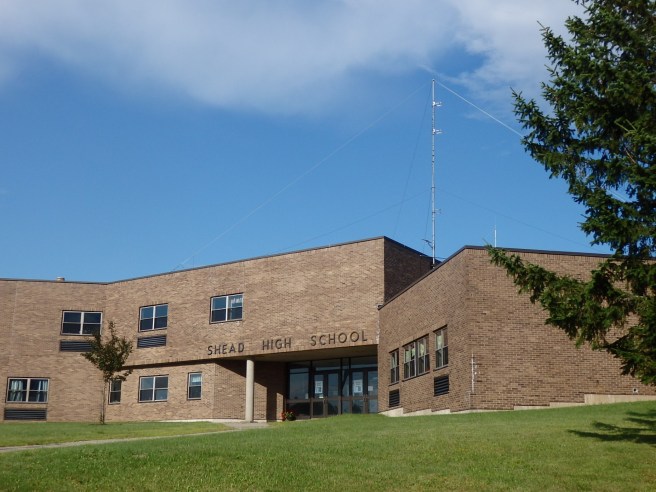
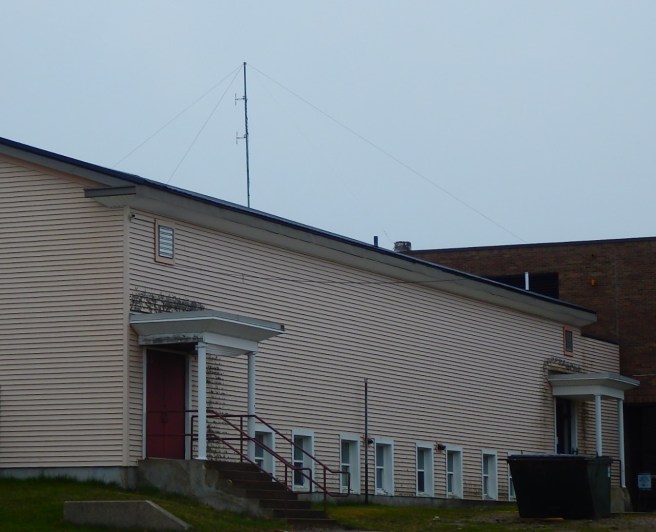
Our local radio station is licensed to the high school. Seriously. And it’s as quirky as KHBR-AM 570 in the legendary TV series “Northern Exposure,” even without Chris Stevens as the DJ. Or I’d contend, even more.
The television show never got into young people, for one thing, but there aren’t many in Sunrise County, where the seven public high schools together have about 200 graduates a year, half of them from just two schools. A private academy adds another 100. It’s a long stretch, by the way.
Pointedly, Eastport’s Shead Memorial High has only about a hundred students, down from 300 a few decades earlier, and a faculty of 11, some of whom also teach at the junior high or elementary. The principal serves all three. The school proudly proclaims its emphasis on personalized education, which I applaud. What’s obvious is the incredible student-faculty ratio.
One big challenge is in trying to find ways to lure more of the younger generation into staying put here. Maybe the economic tide is changing in that direction.
In the meantime, the radio station gives them an opportunity to learn production skills. In fact, the station started out as a school club in 1983 and took off from there. Throughout the day, the station’s IDs feature the different kids, however bashfully, and it’s charming.
Much of the programming is a stream of music, a mix of blues, jazz, rock, country, bluegrass, and more, I’m assuming streamed from somewhere. Yes, and there are public service announcements as well as the honor rolls and other local touches. Truly. And then the DJs kick in, including some of the kids, with surprisingly sophisticated tastes.
They’re not the only ones.
The station’s modest tower sprawls over the high school. Here it’s seen from the front.And from the back, by the gym.
The local demographics skewer sharply upward, and volunteers at the station are welcome. In fact, they create much of its most distinctive programming. As I was saying about do-it-yourself participation?
There’s Cracklin’ Jane, with only 78 rpms, a weekly theme, and radio dramas from a golden age, including commercials for brands that no longer exist. And others like Sam’s Caffeine Café, yes, it’s redundant, but mostly acoustic Americana two mornings a week; the Bass Lady’s informed insights into anything with a bass line, Chloe’s folksy Friday afternoon transition; Firedog’s Electric Doghouse, Boldcoasting; and the like.
Well, this is a town filled with eccentrics and geezers. Its low-power radio station reflects that. And to think, it all started as a school club in the ’80s!
I think of it as Radio Free Eastport, broadcasting to the free spirits on and around our islands.
Come the first touch of chill here, and three-quarters of the population begins to vanish. Those folks quietly pack up and return to their primary residence, as have the many tourists. It rather reminds me of living in a college town, but in reverse.
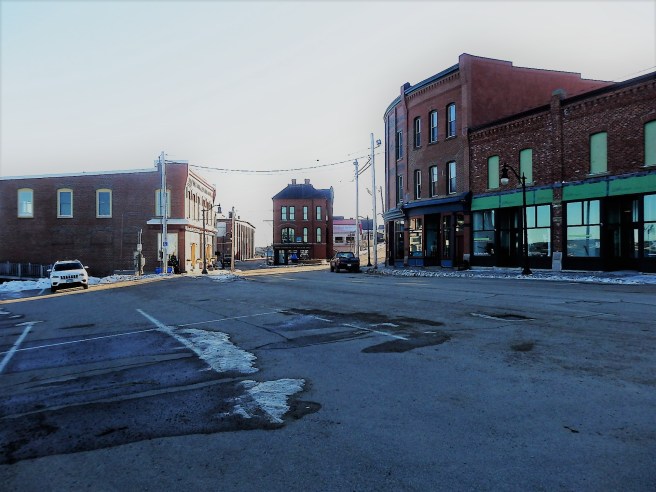
Downtown Eastport in the off-season. The Tides Institute and Museum sits in the old bank building in the center of the scene.
The waterfront and downtown are no longer crowded and festive. Many of the stores, galleries, and eateries are closed up, as are the whale watch, water taxi, and passenger ferry to Lubec. By Halloween, roughly two stores, a diner and a restaurant plus a gallery or two remain open downtown, plus the IGA, two banks, and Family Dollar over on Washington Street.
It makes for a challenging business model, trying to pay the rent and all on a four-month retail prime time. Here the highly watched Black Friday, the make-it-or-break-it financial hurdle of American retailing, doesn’t wait till the day after Thanksgiving but probably hits sometime around the beginning of August.
I have to admire the entrepreneurs who manage it anyway, especially those who stay open through the slim volume of the two-thirds of the year when Eastport’s remote fishing village nature is most prominent.
It also means a lot of do-it-yourself involvement. If you want to see movies, you join the film society. Music? Pitch in with the choir or orchestra. Theater? You guessed it. Dining out? One of the neighboring towns must be having a church supper. Seriously.
And you turn out for others.
Yes, it means more work than just sitting on the sidelines, and with a small population, keeping things going can be a struggle.
But one thing I’ve noticed. It doesn’t take long to be appreciated when you take part.
The region is rife with some stunning instruments and their makers. Start nosing around, and you find them nearly everywhere. For starters, let me mention …
Symphony Hall, Boston: Wish they’d showcase it more in performances but it really looks great.
Busch-Reisinger, Harvard University, Cambridge, Massachusetts: Used by E. Power Biggs to advocate a then-revolutionary awareness of the classic and baroque sounds Bach was grounded in. Many new organs were commissioned with this ideal, while others were “slimmed down,” often ill advisedly.
St. John Methodist/Grace Vision church, Watertown, Massachusetts: A four-manual Aeolian-Skinner instrument that escaped the Biggs’ touch, retaining what’s described as a sweet sound but in need of some serious, costly restoration.
Methuen Memorial Music Hall, Methuen, Massachusetts: Built in 1909 to house the first concert organ in the United States after the instrument had been placed in storage. More than 6,000 pipes in what’s probably the largest hall built solely for an organ.
Memorial Chapel, Harvard University, Cambridge, Massachusetts: Only the best for the best, and they do their best to maintain it. Or them, since the church has several in its space. Used daily, and visitors welcome.
St. John Episcopal, Portsmouth, New Hampshire: An impressive instrument for services, but the tiny Brattle Organ up at the front right of the balcony is believed to be the oldest playable instrument in America. It was rescued from Boston and is said to have a bell-like sound.
Merrill Auditorium, City Hall, Portland, Maine: The Kotschmar Organ built in 1911 by the Austin Organ company was the second largest organ in the world at the time, and it’s still a musical monster, as the ongoing series of concerts demonstrates. Organs were, after all, a mainstay of live entertainment as well as church services.
St. John Methodist, Dover, New Hampshire: The 1875 Hutchings’ instrument was rescued from the old church in 1970 by two Boy Scouts when the congregation moved to a new site and then stored in a barn for 17 years until it was installed in the new sanctuary. The builder also created the first organ for Boston’s Symphony Hall.
Durham Community Church (UCC), Durham, New Hampshire: A lovely two-manual baroque-style instrument, as the local guild of organists proved for a Bach birthday celebration a few years back.
First Parish (UCC), Dover, New Hampshire: A hybrid machine with a classic New England core that’s been augmented several times and now includes electronics. Big sound, as the likes of Cameron Carpenter and Hector Olivera have proved in their appearances as part of an ongoing concert series. The bass notes can really make the whole house shake … notes you feel in your feet and then your ears.
~*~
Not to leave Roman Catholic churches out, let me mention the Casavant instruments built in Quebec and found throughout New England. As an example, when the Shaker Village in Enfield, New Hampshire, was purchased by a monastic order, a Romanesque chapel was inserted into the site and a marvelous Casavant was installed, as I heard on a visit to what’s now mostly a museum.
I also want to mention Houghton Chapel at Wellesley College, Massachusetts, as another fine period instrument, one with hand-powered bellows rather than electrical fan. The bellows fellows sometimes get a bow of their own at the end.
I’m also quite fond of folk music. Here are some concerts at the top of my list.
Peter, Paul, and Mary in Dunn Meadow, Bloomington, Indiana, 1968. Also performing were Phil Ochs, Tom Lehrer, and a raft of others.
Bill Harley and friends at Friends General Conference, Kingston, Rhode Island. The friends included Sally Rogers and Reggie and Kim Harris.
Joan Baez, St. Louis, 1964.
Fiddler Lissa Schneckenburger. She blew us away when she sat in as a teen guest with the contradance band Yankee Ingenuity in Concord, Massachusetts, and later in concert, Rollinsford, New Hampshire, when she also sang.
David Francey at Mill Pond, Durham, New Hampshire. Also on the billing were Bill Staines and bluegrass band Lunch at the Dump.
Pete Seeger in Akron, early ’80s. Charlie King was part of the show.
Peter Blood and Annie Patterson, sometimes just sitting down together after dinner at yearly meeting.
Mike Seeger in a survey of the development of roots styles in America, Bloomington, 1969 or early ’70.
Patty Larkin, Prescott Park, Portsmouth, New Hampshire. Twice.
In the chorus at the Revels equinox concert along the Charles River in Boston, five years, if I’m counting right. It’s impossible to describe the joy of working with Noel Paul Stookey, for sure.
Is the German Romantic opera composer the biggest successful egotist in the history of art? (He couldn’t even compose an effective symphony, yet look, he couldn’t trust anyone else with a libretto, either.)
He was definitely stuck in a Madonna/whore complex regarding women and, more specifically, women within further Roman Catholic entanglements like relics and grails and a sword or spear or two. Where was Freud? Talk about symbolism? It all gets pretty lurid, even before we get to the serious limitations regarding his immortals. I wouldn’t call them gods, exactly, but rather something more like today’s tainted celebrities and political hopefuls. What losers! So badly dressed, at that.
He definitely wouldn’t have gone for today’s fashion supermodels, either. Everything in his world is hefty, leading to some of the most sumptuous music ever. Seems nobody ever asked how he really felt about his mother. Give me some more sumptuous scoring, please.
And yes, he goes way over the top, including the seemingly endlessly boring stretches of boredom.
As Mark Twain said, he’s not nearly as bad as he sounds.
Not that he can apparently help it.
But then, as critic Alex Ross has elaborated, he’s also the foundation of Hollywood, from the plots and scenery all the way up. Think of the thousands involved in each movie and then the music.
For years now, I’ve been explaining opera as the movies of their time. Turns out to be more accurate than I imagined.
In my novel What’s Left, Cassia’s family turns an old church into a hot music center. It seemed like a natural extension from their restaurant.
Where do you go to hear live music?
~*~
Well, when an old church something like this came up for sale next door to their home, how could Cassia’s family resist? They weren’t about to turn it into a parking lot, either.