One of the more baffling things I’m finding in living here is the reluctance of folks in one town to participate in something in a neighboring town, as if they were worlds away.
It’s not just a matter of coming in to the Eastport Arts Center, either, or watching a movie in a little theater in Calais.
Pembroke’s renovated library has been hosting a series of free chantey sings by maritime historian Stephen Sanfilippo, and those would welcome (and do deserve) more participants. His well-researched programs usually include much than work songs, despite the title. A recent one that dug into clams and oysters would be a fine eye-opening example.
The most recent event included an illustrated talk by Susan Sanfilippo, drawing on the town’s historical society’s archives. She discussed ships built along the local tidal banks and then showed images of the resulting vessels as they sat in faraway places like Cuba, China, San Francisco, or Hawaii.
Stephen then used the varied destinations of the Pembroke ships as the basis for songs we all joined in singing later, often including nonsense verses while we looked at slides of the vessels. A calypso, anyone?
I should say it was all delightful and enlightening.
Besides, it was a sampling of what happened all along our Quoddy coast. I could image launchings from Shackford Cove in Eastport that then made similar extraordinary voyages.
Who says there’s nothing to do around here? Please look again and expand your horizon.
As we came together in a shared physical space after Covid, we continued to wear masks as a safeguard against resurgences of the virus. Choirs were, after all, a major source of contamination.
We even gave several concerts donned in special masks that gave us extra breathing room. But they did muffle our sound and diction while also fogging our glasses.
What a relief, then, when our director agreed about a month before our last set of concerts that we could go without the masks, if we individually desired.
What a difference it made! We were clearer in tone and lyrics, and our sound projected better. Our ability to hear each other also improved. It was like being unshackled.
It was like declaring the pandemic over, though we knew the virus was lingering.
What single move gave you that ah-hah! Breakthrough as we came out of the Covid onslaught?
Last weekend the Passamaquoddy Bay Symphony Orchestra ended its run on a wild note. Our 30-some member ensemble tackled Hector Berlioz’ sprawling, opium-inspired Symphonie Fantastique in a program that also included a world premiere and a Mozart piano concerto.
It was, as usual, a daring combination.
Our sprawling county has a tad over 30,000 residents, many of them seniors, mirrored by a similar demographic in neighboring Canada. And you’re going to draw sufficient skilled musicians from that as well as a supportive audience?
Yet that’s basically what happened.
The amateur band, augmented by professional freelance “ringers,” has largely been an extension of Norwegian virtuoso violinist Trond Saevurud, its highly-charged conductor. What we’ve enjoyed are bracingly refreshing performances where impulsiveness and driving passion overcome any shortcomings in perfection or “the” definitive interpretation. It’s vibrant music-making and thrilling.
But now, after a dozen years at the helm and as the orchestra’s godfather, he’s stepping down to spend more time back home in Scandinavia.
Add to that the lingering impact of Covid, which has impaired all the performing arts. Here, the border closing cut off players and supporters on the Canadian side of the line. So much for the slogan “two countries, one orchestra.” Some musicians refused to be vaccinated and instead declined rehearsals and performances. Some concertgoers avoided live events in the intimate spaces the ensemble called home. It hurt.
A resurgence of local virus outbreaks canceled two of the three performances of a recent set of concerts, and that undoubtedly hit the finances hard. (I really was looking forward to Tchaikovsky’s first symphony, which I’ve never heard live, unlike a dozen or so renditions of his last, but I couldn’t make the remaining slot.)
That leads the PBSO to a crisis. Officially, the full ensemble is going into hiatus. Perhaps the organization can regroup, rebuild, attract a new music director, perhaps redefine itself and its mission. More likely, it will dissolve.
Locally, it’s also emblematic of how fragile our communities are. Sunrise County has high poverty levels. We’re don’t have deep pockets, either, the kind based on global conglomerate headquarters or old money. Fewer people are available for public service, especially as volunteers on city councils, school committees, town select boards, or the like.
Churches, too, are stretched thin.
You can no doubt think of many other civic interactions where you live, too.
What would you look for in moving to a new community? It’s an interesting mental exercise, even if you’re staying in place.
What we’re seeing when we look at Eastport is the reality of how ephemeral much of what its attraction for us remains. Quite simply, people are a big part of what makes this place so special, and most of the population here skewers toward the gray end of the scale. Who’s in the wings to step up when they move on?
Our young director of Stage East, Mark Macey, for instance, is heading off to London on the theater fellowship. It puts a dent in the scene.
For me, having a Quaker Meeting is a central factor. Ours is small, older, and spread over a wide geographic area. It’s precious while it lasts.
And, as you’ve seen on this blog, natural wonder in the outdoors is important.
Let me add to that music, usually especially in a classical vein. Eastport is especially blessed on that front.
For example, before I had even met John Newell, his influence became a swing factor in my moving to Eastport. Other family members were already on board for relocating, but I was less ready to uproot, no matter the natural wonder of the place. But then, during a visit, I saw a poster for an upcoming Quoddy Voices concert and sensed this was no ordinary community chorus. Its repertoire was much like the one where I was singing in Boston – except that we didn’t yet have a piece in Chinese. Mandarin? (Which our conductor there did speak.) I also appreciate the fact the Down East ensemble is not auditioned and was told, at a small store downtown, that they’d likely really welcome another male voice. (Whew! I can’t imagine auditioning, only the fright.)
Flash ahead to actually living up here.
During the Covid lockdown, I joined the ensemble as it continued to rehearse via Zoom. At least it kept us in shape, and I did see how much fun everyone had together. But how would we sound when the time came?
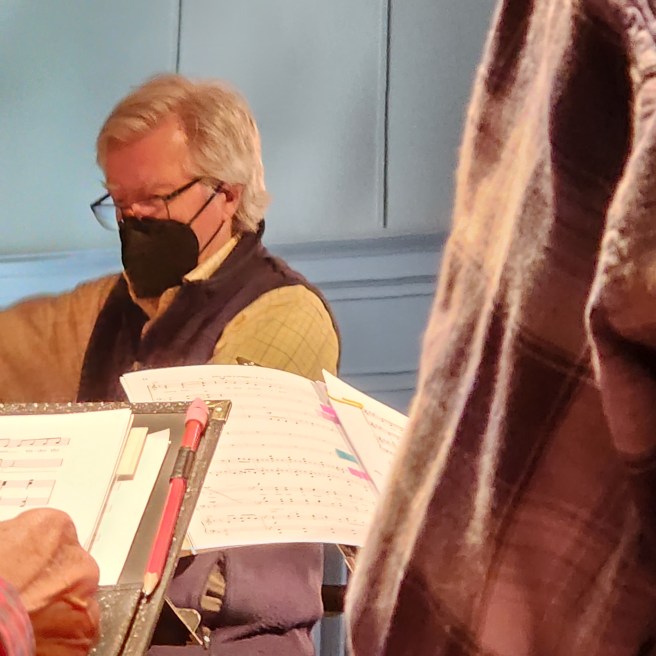
Here’s a surreptitious shot of John Newell rehearsing Quoddy Voices. We were so grateful the masks came off most of us for the actual concerts.
Quite simply, at our first in-person rehearsal post-Covid, I knew from the first two chords out of our mouths in warmup that this was home. After my first concert with the group, I especially appreciated an aside from another bass-section member, “We’re so happy to have you,” or something to that effect. It’s a much smaller chorus than my previous one, and thus more demanding.
Quoddy Voices is, of course, John’s dream and labor of love. Like my previous directors, he’s meticulous yet patient, a published composer, an excellent keyboardist, a clean conductor, and someone with fine senses of humor and delight who also genuinely cares about his singers and colleagues. (George Emlen and Megan Henderson deserve posts of their own. Note to self.)
How perfect!
But, after ten years at the helm of the chorus, he and his wife are relocating to be closer to family for much of the year.
One thing about singing together is the personal warmth people often develop. The right director can be especially admired, for many good reasons.
John will be missed, of course, and warmly remembered. Many thanks to him for all he’s given to us and the wider community.
If you want to see more of our feelings, visit the Eastport Arts Center’s Facebook site.
We do hope he’ll be back often, perhaps even singing under our next director, someone we know is also a Character in his own right.
Meanwhile, from here to September we have a gap in our Monday night schedules.
As I’ve previously noted, the work songs went into the woods in the winter, carried by sailors who came ashore for the season. But few songs in return migrated from the forests to the sea.
Women’s names could be a clue to the, uh, moral integrity of many messages. “Sally” or “Nancy,” for instance, some more sterling than others.
Other work songs include chain-gang ditties or even the racist, “Zip-a-dee-doo-dah,” though it might fit what’s become of the minimum-wage American workplace.
As for spellings, I’m sticking with “chantey,” based on a scholarly friend’s insistence the notes having a chanter setting the pace. “Shanty” and “chanty,” though, are more common.
Here are some related facts.
This folk music genre flourished aboard larger merchant vessels of the 19th century as a means of setting a rhythm to optimize joint labor involved in either a pulling or pushing motion, such as lifting anchor or setting sail, tasks that required working together for a long time. Think of circling a capstan. Think “Heave!” Or “Haul!”
That’s why many of them are about whaling.
The tradition soared in the period between the War of 1812 and the Civil War and died out with the arrival of steam-powered ships.
Its roots, though, go way back through earlier work songs around the world, including stevedores loading and unloading ships.
Some of the chanteys originated with African-Americans performing “cotton-screwing” on shore, using a large screw-jack to compress and bale cotton for shipment from Southern ports. Some of the incomprehensible words in the songs are attributed to this.
Essentially, it’s a call-and-response form between the solo chantey man and the work crew.
Sometimes they were accompanied by a bosun’s pipe, fife, drum, or fiddle.
They were sung by pirates, too.
About 200 were set down on paper, but thousands more were likely lost.
Some may have been used when relaxing in the evening.
If you like to sing, even if only in the shower, let me encourage you to check out some of these online.
One of my biggest surprises after getting involved in serious chorus participation after I retired from the newsroom was the importance of the warmups at our rehearsals. I had come to four-part, a cappella singing through Mennonites in my mid-30s, and I had never cottoned up to practicing scales and similar exercises back when I was learning violin as a preteen.
What George Emlen and then Megan Henderson presented in our first 15 minutes or so of rehearsal each week with Boston Revels totally changed my attitude. A good warmup not only added a few notes to my range but also tuned to the entire ensemble into a more, pardon the pun, finely tuned and more responsive instrument. Some of the exercises were definitely fun, laughter filled, as well as challenging. Try singing “Many mumbling mice singing by the moonlight my how nice” repeatedly as the pitch rises and the tempo speeds up, for instance, and soon the sopranos sound like they’re the Chipmunks on laughing gas. Or any of the numbers games.
And then, when Covid interrupted in-person interaction, some online offerings stepped into the void. I’m still finding them very helpful during the week between the rehearsal warmups with my new group, Quoddy Voices, and conductor John Newell.
Here’s a sampling:
Cheryl Porter Vocal Coach. One of my favorites. With her big boxing gloves (seriously) and irresistible if corny enthusiasm, she could as easily be leading a housewives’ weight-control calisthenics round. But her exercises are heavy-hitting, well-grounded, and even dance inducing. Suitable for group singers and those looking to solo alike. Diss her at your own risk.
Nathan Dame. Great perspectives from an outstanding Wylie East (Texas) public high school music educator. This is an example of why music can be a crucial part of a well-rounded curriculum. Dame pours so much energy into his adolescent choruses, I’m left wondering how he recovers at the end of the day. The kids clearly rise to his challenges and respect them. Many of his insightful techniques, meanwhile, seem to arise somewhere within him rather than from a textbook or standing tradition. And you can practice alongside them.
Roger Hale. Solid college-level sessions for both actors and singers, grounded in classical perspectives with his Dixie State University students.
Madeleine Harvey. Her video series relies on the fundamentals of traditional vocal training, things like breathing, breath control, tone, range top and bottom, pitch, agility, and avoiding strain. These are the kind of sessions a singer encounters with a personal professional vocal coach.
Eric Arceneaux, Professional Vocal Warmup. His technical understanding of the voice extends to many popular music styles. Makes snobby me appreciate the abilities of some top-selling singers, too.
Matthew Gawronski Just follow the notes on the screen. Some versions include a full choir to sing along with.
Church Music Dublin with Mark Duley. Practical, everyday stuff. He’s one leader who finds physical movement with the hands and arms or more can improve the sound. I was skeptical at first. Not so now.
Tony Leach with the Collaborative Music Education series from Pennsylvania State University. Professor Leach adds rote training in the African and African-American traditions to his excellent classical discipline. You’ll definitely get a sense of what makes Gospel such a focused genre to perform. I just wish the videos included his student choruses so that you’d get a feel of singing with others.
Paul McKay One Voice. Not all of the warmups are for folks who read musical scores. McKay’s especially fine for explaining the inner working of things like riffs and runs and other techniques that greatly extend today’s vocal expression.
Cincinnati Youth Choir. Don’t scoff at some of the children’s choirs. Their energy, clarity, and precision can be contagious. Just listen to the CYC’s video of “One voice” for proof. Besides, they can humble some of the rest of us.
Of course, if you start with these, you’ll quickly discover a host of great concerts and conductors as well. Beware.
One of the subtle changes in the world of high culture in my lifetime has been the widespread acceptance of women as both conductors and classical composers.
Long seen as a bastion of Dead White Males, almost exclusively Europeans, the musical bias was deeply engrained. Few of the world’s leading orchestras even had women in their ranks, much less on their programs or as regular guest soloists. That snobbery, by the way, also excluded American conductors and composers, and people of color in general, across the board in the Old World and the New.
When the gender line began to bend, the first women composers to gain significant attention, as far as I remember, were Felix Mendelsohn’s sister, Fanny, and Robert Schumann’s wife, Clara.
More recently, Amy Cheney Beach has come to the fore. New Hampshire-born and then proper Boston society, she was largely self-taught, a piano virtuoso whose hefty piano concerto and symphony are both personal favorites. Her keyboard works have justifiably gained advocates, and a comprehensive retrospective at the University of New Hampshire marking the 150th anniversary of her birth was a revelation. Some of her gorgeous chamber works, moving into a more Impressionistic vein, actually moved me to tears listening in live performance.
Today, talented women composers are showing up everywhere, even winning major prizes like the Pulitzer. Quite simply, it’s hard to keep up.
~*~
Similar advances are being seen on the podium, led by Americans.
Pioneered in the ‘60s and beyond by Sarah Caldwell at her Opera Company of Boston and Margaret Hillis at the Chicago Symphony Chorus, early conductors of note also included Judith Somogi with opera and orchestral roles across the U.S. and then Europe, Eve Queller at her Opera Orchestra of New York, and Fiora Contino, who I remember from opera productions at Indiana University.
Later, as innovative major symphony music directors, we’ve been blessed with Joanne Faletta at the resurrected Buffalo Philharmonic and Marin Alsop in Baltimore.
It’s all opened the doors for a slew of younger conductors who are moving up the ranks and in the running for major positions like heading the Los Angeles Philharmonic, now that Gustavo Dudamel will be moving on to Gotham.
Looking at the 18 conductors being heard on live Metropolitan Opera broadcasts this season, I see four are women, one twice, something that would have been unimaginable at such a conservative institution only a decade ago.
Do note the trend, then. Anyone else find it exciting?
Here’s a shoutout to our monthly open stage at the Eastport Arts Center at 6 tonight or, if the weather’s bad, the same time tomorrow.
It’s always a lot of fun, alternating live music and spoken word. I even tried a section from Quaking Dover last month, instead of poetry or fiction, and some found my reading emotionally moving. I did bill the genre as creative non-fiction rather than history. Well, there are no footnotes and I’ve focused on the overall story and people more than mere names and dates. The reaction has me looking at additional opportunities for presenting the work.
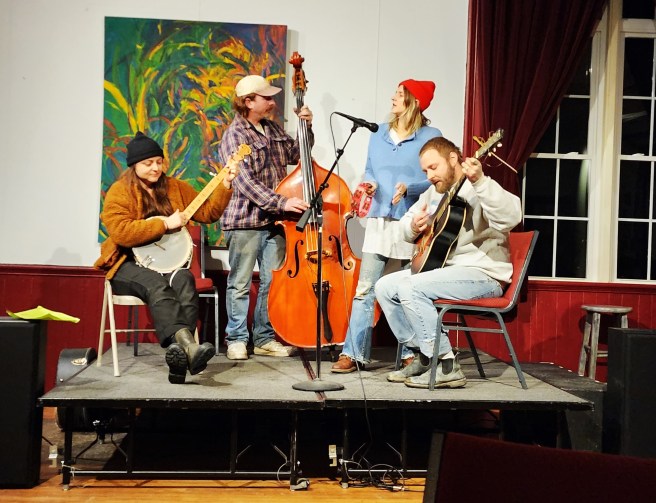
Here’s one band that showed up, and I’m hoping they’re back. They do look quintessentially Maine, and you can imagine their joyful sound.
The free event’s billed as “open mic” but I’ve long hated that spelling of “mike,” even if it’s become too widespread to counter.
Still, we had a fine turnout and went an hour longer than planned. I’d be really surprised if you wouldn’t be wowed by at least something. There’s so much talent around here.
So much of the classical music scene focuses on revisiting a core repertoire of masterpieces and their composers. Ideally, that leads to deeper understandings and discoveries within the most inspired scores, although superficial repetition and familiarity are more common. Even so, it is exciting when new faces are admitted into that circle. Within my own lifetime I’ve seen that happen with Mahler and Vivaldi, as well as to a lesser extent with Charles Ives.
Adding to the excitement is the reality that the repertoire is no longer exclusively dead white (European) males.
Americans, north and south, are gaining recognition after having long been excluded, though it should be much more. From a more global selection, so are women and people of color.
Sometimes, a composer can embody all three, as is the case for Florence Price (1887-1953). A substantial portion of her surviving work, discovered and recovered in 2009 in her abandoned summer home, is only now gaining an airing and a growing admiration. This Little Rock, Arkansas, native was, it turns out, the first Black American woman to have a symphony performed by a major orchestra – Chicago – and her style has a lightness that blends her own roots, the America of her time, and classical expectations. As a choral singer, I can attest to her unique touch underpinning the scores we’ve performed.
Among other Black composers finally gaining overdue attention, let me mention:
Julius Eastman (1940-1990), an eclectic, genre-crossing American trailblazer whose tragic life included seeing his own works largely scattered to the wind when he was evicted from his apartment and officials threw his possessions out into the street. What remains of this Curtis-trained original is well worth exploring in its large, provocative vision of time, space, classical, jazz, pop, politics, sex, and utter wonder.
Edmond Dede (1827-1903), a New Orleans-born Creole who lived much of his life in France as a successful pianist, conductor, and composer. If he sounds a bit like toe-tapping John Phillip Sousa, remember he came along a generation earlier. He emerged from a lively scene of free Black classical musicians in New Orleans who even had their own symphony orchestras. As far as serious music in America goes, only New York seems to have had more going on in the years before the American Civil War. Don’t overlook this when you’re thinking of the origins of jazz, either.
Joseph Bologne, Chevalier de Saint-Georges (1745-1799), is remembered as a man of many talents in Paris, including his abilities as a fencer and as the French Mozart. Among his many achievements are commissioning and premiering Haydn for what are known as the Paris symphonies. For his own work, I’d start with his 14 violin concertos, especially as championed by soloists Randall Goosby or Rachel Barton Pine.
The one who excites me the most is Vicente Lusitano (roughly 1520 to sometime after 1561). He was the first Black to have his music printed, along with some crucial musical theory texts. A Portuguese-born priest and musician, his sonorous choral pieces are said to equal Palestrina’s. I’d agree with that. After some intense rivalry in Rome, he turned Protestant, married, and moved to Germany, where he disappeared. The little we know of him still redefines the history of Black composers as existing all the way back to the high Renaissance rather than being much more recent and marginal. Oh, my, I am hoping my choir will soon be attempting something of his, no matter the challenge.
~*~
While that’s a sampling of Black masters from the past, a lot is happening now, too. Two living composers of special note I’ll mention are Jessie Montgomery and Terence Blanchard.

 Jnana's Red Barn