One musician admiring another

a bass in the Balkan choir has a low C securely
or lower depending on the day, so he admits

what he’s hitting today is three steps below
my best rumble
with luck
or even two, on good fortune

the singers warm up on a modal scale
those two telling flats against a major
rehearse in three locations across the state
and come together at events like the one I’m at

and then dance, in lines not quite Greek

Charles Ives saw music ‘as the lens through which we can glimpse the divine’

For him, that also shook up the universe.

The 150th anniversary of the birth of the American maverick takes place Sunday, the 20th, and despite his relative obscurity, he was a giant as an uncompromising modernist classical composer and as an innovative executive in the insurance industry.

Born in Connecticut and a graduate of Yale, Charles Ives’ musical transformation was certainly one of the most extraordinary cases in history, made all the more remarkable by the fact that he was forced to compose largely without hearing many of his adventurous works played by an orchestra or soloists until a half-century or more after their composition. Even the sonatas, songs, and chamber music suffered from widespread neglect.

As a matter of confession, I am quite fond of his music, from the wonderfully rich late-Romantic scores of his youth to the craggy, thorny modernist fireworks of only a few years later. I am among those who feel scandalized by the fact that this season orchestras aren’t playing even one of his symphonies in celebration, much less all four. Two of them did win Pulitzers, by the way, once they were finally aired, and riotous cheers often break out at the conclusion when the works are performed.

For a biographical overview of this American original, turn to my post, “Thoughts while listening to Charles Ives,” of November 5, 2013, at my blog, Chicken Farmer I still love you.

Today, I’m offering a Double Tendrils. Let’s start with ten quotations about music.

  1. You goddamn sissy… when you hear strong masculine music like this, get up and use your ears like a man.
  2. It is more important to keep the horse going hard than to always play the exact notes.
  3. Please don’t try to make things nice! All the wrong notes are right. Just copy as I have – I want it that way.
  4. In “thinking up” music, I usually have some kind of a brass band with wings on it in back of my mind.
  5. The possibilities of percussion sounds, I believe, have never been fully realized.
  6. There is more to a piece of music than meets the ear.
  7. Music is the art of thinking with sounds.
  8. Beauty in music is too often confused with something that lets the ears lie back in an easy chair. Many sounds that we are used to do not bother us, and for that reason we are inclined to call them beautiful. Frequently, when a new or unfamiliar work is accepted as beautiful on its first hearing, its fundamental quality is one that tends to put the mind to sleep.
  9. The beauty of music is that it can touch the depths of our souls without saying a single word.
  10. Good music is not just heard; it is felt with every fiber of our being.

~*~

And here are ten Ives quotes about life itself.

  1. The word “beauty” is as easy to use as the word “degenerate.” Both come in handy when one does or does not agree with you.
  2. An apparent confusion, if lived with long enough, may become orderly … A rare experience of a moment at daybreak, when something in nature seems to reveal all consciousness, cannot be explained at noon. Yet it is part of the day’s unity.
  3. Awards are merely the badges of mediocrity.
  4. Every great inspiration is but an experiment – though every experiment, we know, is not a great inspiration.
  5. Expression, to a great extent, is a matter of terms, and terms are anyone’s. The meaning of “God” may have a billion interpretations if there be that many souls in the world.
  6. You cannot set art off in a corner and hope for it to have vitality, reality, and substance.
  7. The fabric of existence weaves itself whole.
  8. Vagueness is at times an indication of nearness to a perfect truth.
  9. The humblest artist will not find true humility in aiming low — he must never be timid or afraid of trying to express that which he feels is far above his power to express, any more than he should be in breaking away, when necessary, from easy first sounds, or afraid of admitting that those half-truths the come to him at rare intervals, are half-true; for instance, that all art galleries contain masterpieces, which are nothing more than a history of art’s beautiful mistakes.
  10. Most of the forward movements of life in general … have been the work of essentially religiously-minded people.

Balkan voices

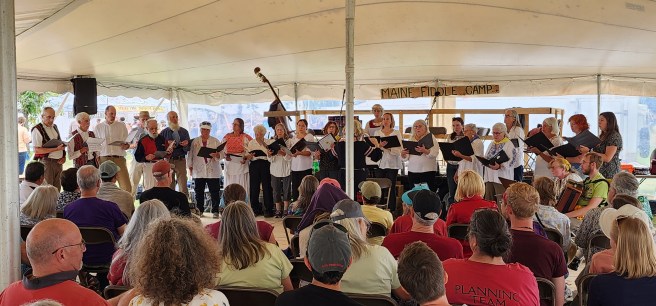
Eastern European music features low bass notes prominently. I listened to this group with envy. They were doing an all-Ukraine program.

The Maine Balkan Choir international music and dance ensemble performs at the annual Common Ground Fair during hour-long breaks in the big contradance tent. The choir rehearses in three subgroups across the state and then comes together for events like this.

Their closest location to me is Ellsworth, two -and-a-half hours away.

How to really play a Strauss waltz

Most conductors try to make it melodious and strictly in time, constrained by starched shirts and gowns. Seated audiences typically go for that tuneful approach, not that humming along is approved.

What I find more compelling and exciting, though, is when the performance is filled with bubbles, like champagne, and a tad tipsy. One dance partner stepping on the other’s toes. Even better, when there’s some tension between, say, the brass and the strings, with a hint of freedom within the beats, the way one dance partner is a hair ahead or behind the other. Yeah, a little swing, if you will. And a little playful unpredictability.

Well, here we go, in the air approaching another new year.

Hodie, hodie!

My choir has been singing a joyous Renaissance piece that translates, in Allen M. Simon’s rendering, as:

Today Christ is born:
Today the Savior appeared:
Today on Earth the Angels sing,
Archangels rejoice:
Today the righteous rejoice, saying:
Glory to God in the highest.
Alleluia.

I first heard it in the second classical concert I ever attended, around age 12, with the velvety Roger Wagner Chorale on tour. Never, ever, did I imagine I’d be part of presenting it myself.

Still blows me away, all around.

In all of the holiday festivities

In the colonial era, neither the Congregationalists/Puritans at First Parish nor the Quakers/Friends observed Christmas.

So much for singing festive carols or decorating a tree.

The Friends didn’t sing at all, actually, unless it was somehow spontaneous.

At First Parish, meanwhile, a bass viol was introduced in the 1700s to accompany the hymns.

That gave way in 1829 to an organ built by Bostonian William M. Goodrich. In 1878, the instrument was rebuilt and repositioned by Hutchings-Plaisted of Boston, with alterations in subsequent years.

In 1995, a thoroughly revised instrument was unveiled, the work of Biddeford, Maine, Faucher Organ company. A hybrid of the original pipes and of newer electronic and computer elements, it’s a monster machine capable of rattling the house and shaking the bottoms of your feet.

I am glad we simple Quakers don’t have to pay for its routine maintenance, though I am grateful for those who do.

Not bad for holiday festivities, including accompanying a community-wide Messiah sing.

It’s not the only option in town, either. For some, those carols have to wait till the end of Advent, when the Twelve Days begin.

And, for the record, the Greek Orthodox start celebrating Christmas 12 days later.

A shoutout some outstanding vocal ensembles

With the holidays just ahead, we’re coming up on the prime choral season of the year.

Look around, and there are many outstanding groups, not just the big, famed organizations in the footsteps of conductors Robert Shaw, Roger Wagner, Margaret Hillis, or John Oliver, either.

Hit on some of these on YouTube or Vimeo and let me hear what you think.

  1. Old Order Mennonite Harmonia Sacra. Let’s start from an old American shape-note tradition of harmony. Singing from the 1832 hymnal compiled by Joseph Funk in the Shenandoah Valley of Virginia, this video will likely lead you to others in this unique stream, including the Shenandoah Christian Music Camp. I’m inclined to sing along, using some much later Mennonite hymnals. Imagine an entire congregation singing parts like this, and many do. Eventually, it may even lead you to the unique Sacred Harp style. If you want to talk about American roots, don’t overlook this. I’m forever indebted to my exposure in this vein. So where do we turn from here? How about something completely different in the religious vein:
  2. Detroit Mass Choir. This large, tightly disciplined urban body runs flawlessly, turning on a dime when director Jimmy Dowell spontaneously decides to repeat a phrase or section or even jump back several parts or similarly ahead. Their take on Charles Tindley’s 1905 “The storm is passing over” is outstanding. Yeah, it’s one more place where stony unemotional me gets teary. That confessed, don’t overlook the instrumentalists, either. And I, for one, do appreciate the audience support throughout, something my mother would have considered interruptive and rude.
  3. Jehovah Shalom Acapella. And you thought the King’s Singers or Cambridge Singers epitomized the small, elite, all-male a cappella field? This six-member Ugandan Gospel group, members of the Seventh-day Adventist faith, delivers with an unbelievably smooth pop style. Where, by the way, do they find such an incredibly deep bass? Now, if we only knew how they’d handle Handel, Bach, and Mozart as well, we might have even more cause for amazement. By the way, we’ve also delighted in live performances by athletic Ladysmith Black Mambazo.
  4. Central Washington University chamber choir. Within a higher education state institution in tiny Ellensburg, well east of the Cascade Range and Seattle, there’s long been an outstanding fine arts program. In such situations, a few good teachers can make a lasting impression. (I hate to think of the destructive obverse.) Under the direction of Gary Weidenaar in works by contemporary Ola Gjeilo or Renaissance master Tomas Luis da Victoria , these student singers reflect, I feel, the high standards found in many other pockets across America – and not just its great conservatories and leading music schools. Returning to the shape-note tradition:
  5. Amherst Madrigals. In William Billings’ “Euroclydon,” a distinctive masterpiece, these ten singers blow me away. It’s a very demanding piece, after “all. And they present it so clearly, with no conductor in sight! For further confirmation, listen to what they do his “I am come into my garden.” Or, for pure polyphony, move onto another group for this:
  6. Indiana University’s Conductor’s Chorus. Their master’s of music performance of Palestrina’s “Sicut cervus” for conductor Daam Beam Kim in 2016 is unbeatable. After seemingly endless rehearsals and a few public performances of this choral masterpiece, I can’t imagine anything more ethereally sublime than this. Period. Even as an IU grad.
  7. Saint Olaf College Choir. This Minnesota Lutheran institution makes some incredible music. The diction in their videos and recordings leaves me envious, and their annual Christmas broadcast is understandably anticipated and admired. Still, compare their rendering of William Billings’ “What wondrous love is this” to one led by Ukrainian conductor Yuriy Kravets and the Shenandoah Christian Music Camp orchestra and choir, previously noted. Both are deeply moving.
  8. Luther College. Set along the upper Mississippi River in Decorah, Iowa, this church institution also has a superb musical program. Just listen to what its Nordic Choir can do. I’m even more impressed when I notice they sing their parts from memory and then their ease in navigating dynamics. Oh, my, that soon leads to a Baton Rouge high school performance that definitely stands out. Yes, high school.
  9. Quoddy Voices. My current chorus is an amazing group in a small remote fishing village with an active arts scene in easternmost Maine. Still, we would really welcome some younger voices. During the Covid restrictions, director John Newell put together some remarkable virtual presentations online, despite the fact we were recording individually under some highly unfavorable conditions. Now that we’re back face-to-face, I’m also delighted and humbled to be part of this circle and its stellar leadership.   
  10. Boston Revels. A unique half-century-old organization that blends history, folk traditions and classical music, dance, plus theatrical acting and story line, I have to admit a bias in being part of the organization though not its justly celebrated annual winter holidays extravaganza. Each year’s Christmas show ends with the entire audience joining in, in full harmony, on the Sussex Mummers’ Carol, inevitably drawing tears from me and, I suspect, most others in the packed and wildly cheering Sanders Theater at Harvard. As a charter member of its community chorus, I do confess this family custom is one thing I do miss in relocating to Way Downeast Maine. Thanks for the memories, all the same.