Recalling an obscure West Coast vinyl record operation

Its albums stood apart from many of the others I borrowed from Dayton’s public library, with its fine record collection and its guardian.

Contemporary Records was the name of the company, founded in Los Angeles in 1951 by Lester Koenig and soon a leading advocate of what became known as West Coast jazz, including Chet Baker, Shelly Manne, Art Pepper, Sonny Rollins, Bud Shank, and Andre Previn. It was even the first jazz label to record in stereo.

It also ventured into classical, including guitarist Pepe Romero, perhaps joined later by his brothers and father, all of whom soon became famous.

The company also offered a Good Time Jazz label focusing on Dixieland, plus the Society for Forgotten Music in a classical vein, and a contemporary composers’ series.

I had thought one of its founders was American songbook master Vernon Duke – aka Vladimir Dukelsky, his Ukrainian name, used for his 12-tone pieces – but I seem to be wrong. I vaguely recall that one of the disks presented his work as played by the Hollywood String Quartet, but find no support for that now, either.

I have no idea what brought all of this to mind, all these years later. What I am seeing now is how easily so much falls into oblivion.

Upbeat in more ones than one

He plays everything. Even automobile hubcaps. And he’s a fine tenor, as we discovered one spring. Even a devilish composer, shown by his setting of a Longfellow poem we tackled under his direction.

He has a discerning ear, fine sense of humor, and rocks as well as Renaissance. He’s also a clean conductor, with supporting gestures, even when he’s playing ukelele on the podium.

Our Mister Music, or Music Man, as Gene Nichols is known in Washington County, Maine, and beyond. Director of Quoddy Voices.

I’m still not quite sure was his center of gravity is, but his orbit is quite wide.

One musician admiring another

a bass in the Balkan choir has a low C securely
or lower depending on the day, so he admits

what he’s hitting today is three steps below
my best rumble
with luck
or even two, on good fortune

the singers warm up on a modal scale
those two telling flats against a major
rehearse in three locations across the state
and come together at events like the one I’m at

and then dance, in lines not quite Greek

Charles Ives saw music ‘as the lens through which we can glimpse the divine’

For him, that also shook up the universe.

The 150th anniversary of the birth of the American maverick takes place Sunday, the 20th, and despite his relative obscurity, he was a giant as an uncompromising modernist classical composer and as an innovative executive in the insurance industry.

Born in Connecticut and a graduate of Yale, Charles Ives’ musical transformation was certainly one of the most extraordinary cases in history, made all the more remarkable by the fact that he was forced to compose largely without hearing many of his adventurous works played by an orchestra or soloists until a half-century or more after their composition. Even the sonatas, songs, and chamber music suffered from widespread neglect.

As a matter of confession, I am quite fond of his music, from the wonderfully rich late-Romantic scores of his youth to the craggy, thorny modernist fireworks of only a few years later. I am among those who feel scandalized by the fact that this season orchestras aren’t playing even one of his symphonies in celebration, much less all four. Two of them did win Pulitzers, by the way, once they were finally aired, and riotous cheers often break out at the conclusion when the works are performed.

For a biographical overview of this American original, turn to my post, “Thoughts while listening to Charles Ives,” of November 5, 2013, at my blog, Chicken Farmer I still love you.

Today, I’m offering a Double Tendrils. Let’s start with ten quotations about music.

  1. You goddamn sissy… when you hear strong masculine music like this, get up and use your ears like a man.
  2. It is more important to keep the horse going hard than to always play the exact notes.
  3. Please don’t try to make things nice! All the wrong notes are right. Just copy as I have – I want it that way.
  4. In “thinking up” music, I usually have some kind of a brass band with wings on it in back of my mind.
  5. The possibilities of percussion sounds, I believe, have never been fully realized.
  6. There is more to a piece of music than meets the ear.
  7. Music is the art of thinking with sounds.
  8. Beauty in music is too often confused with something that lets the ears lie back in an easy chair. Many sounds that we are used to do not bother us, and for that reason we are inclined to call them beautiful. Frequently, when a new or unfamiliar work is accepted as beautiful on its first hearing, its fundamental quality is one that tends to put the mind to sleep.
  9. The beauty of music is that it can touch the depths of our souls without saying a single word.
  10. Good music is not just heard; it is felt with every fiber of our being.

~*~

And here are ten Ives quotes about life itself.

  1. The word “beauty” is as easy to use as the word “degenerate.” Both come in handy when one does or does not agree with you.
  2. An apparent confusion, if lived with long enough, may become orderly … A rare experience of a moment at daybreak, when something in nature seems to reveal all consciousness, cannot be explained at noon. Yet it is part of the day’s unity.
  3. Awards are merely the badges of mediocrity.
  4. Every great inspiration is but an experiment – though every experiment, we know, is not a great inspiration.
  5. Expression, to a great extent, is a matter of terms, and terms are anyone’s. The meaning of “God” may have a billion interpretations if there be that many souls in the world.
  6. You cannot set art off in a corner and hope for it to have vitality, reality, and substance.
  7. The fabric of existence weaves itself whole.
  8. Vagueness is at times an indication of nearness to a perfect truth.
  9. The humblest artist will not find true humility in aiming low — he must never be timid or afraid of trying to express that which he feels is far above his power to express, any more than he should be in breaking away, when necessary, from easy first sounds, or afraid of admitting that those half-truths the come to him at rare intervals, are half-true; for instance, that all art galleries contain masterpieces, which are nothing more than a history of art’s beautiful mistakes.
  10. Most of the forward movements of life in general … have been the work of essentially religiously-minded people.

Balkan voices

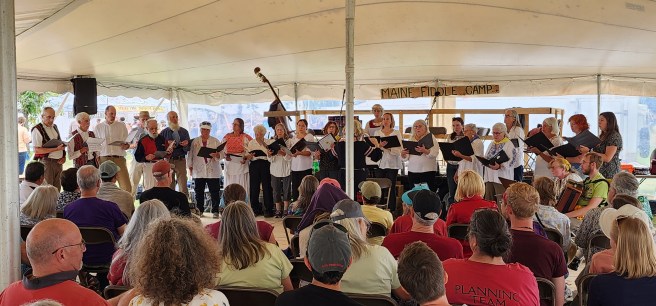
Eastern European music features low bass notes prominently. I listened to this group with envy. They were doing an all-Ukraine program.

The Maine Balkan Choir international music and dance ensemble performs at the annual Common Ground Fair during hour-long breaks in the big contradance tent. The choir rehearses in three subgroups across the state and then comes together for events like this.

Their closest location to me is Ellsworth, two -and-a-half hours away.

How to really play a Strauss waltz

Most conductors try to make it melodious and strictly in time, constrained by starched shirts and gowns. Seated audiences typically go for that tuneful approach, not that humming along is approved.

What I find more compelling and exciting, though, is when the performance is filled with bubbles, like champagne, and a tad tipsy. One dance partner stepping on the other’s toes. Even better, when there’s some tension between, say, the brass and the strings, with a hint of freedom within the beats, the way one dance partner is a hair ahead or behind the other. Yeah, a little swing, if you will. And a little playful unpredictability.

Well, here we go, in the air approaching another new year.