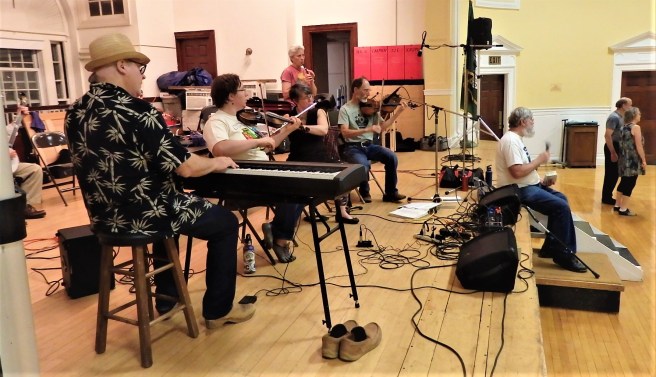
Lamprey River Band
You never know what we'll churn up in cleaning a stall
Boston Revels is an organization – maybe I should say institution – devoted to keeping community tradition alive through music, storytelling, dance, and the like. It has affiliates in nine other cities.
Here are 10 examples of its activity:
~*~
What’s one of your own special group activities?
~*~

In my new novel, What’s Left, her aunt Yin has her helping book rock bands rather than working in the restaurant. For Cassia, it’s a welcome break. She can be cool and hang with her cousin Sakis’ scene.
While her mother’s a skilled violinist, Cassia herself is not a musician. In one explanation that didn’t make it to the final revision, she explains:
When it came to music, I wanted to play drums but was shunted to piano, which I hated. It just wasn’t me.
~*~
Are you part of a band? Do you sing in a choir? Play an instrument? Was there one you wanted to study but told otherwise? Do you sympathize with Cassia here?
~*~

Okay, I know churches don’t have podiums for their music directors, but Rick Gremlitz at First Parish Church (UCC) in our town does conduct with a short white baton. What’s amazing is that he’s been doing this, in that venue, for a half century.
Among other things, the house of worship – serving the oldest congregation in the state – has its Belknap concert series where world-renowned organists perform on a remarkable hybrid organ. Parts of it are historic, as it Hastings and Hutchins, and part are state-of-the-art electronics, probably installed during Rick’s tenure. Any doubts in my mind about the sound itself vanished when bete-noir Cameron Carpenter did one unforgettable, amazing workout on the machine one afternoon a few years ago. It survived. The audience was left in a swoon.
Look, I’m a purist and lean toward the E. Power Biggs line of thinking that contrasts sharply with the Virgil Fox excesses that Rick adores. He addresses the man as the great Virgil Fox. I forgive him. We all have our icons.
So be it.
In his ministry, Rick’s led a number of Handel Messiah performances in the sanctuary. Last year it became an open sing with prepared soloists and two guest conductors. Seated between two seasoned voices, I discovered that the choruses are easier than they sound, not that I was anywhere near perfect. It was a most exhilarating event.
Today, though, Rick’s acclaimed friend Hector Olivera returns to the console, with a twist.
An ecumenical community choir, including yours truly, has been rehearsing to join in the performance.
We’ll be performing the world premiere of an anthem composed by Kevin Siegfried for the occasion, and we’ve been rehearsing weekly since mid-September at the Methodist church. How can you possibly keep something like this a surprise?
We’ll see. It’s still a special occasion. And, I might add, one of the joys of living in a relatively small community.
I’m hoping it comes off well. Especially if I don’t miss a cue while we’re singing.
Dover Friends Meeting where I worship is the fifth oldest congregation in the state – and the first that was not part of the governmentally sponsored parishes that are now affiliated with today’s United Church of Christ.
Our meetinghouse – the third we’ve had, in fact – is the oldest house of worship in the city, and this year marks the 250th anniversary of its construction.
It went up on a single day in 1768, much like an Amish barn raising in our own time. There were likely 150 men and boys at work on the construction itself, plus an equal number of women and girls preparing food and the like.
To commemorate the occasion, we’re holding an open house at 2 p.m. There will be tours, a reading of John Greenleaf Whittier’s “How the Quaker Women Came to Dover” (his parents were married in the meetinghouse), presentations of activities we’re involved in, light refreshments and conversation, and a closing concert by musically talented members and the audience.
All are welcome.
Those highway signs can often take on whimsical readings.
One poetry journal, for instance, took its name from an exit marker of the Interstate crossing from Pennsylvania into Maryland: Northwest Rising Sun. It was for two different towns. Everybody knows the sun rises in the east, not the west. Still, a great name. It pays to be alert.
Likewise, orchestral conductor David Zinman was recording with humorist P.D.Q. Bach (in real life, Peter Schickele) but found his contract with another label prohibited him from using his own name on this project. What could he use instead? Inspiration struck when he was driving on Route 128 outside Boston. That exit sign read Newton Wayland.
More recently, while updating and seriously revising my previously published novels, I set about renaming many of the characters for a better fit.
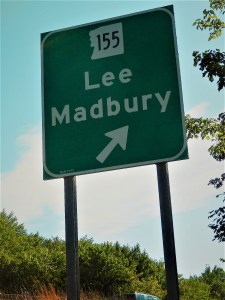
I’ve passed this sign hundreds of times and often thought it sounded great as a possible character, if only I had the right situation. And then, as I reworked the volume that now stands as Daffodil Uprising, I had the perfect guy to go by the name: LEE MADBURY.
From our perch today, it’s hard to believe that a Broadway musical like “South Pacific” could have been a bold statement on behalf of racial tolerance a half century ago.
I’m encouraged, of course, to see a Quaker connection.
First, even though the novelist James A. Michener, whose book was the basis of the show, had served in the U.S. Navy during World War II, he was raised by a Quaker adoptive mother and attended Quaker-affiliated Swarthmore College. In other words, he had been exposed to both pacifist and racial equality values.
Second, as Vanity Fair writer Todd S. Purdom notes in “The Road to Bali-hai,” is that librettist Oscar Hammerstein’s wife’s niece Jennifer attended the George School, another Quaker institution, one where Michener also taught briefly. The Hammersteins’ own son Jimmy also went there, as did a young family friend named and future Broadway great Stephen Sondheim. (And to think how vigorously earlier Quakers denounced theater as vain entertainment!)
Purdom’s article contains another telling point. The hit song “I’m Gonna Wash that Man Right Out of My Hair” was originally a flop. In the preview performances before the Broadway opening, director and co-author Josh Logan was perplexed to see it wasn’t connecting until he realized that star Mary Martin had the women in the audience so abuzz about whether she was actually washing her hair onstage that nobody ever heard the lyrics themselves. He fixed that by having her belt out the first stanza before working her hair.
I wonder about how many other small changes in any art form spell the difference between boffo hit and mundane shelving.
A similar tweak in “Wonderful Guy” changed the song to a soliloquy with the word “you” substituted for “they.” As Logan recalled, “That night they tore the house apart.”
As I was saying about small changes or a simple touch? Never underestimate the importance of revisions in art. Or maybe life itself.
~*~
Michener, by the way, wrote of his experience on the Electoral College elections with the telling title on his political science volume, Presidential Lottery: The Reckless Gamble on Our Electoral System.
He was so prescient there.
Once again, I’ll be in the choir along the Charles River as part of a free concert to welcome the autumn equinox and to praise the extraordinary cleanup of the once noxious waterway on its way to Boston Harbor.
For its 15th annual RiverSing, Boston Revels is moving the family-friendly event upstream from Cambridge and into the Allston section of Boston on the other bank.
We’ll be performing on a Saturday night, rather than Sunday, and it is part of an ongoing series of performances the park hosts, so we’ll have more publicity support than usual for a one-off event in what’s otherwise simply a good place to sunbathe in season.
But the change also means we won’t have our usual gaudy parade down a congested street from Harvard Square to the makeshift stage beside the John W. Weeks Footbridge. That procession has always been glorious and joyfully chaotic, but greatly annoying to any number of drivers waiting to continue on the busy thoroughfare we were blocking. Not all of them are amused, believe me.
On the other hand, free parking won’t be scarce, either, and we’ll be on a permanent stage at the Herter Park amphitheater, which also includes seats for the audience rather than bring-your-own-chairs or blankets on the ground.
For me, it’s always been memorable. Imagine looking down from the back row and watching a pianist in the guest group with us and thinking, “He’s an incredible keyboardist” – and then hearing he plays in the Boston Pops Orchestra. Or singing behind Noel Paul Stuckey of Peter, Paul, and Mary. That’s even before the sunsets, which we get to see from the stage but are behind the audience. This year, it will be off to the side of everyone. Get the picture?
Join us tonight, if you can. For details, go to the Boston Revels website.
When she begins her investigation in my new novel, What’s Left, she may think her generation’s quite different from her father’s.
But her family does run a family restaurant, and that gives her a different insight:
We can always count on someone looking for a handout at the back door. We’re happy to oblige them. And they’re happy, too – the word spreads.
~*~
Restaurants are often staffed by an underworld of their own, or so I’m told. And some of the characters aren’t that far removed from the folks looking for a handout.
I’m surprised to see how many people in my own community remain invisible, especially when your eyes look instead to “normal” society.
Have you ever gone to a “soup kitchen” or charity food pantry? Have you ever worked in one? What was your experience?
~*~

According to one amiga and her buds:
Admittedly, this list is biased in a Cuban direction. But it’s a start.
~*~
Digame más. I’m all ears. Any other world music talent we should know about?

Of course, this is totally unrelated to the theme. Just another thing on my mind.

