MAKING MUSIC TO WELCOME THE EQUINOX

Once again, I’ll be in the choir along the Charles River as part of a free concert to welcome the autumn equinox and to praise the extraordinary cleanup of the once noxious waterway on its way to Boston Harbor.

For its 15th annual RiverSing, Boston Revels is moving the family-friendly event upstream from Cambridge and into the Allston section of Boston on the other bank.

We’ll be performing on a Saturday night, rather than Sunday, and it is part of an ongoing series of performances the park hosts, so we’ll have more publicity support than usual for a one-off event in what’s otherwise simply a good place to sunbathe in season.

But the change also means we won’t have our usual gaudy parade down a congested street from Harvard Square to the makeshift stage beside the John W. Weeks Footbridge. That procession has always been glorious and joyfully chaotic, but greatly annoying to any number of drivers waiting to continue on the busy thoroughfare we were blocking. Not all of them are amused, believe me.

On the other hand, free parking won’t be scarce, either, and we’ll be on a permanent stage at the Herter Park amphitheater, which also includes seats for the audience rather than bring-your-own-chairs or blankets on the ground.

For me, it’s always been memorable. Imagine looking down from the back row and watching a pianist in the guest group with us and thinking, “He’s an incredible keyboardist” – and then hearing he plays in the Boston Pops Orchestra. Or singing behind Noel Paul Stuckey of Peter, Paul, and Mary. That’s even before the sunsets, which we get to see from the stage but are behind the audience. This year, it will be off to the side of everyone. Get the picture?

Join us tonight, if you can. For details, go to the Boston Revels website.

ONE KIND DEED INSPIRES ANOTHER

When she begins her investigation in my new novel, What’s Left, she may think her generation’s quite different from her father’s.

But her family does run a family restaurant, and that gives her a different insight:

We can always count on someone looking for a handout at the back door. We’re happy to oblige them. And they’re happy, too – the word spreads.

~*~

Restaurants are often staffed by an underworld of their own, or so I’m told. And some of the characters aren’t that far removed from the folks looking for a handout.

I’m surprised to see how many people in my own community remain invisible, especially when your eyes look instead to “normal” society.

Have you ever gone to a “soup kitchen” or charity food pantry? Have you ever worked in one? What was your experience?

~*~

If Cassia’s great-grandparents had only bought this house instead! And it’s almost pink … (Manchester, New Hampshire.)

TEN HOT HISPANIC MUSICIANS

According to one amiga and her buds:

  1. Dulce Marcia.
  2. Jencarlos Canela.
  3. Rolando Polo, pop-opera tenor.
  4. Moneda Dura.
  5. Balvin.
  6. Willy Chirino.
  7. Shakira. (And here I’m trying to keep this to performers new to the rest of us. So be it.)
  8. Manolito Simonet.
  9. Gilberto Santa Rosa.
  10. Myriam Herandez.

Admittedly, this list is biased in a Cuban direction. But it’s a start.

~*~

Digame más. I’m all ears. Any other world music talent we should know about?

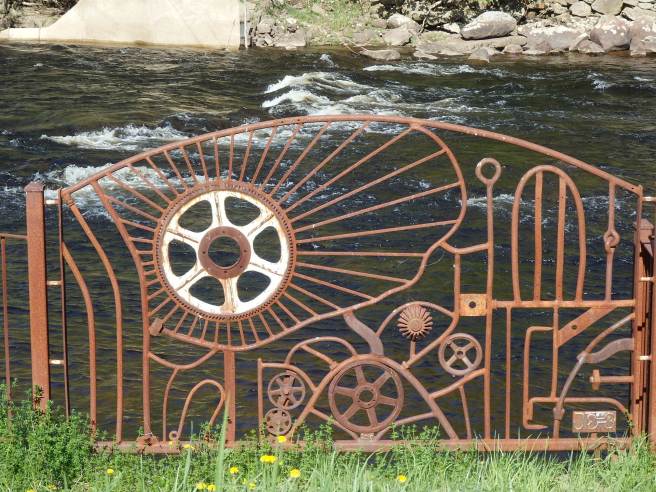
A whimsical fence. Warren, Maine.

Of course, this is totally unrelated to the theme. Just another thing on my mind.

OH, THE FINALS WEEK ORGY

Among the gifts I received at Christmas was a tablet laptop, with the expectation I’d be using especially for Kindle editions – including my own ebooks.

But so far what I’ve really appreciated is its ability to stream music.

For me, that’s meant Q2’s New Sounds and Operavore from WQXR in New York and WHRB from Harvard University in Cambridge.

With solid jazz from 5 a.m. till 1 p.m. and some adventurous classical continuing till 10 p.m., plus the Metropolitan Opera on Saturday afternoons and another opera on Sunday night, my listening is mostly on the Harvard station. Admittedly, the student announcers can be unintentionally amusing in their pronunciations and amateurish touches, but I usually find that more amusing than annoying.

This spring, though, I finally got to experience an amazing tradition on the station – the finals week Orgy, when the regular programming is set aside for in-depth presentations of specific composers or performers.

Continue reading “OH, THE FINALS WEEK ORGY”

PRELUDE & FUGUE 28/

an elephant with flowers painted
around the eyes and painted toenails

four zebras sipping water

*   *   *

luxurious green tent on safari white bone
ornaments through noses armed for the hunt
and cocktails already served
three African bushmen in a field of wrinkled flesh
eyelid (the elephant) the rain
is needed, sticky or no sticky (unlike the rhino)

zebras, black and white in a splash of vibrant green
with netting over the bed
luxurious green tent on safari white
bone ornaments through their noses
armed for the hunt and cocktails
already served three bushmen in a field
of wrinkled African flesh, an eyelid (the elephant)
the rain is needed, sticky or no sticky
(unlike the rhino) zebras, black and white

in a splash of vibrant green            with netting
over the bed’s luxurious green safari tent
white bone noses armed for the ornamental
hunt cocktails served by three bushmen
in an African field of wrinkled eyelids needing rain
sticky or no sticky the elephant (unlike the rhino) or
zebras, black and white in a splash
of vibrant green netting over the bed ornaments

beasts leaping from dust into a tropical river
before a tiger atop a car spirals between
four zebras sipping water the way
a camel’s nose runs ahead of its mouth:

the hairy trunk and mouth of an elephant, so spotted
forages on hind legs, trunk and tusks upraised to the tree

the elephant with flowers painted
around the eyes and painted toenails
still leaps from the dust into a tropical river

a camel’s nose runs ahead of its mouth from hind legs
upraised to the tree in front of the tiger
atop a car of spiraling spots

the hairy trunk and mouth with flowers painted
around the eyes guarding four zebras sipping water
and the foraging beasts leap from dust into the river
running ahead of its mouth

a camel on hind legs, the tree painted with flowers
and toenails a feeling of life finally coming together

atop a car, four zebras leap from the dust
into a hairy river and forage
a feeling of life finally coming together these days

~*~

Poem copyright 2016 by Jnana Hodson
To see all 50 Preludes & Fugues, click here.

THE SILENCE IN BEETHOVEN

When it comes to the fine arts, we love our biographies of tortured genius, and Ludwig van Beethoven serves the storytellers admirably. Baptized December 17, 1770, in Bonn, his tempestuous and tragic life was one of failed love affairs, strained friendships, and especially the deafness that accompanied his greatest musical achievements. And yet many of us find him not only speaking for us but also extending inspiration in the quest for fullness and fidelity.

In part it’s a story of the way Bach, Mozart, and Beethoven reestablish the center of classical music, centering it in the German-speaking world far from its Italian roots and the Renaissance genius of Monteverdi and Palestrina.

As I discussed earlier this year, Beethoven’s popularity rests largely on works that he wrote in the second half of his life, past the age of Mozart’s death, the years that encompass what are known as his Middle (or Heroic) and Late periods. The years accompanied by deafness.

For much of my life, I’ve not been alone in finding that what most appealed to me were the works from the Middle period – the Fifth, Sixth, Seventh, and Ninth symphonies, the violin and “Emperor” piano concertos, the Rasumovsky string quartets – stirring works raging with dramatic struggle and promised victory. With all of their emotional parallels to athletic contests, these have justifiably ensured his enduring public adoration.

More recently, though, they’ve given way in my estimation as the Late period works have risen in preference. Quite simply, these have never been considered all that accessible. Many of them defiantly turn their back on the audience in a pursuit of boldly intricate, often extended, musical puzzles that plumb the depths of human despair, loneliness, resolve, as well as lofty heights. Indeed, for years the assumption has been that these are not for public consumption but are rather reserved for private investigation among the cognoscenti, should they be so honored.

Continue reading “THE SILENCE IN BEETHOVEN”

CURTAINS

to embrace something with the wisdom of the final round

people crowding the boulevard in Baltimore
to watch Robert Kennedy’s funeral train pass
overhead

in that portrait of seven famed figures
Annie, turned to stone under a blue-jay feather

how that small town in snow looks more like Pennsylvania
or Midwest
than New England

Blake, the Muggletonian and lithographer
the surviving Beats portrayed
as Ginsberg tying a shoelace

would see something with the sharpness of the first time

all that baroque light over a cathedral altar
the cumulus effect
enveloping a solo deer

naked
in the garden
awaiting snowfall

Poem copyright 2016 by Jnana Hodson
To see the full set of
Partitas, click here.

PRELUDE & FUGUE 48/

with fiddles and crows
tracing a map of yellow leaves

*   *   *

on a map of frosted snow
three crows with their fiddles
in the crown of their living

of a rock face map, frosted snow
three crows with their fiddles
in the crown of their living rock face

on a map, frosted snow, three crows
with their fiddles in the crown
out of their rock face, tracing some life

 atop scree, another one at the bottom, wintergreen

~*~

Poem copyright 2016 by Jnana Hodson
To see all 50 Preludes & Fugues, click here.